
WHISPER REPAIRS
It seems to me that part of "RC Flying Today" is (or ought to be) fixing the models. So let's concentrate on some repair techniques. The Whisper helicopter may serve as a good starter. What follows is meant as constructive criticism: the Whisper is a good machine, but I think it could be improved. Its structure looks delicate and will require repairs.
Structural weaknesses
- Many small parts are miniature versions of familiar parts and are delicate.
- Examples:
- Paddle rod and main rotor shaft are both tubes (hollow).
- Tail rotor is driven by a toothed belt that resembles a shoelace.
- The "Jesus bolt" is a 2 mm machine screw (about the size of a No. 2-56 screw).
- Runners on the landing gear are like aluminum soda straws.
- There are many places where thin, small parts are joined to thick, large parts, creating potential failure sites.
- The design shows limited torsional strength in places; some assemblies have only barely sufficient static strength.
Initial failure: loss of rudder control
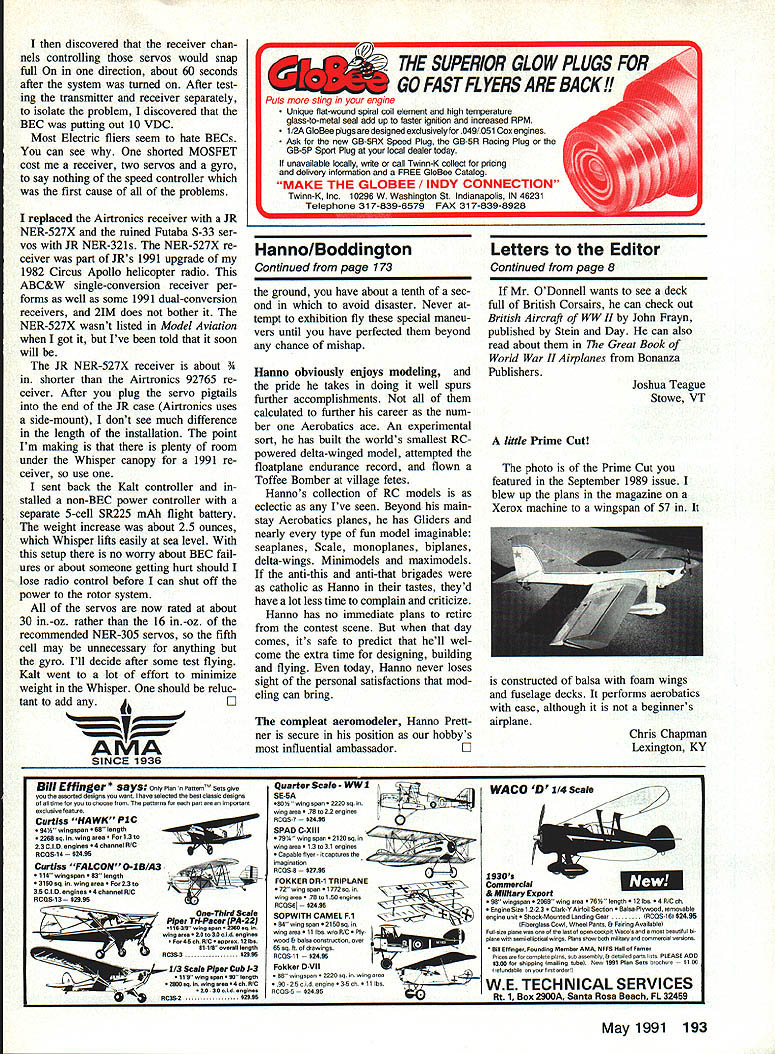
During my 10th flight I lost rudder control, which resulted in one complete blade assembly leaving the machine. After collecting the pieces I found a broken hub plate and a broken pitch-control arm. The hub plate is fiberglass/epoxy; the manual mentions that it is delicate.
When examined, the fracture ran at about 45° to the weave — the weakest direction for the cloth. The strength of a fiberglass part lies mainly in the fiberglass filaments, not the epoxy. My (admittedly simple) stress analysis of the failure site indicates barely sufficient static strength in the part. The design is also weak in torsion.
Some adhesive resembling Blue Loctite was applied to the bearing block during assembly at Kalt, probably to stabilize parts against twisting. Scraping the residue off the fiberglass showed it does nothing to strengthen the joint.
Should the design be left as is — so damage will be confined to an easily replaced (but hard-to-inspect) part — or should the design be changed to move the failure site elsewhere? I prefer the older Baron design, which uses a pressed-steel part for the main-rotor flex plate; I dislike the idea of the main rotor coming apart for any reason, especially under normal operating conditions.
Replacement parts and field repairs
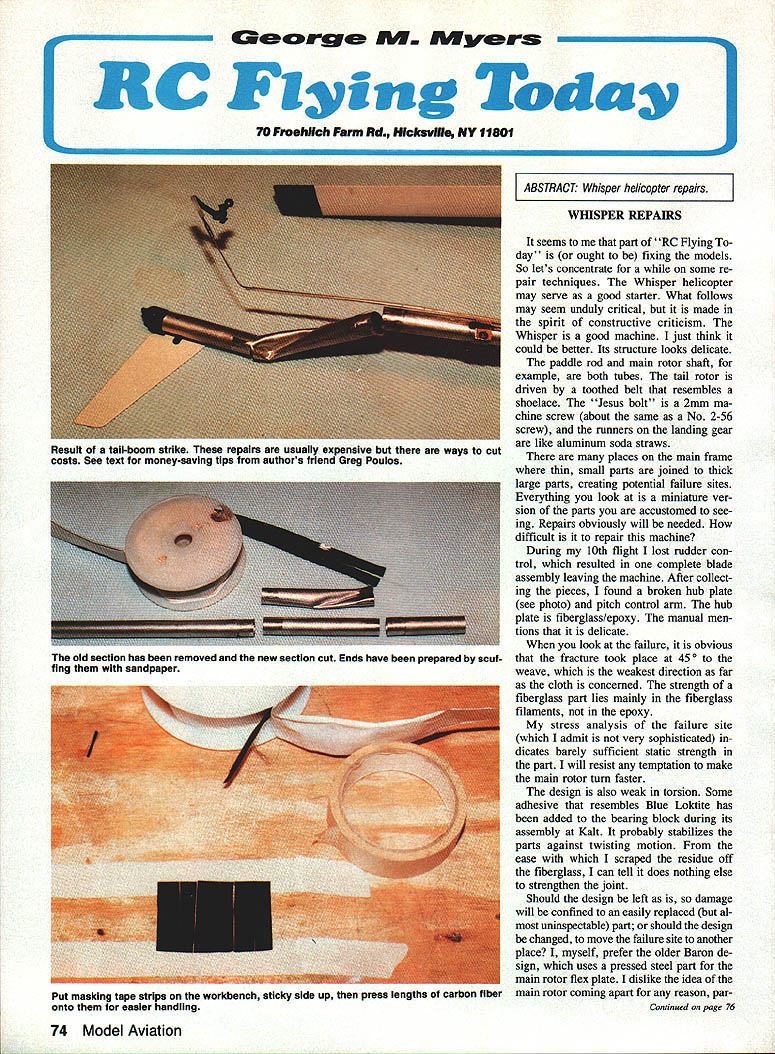
I bought a replacement hub plate. I don't like to buy spares, but my friend Greg Poulos (president of SE-FLI) has put several Whispers through the paces, including tail-boom strikes, and developed cost-saving repair techniques.
Greg’s tail-boom repair routine:
- Cut out the damaged section.
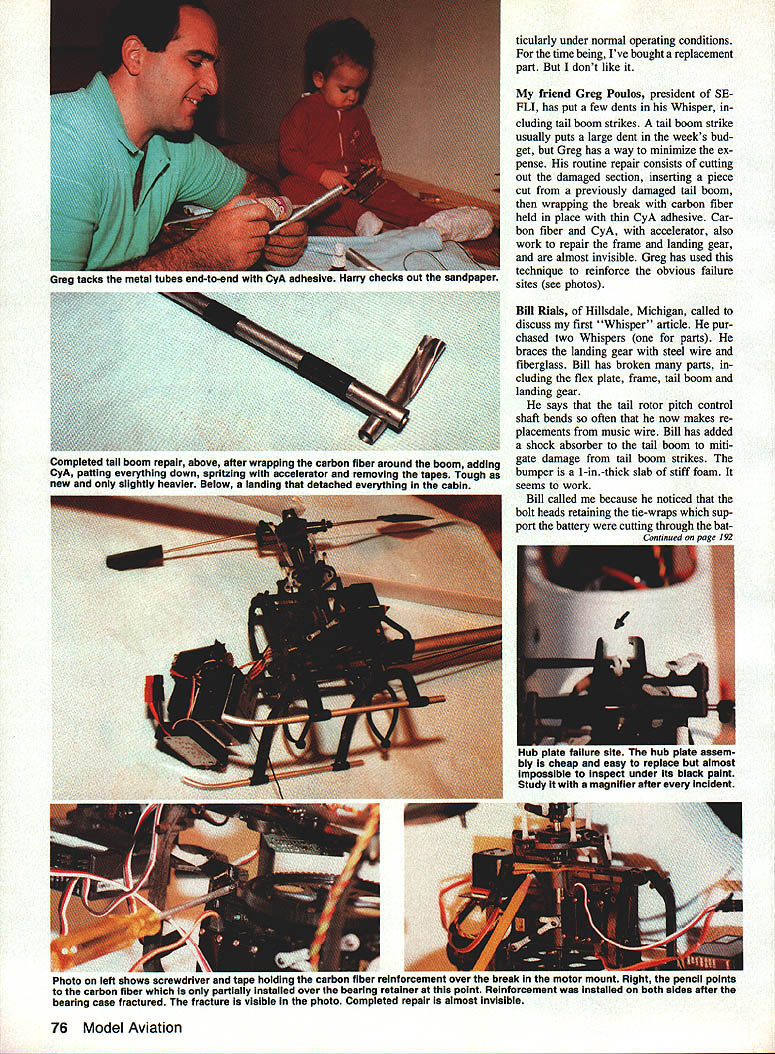
- Scuff and prepare the cut ends; insert a replacement piece cut from a previously damaged boom.
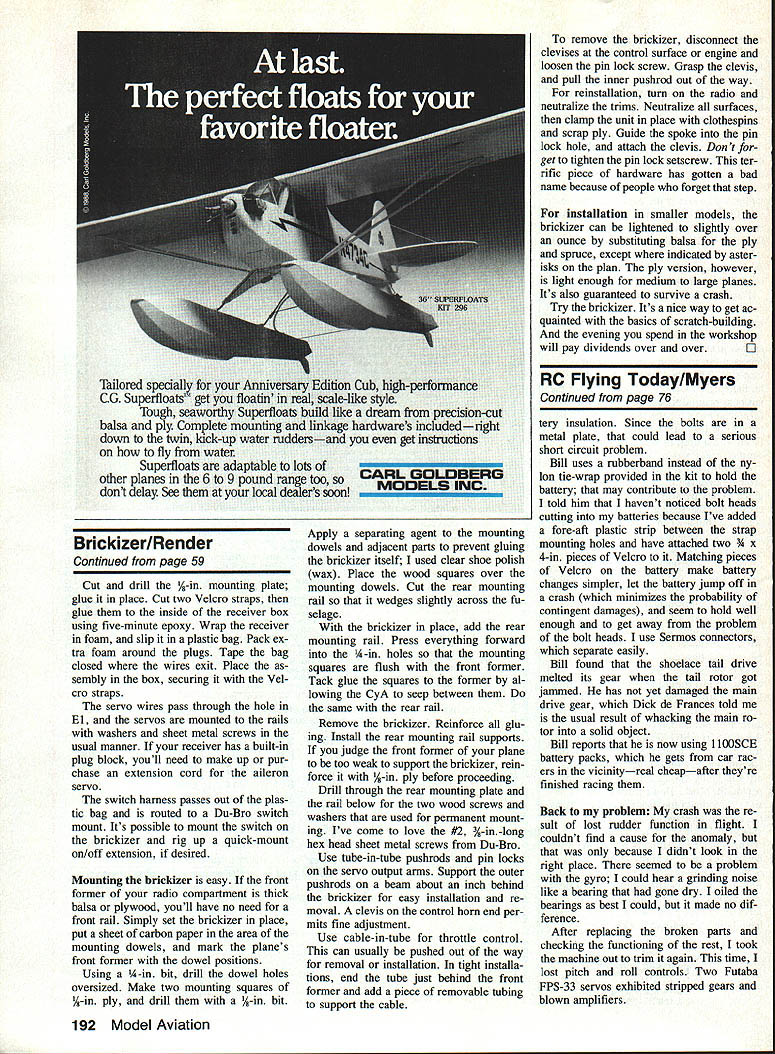
- Lay carbon-fiber strips on masking tape (sticky side up) for easier handling.
- Wrap the break with carbon fiber and apply thin cyanoacrylate (CyA).
- Pat everything down, spritz accelerator, and remove the tapes.
The repaired boom is tough and only slightly heavier. Greg has used this technique to reinforce obvious failure sites on the boom, frame, and landing gear; when done properly the repair can be nearly invisible.
Bill Rials (Hillsdale, Michigan) reported similar experiences:
- He bought two Whispers and has broken braces, landing gear, flex plates, frame pieces, and tail booms.
- Tail-rotor pitch-control shafts bend often; he now makes replacements from music wire.
- He added a tail-boom shock absorber (a 1-inch-thick slab of stiff foam as a bumper) to mitigate damage from strikes.
Battery mounting and tie-wrap issue
Bill noticed the bolt heads retaining the tie-wraps that support the battery were cutting through the battery insulation. Since the bolts are in a metal plate, this could lead to a serious short-circuit.
- Bill uses a rubber band instead of the provided nylon tie-wrap; that may contribute to the problem.
- My solution: add a fore-aft plastic strip between the strap mounting holes and attach two 3/4-in. pieces of Velcro to it. Matching Velcro on the battery makes battery changes easier, lets the battery separate in a crash (which reduces the chance of contact damage), and holds well enough to avoid bolt-head cutting. I use servo connectors which separate easily.
Electronics failure and BEC problems
After replacing the broken mechanical parts and checking the rest, I took the machine out to trim it again. This time I lost pitch and roll controls: two Futaba FPS-33 servos exhibited stripped gears and blown amplifiers.
I then discovered the receiver channels controlling those servos would snap full on in one direction about 60 seconds after power-up. After isolating transmitter and receiver, I discovered the BEC (battery eliminator circuit) was putting out 10 VDC.
Most electric fliers dislike BECs for reasons like this. One shorted MOSFET in the BEC cost me a receiver, two servos, a gyro, and the speed controller (which was the original cause).
What I did:
- Replaced the Airtronics receiver (part 92765) with a JR NER-527X.
- Replaced the ruined Futaba FPS-33 servos with JR NER-321s.
The JR NER-527X receiver was part of JR's 1991 upgrade of my 1982 Cirrus Apollo helicopter radio. This ABC&W single-conversion receiver performs as well as some 1991 dual-conversion receivers. The JR receiver is about 3/4 in. shorter than the Airtronics receiver; after plugging the servo pigtails into the end of the JR case (Airtronics uses a side-mount) there is plenty of room under the Whisper canopy for a 1991 receiver — so use one.
I sent back the Kalt controller and installed a non-BEC power controller with a separate 5-cell SR225 mAh flight battery. The weight increase was about 2.5 ounces, which Whisper lifts easily at sea level. With this setup there is no worry about BEC failures or about someone getting hurt should I lose radio control before I can shut off the power to the rotor system.
All servos are now rated at about 30 in.-oz. rather than the recommended 16 in.-oz. (NER-305). With the higher-torque servos the extra fifth cell may be unnecessary except for the gyro; I will decide after test flying. Kalt went to a lot of effort to minimize weight in the Whisper; be reluctant to add unnecessary mass.
Batteries
Bill reports using 1100SCE battery packs scavenged cheaply from car racers after they finish racing them.
Inspection and reinforcement advice
- Study parts closely with a magnifier after any incident.
- Reinforcement installed over a fractured bearing case on both sides can be nearly invisible when completed.
- Carbon-fiber and CyA accelerator work well for frame and landing-gear repairs; the repair can be almost invisible when properly done.
Recommendations (summary)
- Expect to perform repairs; build a spare-parts strategy.
- Consider reinforcing obvious failure sites (tail boom, flex plate, landing gear) with carbon fiber and CyA.
- Replace flimsy shafts (e.g., tail-rotor pitch-control) with stronger music wire when practical.
- Use a better battery-mount system (Velcro + plastic strip) to avoid insulation cuts and shorts.
- Avoid relying on a BEC for critical power; consider a non-BEC controller with a separate flight battery.
- Use higher-torque servos if practical, but balance against added weight.
Repairs are part of RC flying today. With attention to weak points and a few simple modifications, the Whisper can be made more robust without destroying the machine's performance.
Transcribed from original scans by AI. Minor OCR errors may remain.

