
RC in Full-Scale Development
By Dom Palumbo
Flying quality and RC models
The number of relevant factors that must be considered during the development of full-size aircraft is extensive. The parameter list reflects all facets of the aircraft's in-service scenario, because today's aircraft are designed to meet very specific mission requirements. These requirements are not limited to a simple statement of the aircraft's performance envelope but also include support and systems considerations such as:
- Performance parameters (speed, ceiling, rate of climb, etc.)
- Maintainability and logistics
- Electrical, hydraulic, and deicing systems
- Reliability and other support considerations
Where do RC models fit into the picture? One useful role for RC models is obtaining a qualitative assessment of a characteristic called "flying quality."
Flying quality is less quantitative than performance figures. It concerns how well the aircraft responds to external perturbations (wind gusts, updrafts, thermals, etc.) and to control surface deflections—both normal and abnormal. It is generally agreed within the technical community that if a scale RC model of a given airplane "flies well," then the full-size airplane will also fly well. Reasons for this belief primarily involve the dynamics of the RC model versus those of the full-size counterpart.
Because of the difference in size, the RC model will exhibit dynamics which are accelerated compared to the much larger full-size airplane. It is also well known that a pilot seated in the airplane responds to gyrations quicker and smoother than an RC pilot flying the airplane in sight from the ground. For readers interested in pursuing this argument further, see SAME paper number 781050, "Use of Radio Controlled Models in the Conceptual Development of V/STOL Aircraft" by Robert W. Kress.
Use in the Next Generation Trainer Program
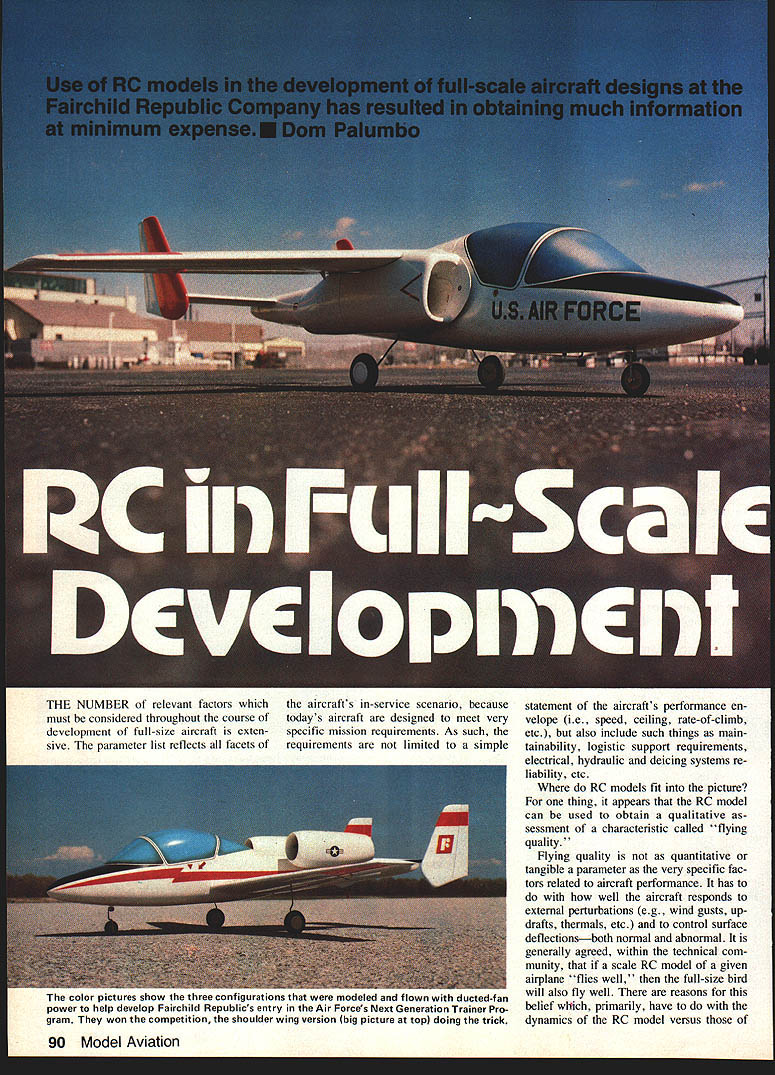
When Fairchild Republic Company decided to enter the Air Force's Next Generation Trainer Program, I proposed using RC models to test the flying qualities of three different configurations we were studying. The project manager agreed, since obtaining additional information to support selection of one candidate configuration for further development was desirable—and RC models were an inexpensive method for obtaining such information.
About the models
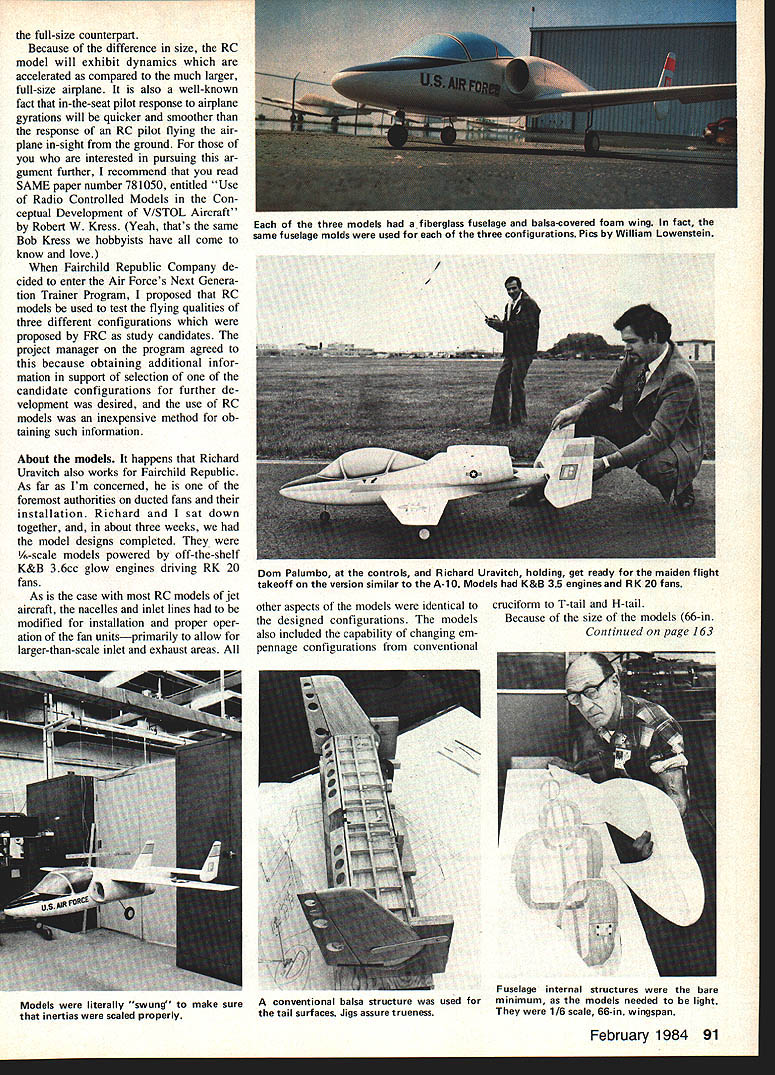
Richard Uravitch, who also works for Fairchild Republic, is one of the foremost authorities on ducted fans and their installation. Richard and I completed the model designs in about three weeks. They were 1/6-scale models powered by off-the-shelf K&B 3.6 cc glow engines driving RK 20 fans.
As is typical with most RC models of jet aircraft, the nacelles and inlet lines were modified for installation and proper operation of the fan units—primarily to allow for larger-than-scale inlet and exhaust areas. All other aspects of the models were identical to the designed configurations. The models also included capability to change empennage configurations from conventional cruciform to T-tail and H-tail.
Because of the size of the models (66-inch wingspan) and their relatively small wing area (4.5 sq. ft.), it was imperative that structural weight be kept to a minimum so that standard, unassisted takeoffs could be accomplished with the RK 20s. Thus, a fiberglass fuselage with plywood bulkheads was used together with built-up tail surfaces and foam-core wings covered with 1/16-inch balsa skins. The models were guided using a Futaba FG0 radio with S-7 servos. Fabrication was performed in part by the FRC Model Shop and by Nick Ziroli.
Flight testing and results
The models were flown from a smooth runway under wind conditions ranging from calm to 25 mph gusts. Flap-out maximum speed was 55–60 mph depending on configuration (up to 70 mph in some cases); landing approach speed was 25–30 mph.
- The H-tail configuration gave the best overall flying qualities. It showed better longitudinal stability and was more forgiving of pilot error.
- Landing characteristics were acceptable, although landing roll was longer than desired.
- The cruciform-tail configuration tended to pitch up abruptly during power-on approaches, especially with full-up elevator.
- The T-tail configuration tended to be less stable in pitch at low speed.
The models weighed 15½ pounds. I was initially skeptical that the two fans could get the models off the ground, but the first few flights proved me wrong; thrust and performance were adequate. I developed a real respect for the RK 20 the day a model lifted off and climbed out at a 30-degree angle. Another convincing event was the flame-out of one engine during a flight. The model continued to fly quite well; it would have been difficult to determine which engine had flamed out. The flame-out allowed us to observe the aerodynamic effects of a single-engine failure—effects that were minimal and in line with expectations.
Conclusions
The flight tests were extremely beneficial to Fairchild Republic in three ways:
- They provided supportive data for configuration selection.
- Videotape and motion-picture film of the flight tests supported the Air Force presentation and publicity efforts.
- The engineers who worked on the aerodynamic and configuration designs were inspired by the flight tests of these miniature facilities.
Management at Fairchild Republic was so pleased with the program and the support afforded by the models that RC models will be used at FRC for future research and development programs.
Fairchild Republic did win the competition for the Air Force Next Generation Trainer. The airplane has been designated the T-46A, and the first prototypes were expected to roll off the assembly line sometime in 1984. It was the shoulder-wing configuration that ultimately won the contract.
Transcribed from original scans by AI. Minor OCR errors may remain.

