
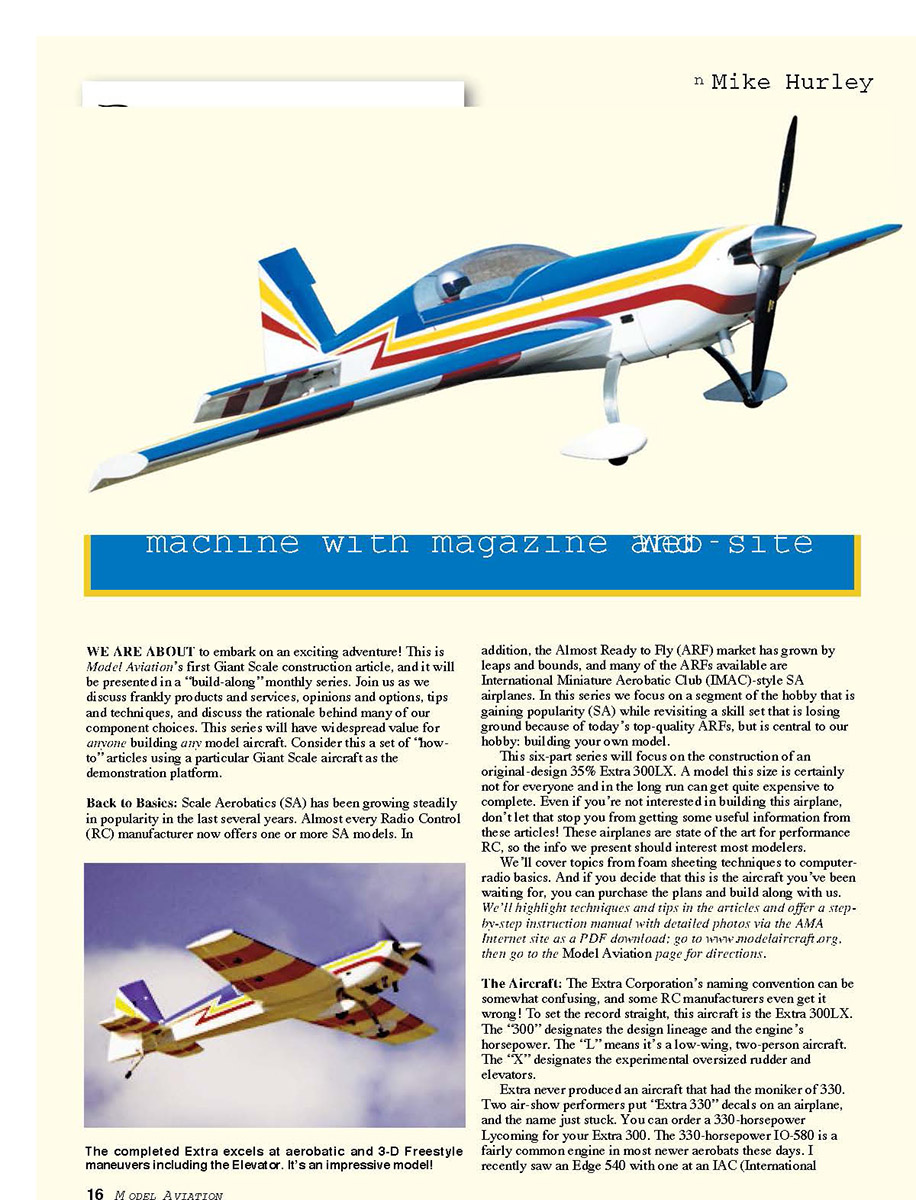
RC Giant Scale Aerobatics machine with magazine and Web-site how-to series
WE ARE ABOUT to embark on an exciting adventure! This is Model Aviation’s first Giant Scale construction article, and it will be presented in a “build-along” monthly series. Join us as we discuss frankly products and services, opinions and options, tips and techniques, and the rationale behind many of our component choices. This series will have widespread value for anyone building any model aircraft. Consider this a set of “how-to” articles using a particular Giant Scale aircraft as the demonstration platform.
Back to Basics
Scale Aerobatics (SA) has been growing steadily in popularity in the last several years. Almost every Radio Control (RC) manufacturer now offers one or more SA models. In addition, the Almost Ready to Fly (ARF) market has grown by leaps and bounds, and many of the ARFs available are International Miniature Aerobatic Club (IMAC)-style SA airplanes. In this series we focus on a segment of the hobby that is gaining popularity (SA) while revisiting a skill set that is losing ground because of today’s top-quality ARFs, but is central to our hobby: building your own model.
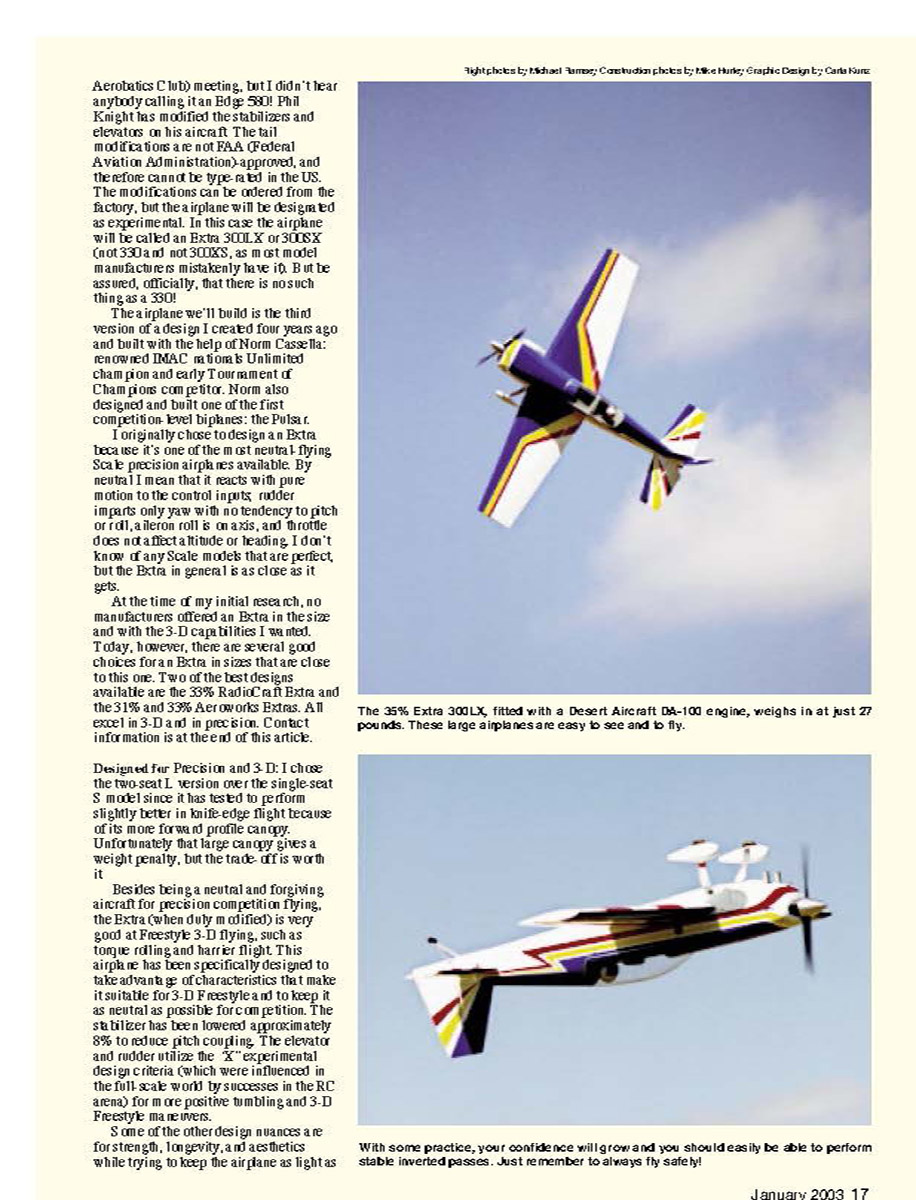
This six-part series will focus on the construction of an original-design 35% Extra 300LX. A model this size is certainly not for everyone and in the long run can get quite expensive to complete. Even if you’re not interested in building this airplane, don’t let that stop you from getting useful information from these articles! These airplanes are state of the art for performance RC, so the information we present should interest most modelers. We’ll cover topics from foam sheeting techniques to computer-radio basics. And if you decide that this is the aircraft you’ve been waiting for, you can purchase the plans and build along with us.
We’ll highlight techniques and tips in the articles and offer a step-by-step instruction manual with detailed photos via the AMA Internet site as a PDF download; go to www.modelaircraft.org, then go to the Model Aviation page for directions.
The Aircraft
The Extra Corporation’s naming convention can be somewhat confusing, and some RC manufacturers even get it wrong. To set the record straight, this aircraft is the Extra 300LX. The “300” designates the design lineage and the engine’s horsepower. The “L” means it’s a low-wing, two-person aircraft. The “X” designates the experimental oversized rudder and elevators.
Extra never produced an aircraft that had the moniker 330. Two air-show performers put “Extra 330” decals on an airplane, and the name just stuck. You can order a 330-horsepower Lycoming for your Extra 300. The 330-horsepower IO-580 is a fairly common engine in most newer aerobats these days. I recently saw an Edge 540 with one at an IAC (International Aerobatics Club) meeting, but I didn’t hear anybody calling it an Edge 580!
Phil Knight has modified the stabilizers and elevators on his aircraft. The tail modifications are not FAA (Federal Aviation Administration)-approved, and therefore cannot be type-rated in the US. The modifications can be ordered from the factory, but the airplane will be designated as experimental. In this case the airplane will be called an Extra 300LX or 300SX (not 330 and not 300XS, as many model manufacturers mistakenly have it). Officially, there is no such thing as a 330.
The airplane we’ll build is the third version of a design I created four years ago and built with the help of Norm Cassella: renowned IMAC national and Unlimited champion and early Tournament of Champions competitor. Norm also designed and built one of the first competition-level biplanes: the Pulsar.
I originally chose to design an Extra because it’s one of the most neutral-flying, scale-precision airplanes available. By neutral I mean that it reacts with pure motion to the control inputs: rudder inputs only yaw with no tendency to pitch or roll, aileron roll is on axis, and throttle does not affect attitude or heading. I don’t know of any scale models that are perfect, but the Extra in general is as close as it gets.
At the time of my initial research, no manufacturers offered an Extra in the size and with the 3-D capabilities I wanted. Today, however, there are several good choices for an Extra in sizes that are close to this one. Two of the best designs available are the 33% RadioCraft Extra and the 31% and 33% Aeroworks Extras. All excel in 3-D and in precision. Contact information is at the end of this article.
Designed for Precision and 3-D
I chose the two-seat L version over the single-seat S model since it has tended to perform slightly better in knife-edge flight because of its more forward canopy. Unfortunately that large canopy gives a weight penalty, but the trade-off is worth it.
Besides being a neutral and forgiving aircraft for precision competition flying, the Extra (when duly modified) is very good at Freestyle 3-D flying, such as torque rolling and harrier flight. This airplane has been specifically designed to take advantage of characteristics that make it suitable for 3-D Freestyle while remaining as neutral as possible for competition. The stabilizer has been lowered approximately 8% to reduce pitch coupling. The elevator and rudder utilize the "X" experimental design criteria (which were influenced in the full-scale world by successes in the RC arena) for more positive tumbling and 3-D Freestyle maneuvers.
Some of the other design nuances are for strength, longevity, and aesthetics while trying to keep the airplane as light as possible.
Transcribed from original scans by AI. Minor OCR errors may remain.

