
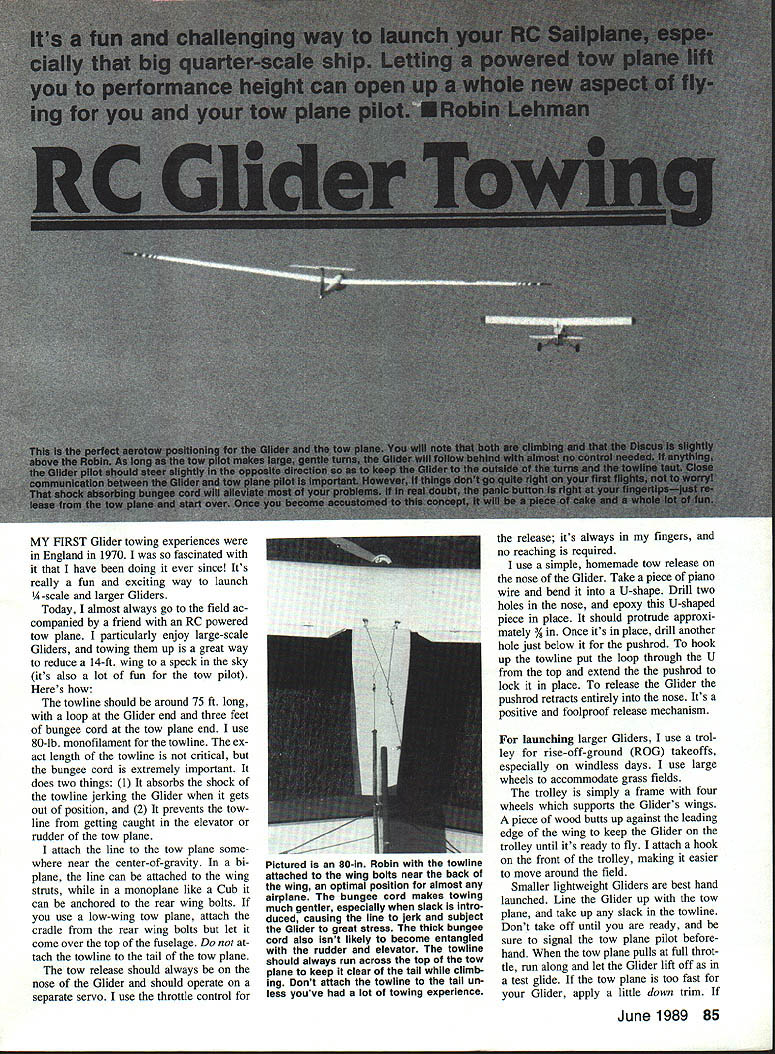
RC Glider Towing
by Robin Lehman
It's a fun and challenging way to launch your RC sailplane, especially that big quarter-scale ship. Letting a powered tow plane lift you to performance height can open up a whole new aspect of flying for you and your tow plane pilot.
Introduction
My first glider towing experiences were in England in 1970. I was so fascinated with it that I have been doing it ever since. I particularly enjoy large-scale gliders, and towing them up is a great way to reduce a 14-ft. wing to a speck in the sky (it's also a lot of fun for the tow pilot).
Today I almost always go to the field accompanied by a friend with an RC powered tow plane. Here are the practical details and tips I've learned over the years.
Towline and attachment
- Towline length: around 75 ft. (exact length not critical). I use 80-lb. monofilament and a loop at the glider end.
- Bungee: include about 3 ft. of bungee cord at the tow plane end. This is extremely important because it:
- absorbs the shock when the towline jerks the glider out of position, and
- helps prevent the towline from getting caught in the elevator or rudder of the tow plane.
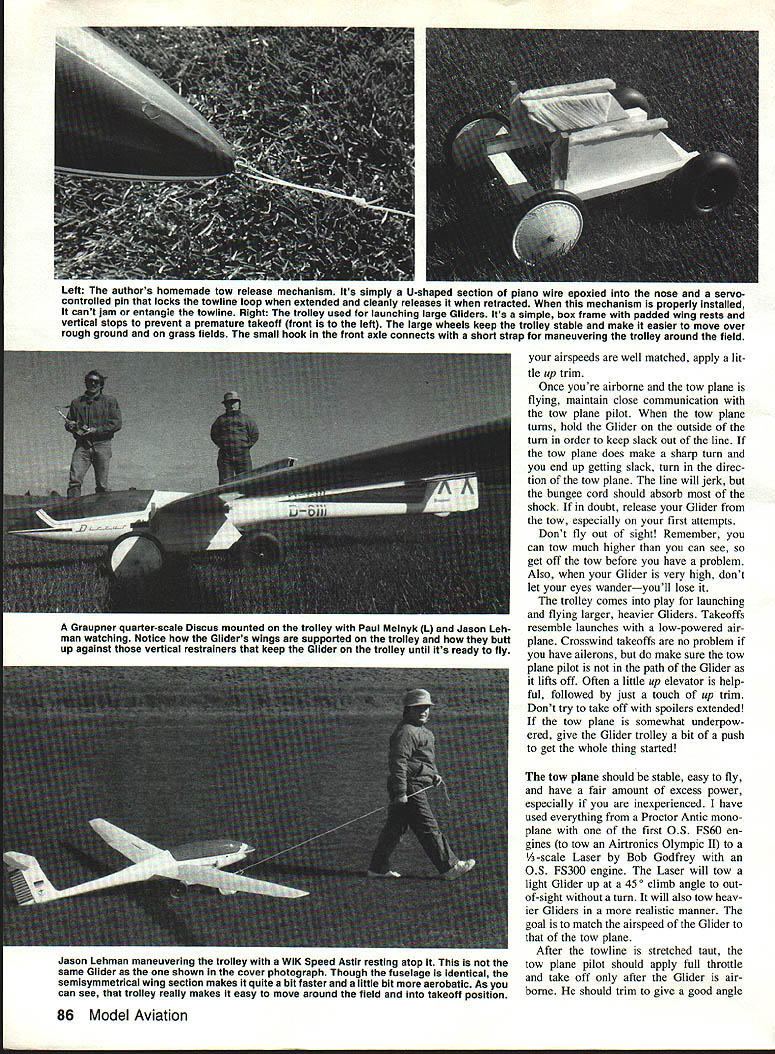
- Tow plane attachment: attach the line near the tow plane's center of gravity.
- Biplane: attach to the wing struts.
- High-wing monoplane (e.g., Cub): anchor to the rear wing bolts.
- Low-wing tow plane: attach a cradle to the rear wing bolts and let it come over the top of the fuselage.
- Do not attach the towline to the tail of the tow plane.
Tow release
- The tow release should always be on the nose of the glider and should operate on a separate servo.
- I use the throttle control for the release because it's always in my fingers and no reaching is required.
- Simple homemade release: bend a piece of piano wire into a U-shape, drill two holes in the nose, epoxy the U in place so it protrudes about 3/8 in. Drill another hole just below it for the pushrod. Hook the towline loop through the U from the top and extend the pushrod to lock it. To release, retract the pushrod entirely into the nose. It's positive and foolproof.
Trolley (ROG) for larger gliders
- For rise-off-ground (ROG) takeoffs on windless days, use a trolley. I prefer large wheels for grass fields.
- The trolley is a simple frame with four wheels that supports the glider's wings. A piece of wood butts up against the leading edge to keep the glider on the trolley until takeoff. Attach a hook on the front to make it easier to move around the field.
- If the tow plane is somewhat underpowered, give the trolley a bit of a push to get the whole thing started.
Hand launching smaller gliders
- Smaller, lightweight gliders are best hand launched.
- Line the glider up with the tow plane and take up the slack in the towline. Signal the tow plane pilot beforehand.
- When the tow plane pulls at full throttle, run along and let the glider lift off as a test glide.
- If the tow plane is too fast for your glider, apply a little down trim.
In-flight coordination and safety
- Maintain close communication between the tow plane pilot and the glider pilot.
- When the tow plane turns, hold the glider outside the turn to keep slack out of the line.
- If a sharp turn creates slack, turn in the same direction as the tow plane; the line will come taut and the bungee will absorb the shock.
- If in doubt, release the glider—especially on early attempts.
- Do not fly out of sight. You can tow much higher than you can see—get off tow before you have a problem.
- When the glider is very high, stay focused or you may lose sight of the tow plane or trolley.
Launching and flying larger, heavier gliders
- Takeoffs resemble launches of low-powered airplanes.
- Crosswind takeoffs are no problem if the glider has ailerons; make sure the tow plane pilot holds a steady path as the glider lifts off.
- Often a little up elevator is helpful, followed by a touch of up trim. Do not take off with spoilers extended.
- The tow plane should be stable, easy to fly, and have a fair amount of excess power—especially if the tow pilot is inexperienced.
- After the towline is taut, the tow plane pilot should apply full throttle and take off only after the glider is airborne. Trim for a good angle of climb, being careful to avoid stalling by climbing too fast.
- The tow plane pilot should inform the glider pilot of every maneuver, fly in a large circle keeping turns wide and gentle, avoid flying directly into the sun, and avoid long straight runs unless it is very windy. When the glider releases, throttle back, descend, and land. The towline will not affect the tow plane's flight characteristics.
Matching tow planes and gliders
The goal is to match the airspeed and power of the glider to that of the tow plane. Any good floater can be towed; the more experienced you are, the less excess power you need (though you'll ascend more slowly).
Examples of reasonably well-matched combinations I have used:
- 1/3-scale Laser by Bob Godfrey with an O.S. FS300 engine: tows the 10-lb., 3/4-scale Discus (Graupner) and the 8-lb., 3/4-scale Salto. The Laser is very powerful and will tow almost anything.
- Proctor Antic monoplane/biplane with an O.S. FS60 engine: tows the 3-lb. Airtronics Olympic II, the 2-lb. Hobie Hawk, the 3-lb. Clou, and the 2-lb. Graupner Amigo II.
- Sig Gazariator with an O.S. .60 engine: tows the 4-lb. Dodgson Maestro, the 3-lb. Olympic II, the 2-lb. Hobie Hawk, and the 5-lb. ASW17.
- 1/4-scale Fleet Biplane with a Kavan FS300 engine: tows the 12-lb., 1/4-scale LS3 and the 15-lb. LS5 (both by Rowing), and the 8-lb. Graupner Discus.
- 1/4-scale Sig Cub with an O.S. FS120 engine: tows the 8-lb., 1/3-scale WIK Speed Astir, the 4-lb. Dodgson Maestro, the 10-lb., 1/4-scale Jantar—and, very slowly and carefully, the 1/4-scale LS5 which weighs 16 lb.
- Hobby Lobby Senior Telemaster with an O.S. FS120 engine: tows the LS3, Amigo II, Speed Astir, and Jantar.
- 80-in. Robin with a Zenoah G-23 engine: tows the 8-lb., 3/4-scale Speed Astir, the 8-lb., 3/4-scale Discus, the 10-lb., 3/4-scale Jantar, the LS3 and LS5, and the 11-1/2-lb., 3/4-scale DG 202 (Roland Kern design).
Performance and fuel
- My 1/3-size Laser takes about three minutes to tow a 3/4-scale Discus out of sight. The tow plane's entire flight, from takeoff to landing, can be as little as six minutes if you spin it down to land.
- Theoretically, several large gliders could be towed on one 16-oz. tank of fuel, assuming a well-matched glider and tow plane.
Final thoughts
I've heard it said that gliders and powered models are not compatible. In my experience, that's simply not so. On thermal days, just limit your flight time when someone else is waiting to go up. Large-scale gliders really come into their own when coupled to tow planes—fifteen-minute flights are common, and there's plenty of room for an aerobatic routine if you wish.
Find a friend with a suitable tow plane. Both of you will have a challenging and thoroughly good time!
Transcribed from original scans by AI. Minor OCR errors may remain.

