
RC IN "THE GREAT LAND"
In what those of us in the "lower 48" would consider harsh conditions, RC flying in Alaska and Canada has developed a flavor all its own.
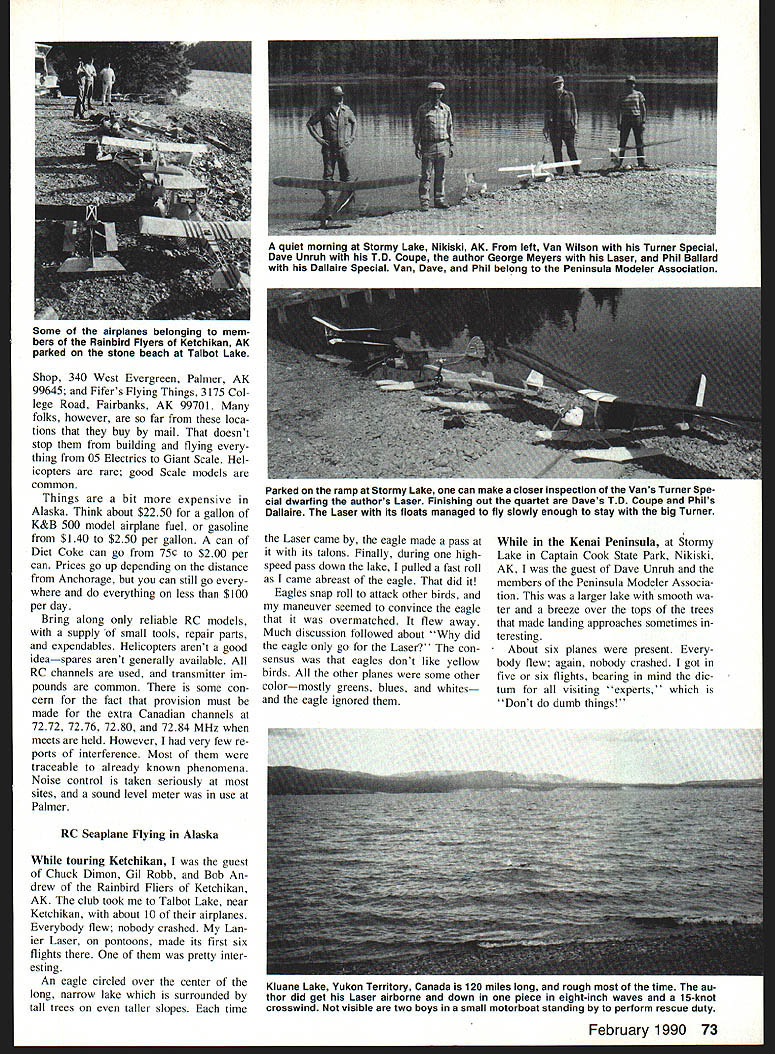
I spent the summer touring the Great Northwest (Alaska, British Columbia, and the Yukon Territory). I found many opportunities to indulge in RC flying, and this article describes how to find them. The people I met were warm and friendly, the scenery spectacular, and the weather—according to locals—remarkably good. The normally rainy regions of southeast Alaska were experiencing a drought not equaled since 1917: most of the time was sunny (even at night), daytime highs were usually in the 70s, and nighttime lows dropped into the 40s. With only three or four hours of darkness in the 24-hour cycle, I was active at least 18 hours a day.
Everywhere I flew in Alaska and Canada I was treated royally. If you plan to visit Alaska and will be bringing an RC model, this article can help put you in touch with local fliers and clubs.
RC flying in Alaska is quite popular. There are more skilled RC pilots and better flying sites than you might expect from a state with a total population around 330,000. Part of that popularity may be due to the number of full-scale pilots and light propeller-driven aircraft found there. It would be nice to see more Alaskan RC activities reported in the magazines.
Some well-stocked hobby stores in Alaska:
- Island RC, 2021 First Ave., Ketchikan, AK 99901
- K-Beach Hobbies, P.O. Box 3429, Soldotna, AK 99669
- Hobbycraft, Inc., Suite 136, Dimond Center, Anchorage, AK 99515
- York's Hobby & Model Aviation Shop, 340 West Evergreen, Palmer, AK 99645
- Fifer's Flying Things, 3175 College Road, Fairbanks, AK 99701
Many folks who live far from hobby stores buy by mail; that doesn't stop building and flying. Electrics and giant-scale models are common; helicopters are rare and spares are generally not available, so bringing reliable models and a supply of small tools, repair parts, and expendables is recommended. Prices can be higher in remote locations—expect roughly $2.25/gal for K&B model fuel, gasoline $1.40–$2.50/gal, and soft drinks anywhere from $0.75–$2.00 depending on location.
Common transmitter radio use:
- 72 MHz band is widely used.
- Make provision for extra Canadian channels: 72.72, 72.76, 72.80, 72.84 MHz.
Meets are held, and very few interference reports have been received; most interference is traceable to known phenomena. Noise control is taken seriously at many sites, and a sound-level meter is often used.
Videotapes and contacts
If you want to see Alaskan and Canadian RC seaplane flying, Rainbird Model Products offers two VHS tapes: "Seaplanes, 88" and "Seaplanes, 89" (60+ minutes each), retail $22.50 postpaid. Contact:
- Rainbird Model Products, 534 Hill Road, Ketchikan, AK 99901; tel. 1-907-225-3302.
When you get to Ketchikan with an RC seaplane, contact Gil Robb at Rainbird—he and the Rainbird Fliers are welcoming hosts.
RC Seaplane Flying
Touring the Great Northwest provided numerous float-flying highlights.
Ketchikan — Talbot Lake
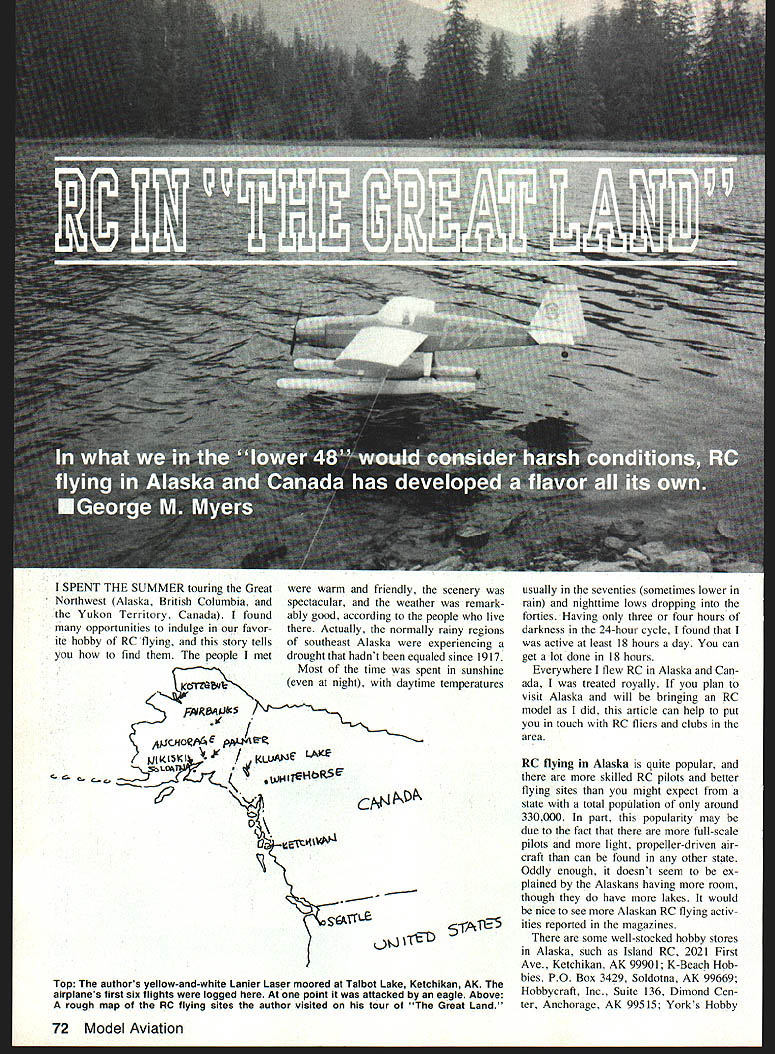
- I flew with the Rainbird Fliers (guest pilots included Chuck Dirnon, Gil Robb, Bob Andrew). About ten airplanes were present; everybody flew and nobody crashed.
- My Lanier Laser on pontoons made its first six flights there. At one point an eagle circled the lake and made passes at the Laser; after a high-speed roll and a close pass the eagle broke off. Locals joked that eagles "don't like yellow birds."
Kluane Lake, Yukon Territory
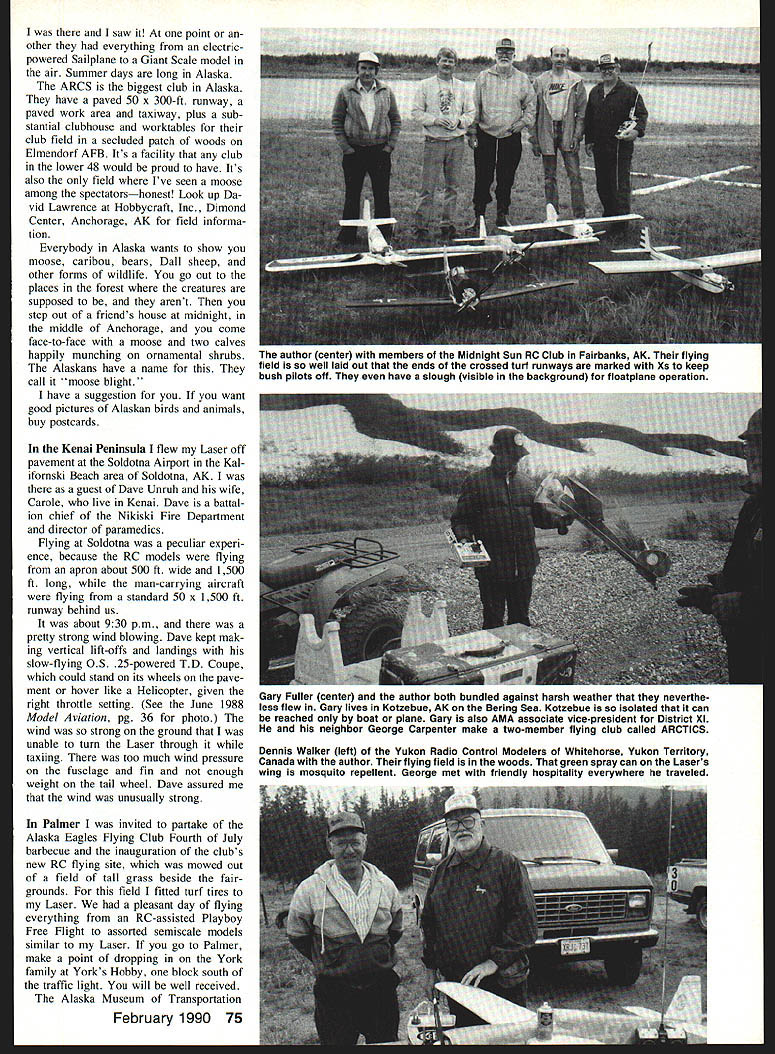
- Cottonwood RV Park & Campground is right on the 120-mile-long lake and has a beach right out the back door. With eight-inch waves toward shore and a 15-knot wind parallel to the shoreline, the Laser took some spray but I managed takeoffs, aerobatics, and powered returns to shore. The RV park owner enjoyed the show and welcomed future visitors.
If you enjoy seaplane flying, plan to bring a float-equipped aircraft and contact local clubs or Rainbird for local site information.
RC Landplane Flying in Alaska
I flew the Lanier Laser as a landplane using 2½-inch sponge tires inside the wheel pants for hard surfaces and naked three-inch Du-Bro lightweight wheels for turf—both configurations worked well.
Anchorage and Elmendorf AFB
- David Lawrence and Dr. Welton L. Lawrence gave a tour of Merrill Field and the Aviation Trades School, and David showed me the Lake Hood/Lake Spenard floatplane area.
- As a guest of the Alaska Radio Control Society (ARCS) at Elmendorf AFB I flew the Laser off pavement several times, including during ARCS's Midnight Fun Fly—nine airplanes flying simultaneously at midnight (June 24, 1989). ARCS has a paved 50 x 300 ft runway, paved work area and taxiway, a clubhouse and worktables—an excellent facility. For field information contact David Lawrence at Hobbycraft, Inc., Dimond Center, Anchorage.
Kenai Peninsula — Stormy Lake (Captain Cook State Park, Nikiski)
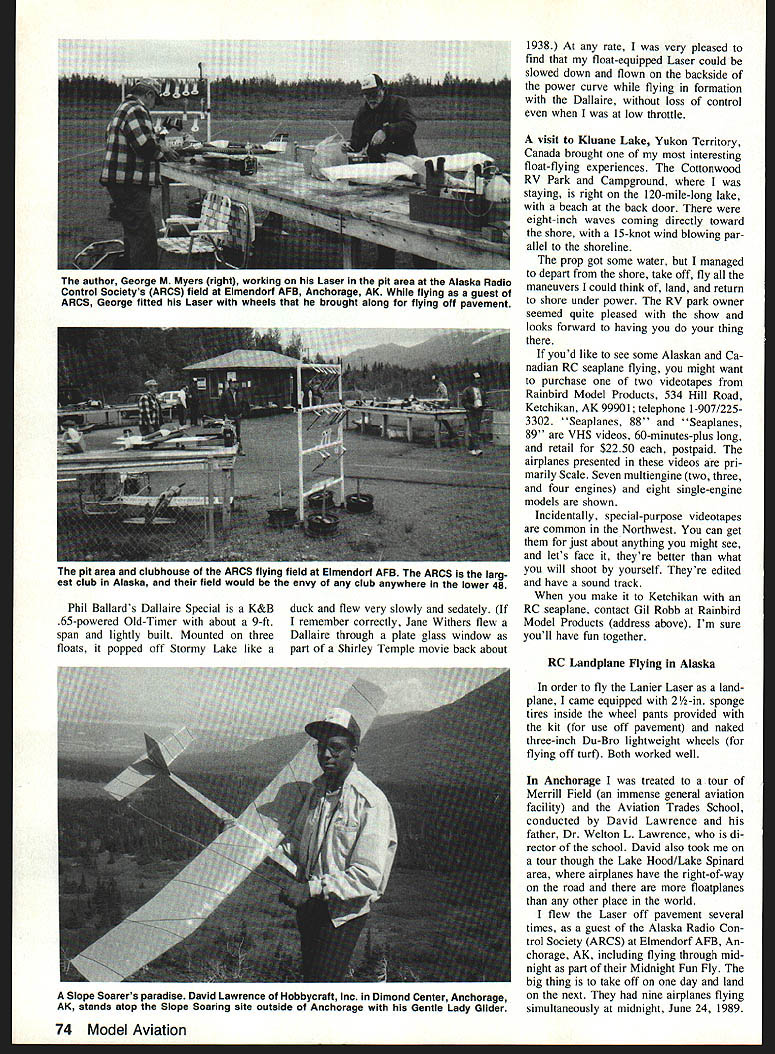
- A visit as a guest of Dave Unruh and the Peninsula Modeler Association: about six planes flew from a larger lake with smooth water and a breeze over the treetops that made approaches interesting. Everybody flew and nobody crashed.
- Phil Ballard's Dallaire Special (K&B .65-powered Old-Timer on three floats, ~9 ft span) popped off Stormy Lake and flew slowly and sedately. It was possible to fly my float-equipped Laser slow on the backside of the power curve and maintain control while flying formation with the Dallaire.
Soldotna (Soldotna Airport, Kalifornsky Beach)
- I flew off pavement from an apron about 500 x 1,500 ft while full-scale traffic used the standard 50 x 1,500 ft runway behind us. Strong winds made taxiing difficult; Dave Unruh demonstrated vertical lift-offs and near-hovering with a slow-flying O.S. .25-powered T.D. Coupe.
Palmer
- I attended the Alaska Eagles Flying Club Fourth of July barbecue and helped inaugurate the club's new mowed flying site beside the fairgrounds. Turf tires were fitted to the Laser for this field. The York family at York's Hobby (one block south of the traffic light in Palmer) are welcoming hosts.
Fairbanks and Midnight Sun R/C Club
- The Midnight Sun R/C Club field is out of town (to avoid noise complaints), large enough for any RC model, with crossed flat turf runways and a beautiful slough for seaplanes right behind the pits. The club keeps permanent X-marks on runway ends to keep ultralights and bush pilots away. Ask at Fifer's Flying Things for the club president.
Kotzebue
- Gary Fuller (AMA associate vice-president, District XI) hosted me at Kotzebue Technical Center. Kotzebue is 65 miles above the Arctic Circle at the Bering Sea and is accessible only by boat, airplane, or seasonal ice routes. Buildings are mounted on pilings with radiators to prevent permafrost melt.
- Weather limited full-scale operations for part of my stay, but when conditions allowed Gary and I rode ATVs to a firm, level beach and flew—again, nobody crashed.
Equipment, Supplies & Frequencies
- Bring reliable models, spare parts, small tools, and expendables—helicopters are not recommended due to limited spare availability.
- Expect higher prices in remote areas; plan accordingly.
- Radio channels: 72 MHz is common; include Canadian channels (72.72, 72.76, 72.80, 72.84 MHz) if you may cross the border.
- Noise control is taken seriously at club sites; a sound-level meter is often used.
Travel and Living on the Road
My trip lasted three months and covered about 16,000 miles in a van that contained all necessary support systems. I often slept in RV parks that provided electricity, convenience stores, ice, showers, and laundry. I carried backup camping gear (backpack, tent, sleeping bag), a portable toilet, cookware and stove, flashlights, food, and water—frontier travel calls for redundancy: have at least two ways to do everything.
Recommended reading and guides:
- Adventure in Alaska (pocket-size) by Peggy Wayburn, ISBN 0-87156-787-3.
- The Milepost (annual), ISBN 0-88240-213-7 — essential road and map information.
- The Pocket Doctor by Dr. Stephen Bezruchka, ISBN 0-89886-165-9.
Medical and personal kit suggestions:
- A medical kit tailored to your needs, Band-Aids, antiseptic, Calamine lotion, sunblock, aspirin, and any personal medications.
- A fanny pack with soap, paper towels, toilet paper, toilet seat covers, safety pins, a small sewing kit, a head net for mosquitoes, a small flashlight, pen and pad, spare film (if using film), and other items you want readily at hand.
Final Notes
Everywhere I flew in Alaska and Canada I was welcomed by local RC fliers and clubs. If you plan to visit and bring an RC model, contact the local clubs or the hobby stores listed above for field information and local hospitality—Alaskan fliers are generous hosts and the flying experiences are memorable.
Transcribed from original scans by AI. Minor OCR errors may remain.

