
RC Helicopter World Championships
By Horace G. Hagen
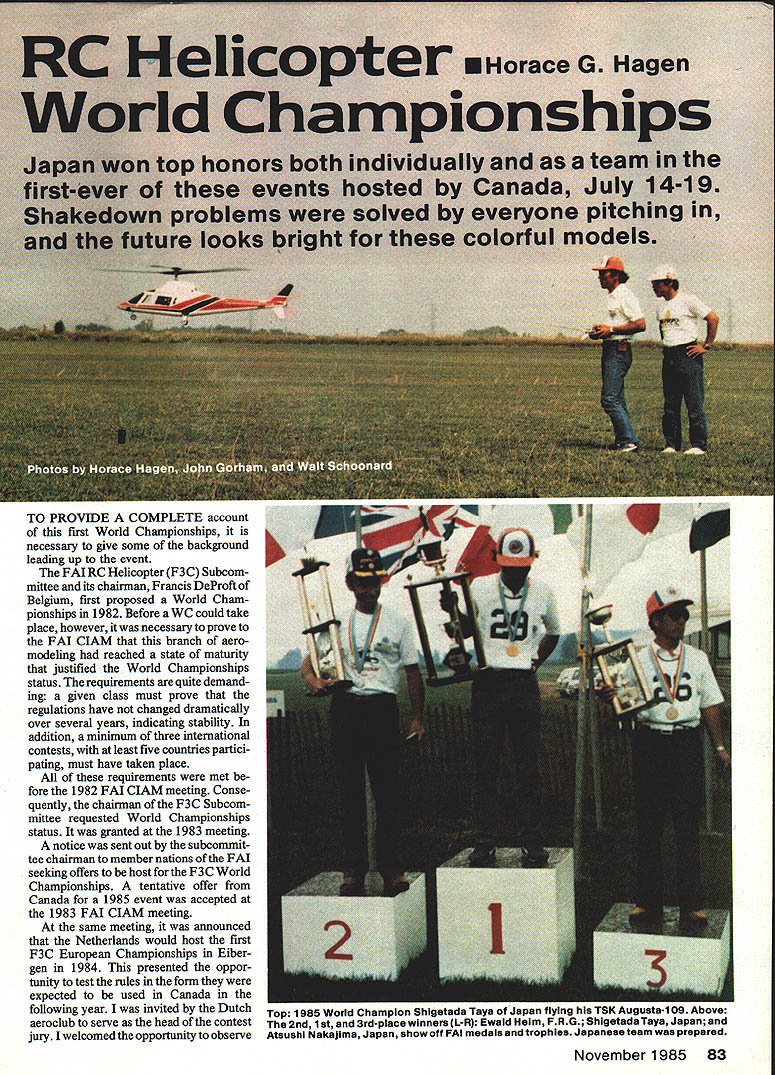
Japan won top honors both individually and as a team in the first-ever FAI F3C World Championships, hosted by Canada July 14–19, 1985. Shakedown problems were solved by everyone pitching in, and the future looked bright for these colorful models.
Background and origins
The FAI RC Helicopter (F3C) Subcommittee, chaired by Francis DeProft of Belgium, first proposed a World Championships in 1982. Before a World Championships could take place, the FAI CIAM required proof that the class had reached sufficient maturity: rules stability over several years and at least three international contests with participation from at least five countries.
Those requirements were met before the 1982 CIAM meeting, and the subcommittee's request for World Championships status was granted at the 1983 meeting. A tentative offer from Canada to host the event in 1985 was accepted at that meeting.
At the same CIAM meeting it was announced the Netherlands would host the first F3C European Championships in Eibergen in 1984. That contest provided an opportunity to test rules in the form expected for Canada. I was invited by the Dutch aeroclub to serve as head of the contest jury. Observations from Eibergen — many of which I passed to Walter Knaus, chairman of the Canadian organizing committee — led to a number of proposed amendments to the FAI F3C rules submitted to CIAM in December 1984.
Because the 1984 FAI Sporting Code had just been published and would be in effect for five years, amendments accepted in 1984 could not formally take effect until 1989. However, clarifying amendments were allowed to be used immediately as recommended clarifications, and these clarifications were applied at the World Championships. Preliminary contest information was mailed late in 1984, and the event was officially named Chopper Champs '85.
Arrival and facilities
I arrived in Canada on July 12, the day before the competition officially opened. Headquarters hotel and women's dormitory was Delaware Hall on the University of Western Ontario campus in London. Most contestants arrived a few days before the competition, enjoying reunions with old friends from Eibergen and making new ones from other countries.
Some fliers practiced on the large campus lawn; others used flying fields belonging to local RC clubs. The dormitory rooms were first rate, and the entire facility was dedicated to Chopper Champs, so anyone seen in the halls was likely an RC helicopter enthusiast.
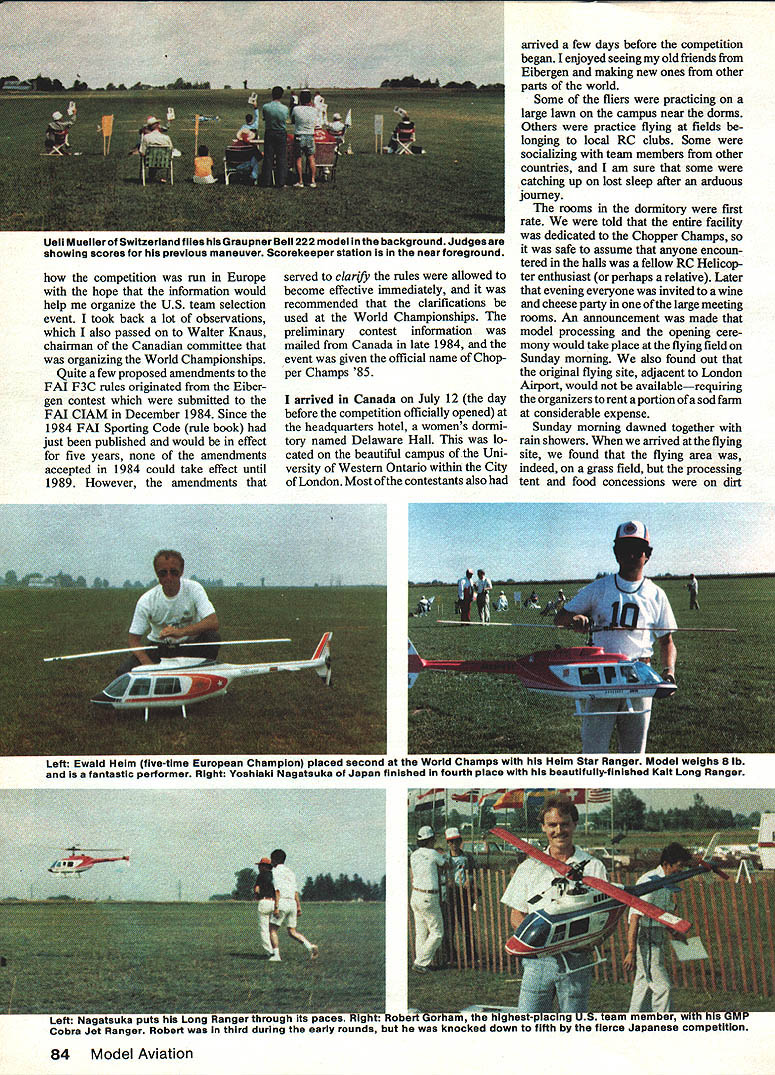
That evening a wine-and-cheese party was held and an announcement made that model processing and the opening ceremony would take place at the flying field Sunday morning. We also learned the original site adjacent to London Airport would not be available, requiring the organizers to rent a portion of a sod farm at considerable expense.
The flying site and early problems
Sunday morning dawned with rain showers. The flying area was a grass field with a processing tent and food concessions on dirt that had turned to mud. This did not make a favorable first impression. Neither the tables for model processing nor the personnel to run them had arrived. While waiting for these inadequacies to be solved, members of the FAI jury and judging team volunteered their services to get model processing underway.
The FAI jury presided over a judges' briefing that afternoon. Although some judges felt little briefing was necessary, the session ran three hours — time well spent in the eyes of the jury.
A meeting of team managers and contest officials was scheduled for Sunday evening. The contest director was unable to attend, and the FAI jury was required to fill the gap. Many questions were raised and settled; the more important issues are covered below.
- Helipads: Although wooden helipads had been prepared, most nations mark helipads on grass using lime, chalk, or tape. By a show of hands (15 to 2), it was decided to mark helipads with plastic tape.
- Practice day: The Swiss team manager asked about a practice day at the official site. The organizers had not scheduled one, asserting practice had taken place at other sites for three days. The FAI Sporting Code requires a practice day for World Championships, so by show of hands Monday was assigned as the official practice day at the field. To accommodate this, Friday (originally a rain date) became a full contest day.
- Impound and practice procedure: All transmitters had to be placed into the impound area before practice. Each contestant was assigned a 10-minute practice period with a maximum of two practice flights. Each pilot brought a helper to perform rotor and fuel checks; FAI jury members performed rotor checks and helpers remained outside the impound area. The impound procedure worked very well and, with 37 contestants, fit into one day's schedule.
The team managers meeting was supposed to last an hour, but ran over three hours, cancelling the pilots' briefing. Pilots who waited were not informed, and we apologized to those who waited in vain.
Practice and competition
Practice flying on Monday ran smoothly. Many contestants spent as much time watching other pilots as they did flying. Wind direction shifted frequently, often by as much as 90°, but the site had two landing areas to accommodate changes.
The competition officially began Tuesday morning. The FAI jury chose the course layout based on the wind direction at the time. After the first 10 contestants, the wind shifted almost 90°, leading to complaints until one contestant successfully flew the course in the new crosswind.
As expected for a first World Championships, many small problems surfaced during the first round. The jury took extensive notes; two of the jurors are on the FAI F3C Subcommittee and will convert observations into rules proposals or clarifications for the next CIAM meeting.
- End of Round 1: Positions were Shigetada Taya (Japan) 1st; Len Mount (Great Britain) 2nd; Yoshiaki Nagatsuka (Japan) 3rd. Team standings were Japan, Great Britain, and Germany. U.S. positions were Cliff Hiatt 9th, Robert Gorham 15th, and Tom Dalusio 24th.
- Round 2 (Wednesday): Wind again shifted nearly 90°. Scores rose as nerves settled. Top individuals were Shigetada Taya (1st), Ewald Helm (F.R. Germany, 2nd), and Robert Gorham (3rd). Top teams were Japan, U.S.A., and F.R. Germany. Other U.S. placings included Cliff Hiatt (7th) and Tom Dalusio (11th). A pilots' briefing followed to resolve new issues: flash/score card timing, pilots practicing in the ready box (banned for safety), and coaching by mechanics (also banned).
- Round 3 (Thursday): Things ran smoothly. Transmitter impound, ready box calls, and timing were well managed. TV crews and RC Video Magazine arrived to tape the contest. The top three individual places and team standings remained the same.
- Round 4 (Friday): The title battle was effectively decided. Shigetada Taya was nearly untouchable with high-scoring flights of 1691 (Round 2) and 1523 (Round 3) points, giving him a comfortable lead. Ewald Helm's last-round score of 1604 was the second-highest of the contest. Taya's 1691 flight represents an average per-maneuver score of 8.54; Helm's 1604 averages 8.10. Only two flights exceeded 1600 points, three exceeded 1500, and seven exceeded 1400 — out of a total of 138 flights.
Awards and acknowledgments
The awards ceremony began on the flying field in front of the flags of participating nations, but rain interrupted the presentations. Individual awards were given before the weather became intolerable. FAI diplomas and medallions were presented by FAI President Dr. Cepac, who had come from Czechoslovakia. Each individual winner also received a large trophy from the Canadian organizers. Team awards were presented later at the banquet.
At the banquet the contest director, Erich Blunt, presented team trophies to:
- Japan (1st) — accepted by team manager Shin Abe
- U.S.A. (2nd) — accepted by team manager Richard Robbins
- F.R. Germany (3rd) — accepted by team manager Hans Joachim Kunze
A special award honored Dieter Schlueter of F.R. Germany, recognized as the Father of RC Helicopters for his successful flights beginning in 1970.
Special thanks were given to Francis DeProft for championing the World Championships, and to Walter Knaus for organizing the event despite warnings. The Forest City Flyers Club and the Model Aeronautics Association of Canada were also credited for their help.
The FAI jury members served in multiple roles — running a judges school, organizing model processing, and conducting the team managers meeting. The jury comprised:
- Tony Aarts (chief), Netherlands
- Horace Hagen, U.S.A.
- Jean Michel, France
The judges worked long days in the sun to determine the World Champions. They were:
- Wolfgang Roth (chief), F.R. Germany
- Henk Schoenmaker, Netherlands
- Don Chapman, U.S.A.
- Rudolf Hadorn, Switzerland
- Willem Goossens, Belgium
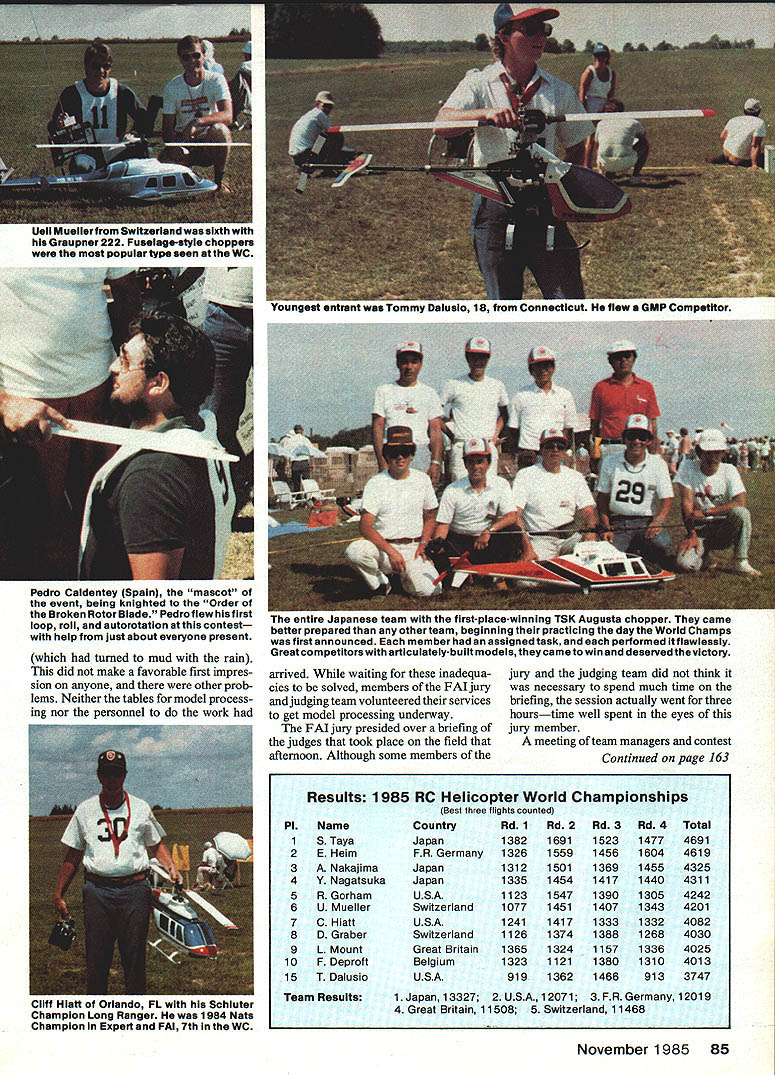
Although this was the first World Championships for the F3C class, attendance was strong: 17 countries and 37 contestants. Mistakes were expected, but everyone learned much from the experience.
I hope everyone interested in this exciting branch of aeromodeling gets a chance to attend the next World Championships — which will likely be held in Europe. Hope to see you there.
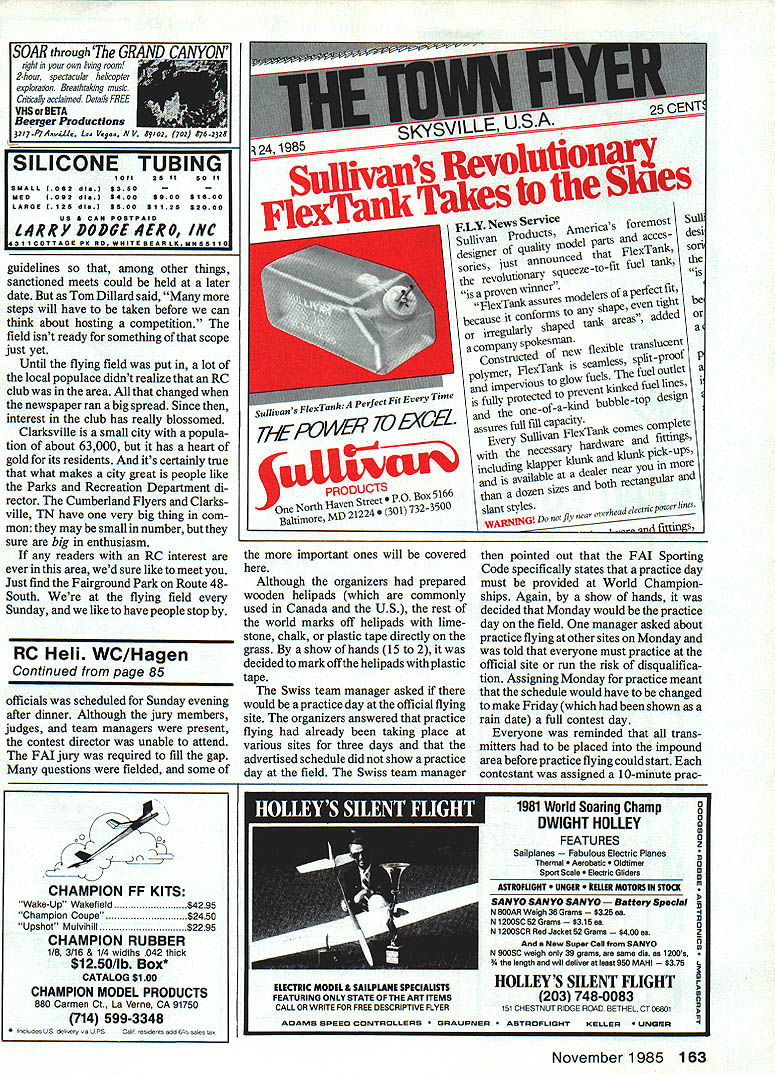
Results: 1985 RC Helicopter World Championships
(Best three flights counted)
- Shigetada Taya, Japan — Rd. 1: 1382 Rd. 2: 1691 Rd. 3: 1523 Rd. 4: 1477 Total: 4691
- Ewald Helm, F.R. Germany — Rd. 1: 1326 Rd. 2: 1559 Rd. 3: 1456 Rd. 4: 1604 Total: 4619
- Atsushi Nakajima, Japan — Rd. 1: 1312 Rd. 2: 1501 Rd. 3: 1369 Rd. 4: 1455 Total: 4325
- Yoshiaki Nagatsuka, Japan — Rd. 1: 1335 Rd. 2: 1454 Rd. 3: 1417 Rd. 4: 1440 Total: 4311
- Robert Gorham, U.S.A. — Rd. 1: 1123 Rd. 2: 1547 Rd. 3: 1390 Rd. 4: 1305 Total: 4242
- U. Mueller, Switzerland — Rd. 1: 1077 Rd. 2: 1451 Rd. 3: 1407 Rd. 4: 1343 Total: 4201
- Cliff Hiatt, U.S.A. — Rd. 1: 1241 Rd. 2: 1417 Rd. 3: 1333 Rd. 4: 1332 Total: 4082
- D. Graber, Switzerland — Rd. 1: 1126 Rd. 2: 1374 Rd. 3: 1388 Rd. 4: 1268 Total: 4030
- Len Mount, Great Britain — Rd. 1: 1365 Rd. 2: 1324 Rd. 3: 1157 Rd. 4: 1336 Total: 4025
- Francis DeProft, Belgium — Rd. 1: 1323 Rd. 2: 1121 Rd. 3: 1380 Rd. 4: 1310 Total: 4013
- Tom Dalusio, U.S.A. — Rd. 1: 919 Rd. 2: 1362 Rd. 3: 1468 Rd. 4: 913 Total: 3747
Team results:
- Japan — 13327
- U.S.A. — 12071
- F.R. Germany — 12019
- Great Britain — 11508
- Switzerland — 11468
Transcribed from original scans by AI. Minor OCR errors may remain.

