
RC Helicopters
By Larry Jolly
Paging through this magazine, it quickly becomes evident that it's the annual Model Aviation Nats issue and that they did, in fact, fly RC helicopters at the Nationals.
For those familiar with the AMA Rule Book and National Championship outline, there are four classes of RC helicopters flown at the Nats: Novice, Intermediate, FAI, and Scale. The first three classes are separated based on pilot proficiency and encompass progressively more difficult maneuvers. Scale combines static scoring with flying.
Each year the national contest is held at a different site in the contiguous United States, alternating as much as possible between the East Coast, the Midwest, and the West Coast. This year the annual competition was held in the Tri-Cities area of Washington State. The Tri-Cities consists of three communities located on or near the Columbia River in the southwestern corner of the state. The area is very arid and capable of variable weather conditions, including rain. The predominant contest factor for helicopters, of course, was wind.
There was a lot of wind plus generous quantities of sunshine and high temperatures. Several contestants joked that the wind started to blow every time they were scheduled to fly. Some fliers, however, seemed to get better conditions than others. The wind was definitely a factor, especially in the hover maneuvers.
This year's event director was Craig Hatt of Circus Hobbies fame, from Las Vegas, NV. Craig is a good flier and author and knows how to run a contest and solve problems. The first problem was the site. By now everyone knows the old story of the Nationals concerning helicopters — it's almost like it's always the same old story: some unusable site, normally copious amounts of dirt that ruin contestants' machines. This year the original site again was a dirt field, definitely not a place one would normally choose to fly. Craig had the site moved to the Hanford School complex bordering the Columbia River in Richland, WA. Hanford School was suitable, though a little wind caused some problems in FAI and Intermediate. In fact, the Intermediate schedule had to be flown opposite to the way it is published in the rule book to suit the layout of the field. This hindered some fliers but rewarded others who were able to adapt.
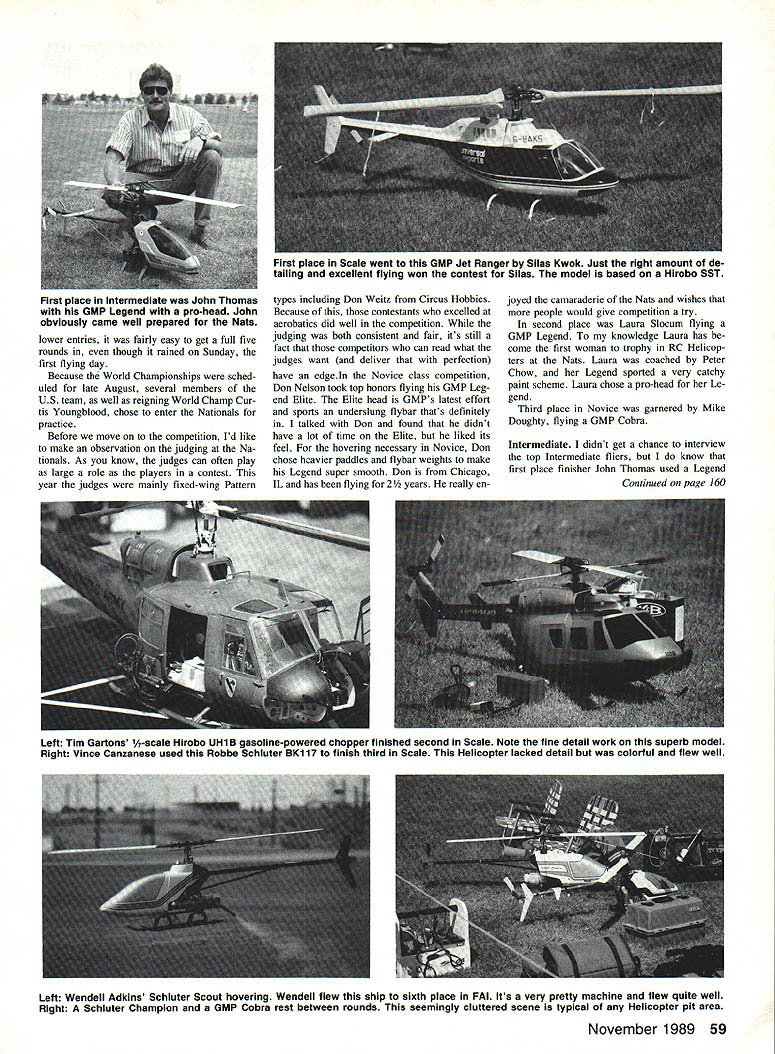
With lower entries, it was fairly easy to get a full five rounds in, even though it rained on Sunday, the first flying day.
Entries
- FAI: 10 entries
- Intermediate: 9 entries
- Novice: 6 entries
- Scale: 3 entries
While the numbers were slim, the skill level was up. Good flying was the rule rather than the exception. With the World Championships scheduled for late August, several members of the U.S. team, including current World Champion Curtis Youngblood, chose to enter the Nationals as practice.
Before covering competition results, a note on judging: judges can often play a large role in the outcome of a contest. This year judges were mainly fixed-wing Pattern types, including Don Weitz of Circus Hobbies. Because contestants excelled in aerobatics, they did well in the competition. Judging was both consistent and fair; competitors can read what judges want and deliver near perfection to have an edge.
Novice
In Novice class competition, Don Nelson took top honors flying a GMP Legend equipped with an Elite head. GMP's latest effort sports an underslung flybar, which was being talked about. Don found he didn't have a lot of time with the Elite but liked its feel in hovering. He chose heavier paddles and flybar weights to make the Legend super smooth. Don, from Chicago, IL, has been flying two years and really enjoyed the camaraderie at the Nats. He recommends people try competition — it's a lot of fun, and you make lasting friends.
- Don Nelson — GMP Legend (Elite head)
- Laura Slocum — GMP Legend (pro head)
- To my knowledge, Laura became the first woman to win a trophy in RC helicopters at the Nats. She was coached by Peter Chow and sported a very catchy paint scheme.
- Mike Doughty — GMP Cobra
Intermediate
I didn't get a chance to interview the top Intermediate fliers, but I know the placings and equipment:
- John Thomas — Legend (pro head)
- Maurice Chai — Kalt Baron 60
- Steven Rhodes — Robbe Schluter Magic
- Steven became the first person to trophy at a Nationals with Robbe's new Schluter Magic. The wind played havoc with patterns, so well done.
FAI
From the start it was noticeable that the judges favored aerobatics. They gave first-place finisher Curtis Youngblood the highest score in Round One. Curtis is an excellent flier who excels at aerobatics. He flew his familiar Competitor Ranger with an Elite head.
- Curtis Youngblood — Competitor Ranger (Elite head)
- Mike Mas — Schluter Champion (box stock, no pipe)
- Mike started a little slow but posted two consistent 94.25s in Rounds 4 and 5 to finish second. According to Mike, the machine had many hours on it and was just broken in. The Schluter Champion proved great value in its class.
- Robert Gorham — Legend Elite
- Robert finished just two points behind Mike. His hovering was as good as any I have seen — smooth even in the windy conditions.
- Tim Schoonard — Miniature Aircraft Supply Long Ranger
- Ted Schoonard — Miniature Aircraft Supply Long Ranger
- Both Tim and Ted posted high single-flight scores but failed to tie three good flights together for higher placing.
Scale
- Silas Kwok — Hirobo SST Jet Ranger (replica of Universal Exports' Jet Ranger)
- The model featured good detailing and agile flying, perhaps a bit fast for Scale.
- Timothy Garton — Hirobo UH-1B (1/4-scale gasoline-powered Huey)
- Excellent detailing; hampered by what appeared to be an underpowered situation.
- Robbie Vincent Cannanese — Schluter BK 117
- Lacked detail but was colorful and flew well.
Conclusion
Craig Hatt ran a smooth event, the judges were consistent, and the fliers had a good time. Start practicing for next year, and we'll see you there.
Transcribed from original scans by AI. Minor OCR errors may remain.

