
RC Masters: Team Selection Tournament
Ron Van Putte
The 1975 RC Masters Tournament was the culmination of an AMA/NSRCA program to competitively select the very best U.S. flyers to represent the U.S. in the 1975 RC Aerobatics World Championships. Eligible to compete were the top ten from each of the 1972 Masters, the 1972 Nationals, the 1973 Nationals (among those who entered the qualifying program), and the 1973 nationwide points program. Runners-up in the points program were allowed to fill in for any no-shows among the primary group of 40. The event originally was planned for Hutchinson, Kans., in 1974, but that event was canceled due to adverse weather, and the RC Masters Tournament was rescheduled for 1975 at Rough River, Ky., by participant vote.
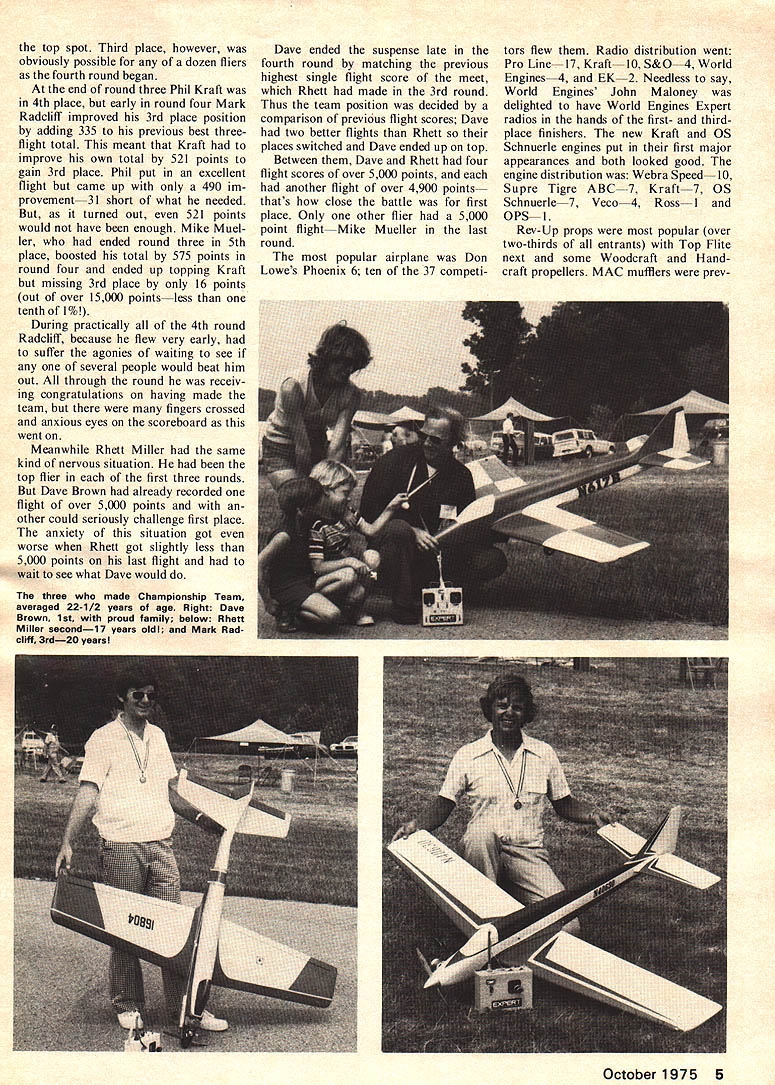
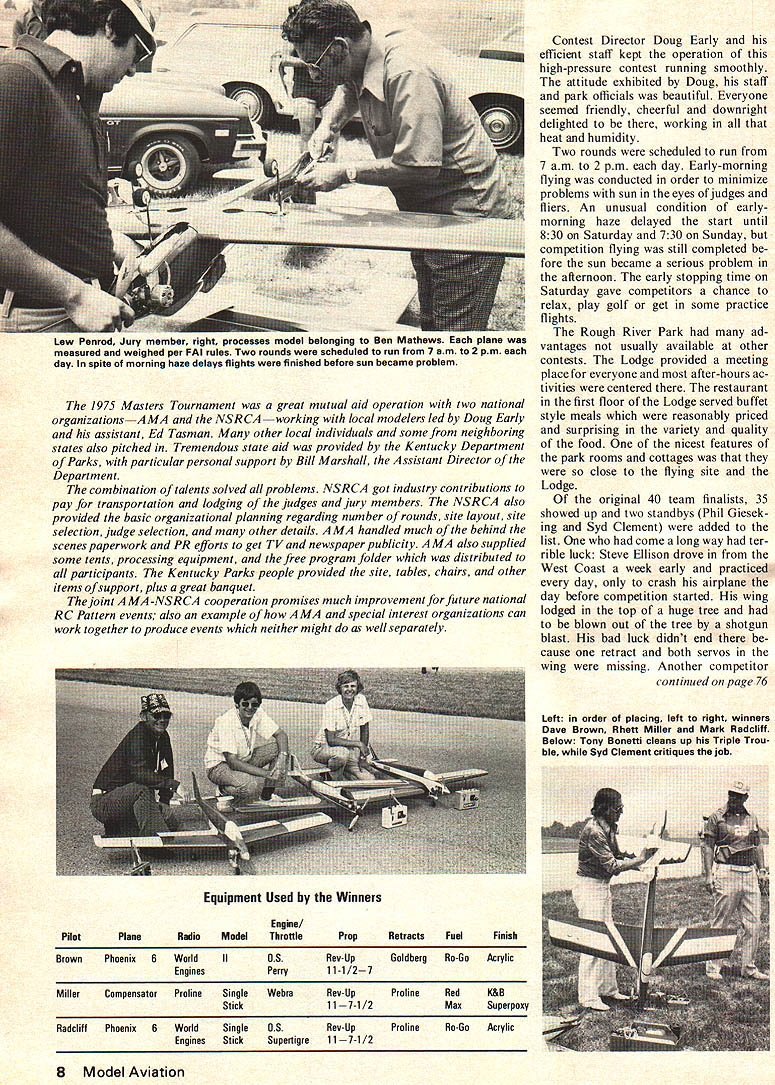
Dave Brown, Rhett Miller, and Mark Radcliff will represent the United States in September at the World Championships in Switzerland.
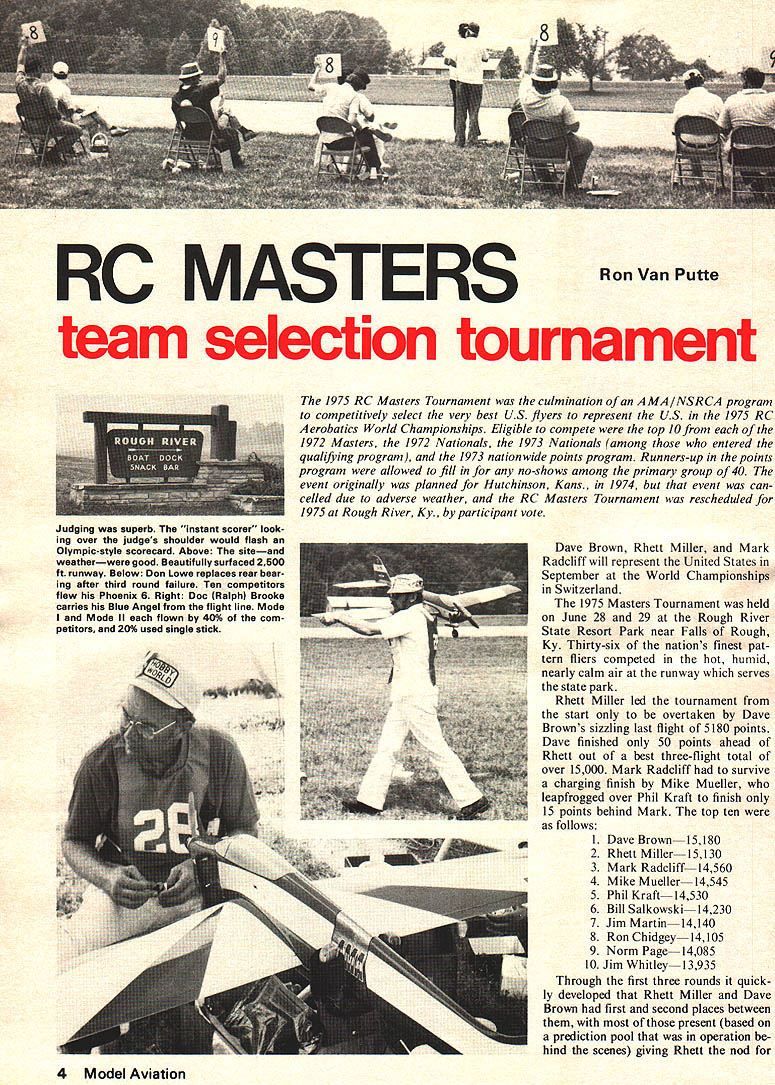
The 1975 Masters Tournament was held on June 28 and 29 at the Rough River State Resort Park near Falls of Rough, Ky. Thirty-six of the nation's finest pattern fliers competed in the hot, humid, nearly calm air at the runway which serves the state park.
Rhett Miller led the tournament from the start only to be overtaken by Dave Brown's sizzling last flight of 5180 points. Dave finished only 50 points ahead of Rhett out of a best three-flight total of over 15,000. Mark Radcliff had to survive a charging finish by Mike Mueller, who leapfrogged over Phil Kraft to finish only 15 points behind Mark. The top ten were as follows:
- Dave Brown — 15,180
- Rhett Miller — 15,130
- Mark Radcliff — 14,560
- Mike Mueller — 14,545
- Phil Kraft — 14,530
- Bill Salkowski — 14,230
- Jim Martin — 14,140
- Ron Chidgey — 14,105
- Norm Page — 14,085
- Jim Whitley — 13,935
Through the first three rounds it quickly developed that Rhett Miller and Dave Brown had first and second places between them, with most of those present (based on a prediction pool that was in operation behind the scenes) giving Rhett the nod for the top spot. Third place, however, was obviously possible for any of a dozen fliers as the fourth round began.
At the end of round three Phil Kraft was in 4th place, but early in round four Mark Radcliff improved his 3rd place position by adding 335 to his previous best three-flight total. This meant that Kraft had to improve his own total by 521 points to gain 3rd place. Phil put in an excellent flight but came up with only a 490 improvement—31 short of what he needed. But, as it turned out, even 521 points would not have been enough. Mike Mueller, who had ended round three in 5th place, boosted his total by 575 points in round four and ended up topping Kraft but missing 3rd place by only 16 points (out of over 15,000 points—less than one-tenth of 1%).
During practically all of the 4th round Radcliff, because he flew very early, had to suffer the agonies of waiting to see if any one of several people would beat him out. All through the round he was receiving congratulations on having made the team, but there were many fingers crossed and anxious eyes on the scoreboard as this went on.
Meanwhile Rhett Miller had the same kind of nervous situation. He had been the top flier in each of the first three rounds. But Dave Brown had already recorded one flight of over 5,000 points and with another could seriously challenge first place. The anxiety of this situation got even worse when Rhett got slightly less than 5,000 points on his last flight and had to wait to see what Dave would do.
Dave ended the suspense late in the fourth round by matching the previous highest single-flight score of the meet, which Rhett had made in the 3rd round. Thus the team position was decided by a comparison of previous flight scores; Dave had two better flights than Rhett so their places switched and Dave ended up on top. Between them, Dave and Rhett had four flight scores of over 5,000 points, and each had another flight of over 4,900 points—that's how close the battle was for first place. Only one other flier had a 5,000-point flight—Mike Mueller in the last round.
The most popular airplane was Don Lowe's Phoenix 6; ten of the 37 competitors flew them. Radio distribution went: Pro Line—17, Kraft—10, S&O—4, World Engines—4.
World Engines' John Maloney was delighted to have World Engines Expert radios in the hands of the first- and third-place finishers. The new Kraft and OS Schnuerle engines put in their first major appearances and both looked good. The engine distribution was: Webra Speed—10, Super Tigre ABC—7, Kraft—7, OS Schnuerle—7, Veco—4, Ross—1, OPS—1.
Rev-Up props were most popular (over two-thirds of all entrants) with Top Flite next and some Woodcraft and Handcraft propellers. MAC mufflers were prevalent. About half the contestants finished with K & B Superpoxy, one-third used auto acrylic, and the rest Hobbypoxy, Aero-Gloss, and MonoKote.
Transmitter Mode (stick arrangement) made for an interesting comparison at the Masters. Mode I (throttle right) was used by 40 percent of the flyers as was Mode II (throttle left). The remaining 20 percent flew Single Stick. With a few exceptions, pilots over age 40 preferred Mode I; those under 40, Mode II. Single-stick indicated no preference based on age.
The Rough River State Park is a superb place to hold a contest. The 2,500 foot runway, although slightly upslope from south to north, is beautifully surfaced. The only feature which could have caused problems for fliers was a line of very large trees approximately 250 yards from the runway. The contest management placed the two flight circles at the extreme ends of the runway and avoided most of the trees. The site was far superior to the site of the first Masters Tournament in 1968.
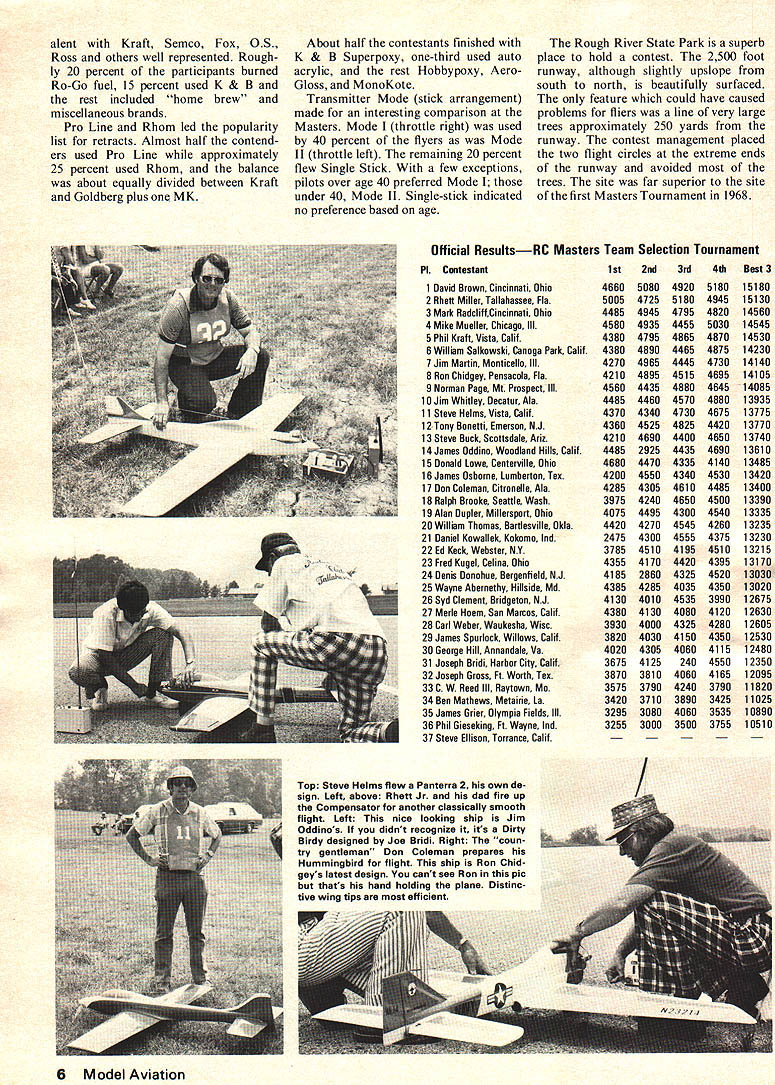
Official Results — RC Masters Team Selection Tournament
Pl. Contestant .................................... 1st 2nd 3rd 4th Best 3
- David Brown, Cincinnati, Ohio ................. 4660 5080 4920 5180 15180
- Rhett Miller, Tallahassee, Fla. ............... 5005 4725 5180 4945 15130
- Mark Radcliff, Cincinnati, Ohio ............... 4545 4945 4795 4820 14560
- Mike Mueller, Chicago, Ill. ................... 4580 4935 4465 5030 14545
- Phil Kraft, Vista, Calif. ..................... 4380 4795 4865 4870 14530
- William Salkowski, Canoga Park, Calif. ....... 4380 4890 4465 4875 14230
- Jim Martin, Monticello, Ill. ................. 4270 4965 4445 4695 14140
- Ron Chidgey, Pensacola, Fla. ................. 4210 4895 4515 4695 14120
- Norman Page, Mt. Prospect, Ill. .............. 4560 4435 4880 4645 14085
- Jim Whitley, Decatur, Ala. ................... 4485 4460 4570 4880 13935
- Steve Helms, Vista, Calif. ................... 4370 4340 4730 4675 13785
- Tony Bonetti, Emerson, N.J. .................. 4360 4525 4825 4420 13770
- Steve Buck, Scottsdale, Ariz. ................ 4165 4260 4690 4400 13155
- James Uddo, Woodland Hills, Calif. ........... 4485 4295 4335 4690 13140
- Donald Lowe, Centerville, Ohio .............. 4680 4470 4335 4140 13450
- James Osborne, Lumberton, Tex. .............. 4200 4050 4340 4530 13420
- Don Coleman, Citronelle, Ala. ............... 4285 4305 4610 4485 13090
- Ralph Brooke, Seattle, Wash. ................. 3975 4240 4650 4500 13325
- Alan Dapier, Millersport, Ohio ............... 4075 4495 4300 4350 13230
- William Thomas, Bartlesville, Okla. ......... 4420 4270 4545 4160 13235
- Daniel Kowallek, Kokomo, Ind. ............... 4475 4300 4555 4375 13330
- Ed Keck, Webster, N.Y. ...................... 3785 4510 4195 4510 12415
- Fred Kugel, Celina, Ohio .................... 4355 4170 4200 4600 12655
- Denis Donohue, Bergenfield, N.J. ............ 4185 2860 4325 4385 12895
- Wayne Abernethy, Hillside, Md. .............. 4385 4285 4035 3720 12705
- Syd Clement, Bridgeton, N.J. ................ 4130 4010 4535 3990 12675
- Merle Horen, San Marcos, Calif. ............. 4380 4130 4080 4120 12630
- Carl Weber, Waukesha, Wisc. ................. 3930 4000 4325 4280 12535
- James Spurlock, Willows, Calif. ............. 3525 4030 4150 4230 12385
- George Hill, Annandale, Va. ................. 4020 4305 4060 4115 12480
- Joseph Birdl, Harbor City, Calif. ........... 3675 3510 4125 2450 11210
- Joseph Gross, Ft. Worth, Tex. ............... 3870 3810 4060 4165 11795
- C. W. Reed III, Raytown, Mo. ................ 3575 3790 4240 3790 11205
- Ben Mathews, Metairie, La. .................. 3420 3100 3890 3425 11035
- James Grier, Olympia Fields, Ill. ........... 3295 3080 4060 3535 10490
- Phil Gieseking, Ft. Wayne, Ind. ............. 3255 3000 3500 3755 10510
- Steve Ellison, Torrance, Calif. ............. -- -- -- -- --
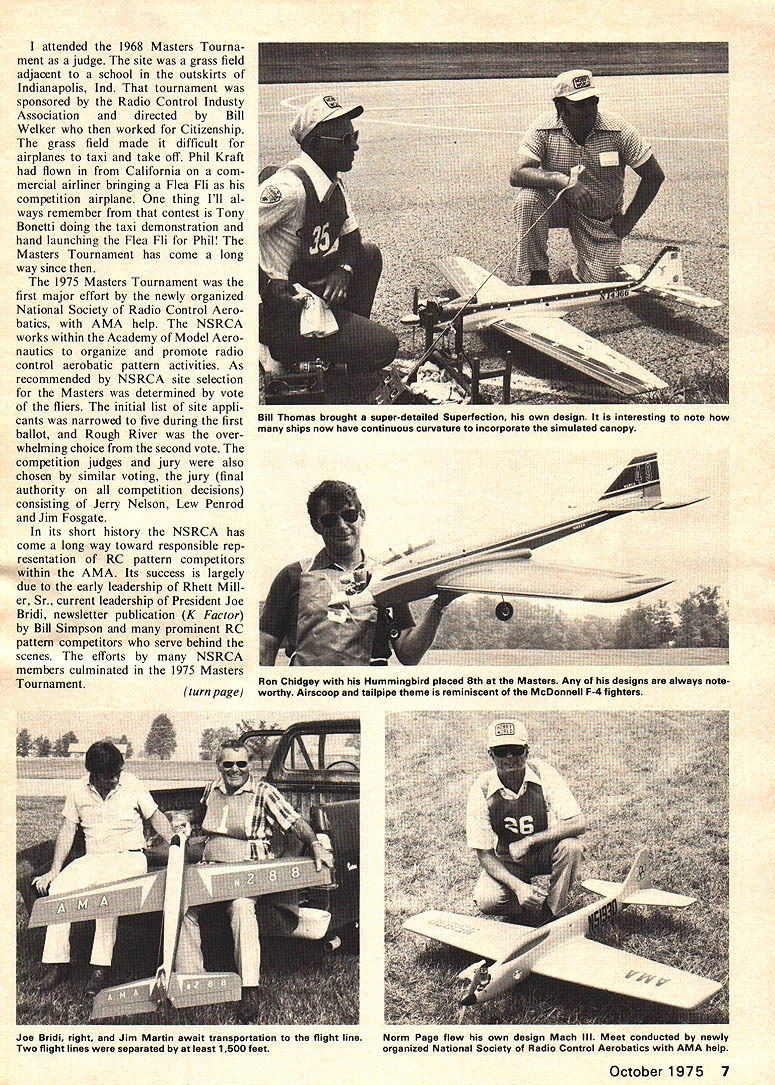
I attended the 1968 Masters Tournament as a judge. The site was a grass field adjacent to a school in the outskirts of Indianapolis, Ind. That tournament was sponsored by the Radio Control Industry Association and directed by Bill Welker who then worked for Citizenship. The grass field made it difficult for airplanes to taxi and take off. Phil Kraft had flown in from California on a commercial airliner arranging a Flea Fli as his competition airplane. One thing I'll always remember from that contest is Tony Bonetti doing the taxi demonstration and hand launching the Flea Fli for Phil! The Masters Tournament has come a long way since then.
The 1975 Masters Tournament was the first major effort by the newly organized National Society of Radio Control Aerobatics, with AMA help. The NSRCA works within the Academy of Model Aeronautics to organize and promote radio control aerobatic pattern activities. As recommended by NSRCA site selection for the Masters was determined by vote of the fliers. The initial list of site applicants was narrowed to five during the first ballot, and Rough River was the overwhelming choice from the second vote. The competition judges and jury were also chosen by similar voting, the jury (final authority on all competition decisions) consisting of Jerry Nelson, Lew Penrod and Jim Fosgate.
In its short history the NSRCA has come a long way toward responsible representation of RC pattern competitors within the AMA. Its success is largely due to the early leadership of Rhett Miller, Sr., current leadership of President Joe Bridi, newsletter publication (K Factor) by Bill Simpson and many prominent RC pattern competitors who serve behind the scenes. The efforts by many NSRCA members culminated in the 1975 Masters Tournament. The 1975 Masters Tournament was a great mutual aid operation with two national organizations—AMA and the NSRCA—working with local modelers led by Doug Early and his assistant, Ed Tasman. Many other local individuals and some from neighboring states also pitched in. Tremendous state aid was provided by the Kentucky Department of Parks, with particular personal support by Bill Marshall, the Assistant Director of the Department.
The combination of talents solved all problems. NSRCA got industry contributions to pay for transportation and lodging of the judges and jury members. The NSRCA also provided the basic organizational planning regarding number of rounds, site layout, site selection, judge selection, and many other details. AMA handled much of the behind-the-scenes paperwork and PR efforts to get TV and newspaper publicity. AMA also supplied some tents, processing equipment, and the free program folder which was distributed to all participants. The Kentucky Parks people provided the site, tables, chairs, and other items of support, plus a grand banquet.
The joint AMA‑NSRCA cooperation promises much improvement for future national RC Pattern events; also an example of how AMA and special interest organizations can work together to produce events which neither might do as well separately.
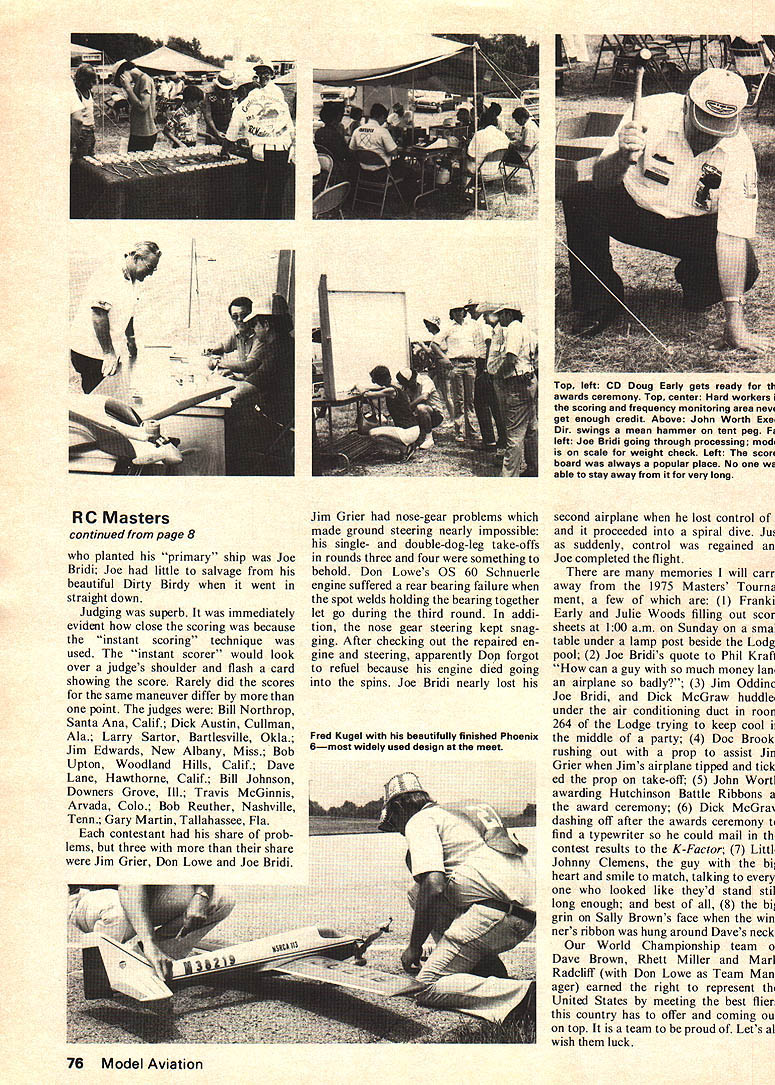
Contest Director Doug Early and his efficient staff kept the operation of this high-pressure contest running smoothly. The attitude exhibited by Doug, his staff and park officials was beautiful. Everyone seemed friendly, cheerful and downright delighted to be there, working in all that heat and humidity.
Two rounds were scheduled to run from 7 a.m. to 2 p.m. each day. Early-morning flying was conducted in order to minimize problems with sun in the eyes of judges and fliers. An unusual condition of early-morning haze delayed the start until 8:30 on Saturday and 7:30 on Sunday, but competition flying was still completed before the sun became a serious problem in the afternoon. The early stopping time on Saturday gave competitors a chance to relax, play golf or get in some practice flights.
The Rough River Park had many advantages not usually available at other contests. The Lodge provided a meeting place for everyone and most after-hours activities were centered there. The restaurant in the first floor of the Lodge served buffet-style meals which were reasonably priced and surprising in the variety and quality of the food. One of the nicest features of the park rooms and cottages was that they were so close to the flying site and the Lodge.
Of the original 40 team finalists, 35 showed up and two standbys (Phil Gieseker and Syd Clement) were added to the list. One who had come a long way had terrible luck: Steve Ellison drove in from the West Coast a week early and practiced every day, only to crash his airplane the day before competition started. His wing lodged in the top of a huge tree and had to be blown out of the tree by a shotgun blast. His bad luck didn't end there because one retract and both servos in the wing were missing. who planted his "primary" ship was Joe Bridi; Joe had little to salvage from his beautiful Dirty Birdy when it went in straight down.
Judging was superb. It was immediately evident how close the scoring was because the "instant scoring" technique was used. The "instant scorer" would look over a judge's shoulder and flash a card showing the score. Rarely did the scores for the same maneuver differ by more than one point. The judges were: Bill Northrop, Santa Ana, Calif.; Dick Austin, Cullman, Ala.; Larry Sartor, Bartlesville, Okla.; Jim Edwards, New Albany, Miss.; Bob Upton, Woodland Hills, Calif.; Dave Lane, Hawthorne, Calif.; Bill Johnson, Downers Grove, Ill.; Travis McGinnis, Arvada, Colo.; Bob Reuther, Nashville, Tenn.; Gary Martin, Tallahassee, Fla.
Each contestant had his share of problems, but three with more than their share were Jim Grier, Don Lowe and Joe Bridi.
Jim Grier had nose-gear problems which made ground steering nearly impossible; his single- and double-dog-leg take-offs in rounds three and four were something to behold. Don Lowe's OS 60 Schnuerle engine suffered a rear bearing failure when the spot welds holding the bearing together let go during the third round. In addition, the nose gear steering kept snatching. After checking out the repaired engine and steering, apparently Don forgot to refuel because his engine died going into the spins. Joe Bridi nearly lost his second airplane when he lost control of it and it proceeded into a spiral dive. Just as suddenly, control was regained and the plane completed the flight.
There are many memories I will carry away from the 1975 Masters Tournament, a few of which are: (1) Frank Early and Julie Woods filling out score sheets at 1:00 a.m. on Sunday on a small table under a lamp post beside the Lodge; (2) Joe Bridi's quote to Phil Kraft: "How can a guy with so much money land an airplane so badly?"; (3) Joe Bridi and Dick McGraw huddled under the air-conditioning duct in room 264 of the Lodge trying to keep cool in the middle of a party; (4) Doc Brown pushing out with a prop to assist Jim Grier when Jim's airplane tipped and took off the prop on take-off; (5) John Worth awarding Hutchinson Battle Ribbons at the awards ceremony; (6) Dick McGraw dashing off after the awards ceremony to find a typewriter so he could mail in the contest results to the K-Factor; (7) Little Johnny Clemens, the guy with the big beard and smile to match, talking to everyone who looked like they'd stand still long enough; and best of all, (8) the big grin on Sally Brown's face when the winner's ribbon was hung around Dave's neck.
Our World Championship team of Dave Brown, Rhett Miller and Mark Radcliff (with Don Lowe as team manager) earned the right to represent the United States by meeting the best flyers this country has to offer and coming out on top. It is a team to be proud of. Let's all wish them luck.
Transcribed from original scans by AI. Minor OCR errors may remain.

