
The NSRCA Pan‑American Championships: 1992's biggest RC Pattern contest
Ron Van Putte
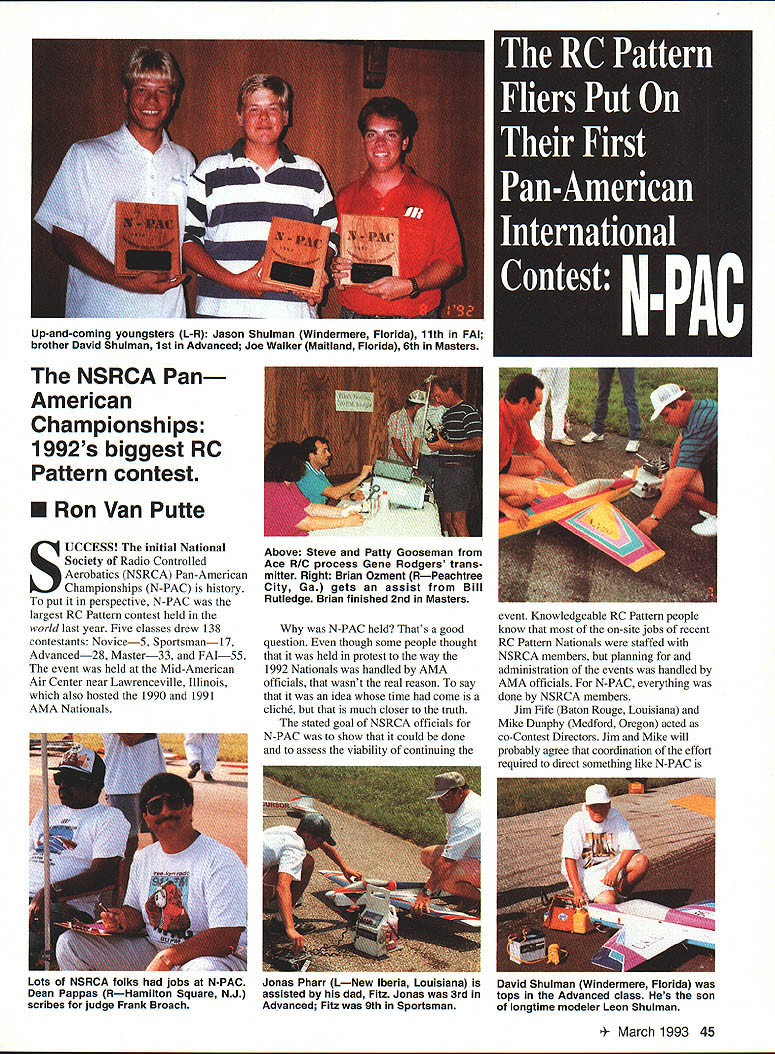
SUCCESS! The inaugural National Society of Radio Controlled Aerobatics (NSRCA) Pan‑American Championships (N‑PAC) is history. To put it in perspective, N‑PAC was the largest RC Pattern contest held in the world last year. Five classes drew 138 contestants:
- Novice — 5
- Sportsman — 17
- Advanced — 28
- Master — 33
- FAI — 55
The event was held at the Mid‑American Air Center near Lawrenceville, Illinois, which also hosted the 1990 and 1991 AMA Nationals. The stated goal of NSRCA officials for N‑PAC was to show that it could be done and to assess the viability of continuing the event.
Event processing and judges' seminar
Event processing was held at the Executive Inn, Vincennes, Indiana, on Sunday, July 26. Thanks to Ace R/C representatives Steve Patty and Gooseman, contestants were able to get transmitters processed after promised transmitter‑processing personnel backed out a week before N‑PAC. They jumped into the breach and kept things moving.
A judges' training seminar was conducted Sunday afternoon by Chief Judge Jim Graham (R/C City's owner). Most judges attended the 2½‑hour clinic. Jim showed the new judging video produced by Jay Gerber and Ron Chidgey. He had a big box of videos for sale, and they were snapped up by participants. The video is an excellent review of judging fundamentals and is highly recommended for club officials to review with their judges. It explains judging of almost every maneuver by breaking them into lines, loops, stalls, rolls, and spins.
Sites, flight lines and schedule
Three sites were set up on an east–west runway at Mid‑American Air Center. Two flight lines were available at a site; schedule and normalization rules were:
- Morning session (started 9:30 a.m., ended about 12:30 p.m.): Novice, Advanced, Master.
- Afternoon session (began 1:30 p.m. after about an hour break): Sportsman and FAI.
Normalization and line usage:
- Novice: flown on one flight line; scores could be normalized after a round.
- Sportsman: started on two lines; lines were combined after the second round, allowing normalization after round two.
- Advanced: flew on two lines; normalization permitted after the second, fourth and sixth rounds.
- Master: used three lines; normalization permitted after the third and sixth rounds.
- FAI: a special case. Pilots were assigned flight‑line seeding based on how they had placed in the two previous Nationals and the FAI Team Selection contest. Each FAI line operated as a mini‑contest during qualifying.
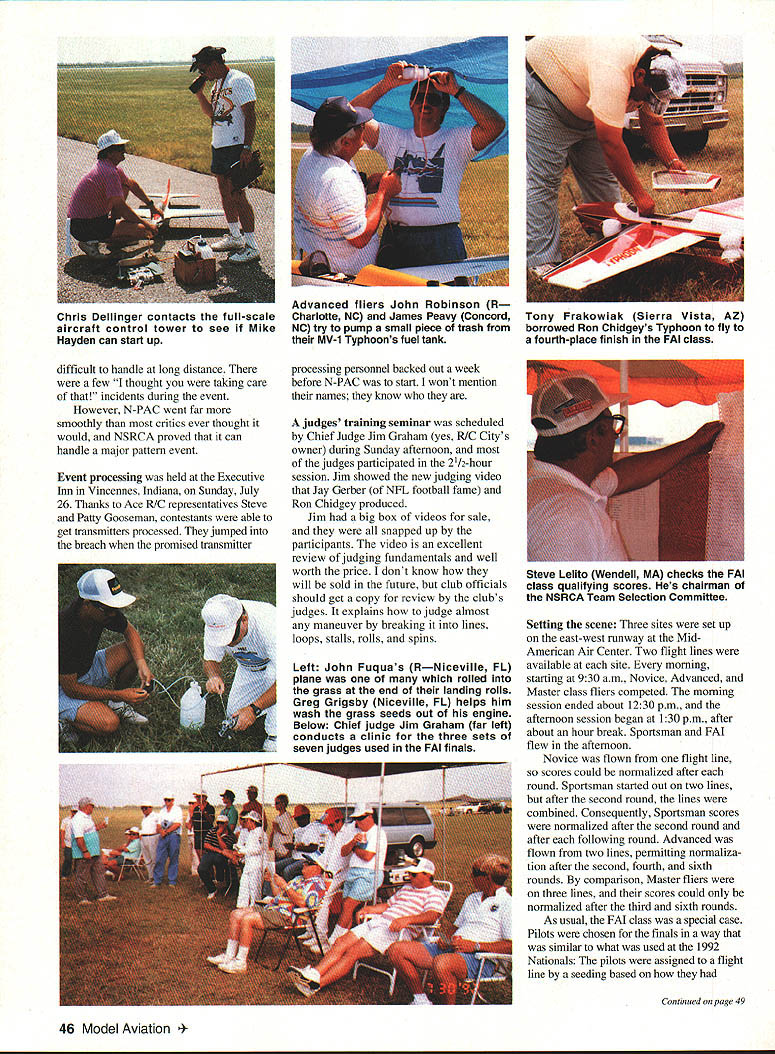
Each FAI line: pilots flew four qualifying flights in front of four sets of judges. Scores for fliers on a particular line were normalized only against fliers on that same line. The top four Americans on each line made the finals, along with any Canadians who were among those top four Americans. After that, additional fliers were selected based on normalization across all fliers until a total of 21 finalists was reached.
It turned out one flight line had only four finalists selected, two lines had five each, and the last line had seven. If seeding were perfect one would expect a 5‑5‑5‑6 split. As Ron Chidgey joked, "Bill Rutledge messed up the seeding." Bill Rutledge (Jonesboro, Georgia) had not attended the last two Nationals or the Team Selection contest, so he was unseeded. He nevertheless made the finals and surprised no one — he is a national‑class flier.
There were a few organizational hiccups — “I thought you were taking care of that!” incidents — but overall N‑PAC went far more smoothly than many critics expected, and NSRCA proved it can handle a major pattern event.
Weather and conditions
Wind was a factor, as usual. At the 1990 Nationals the wind was primarily from the southwest (takeoffs right‑to‑left, quartering crosswind); in 1991 it was mostly from the northeast (takeoffs left‑to‑right). At N‑PAC the first morning’s takeoffs were left‑to‑right into a northeast wind. For much of the week the co‑CDs called right‑to‑left takeoffs, but during much of the time the wind was from the south — a direct crosswind. This reinforced the recurring question of permitting pilot option on takeoff direction; the arbitrary designation by contest management can advantage some fliers over others.
Rain threatened during most of the week, with some heavy overnight and early‑morning storms, but only a brief shower affected competition — a 15–20 minute pause during the FAI finals. Heat was not as significant as in prior years; daytime highs were in the low to mid‑80s, except the last day when a cold front dropped the high to about 70°. The cooler, windy, wet conditions had some judges and fliers wishing they’d brought jackets.
Competition summaries
Novice
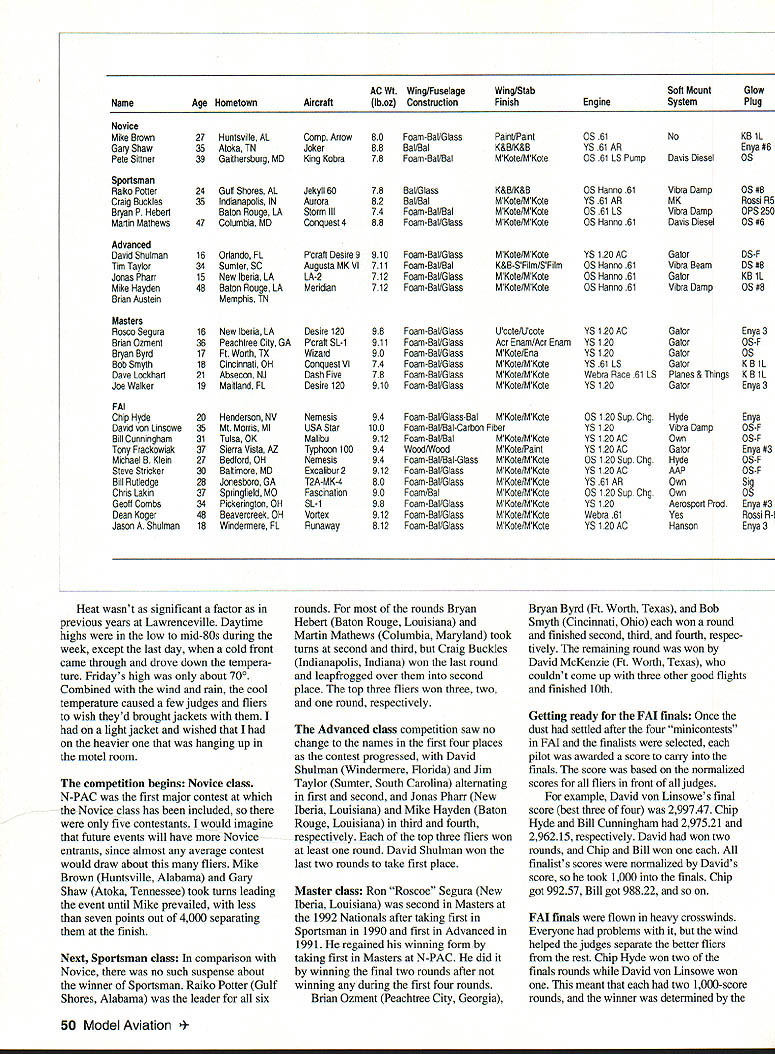
N‑PAC was the first major contest to include a Novice class, so there were only five contestants. Future events will likely draw more Novice entrants. Mike Brown (Huntsville, Alabama) and Gary Shaw (Atoka, Tennessee) traded the lead until Mike prevailed — less than seven points out of 4,000 separated them at the finish.
Sportsman
Raiko Potter (Gulf Shores, Alabama) led Sportsman from start to finish, winning all six rounds. Bryan Hebert (Baton Rouge, Louisiana) and Martin Mathews (Columbia, Maryland) alternated for second and third for most rounds, but Craig Buckles (Indianapolis, Indiana) won the last round and moved into second. The top three won three, two, and one rounds, respectively.
Advanced
The top four names stayed the same through the contest. David Shulman (Windermere, Florida) and Jim Taylor (Sumter, South Carolina) alternated first and second, with Jonas Pharr (New Iberia, Louisiana) and Mike Hayden (Baton Rouge, Louisiana) in third and fourth. Each of the top three won at least one round; David Shulman won the last two rounds to take first overall.
Master
Ron "Roscoe" Segura (New Iberia, Louisiana) reclaimed winning form by taking first in Masters after winning the final two rounds despite not winning any of the first four. Brian Ozment (Peachtree City, Georgia), Bryan Byrd (Ft. Worth, Texas), and Bob Smith (Cincinnati, Ohio) each won a round and finished second, third, and fourth, respectively. David McKenzie (Ft. Worth, Texas) won one round but was inconsistent and finished 10th.
FAI finals and highlights
After qualifying, each FAI finalist was awarded a score to carry into the finals based on normalized qualifying scores. For example:
- David von Linsowe (best three of four) — 2,997.47 (normalized to 1,000 going into finals)
- Chip Hyde — 2,975.21 (normalized to 992.57)
- Bill Cunningham — 2,962.15 (normalized to 988.22)
FAI finals were flown in heavy crosswinds. The wind challenged everyone and helped judges separate the better fliers. Chip Hyde won two finals rounds, David von Linsowe won one, and Bill Cunningham won one. Each had two 1,000‑score rounds; the winner was determined by the sum of their other two final rounds. Chip’s next best flight score (992.97) exceeded David’s (970.59), so Chip won the event. Bill Cunningham, a member of the 1991 World Championship team, finished third.
It was encouraging to see several fliers reach higher finishes or appear in the finals for the first time:
- Mike Klein (Bedford, Ohio) — finished 5th (his best ever).
- Jason Shulman (Windermere, Florida) — 11th (first finals).
- Rick Mattie (Winchester, Tennessee) — 16th (first finals).
- Richard Byrd (Ft. Worth, Texas) — 17th (first finals).
- Norm Staub — first time in the finals; Norm covered the 1992 AMA Nationals RC Pattern events for Model Aviation.
Midair collision and recovery
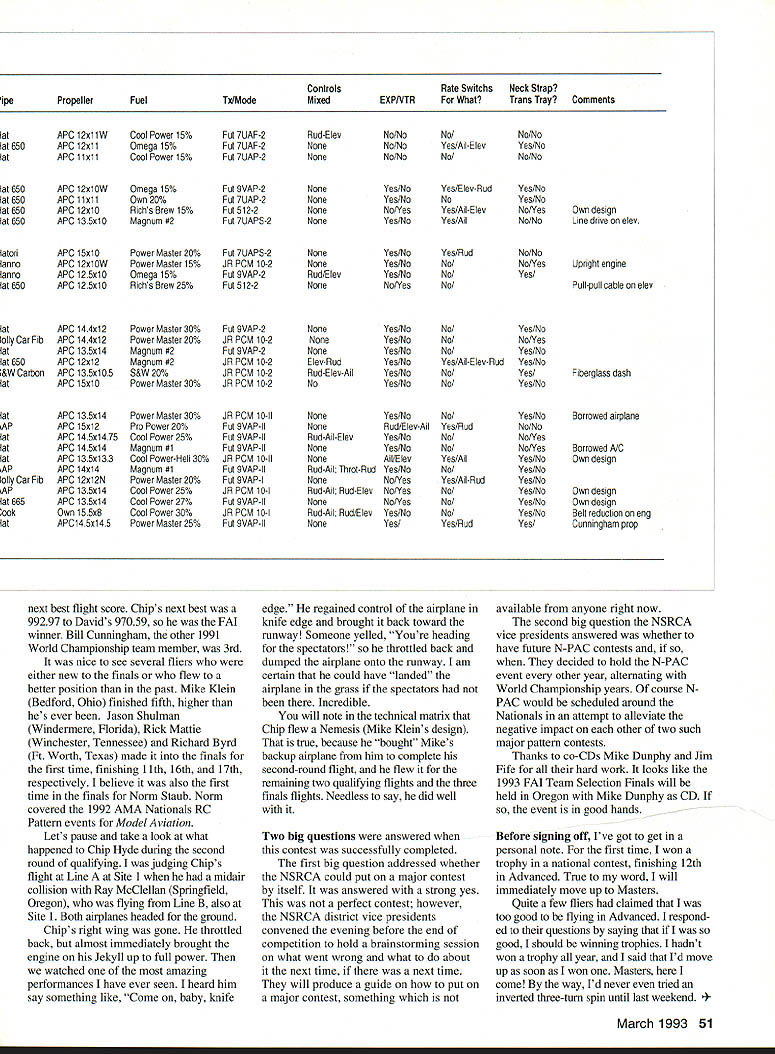
During the second round of qualifying, Chip Hyde (Line A, Site 1) had a midair collision with Ray McClellan (Springfield, Oregon) flying from Line B at the same site. Both airplanes headed for the ground and Chip’s right wing was gone. He throttled back, then brought the Jekyll engine to full power and performed an astounding recovery, flying knife‑edge control toward the runway before safely dumping the airplane onto the runway to avoid spectators. After the collision, Chip "bought" Mike Klein’s back‑up airplane (a Nemesis) to complete his second qualifying flight and flew that Nemesis for the remaining two qualifying flights and all three finals flights — and did very well with it.
Outcomes and the future of N‑PAC
Two big questions were answered by the successful completion of this contest:
- Can the NSRCA put on a major contest by itself?
- Yes. It was not a perfect contest, but NSRCA district vice presidents met the evening before the contest to brainstorm what went wrong and how to improve. They plan to produce a guide on how to put on a major contest — a resource not currently available.
- Should there be future N‑PAC contests, and when?
- The vice presidents decided to hold N‑PAC every other year, alternating with World Championship years. N‑PAC will be scheduled around the Nationals to reduce negative impacts of having two major pattern contests close together.
Thanks to co‑CDs Mike Dunphy and Jim Fife for their hard work. It looks like the 1993 FAI Team Selection Finals may be held in Oregon with Mike Dunphy as CD. If so, the event is in good hands.
Personal note
For the first time I won a top trophy in a national contest, finishing 12th in Advanced. True to my word, I will immediately move up to Masters. Quite a few fliers had said I was too old to be flying in Advanced; I replied that if I was so good I should be winning trophies. I hadn’t won one all year, and now that I have, Masters here I come! By the way, I’d never even tried an inverted three‑turn spin until last weekend.
Transcribed from original scans by AI. Minor OCR errors may remain.

