
RC Pylon Racing World Championships
By Art Arro
Overview
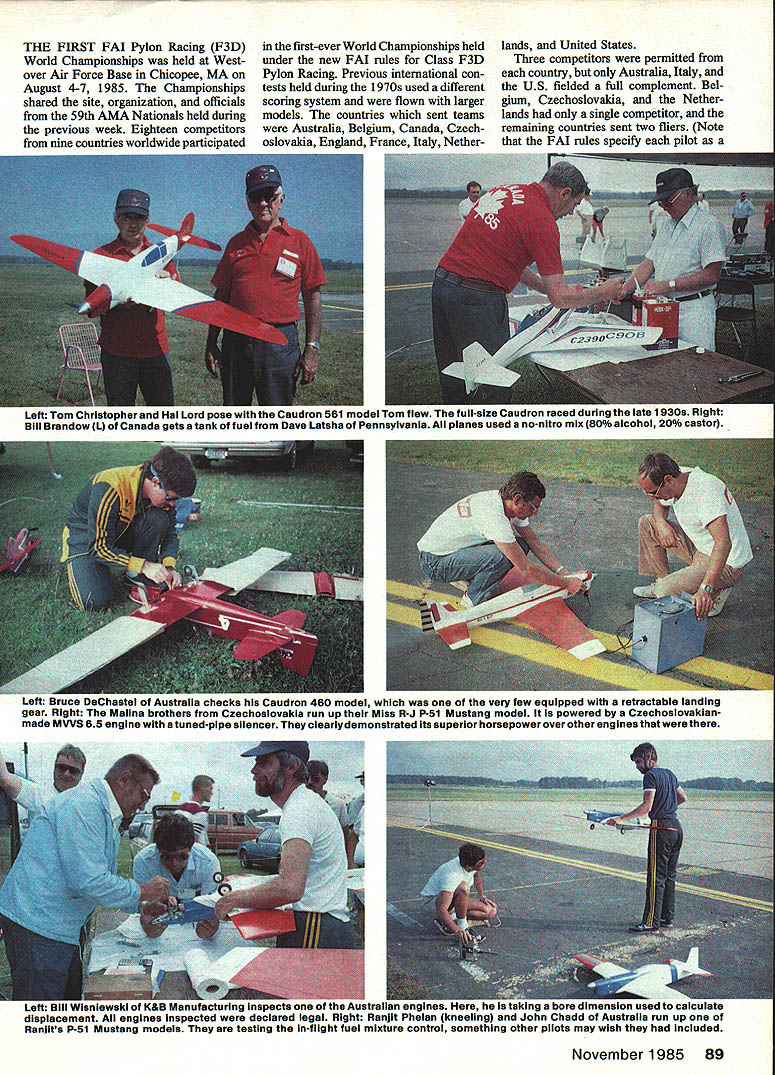
The first FAI Pylon Racing (F3D) World Championships was held at Westover Air Force Base in Chicopee, MA, on August 4–7, 1985, immediately following the 59th AMA Nationals. The event used the site, organization, and officials from the AMA Nationals. Eighteen competitors from nine countries participated under the new FAI rules for Class F3D Pylon Racing. Previous international contests in the 1970s used a different scoring system and larger models.
The participating countries were:
- Australia
- Belgium
- Canada
- Czechoslovakia
- England
- France
- Italy
- Netherlands
- United States
Czechoslovakia took the individual title (Milos Malina) and Australia won the team competition. With nine nations represented, the inaugural FAI World Championships got off to a great start.
Teams and Entries
- Each country was permitted up to three competitors and one team manager (the FAI rules specify each pilot as a team member and allow a team manager to represent the team at official meetings and protests).
- Australia, Italy, and the U.S. fielded full teams of three.
- Belgium, Czechoslovakia, and the Netherlands had only one competitor each.
- The remaining countries sent two fliers.
FAI competition was notably more formal and regulated compared with AMA contests because of these personnel and procedural requirements.
Registration and Model Processing
Registration and model processing were conducted at the Quality Inn headquarters. Thirty-four models were inspected for compliance with the rules according to the scheduled times. Only minor discrepancies regarding model weight were noted.
Opening Ceremonies
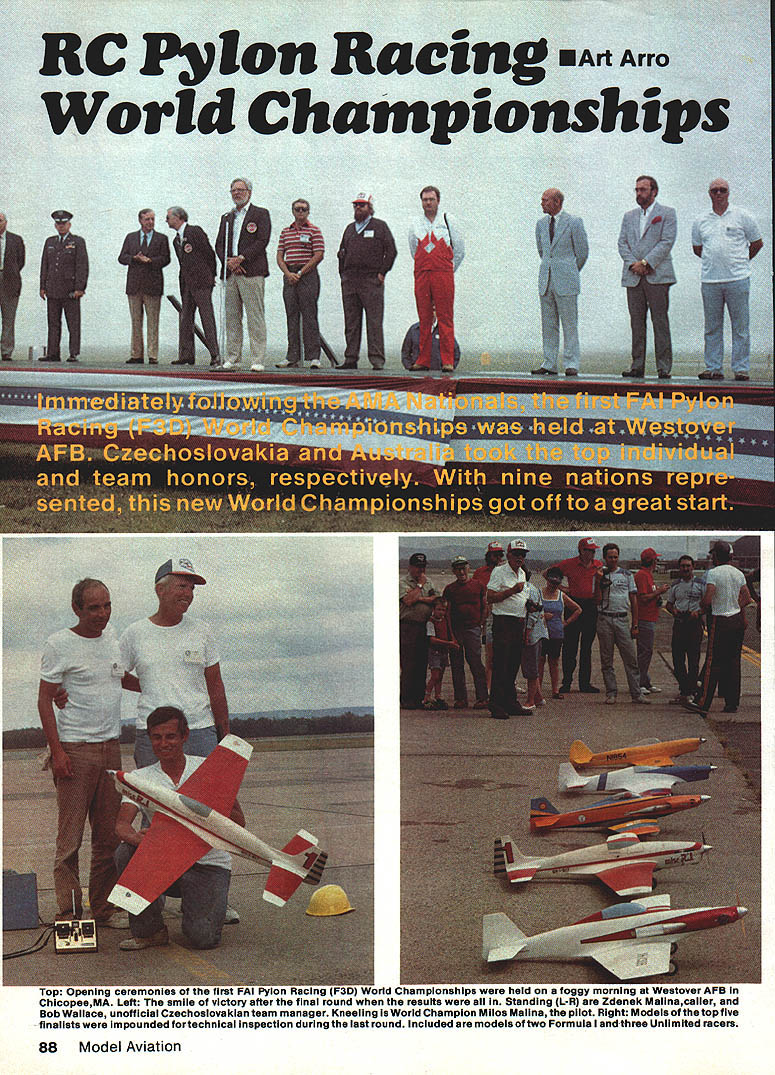
Opening ceremonies took place Monday morning at the Westover racing site. Heavy ground fog lent a solemn mood as participants were greeted by officials including:
- John Grigg, AMA president
- John Worth, AMA executive director
- Vince Mankowski, contest manager
- The base commander
- Members of the FAI jury
- Representatives from the Chicopee Chamber of Commerce
Geoff Styles, AMA public relations director, read a telegram from President Ronald Reagan wishing the competitors well. The ceremonies included raising of the flags and national anthems of participating countries. The fog later burned off and produced a clear, hot, humid day for practice flying.
Practice Flying
- Practice flights were flown solo to avoid midair collisions before official racing began.
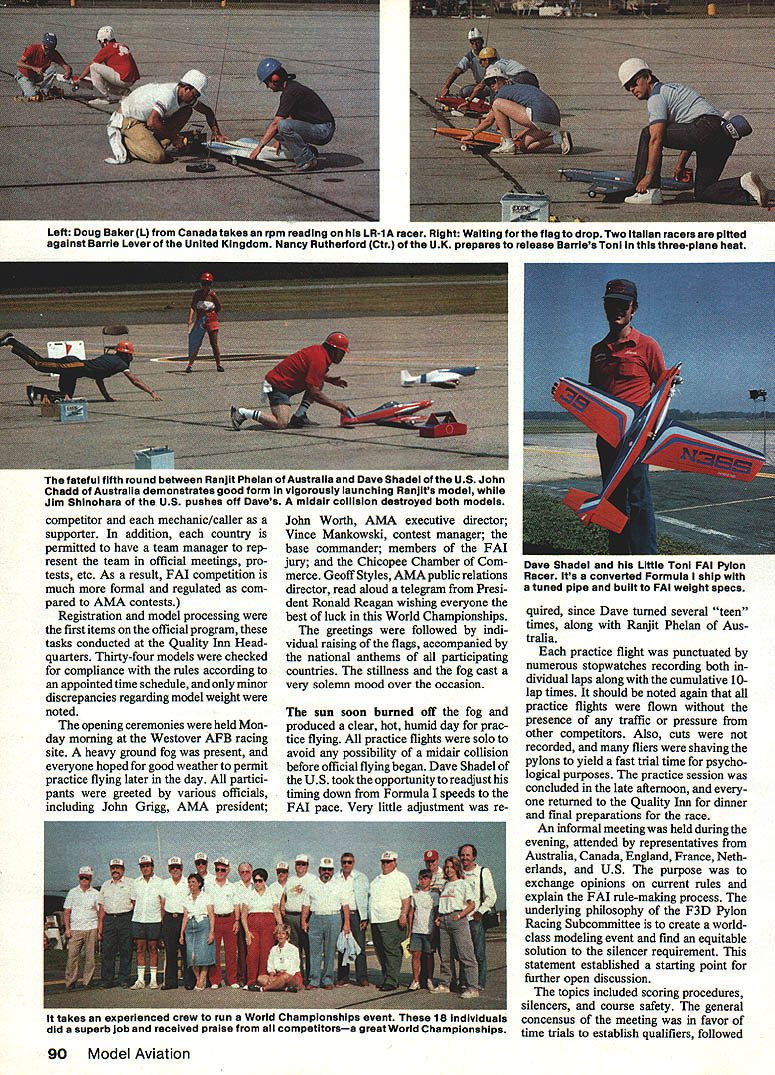
- Dave Shadel (U.S.) adjusted his timing from Formula 1 speeds to the FAI pace; his Little Toni FAI pylon racer required little change because it was a converted Formula 1 ship tuned to FAI weight specifications.
- Ranjit Phelan (Australia) had an outstanding practice session, with stopwatches recording individual laps and cumulative 10-lap times.
- Practice flights were used for psychological preparation: pilots often flew close to pylons and recorded fast trial times, though cuts were not officially recorded during practice.
The practice session concluded in the late afternoon. Competitors returned to the Quality Inn for dinner and final preparations. An informal evening meeting was attended by representatives from Australia, Canada, England, France, the Netherlands, and the U.S. The meeting discussed scoring procedures, silencers, course safety, and the FAI rule-making process. The F3D Pylon Racing Subcommittee emphasized creating a world-class event and finding an equitable solution to the silencer requirement.
Race Rounds — Highlights and Incidents
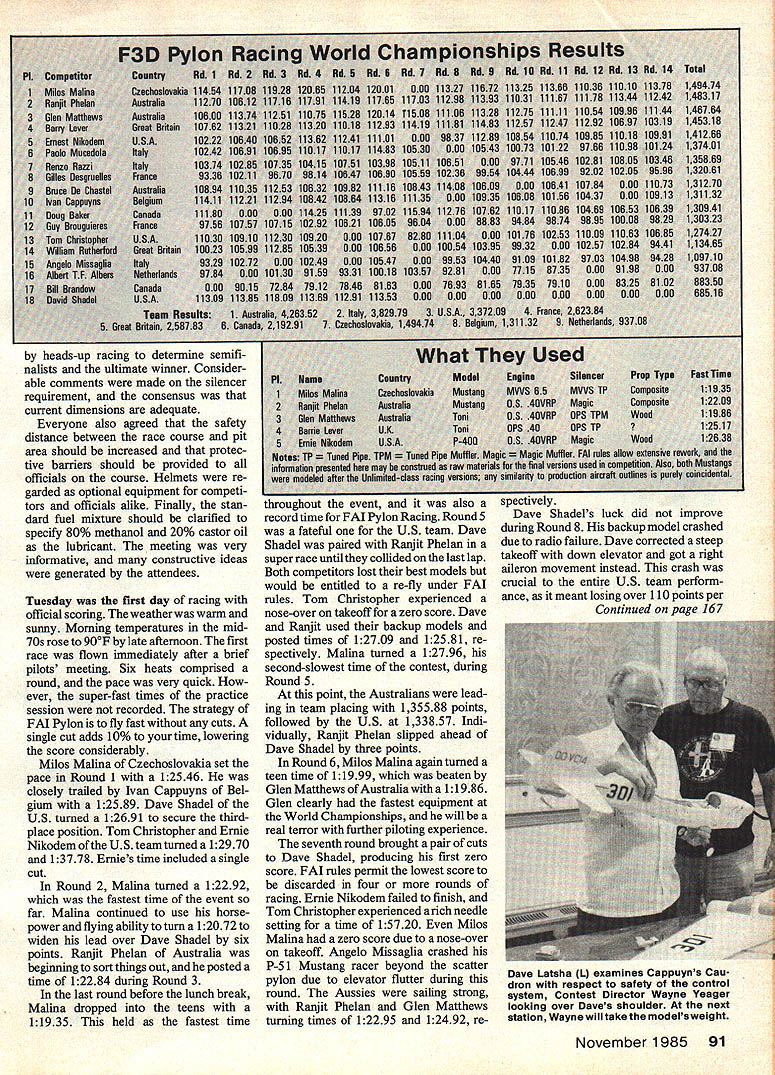
- Round 6: Milos Malina posted a 1:19.99, which was beaten by Glen Matthews (Australia) with a 1:19.86. Glen demonstrated the fastest equipment at the Championships.
- Round 7: Dave Shadel recorded cuts that produced his first zero score (FAI rules permit discarding the lowest score when four or more rounds are flown). Ernie Nikodem failed to finish. Tom Christopher experienced a nose-over on takeoff, scoring zero. Milos Malina also suffered a nose-over on takeoff and scored zero. Angelo Missaglia crashed his P-51 Mustang racer beyond the scatter pylon due to elevator flutter. Australia remained strong with Ranjit Phelan and Glen Matthews turning competitive times (1:22.95 and 1:24.92 respectively).
- Round 8: Dave Shadel’s backup model crashed due to radio failure after a corrective input led to an unintended aileron movement. The loss of both of Dave’s models was crucial to U.S. team scoring, costing significant points per round.
- End of Day 1: With Dave out of contention, the race tightened among Milos Malina, the Australian pilots, and Barrie Lever (England) holding a strong overall position.
Next day:
- Round 9: Tom Christopher failed to start due to a flat starter battery. Ernie Nikodem turned 1:27.11 — his second-fastest time of the contest — moving him up to 7th overall. Milos Malina expanded his lead over Ranjit Phelan, but he had already used his throwaway score and could not afford further setbacks.
- Rounds 10–12: Mostly uneventful; positions held steady down to 10th place.
- Round 13: Flown after lunch amid intermittent storm cells. Winds increased to 15–20 knots, quartering down the course. Bruce De Chastel (Australia) failed to keep his engine on the pipe and it died after takeoff. Ivan Cappuyns (Belgium) recorded a zero. Ernie Nikodem moved up to 5th overall.
- Round 14 (final round): The Malina brothers (Czechoslovakia) were scheduled in the last heat under intense pressure to protect their lead. Milos Malina cruised to a 1:26.22, securing his individual victory.
Results and Awards
- Individual champion: Milos Malina (Czechoslovakia)
- Team champion: Australia
After the final round the Australians celebrated with champagne; awards for individual and team placements were presented immediately, followed by additional recognition at the dinner banquet at the Quality Inn.
Organization and Acknowledgments
The Championships were widely praised for superb organization, competition, and favorable weather. Key organizers and officials included:
- Wayne Yeager and his crew — overall administration and execution
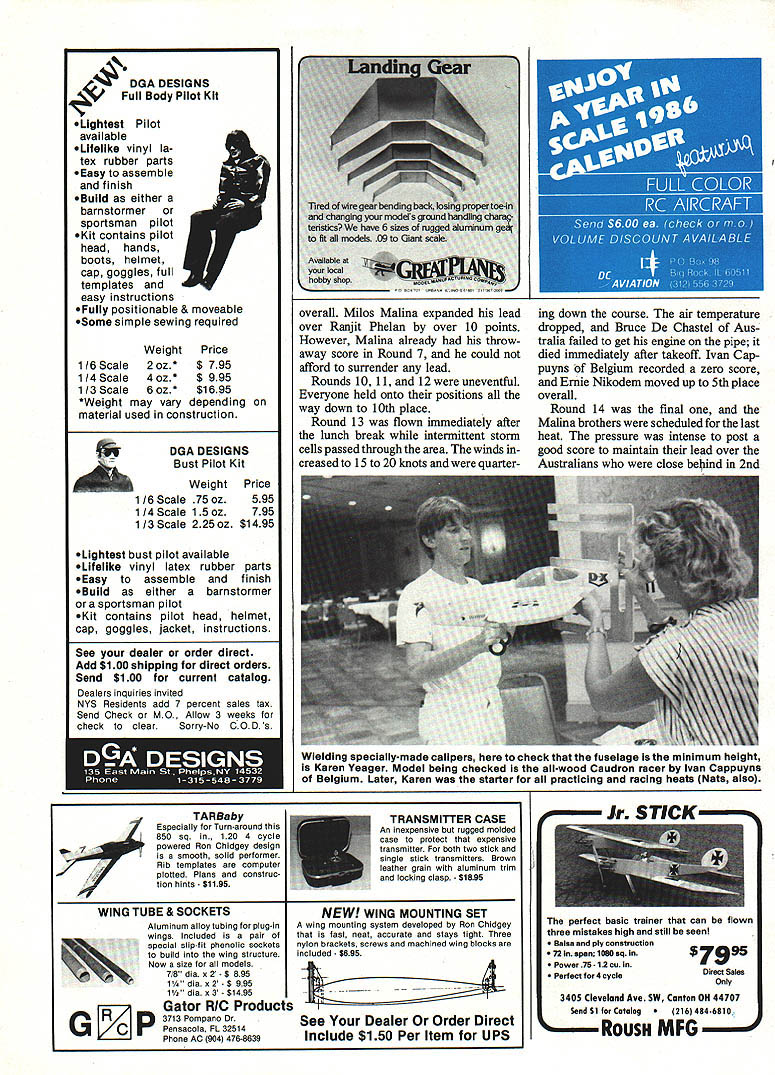
- Karen Yeager — official starter for all heat races, including practice
- Loren Holm, Paul Page, and assistants — computer processing of scores
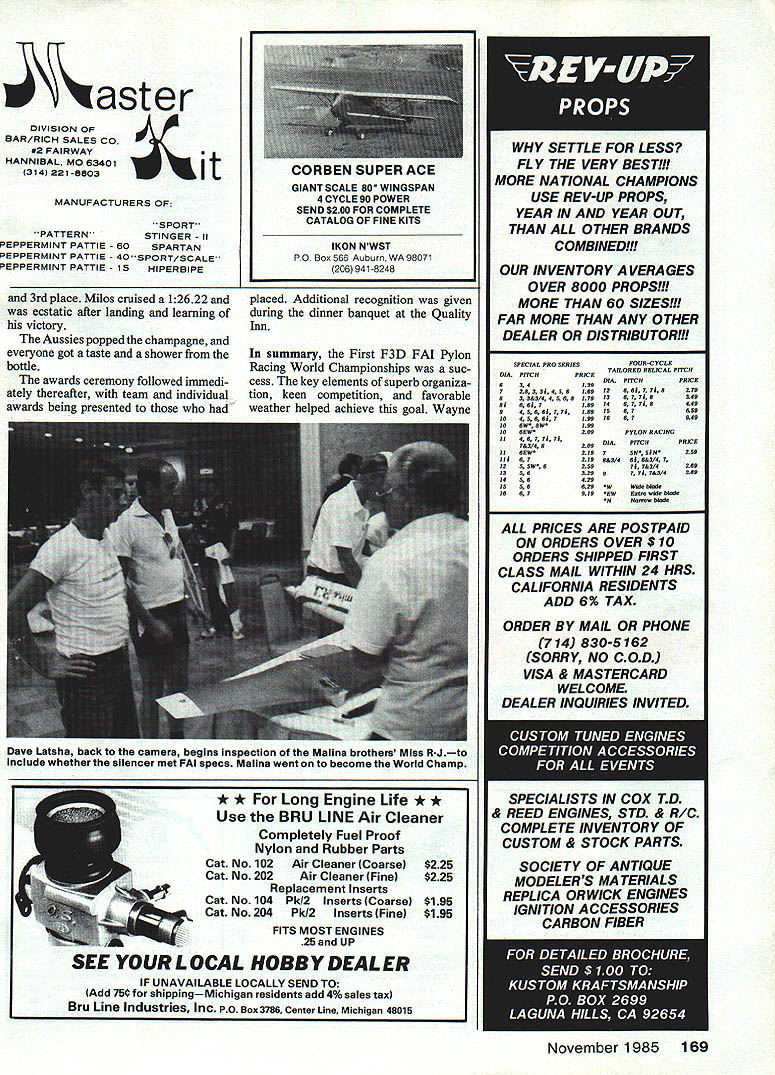
- Vince Mankowski — contest manager overseeing many tasks
- Gary Hoyer — U.S. team manager, provided team support and flight analysis
The use of computer processing to provide near real-time hard-copy score printouts was especially commended.
Summary and Outlook
The inaugural F3D FAI Pylon Racing World Championships was a success. The caliber of competition was high, especially from the Australian and Czechoslovakian entries. The Malina brothers captured gold for Czechoslovakia and had also finished at the top in the AMA Nationals the previous week; Milos recorded the fastest times in both events.
The Australian team’s preparation and team spirit earned them the team title. The U.S. team showed resilience despite setbacks, particularly the loss of both of Dave Shadel’s models; notable performances included Ernie Nikodem’s determined 5th place and promising runs by Tom Christopher and others.
This World Championships stimulated increased interest and experience in FAI-style pylon racing, and organizers and competitors looked forward to even stronger competition at future World Championships.
Transcribed from original scans by AI. Minor OCR errors may remain.

