
RC Pylon World Champs
WORLD CHAMPION — nice title. Champions of the world — whoa, that sounds nice, too. We're not talking North America, or Texas, or SEMPRA. We're talking the entire globe.
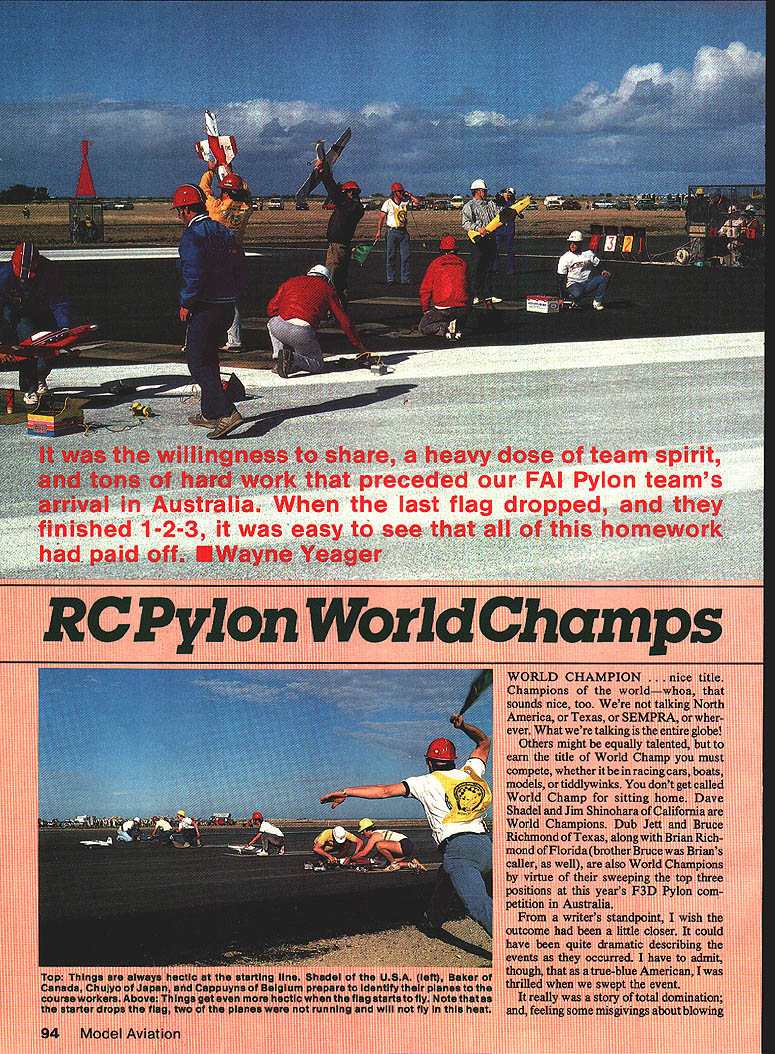
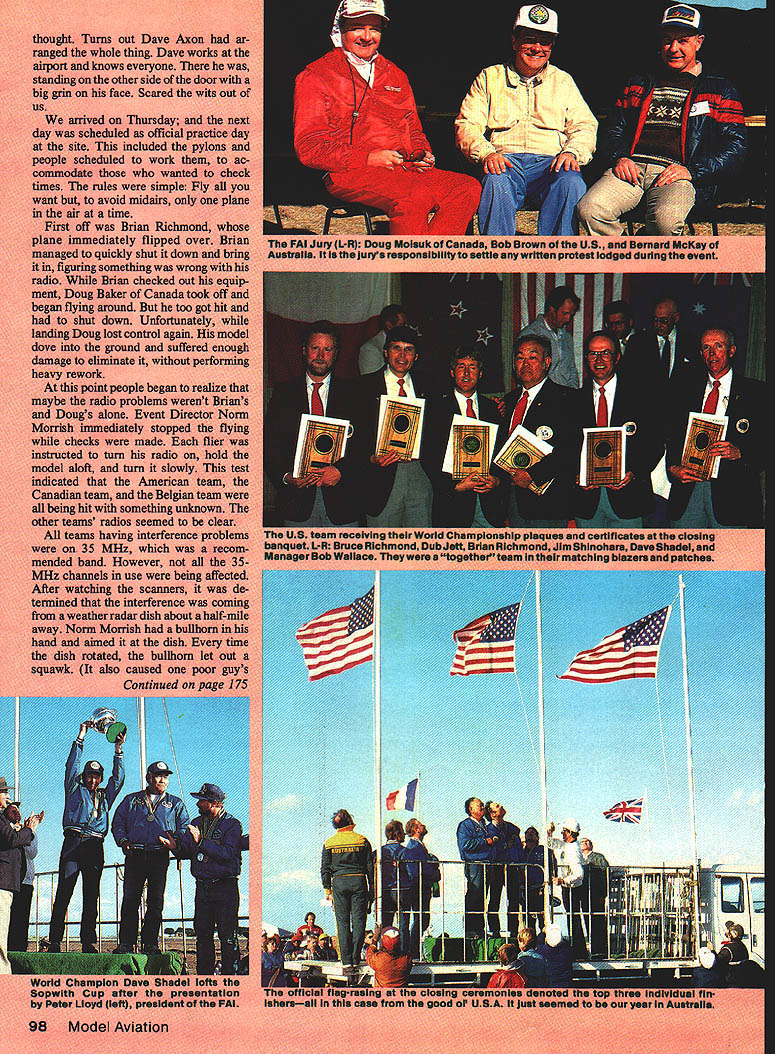
Others might be equally talented, but to earn the title of World Champ you must compete, whether it be in racing cars, boats, models, or tiddlywinks. You don't get called World Champ for sitting home. The U.S. team dominated this year's F3D Pylon competition in Australia. Dave Shadel emerged as World Champion, and the U.S. team swept the event to claim the team title. Team members and supporters included Dub Jett, Brian Richmond (with his brother Bruce as caller), Jim Shinohara, and Manager Bob Wallace.
Team highlights
- Individual World Champion: Dave Shadel
- Top U.S. pilots: Dave Shadel, Brian Richmond, Dub Jett
- U.S. Team Manager: Bob Wallace
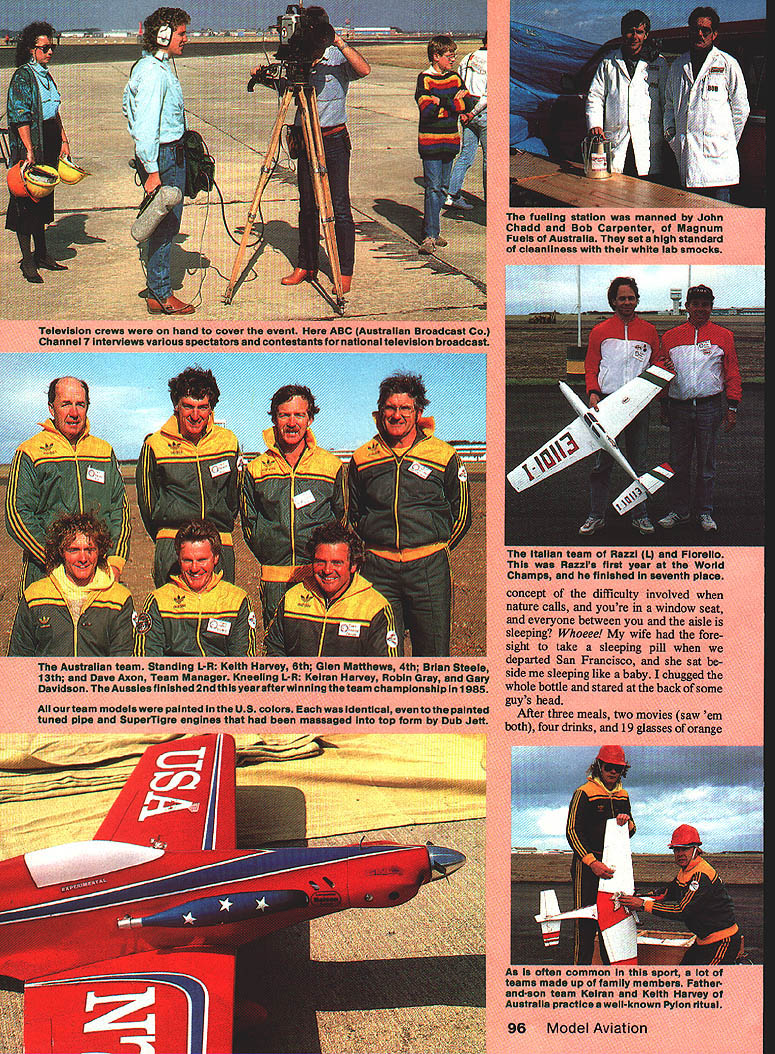
- Event Director / Contest Director (CD): Norm Morrish
Travel to Australia
"It was a dark and stormy night…" when it was announced the World Championship race would be held in Australia. My wife and I immediately made plans to attend. We'd become very close to the Australians during the 1985 Championships, so visiting Australia was a must. Our trip turned out to be everything we expected—except, that is, for getting there.
Oh, the aggravation and the agony of that journey! Since "Oz-stralia" is half a world away, traveling there exposes you to the airline systems of several different countries—and, to put it mildly, all of them can be faulted, ours included. No one is safe from the phrase "We are experiencing technical difficulties." I think you could be floating in a life raft in the middle of the Pacific and they'd slap that cop-out on the situation.
We left Detroit on time, but everything began to come apart in Chicago. We spent two hours sitting on the ground in a hot airplane, which ate up two-thirds of our planned layover and a quick visit in San Francisco. Then the Frisco-to-Sydney flight that was scheduled for 9 p.m. was delayed until 1 a.m., which at least gave us time to bus into town, ride the cable cars, and do a short tour of Fisherman's Wharf. By 1 a.m. we were boarding again.
Try to sleep in a narrow airplane chair that tilts back about 5° and is only wide enough for a small dog. My wife had the foresight to take a sleeping pill and slept like a baby beside me. I chugged along and stared at the back of some guy's head. After three meals, two movies, four drinks, and far too much orange juice, we finally arrived in Los Angeles and pressed on to Australia.
Practice day — interference and radio problems
We arrived on Thursday; Friday was the official practice day at the site. Rules allowed as many practice flights as desired but only one plane in the air at a time to avoid midairs. The first off the line was Brian Richmond, whose plane immediately flipped over. Brian quickly shut it down and brought it in, assuming a radio issue. Doug Baker of Canada took off next and also experienced interference. While landing he lost control and crashed.
Event Director Norm Morrish immediately stopped flying and instructed each flyer to turn his radio on and hold the model aloft, turning it on slowly. This test showed that the American, Canadian, and Belgian teams were all being affected by something unknown. All affected teams were on 35 MHz, but not all 35-MHz channels were hit. Scanners traced the interference to a weather radar dish about a half-mile away. Every time the dish rotated it produced a squawk heard through Morrish's bullhorn and even caused one fellow's hearing aid to go wild.
Norm Morrish contacted the weather station; they agreed to turn the radar off and leave it off if possible. However, a weather front was due, and they warned the dish would have to go back on when the front approached. The CD could only cross his fingers and hope the front would hold off long enough to finish the meet.
The U.S. team had come prepared and changed frequencies Saturday night; the Canadians also changed and cleared channels. Cappuyns of Belgium was initially stuck because his radio couldn't change frequencies, but the Aussies arranged for him to borrow a set. (The Australians flew Mode 2; Cappuyns was Mode 1.) Eventually everything was resolved and practice continued with no further problems.
Race day — opening ceremonies
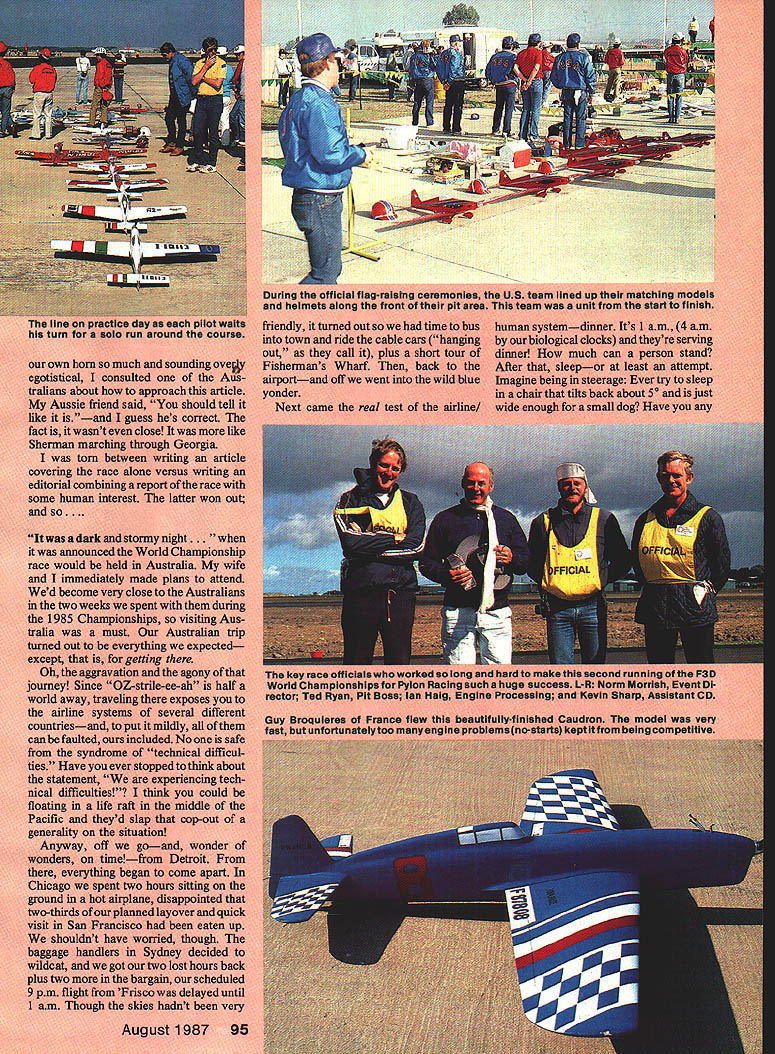
Race day dawned: sun shining, birds singing, grass green. The opening ceremonies were conducted with pomp and circumstance—national anthems, flag raising, welcome speeches, and several dignitaries. The Japanese team impressed everyone by singing their national anthem. The American team impressed visually as well: models lined neatly across the front of their pit, matching helmets alongside, jackets and shirts coordinated, each plane painted red with blue trim and a small Australian flag attached. It was a very professional presentation.
Round summaries — early rounds and relocations
Because several pilots still needed a last trim flight after the opening ceremonies, CD Morrish delayed the start. Around 12:30 p.m. the wind shifted direction, requiring a course reversal. Some pilots who had changed radio frequencies were still experiencing interference because the radar dish had been turned back on.
After learning the dish had to remain on for weather reasons, Morrish and the jury decided to move the competition to another RAAF base about 10 miles away. Everyone packed up and moved in a kind of wagon-train convoy; despite planes sticking out of trunks, the relocation took only about 1.5 hours. By 3 p.m. they were ready to race—portable facilities were still being brought in, but pilots were eager to begin.
Early heats were rough for some teams. In the first round Broquières (France) and Baker (Canada) failed to start and scored zeros. Other heats saw engines flame out and pilots coast in dead-stick. Heat three included Dub Jett; all started, but Dub had no official time and had to refl y. Heat four saw Brian Richmond post a solid 1:20. Heat five included Dave Shadel, who turned a 1:22. After the first round the Americans were positioned first, second, and third.
By the end of three rounds it was 5:30 p.m., the sun was low, and only three rounds had been completed. The U.S. team led by 96.6 points. Brian Richmond led Dub Jett narrowly, with Shadel close behind. Glen Matthews of Australia sat in fourth.
Sunday — flameouts, lead builds, and the Southerly Buster
Flying resumed early Sunday morning with plans to complete 14 rounds. Dub Jett flamed out in his first heat with a blown plug and picked up a zero. He flamed out again in Round 5 but managed to coast across the line, salvaging a marginal time. He fixed his problem after that and had no more flameouts.
The U.S. team steadily increased its lead over Australia. After Round 1 the Americans held a 30-point lead; after Round 2 the lead increased to 63 points. The Americans were averaging about 359 points per round versus the Australians' 328.
The scoring system: each second is a point subtracted from 200. For example, a 1:20 (80 seconds) becomes 200 − 80 = 120 points.
After eight rounds the three U.S. pilots were separated by only 13.2 seconds collectively. Then a cold front arrived. The wind shifted, temperature dropped about 30 degrees, and the "Southerly Buster" blew in—sustained, cold winds that made everyone lean at a 45° angle. Rain came on and off. Racing was called off for the day; the forecast was better for the next day. The competitors returned to the motel for an impromptu get-together—people from all nine countries sat around sharing jokes and stories. That made for a good party.
Final day — winds, drama, and the finish
Day three dawned sunny, windy, and cold. Plans were to start by 9 a.m., but the wind direction required another course change. The Aussies had recovered from their earlier setbacks and were closing the gap, but the Americans still held the lead.
Round 11 saw close competition. Dub Jett posted a 1:21.6 for 118.4 points; Shadel hit 1:18.6 for 121.4 points; Brian Richmond suffered a 10% penalty for clipping the Number 1 pylon and fell behind by about 2.5 seconds. After Round 11, Shadel led Richmond 1,196.8 to 1,194.3; Jett was at 1,192.2.
Round 12 brought the decisive moments. Dub Jett turned a relatively slow 1:24.1. Then Brian Richmond delivered an incredible flight: a flawless, aggressive run that set the fast time of the meet with a 1:15.6 (124.4 points). Finally, Dave Shadel flew the last heat of the meet needing about a 1:18.1 to tie; he produced a 1:17.3—eight-tenths of a second better than Brian—and clinched the individual World Championship.
It was a tight finish. Dub Jett could not afford another zero but still finished only 11.3 seconds behind Shadel—an average of about a second a round, since only 11 of the 12 rounds flown counted. In the end, Dave Shadel took individual gold, and the U.S. team won the team title by a whopping 442.8 points over Australia.
Awards, banquet, and camaraderie
The flag-raising and medal ceremonies were warm and friendly. Peter Lloyd, president of FAI, handed out plaques and certificates to winning individuals and teams. Australia finished second as a team, New Zealand third. Dave Shadel was presented the starting flag; Brian Richmond received the Number 1 pylon flag for fast time. The New Zealanders presented U.S. Team Manager Bob Wallace with a Kiwi doll mascot; the American team autographed and presented one of their glossy helmets to Norm Morrish.
The awards banquet was convivial. The whole affair was one of friendship. The Japanese team, down in numbers, received a goodwill gesture when Shinohara sent champagne to their table. In the room full of happy, friendly people, it was clear that the practice, the racing, the tortures of travel and weather were, in the end, secondary to the camaraderie shared by all.
Reflections
On the way home my wife asked if we'd ever go back. "Go back?" I asked myself. Go to a land where the clocks are 14 hours different, where sometimes you can't get breakfast at a familiar chain, where steering wheels are on the right, and the Southern Cross hangs high in the sky? Go back to a place where the people treat you like royalty and the hospitality is impeccable? Go back to Tangalooma? To Oz? YOU BETCHA!
Transcribed from original scans by AI. Minor OCR errors may remain.

