
RC Scale
Bob Benjamin
Introduction
My eye is that of an artist, and I saw the RC Scale event at the 1989 Tri-Cities Nats. Though many of you may be aware of my contributions to model aviation as a cover artist for Model Aviation, I also have a longstanding affection for scale models. That interest led to an invitation from Nats Scale manager John Guenther to help run the RC Scale events.
I arrived at Nats HQ (Shiloh Riverside Motor Inn, Richland, WA) on Thursday, checked in, picked up press passes, and confirmed schedules. What should have taken about 20 minutes turned into several hours as I ran into modeling friends and explored the area—especially the runway at Kennewick's Vista Field, which was closed to full-scale traffic for the Nats.
Site and weather
- Elevation: about 500 ft.
- Midday temperatures: 80s–90s.
- Density altitude: high enough to demand attention but not a major problem.
- Wind: initially a strong crosswind for some pattern events on Thursday; settled to a moderate annoyance (~10 mph) for the weekend, generally on runway heading with occasional thermal gusts.
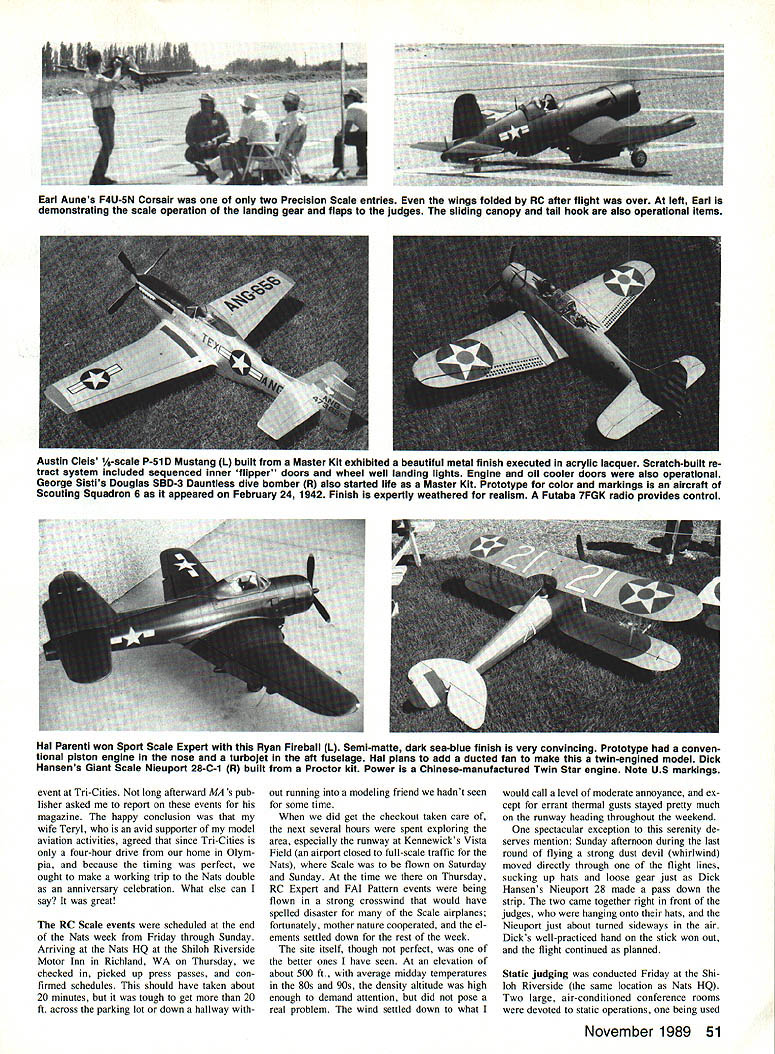
A spectacular exception occurred Sunday afternoon: a strong dust devil moved through the flight lines, sucking up hats and loose gear. As Dick Hansen's Nieuport 28 made a pass, a gust nearly turned it sideways, but Dick recovered and continued.
Static judging and display
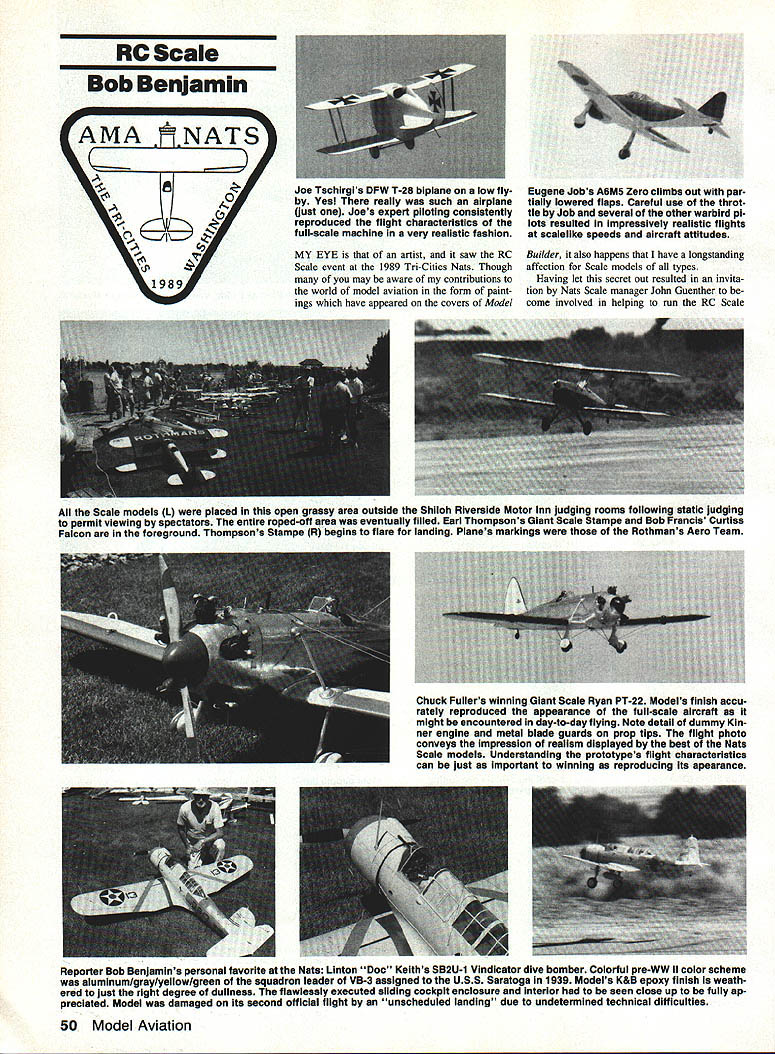
Static judging was conducted Friday at the Shiloh Riverside (Nats HQ). Two large air-conditioned conference rooms were used—one for model assembly, registration, and weigh-in; the other reserved for judging. Nonessential personnel were kept out during judging; afterward, all models were displayed for several hours in an open grassy area outside the hotel for general viewing. This arrangement protected the models, freed the judging crew to work, and provided a relaxed viewing opportunity for spectators.
My wife Teryl and I assisted with model weigh-in and documentation checks, giving us a close look at each of the 44 models entered.
Entries and classes
Entry totals by class:
- Sport Scale Senior — 1
- Sport Scale Expert — 13
- Precision Scale — 2
- Giant Scale — 20
- FAI Scale — 0
- FAI Large Scale — 1
Notes:
- Total entries: 44 models.
- No multiengine aircraft or ducted fans were present, with one short exception: Hal Parenti's Ryan Fireball, normally a prop-and-ducted-fan twin, was entered with the ducted-fan removed and won Sport Scale Expert.
- Electric power was represented by Bernard Cawley's 1/6-scale 1946 Taylorcraft—likely the first Electric seen in Nats Scale in many years.
Flight operations
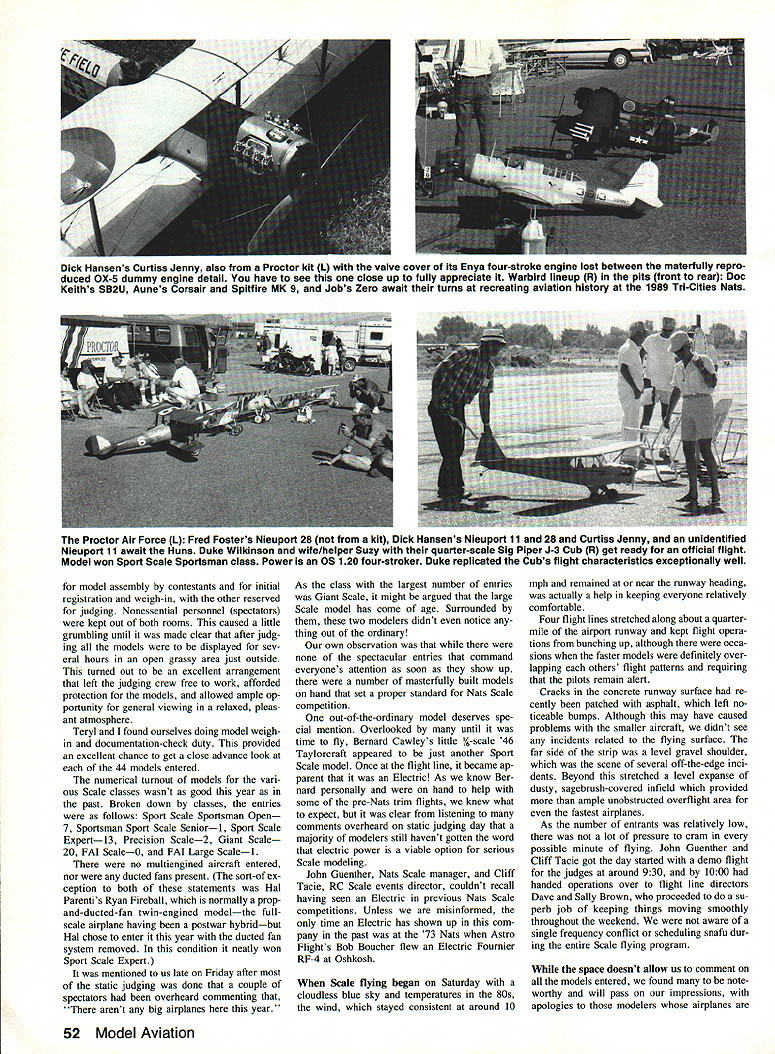
Scale flying began Saturday under cloudless skies and temperatures in the 80s. Four flight lines stretched along about a quarter-mile of the runway to keep operations from bunching up. Faster models occasionally overlapped patterns, so pilots had to remain alert.
Concrete cracks had been patched with asphalt, leaving noticeable bumps; however, no incidents related to the runway surface were observed. The flight-line arrangement and ample staging area made operations run smoothly.
Notable models and impressions
- Linton "Doc" Keith — SB2U-1 Vindicator (scratch-built). Powered by a SuperTigre .300, finished in a period color scheme. The model used a custom 90°-rotating retract system (rebuilt for the Nats). It placed third in static judging and flew well in the first round but struck the runway at a shallow angle in the second round and was finished for competition that day.
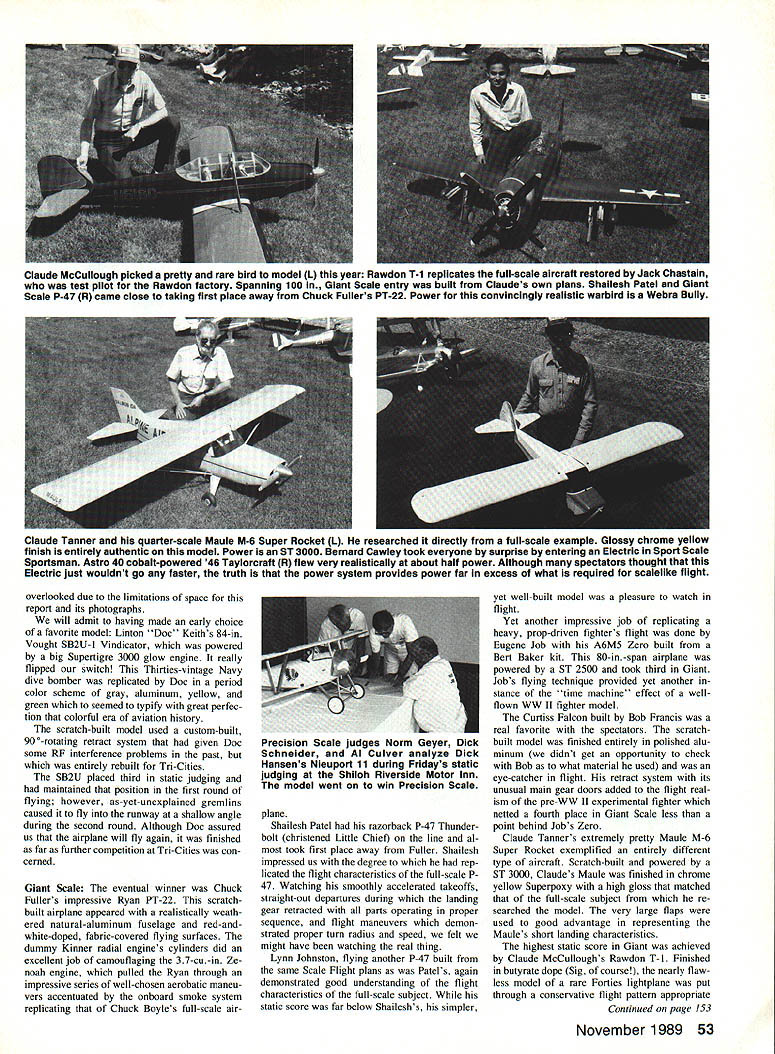
- Chuck Fuller — Ryan PT-22 (scratch-built). Winner in Giant Scale. Realistically weathered natural-aluminum fuselage with red-and-white fabric flying surfaces, a dummy Kinner radial, Zenoah 3.70-cu.-in. power, onboard smoke system, and convincing finish and workmanship.
- Shailesh Patel — P-47 Thunderbolt "Little Chief." Razorback P-47 that closely replicated prototype flight characteristics: smooth takeoffs, straight departures, powerful climbs, proper turn radius and speeds.
- Joe Tschirgi — DFW T-28 biplane. Noted for low, realistic flying and excellent muffled sound from the chosen powerplant.
- Earl Thompson — Giant Scale Stampe. Notable low approaches and accurate markings.
- Bob Francis — Curtiss Falcon. Notable entry in Giant Scale.
- George Sisti — Douglas SBD-3 (Master Scale kit, ST .61). Well researched and weathered to represent a worn service aircraft.
- Bruce Cooper — Laser 200 in 1/3-scale (Saito 300 Twin). Highly aerobatic routine; used clear MonoKote painted with K&B Superpoxy as a cover/finish system.
- Austin Cleis — P-51D (metal finish). Tied for second in static in Expert; crashed in second flight due to what appeared to be a wingtip stall during a low-altitude roll. Austin planned repairs and expected to be back in competition.
- Bernard Cawley — 1946 Taylorcraft (1/6-scale, electric). Geared Astro 40 cobalt motor on 18 SC-type 1,200-mAh cells. Flew a conservative schedule; a fine example of an electric-powered scale entry and of how to approach Scale competition correctly.
Judges and judging focus
Precision Scale static judges included Norm Geyer, Dick Schneider, and Al Culver. Judges looked for meticulous craftsmanship, appropriate weathering, accurate cockpit and interior detail, operational scale features (sliding canopies, tail hooks, flaps, retracts), and high-quality finishes (epoxy finishes, careful painting, subtle dulling where appropriate).
Results and awards (highlights)
Giant Scale
- Winner: Chuck Fuller — Ryan PT-22.
- Notable contenders: Shailesh Patel — P-47 "Little Chief" (very scale-like flying), Earl Thompson — Stampe, Bob Francis — Curtiss Falcon.
Sport Scale Expert
- Winner: Hal Parenti — Ryan Fireball (entered without the ducted fan).
- Second: Wayne Sievert — Porsche-engined Mooney M20K (highest static score in Expert; aborted takeoff in fourth round but completed flight).
- Third: Joe Tschirgi — DFW T-28.
Precision Scale
- First: Dick Hansen — Nieuport 11 (Proctor kit, OS 70 four-stroke). Dick dedicated his win to Lou Proctor when accepting the award.
- Second: Earl Aune — F4U-5N Corsair (flat-black finish). Built from Bob Hobelmann plans; 76 in. span, 18.5 lb, OS 1.20 with 1.40 Surpass four-stroke. Noted for spectacular flying.
Sport Scale Senior / Sportsman
- Only Senior entrant: Derek Walkington — Curtiss Jenny (eight-foot span, OS .90 four-stroke). Credible reproduction of low-speed flight characteristics.
- Sportsman second place: Bernard Cawley — 1946 Taylorcraft (electric).
FAI Large Scale
- Lone FAI-class entry: Claude McCullough — Waco AVN-8. Well built, fabric-and-dope finish, conservative realistic flight demonstration.
Other notes:
- Hal Parenti's approach of removing the ducted fan still produced a winning static score and consistent flying.
- Several kit-based entries (e.g., Chuck Fuller's PT-17 from a Sterling kit, George Sisti's Master Scale SBD-3) demonstrated what can be achieved with careful research and finish work.
Observations and conclusion
While the numerical turnout for some Scale classes was lower than in past years, the quality of many entries was high. There were fewer spectacular show-stoppers, but several masterfully built models set a proper standard for Nats Scale competition.
The Tri-Cities site proved an excellent venue: manageable elevation and temperatures, generally cooperative winds, thoughtfully arranged flight lines, and good static display arrangements. Between the competent judging, the skillful flying on display, and the variety of well-finished models, the RC Scale events at the 1989 Tri-Cities Nats provided a fine showcase for scale modelers and an enjoyable event for participants and spectators alike.
Transcribed from original scans by AI. Minor OCR errors may remain.

