

RC Scale
Larry Kruse
MIDWESTERN friendliness is no myth. To those of us who attended the 1990 Nats, "Back Home Again in Indiana" has become more than the familiar lyrics of a state song or a catchphrase stamped on a license plate. It sums up the atmosphere created by the great people of the Lawrenceville, IL / Vincennes, IN area who were kind enough to host the 1990 National Model Airplane Championships at the Mid‑American Air Center near Lawrenceville.
Using the familiar words of Indiana's state song as a lead is in no way intended to minimize the hospitality of their good Illinois neighbors from across the Wabash, who also went out of their way to welcome AMA competitors and offer the most congenial atmosphere possible. Because I have covered almost every Nats since 1974 for the modeling press, I can say with some sense of perspective that nowhere have the members of the host communities been more conscious of AMA's presence or done more to make the modelers, who came from all over the world, feel at home.
As Nats week progressed, community and area‑wide interest heightened. Everyone looked forward to the bigger throngs of spectators for that queen of Nats events, RC Scale, which was set for Saturday and Sunday, the last two days. As luck and the weatherman would have it, while Saturday's weather was moderate to excellent for flying and spectating purposes, Sunday had a bad case of the cruds brought forth by a weather front which floated wave after sporadic wave of showers over the flying field. Needless to say, spectator interest in model aviation was weighed against staying dry, with most opting for the latter.
Weather notwithstanding, 62 aircraft were entered in the five fixed‑wing power categories specified by AMA and FAI rules. The always‑popular Sport Scale class attracted the largest number with a total of 22 entries in Sportsman and Expert. Giant Scale reveled in its continually growing popularity, fielding 21 behemoths. Fun Scale drew 14 models for its entry‑level competition. The other five entries were split, with two in AMA Precision Scale and three in FAI, which is judged and flown under international rules.
As a matter of practicality, a close examination of the models entered in the various events would tend to blur many of the distinctions between categories. Significant numbers of the models entered in Sport Scale, for example, could just as easily have competed in Precision Scale. Likewise, several of the Fun Scale entries could have flown in Sport Scale, should their pilots have opted to do so. The finish, workmanship, and extensive detail of several of these models would have served them well in the more rigorous judging categories. An example: Steve Cummings' rather smallish cream‑and‑maroon‑trimmed Culver had flight problems but attracted enough interest and attention during static judging in Fun Scale for future consideration as a Sport Scale subject. This Nats showed the full range of options available in RC Scale competition even for a modeler of limited experience.
Fun Scale
Fun Scale is the entry‑level RC Scale event, placing emphasis upon flying skills rather than scale‑building proficiency. The rules specify that static judging is a "go/no‑go" proposition; i.e., the model receives five static judging points if the contestant can "show proof that a full‑size aircraft exists" using colored illustrations, imprinted T‑shirts, or a shirt neatly folded next to the airplane pictured. In Fun Scale there's no question flying is the name of the game. So much so that the event was won by a Junior entrant, Jerad Cheney, who certainly can wring a convincing pattern out of his fully acrobatic Extra 230. Andrew Terrell, an up‑and‑coming Senior, garnered fourth place with his Laser 200, another fully aerobatic ship.
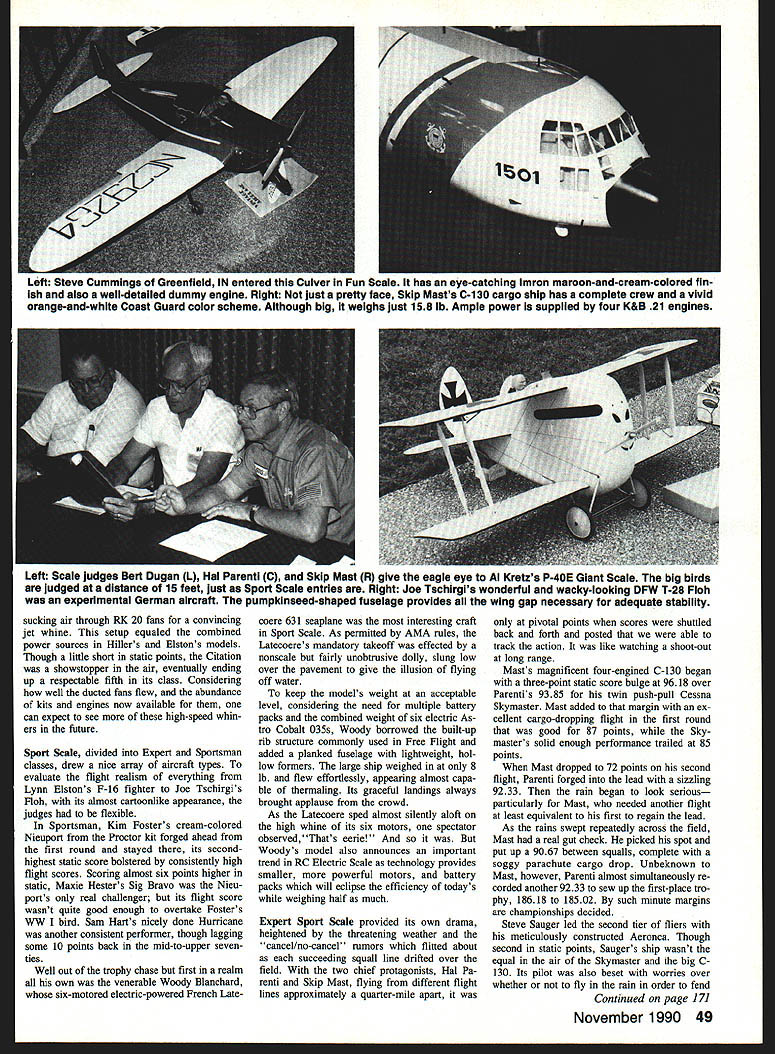
The nerves‑of‑steel award went to Bill Hiller, who placed second in his class. On its first time up, his ducted‑fan F‑16 had an engine flameout, leaving him with an ineffectual 12‑point flight score. Going from one extreme of misfortune to the other, on a subsequent flight Bill's F‑16 had the throttle stuck wide open as he was making his landing approach. Calmly explaining his predicament to the judges, he towed the bird very realistically about the sky until the engine was finally starved of fuel. Gauging his glide and sink perfectly, Bill brought the partially painted bird to an exquisite main‑gear‑to‑nosewheel landing squarely at the feet of the judges. Needless to say, he was roundly applauded.
Somewhat surprisingly, by my count only three ducted‑fan airplanes were entered in RC Scale events. In addition to Hiller's F‑16, Expert Scale flier Lynn Elston entered a sister F‑16, apparently also from the Byron kit, that was decked out in the desert camouflage markings of the Israeli Air Force.
In Sportsman Sport Scale, Jerry Skreckoski's twin‑jet Cessna Citation had two piped K&B 3.5s sucking air through RK‑20 fans for a convincing jet whine. This setup equaled the combined power sources in Hiller's and Elston's models. Though a little short in static points, the Citation was a showstopper in the air, eventually ending up a respectable fifth in its class. Considering how well the ducted fans flew, and the abundance of kits and engines now available for them, one can expect to see more of these high‑speed whinnies in the future.
Sport Scale
Sport Scale, divided into Expert and Sportsman classes, drew a nice array of aircraft types. To evaluate the flight realism of everything from Lynn Elston's F‑16 fighter to Joe Tschirgi's Fokker, with its almost cartoonlike appearance, the judges had to be flexible.
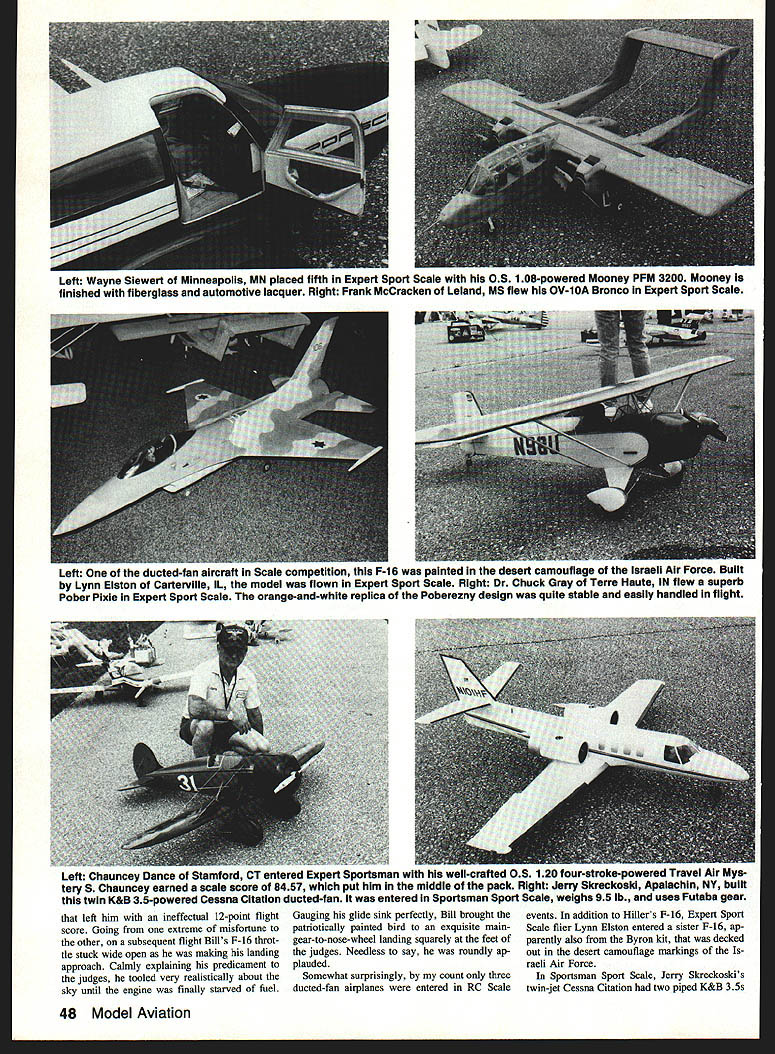
In Sportsman, Kim Foster's cream‑colored Nieuport from the Proctor kit forged ahead from the first round and stayed there, its second‑highest static score bolstered by consistently high flight scores. Scoring almost six points higher in static, Maxie Hester's Sig Bravo was the Nieuport's only real challenger; but its flight score wasn't quite good enough to overtake Foster's WW I bird. Sam Hart's nicely done Hurricane was another consistent performer, though lagging some 10 points back in the mid‑to‑upper sevens.
Well out of the trophy chase but first in a realm all his own was the venerable Woody Blanchard, whose six‑motored electric‑powered French Latecoere 631 seaplane was the most interesting craft in Sport Scale. As permitted by AMA rules, the Latecoere's mandatory takeoff was effected by a small boat that pulled the aircraft over the water, slinging low over the pavement to give the illusion of flying off water.
To keep the model's weight at an acceptable level—considering the need for multiple battery packs and the combined weight of six electric Cobalt 035s—Woody borrowed the built‑up rib structure commonly used in Free Flight and added a planked fuselage with lightweight, hollow formers. The large ship weighed in at only 8 lb., and flew effortlessly, appearing almost capable of aerobatics. Its graceful landings always brought applause from the crowd.
As the Latecoere sped almost silently aloft on the high whine of its six motors, one spectator observed, "That's eerie!" And so it was. But Woody's model also announces an important trend in RC Electric Scale as technology provides smaller, more powerful motors and battery packs which will eclipse the efficiency of today's batteries while weighing half as much.
Expert Sport Scale
Expert Sport Scale provided its own drama, heightened by the threatening weather and the so‑called "no‑score" rumors which drifted about the field. With the two chief protagonists, Hal Parent and Skip Mast, flying from different flight lines approximately a quarter‑mile apart, it was only at pivotal points when scores were shuffled back and forth and posted that we were able to track the action. It was like watching a shoot‑out at long range.
Mast's magnificent four‑engined C‑130 began with a three‑point static score of 96.18 over Parent's 93.85 for his twin push‑pull Cessna Skymaster. Mast added to that margin with an excellent cargo‑dropping flight in the first round that scored a solid 97 for 87 points, while the Skymaster's solid enough performance trailed at 85 points.
When Mast dropped to 72 points on his second night, Parent forged into the lead with a sizzling 92.33. Then the rain began to look serious—particularly for Mast, who needed another flight at least equivalent to his first to regain the lead. As the rains swept repeatedly across the field, Mast had a real gut check. He picked his spot and put up a 90.67 between squalls, quite an upset to say the least. However, Parent's 93.23 took the first‑place trophy, 186.18 to 185.02. By such minute margins are championships decided.
Steve Sauger led the second tier of fliers with his meticulously constructed Aeronca. Though second in static points, Sauger's ship wasn't a clear third in the air behind the Skymaster and the big C‑130. Its pilot was able to judge whether or not to fly in the rain in order to fend off the challenge of Bill McCallie's fine‑flying FW‑190. Ironically, Sauger's final flight was aborted, the victim of a wet engine, while McCallie couldn't improve his position and fell less than two and a half points short of Sauger's third‑place finish.
Nats RC Scale — Continued
Giant Scale
In Giant Scale, where the battle of the biggies was dominated by WWII types, McCallie didn't falter. Bruce Tharp's Spacewalker, the sole exception to the WWII theme and the leader in static scores, finished third. As for the warbirds, first place went to a P‑40, followed by a P‑51D, a Ki‑100, and a Sea Fury, respectively.
Growling past on their flyby or diving off a turn, these big thunder wagons are uncannily like their full‑scale counterparts in sound, speed, and visual effects. The models literally whistled through the air as G‑forces accumulated.
After the third round of flights, Bill Carper's big P‑47 razorback from the Yellow Aircraft kit was ahead of Bill McCallie's P‑40 by a scant 0.56 points. Trophy winners or not, these big models are the hands‑down Scale favorites with the crowds. The biggest of this year's biggies was Bill Bruckner's Sopwith Scout, powered by a Zenoah and weighing 30.5 lb. Its period appearance was complemented by 300 yards of hand‑laced rib stitching incorporated into the wing covering, which is just the way the prototype's covering was attached almost 75 years ago. When Bill's bird took off from the grass adjoining the runways, you had the eerie feeling it wasn't off on a solitary sortie over German lines.
AMA Precision and FAI Scale
The most realistic of the RC Scale models, of course, are found in AMA Precision and FAI Scale. Aircraft entered in these two exacting classes can be penalized substantially for a missing seam in a fabric covering or an exact color match that isn't. Traditionally, few modelers have chosen to submit to such stringent standards. At Lawrenceville, only two contestants, Claude McCullough and Bill Bruckner, chose to enter Precision Scale.
McCullough's original first‑place Rawdon T‑1 duplicated the striking red‑and‑blue finish of its prototype, a 1940 design that was intended to compete with the Fairchild PT‑19 as an Army Air Corps trainer. Bruckner, an obvious lover of biplanes, chose to enter a model of an early Pitts aerobatic ship, the Pitts S‑1. This was a good choice for Precision Scale because of the large number of aerobatic maneuvers available as options in the flight program.
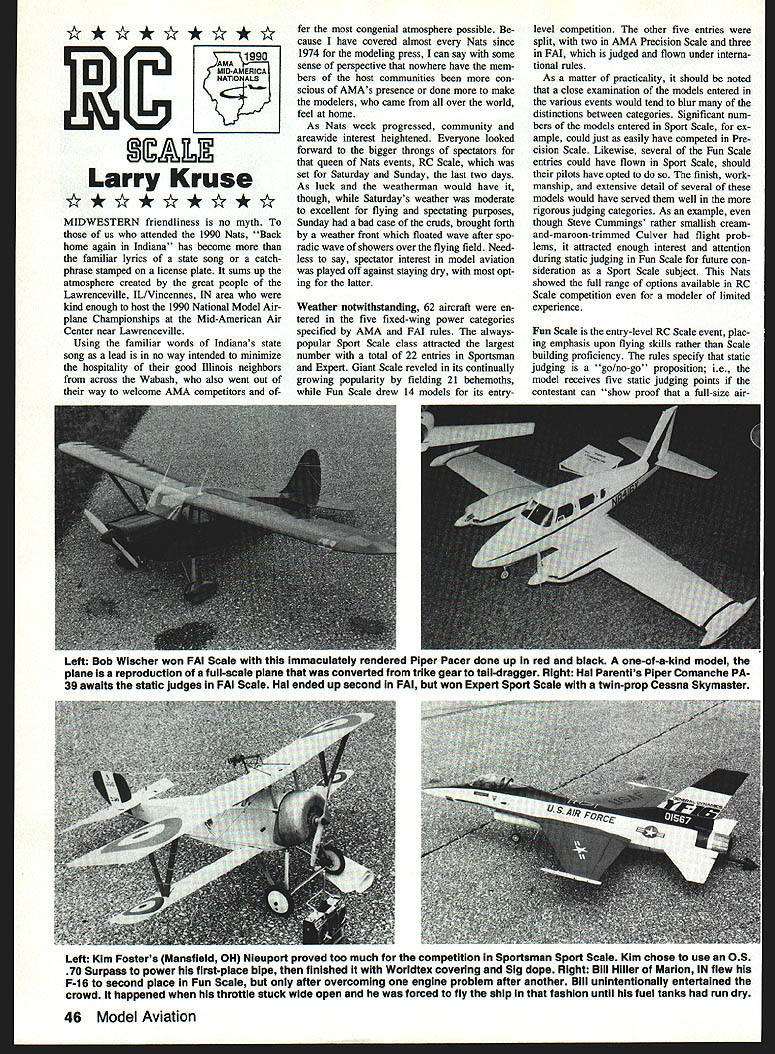
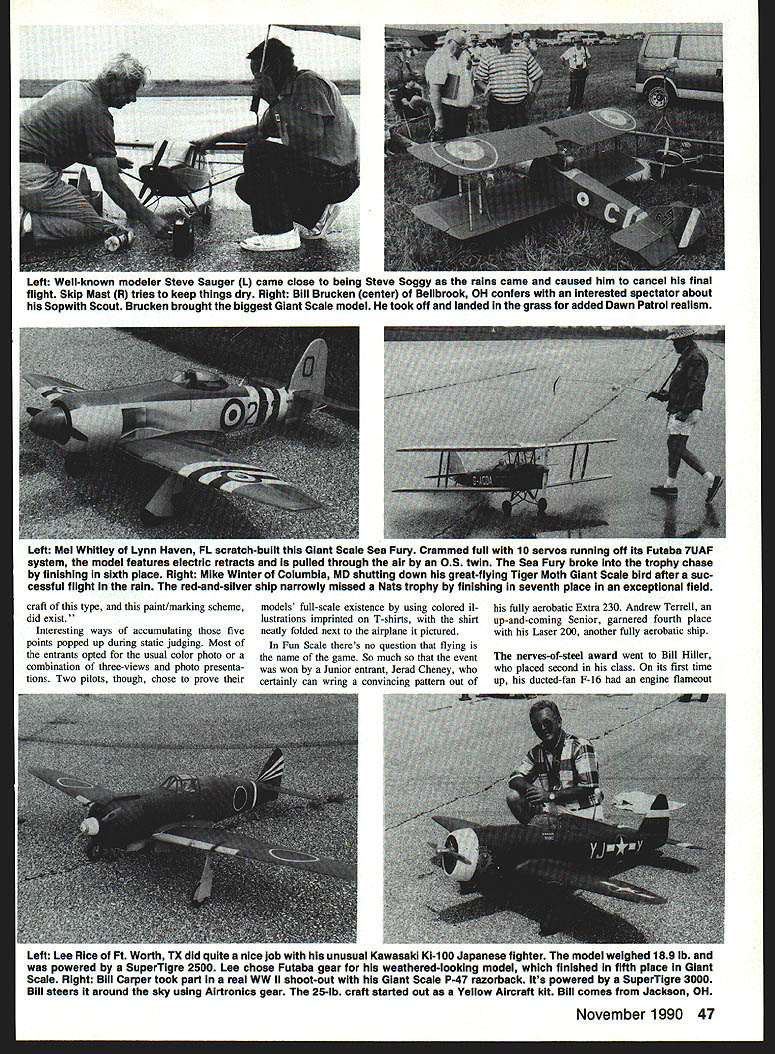
FAI Scale has a scoring regime suited to the decimal system. Both flight performance and static scale conformity are scored by four digits plus two decimal places, rather than the three digits and two decimal places common to AMA classes. That note of explanation will help you understand why veteran Bob Wischer's immaculate red‑and‑black conventionally geared Piper Pacer amassed over 3,543 points to edge out Hal Parent's fine twin Comanche by just over 15 points. The precise scale fidelity of the Pacer proved to be the margin of difference.
The yellow‑and‑white Comanche, with its twin engines in perfect sync, outflew the one‑of‑a‑kind Pacer by an average of slightly over 220 points per flight. That was not enough, however, to make up the 236‑point edge in scale fidelity held by Wischer's masterpiece. The twin pinnacles of scale points and flight points needed to produce a truly competitive FAI ship are perhaps the greatest challenge in Scale modeling. Wischer and Parent are two of the best, and it was a pleasure to watch them perform.
Conclusion
Pleasure was what RC Scale was about at Lawrenceville this year. From the terrific public relations job done by Geoff Styles and his crew prior to the Nats, to the sensory enjoyment of watching and hearing so many fine aircraft attempt to duplicate the flight of their larger brothers, the two days of RC Scale were immensely enjoyable.
Even Sunday's rains had some value. While they cut down on the crowds, they also heightened the drama of competition, adding a degree of tension and uncertainty to the thoroughly well‑run show. All National Model Airplane Championships should come off so well.
Transcribed from original scans by AI. Minor OCR errors may remain.

