
RADIO CONTROL SCALE AEROBATICS
Author
Mike Hurley 11542 Decatur Ct., Westminster CO 80234 E-mail: m.hurley@attbi.com
Interview: Chuck Hobart
Interviewer: Chuck, describe your radio control background.
Chuck: I've been flying for about 10 years. I'd say I'm a sport flier who likes to burn holes in the sky. In recent years I've gotten into a little more serious airplanes — aerobatic, precision-type airplanes — but my flying skill has leveled off. I've been instructing for about six or seven years. I've also dabbled with helicopters, again trying to improve my flying skills.
Interviewer: What attracts you to IMAC?
Chuck: For me, it's the opportunity to have some fun with fellow competitors and to bring my level of flying up. Also, it would be fun for my wife and I to take some weekend trips to IMAC contests away from the city and spend some time together.
Interviewer: Is there any particular style or type of airplane that interests you as part of why you like IMAC?
Chuck: I'm really into the precision-type airplane. Probably my favorite airplane that I'd like to get into would be the Edge 540. But the really large airplanes, at least at this time, aren't of interest to me — and they don't fit in the family budget. I want to see if the 72- to 80-inch airplane can really be fun and competitive. It's a little intimidating to fly against the big airplanes, but I'm just going to worry about my own personal performance.
Interviewer: You're building a new airplane. Tell me about it and what you expect out of it.
Chuck: I'm building the original Goldberg Sukhoi, and the main reason I'm going with that for IMAC is a personal sentimental attachment. When I started the construction I made sure the wing was perfectly flat with zero dihedral, the stabilizers were all zero, and I built it as light and as precise as possible to see if I could make it into a good basic IMAC airplane. I also wanted enough power. It's supposed to fly on a .90, but I wanted vertical with authority so I put the O.S. 1.60 FX in it.
Right now, with a few test flights, it seems to fly really well. My previous Goldberg Sukhoi just floated in for a landing. But with the changes to this one it comes in under control, and I must have really changed the wing loading because it now sinks quickly. It's definitely different than my first one.
Interviewer: You have your first IMAC contest coming up soon.
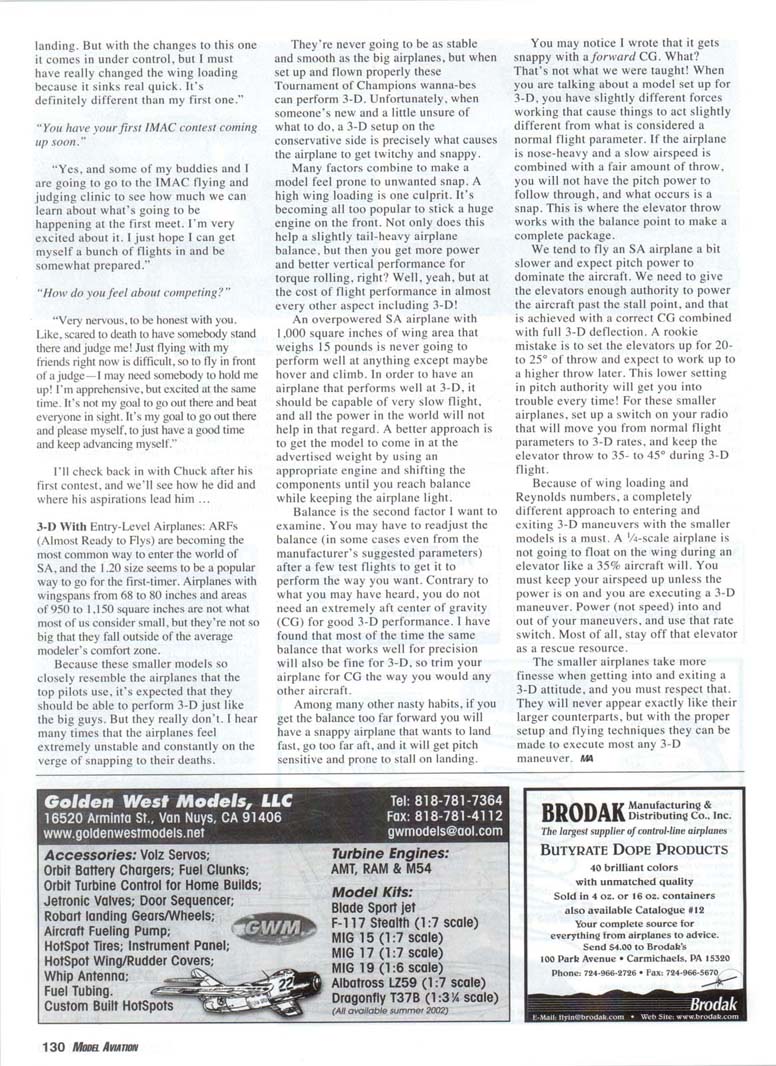
Chuck: Yes, and some of my buddies and I are going to go to the IMAC flying and judging clinic to see how much we can learn about what's going to be happening at the first meet. I'm very excited about it. I just hope I can get myself a bunch of flights in and be somewhat prepared.
Interviewer: How do you feel about competing?
Chuck: Very nervous, to be honest with you — scared to death to have somebody stand there and judge me! Just flying with my friends right now is difficult, so to fly in front of a judge I may need somebody to hold me up! I'm apprehensive, but excited at the same time. It's not my goal to go out there and beat everyone in sight. It's my goal to go out there and please myself, to just have a good time and keep advancing myself.
I'll check back in with Chuck after his first contest, and we'll see how he did and where his aspirations lead him.
3-D With Entry-Level Airplanes
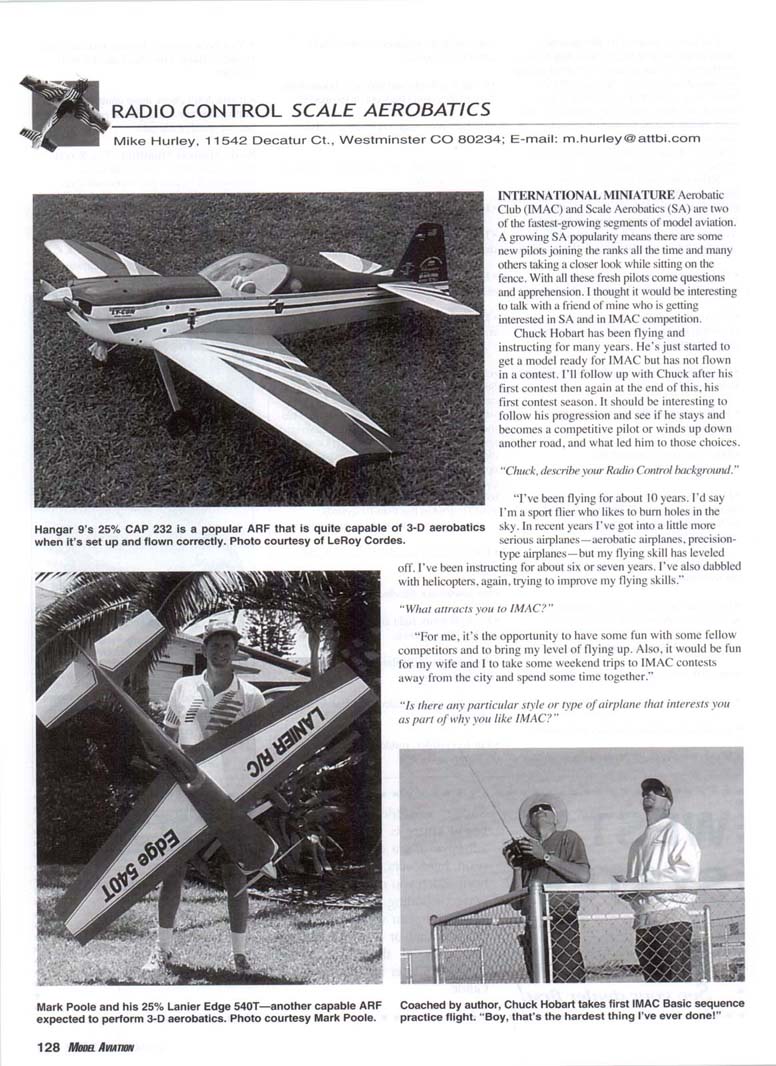
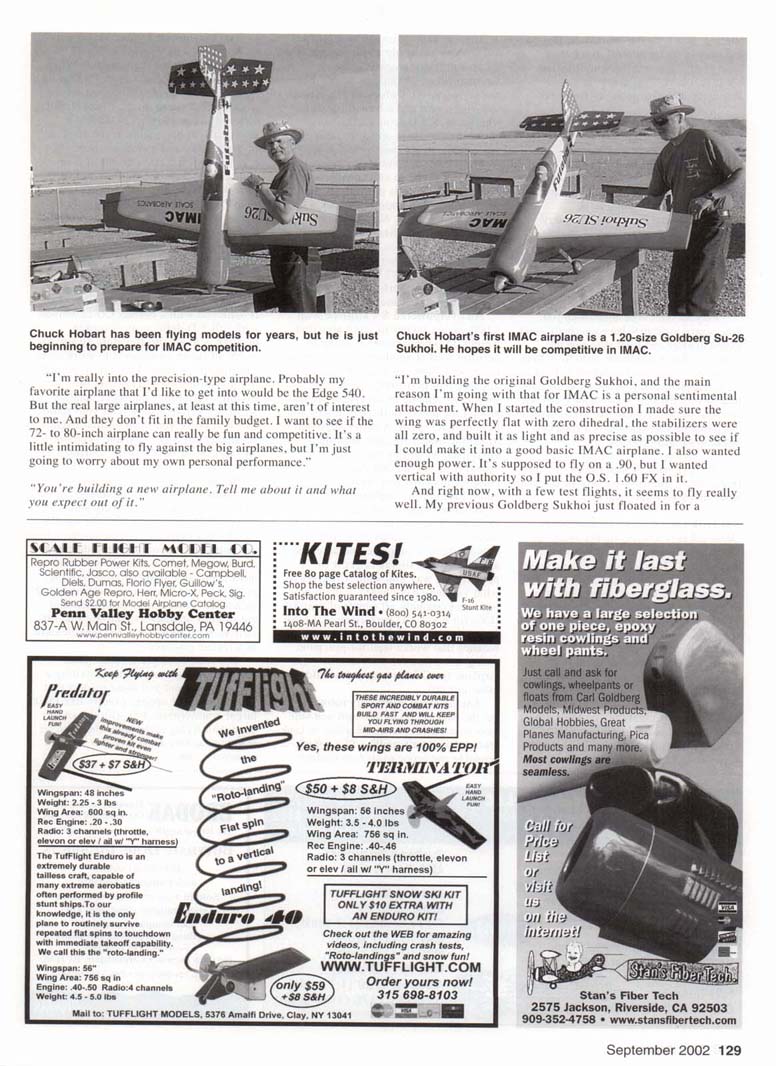
ARFs (Almost Ready to Fly) are becoming the most common way to enter the world of scale aerobatics, and the 1.20-size seems to be a popular choice for first-timers. Airplanes with wingspans from 68 to 80 inches and wing areas of 950 to 1,150 square inches are not what most of us consider small, but they're not so big that they fall outside the average modeler's comfort zone.
Because these smaller models so closely resemble the airplanes the top pilots use, it's expected that they should be able to perform 3-D just like the big guys. But they really don't. I often hear that the airplanes feel extremely unstable and constantly on the verge of snapping to their deaths.
They're never going to be as stable and smooth as the big airplanes, but when set up and flown properly these Tournament of Champions wannabes can perform 3-D. Unfortunately, when someone is new and a little unsure of what to do, a 3-D setup on the conservative side is precisely what causes the airplane to get twitchy and snappy.
Many factors combine to make a model feel prone to unwanted snap:
- High wing loading. It's become popular to stick a husky engine on the front. Not only does this help a slightly tail-heavy airplane balance, but then you get more power and better vertical performance for torque rolling. That helps hover and climb, but often at the cost of flight performance in almost every other aspect, including 3-D.
- Overpowering. An overpowered SA airplane with 1,000 square inches of wing area that weighs 15 pounds is never going to perform well at anything except maybe hover and climb. To have an airplane that performs well at 3-D, it should be capable of very slow flight — and all the power in the world will not help in that regard. A better approach is to get the model to come in at the advertised weight by using an appropriate engine and shifting components until you reach balance while keeping the airplane light.
- Balance (center of gravity). You may have to readjust the balance (in some cases even from the manufacturer's suggested parameters) after a few test flights to get it to perform the way you want. Contrary to what you may have heard, you do not need an extremely aft center of gravity (CG) for good 3-D performance. Most of the time, the same balance that works well for precision will also be fine for 3-D, so trim your airplane for CG the way you would any other aircraft.
Among many other nasty habits, if you get the balance too far forward you will have a snappy airplane that wants to land fast. Go too far aft, and it will get pitch-sensitive and prone to stall on landing.
You may notice I wrote that it gets snappy with a forward CG. What? That's not what we were taught! When you are talking about a model set up for 3-D, you have slightly different forces working that cause things to act a bit differently from normal flight parameters. If the airplane is nose-heavy and a slow airspeed is combined with a fair amount of throw, you will not have the pitch power to follow through, and what occurs is a snap. This is where elevator throw works with the balance point to make a complete package.
We tend to fly an SA airplane a bit slower and expect pitch power to dominate the aircraft. We need to give the elevators enough authority to power the aircraft past the stall point, and that is achieved with a correct CG combined with full 3-D deflection. A rookie mistake is to set the elevators up for 20° to 25° of throw and expect to work up to a higher throw later. This lower setting in pitch authority will get you into trouble every time. For these smaller airplanes, set up a switch on your radio that will move you from normal flight parameters to 3-D rates, and keep the elevator throw to 35° to 45° during 3-D flight.
Because of wing loading and Reynolds number effects, a completely different approach to entering and exiting 3-D maneuvers with the smaller models is a must. A 1/4-scale airplane is not going to float on the wing during an elevator like a 35% aircraft will. You must keep your airspeed up unless the power is on and you are executing a 3-D maneuver. Use power (not speed) into and out of your maneuvers, and use that rate switch. Most of all, stay off that elevator as a rescue resource.
The smaller airplanes take more finesse when getting into and exiting a 3-D attitude, and you must respect that. They will never appear exactly like their larger counterparts, but with the proper setup and flying techniques they can be made to execute most any 3-D maneuver.
MA
Transcribed from original scans by AI. Minor OCR errors may remain.

