
Proper rudder usage is the key to achieving success
by John Glezellis jglezellis@comcast.net
Every competition pilot involved in aerobatics understands the satisfaction that comes from flying the perfect sequence, no matter the weather. Achieving that consistently takes time and practice.
If a person is competitive, he or she will rarely be satisfied even after a perfect routine, because they will want to replicate it repeatedly. To do that a pilot must fully understand personal flying skills and limits, the aircraft, and what control inputs are needed throughout every part of the flight.
When precise figures must be flown, one quickly realizes the importance of the rudder. Although a newcomer may think the rudder is used only to taxi the aircraft, that's not true. An experienced pilot uses the rudder as much as any other control surface. It corrects the aircraft’s attitude with respect to yaw inputs. If a pilot is to perform an aerobatic schedule of 10 back-to-back maneuvers, timing with respect to the rudder is essential.
Over the years I have seen many pilots struggle with proper rudder usage. Incorrect rudder performance can be fatal to an airframe. I have seen Giant Scale aerobatic airplanes crash while performing torque rolls close to the ground simply because the pilot became disoriented and didn't know which rudder direction to use.
Throughout this column I will reveal a few basic flight practices and mental strategies and share tips for using the rudder in the wind.
Mental Preparation: Proper Rudder Usage
One of the most challenging aspects of International Miniature Aerobatic Club (IMAC) routines is that maneuvers are flown one after another with only brief line segments between them, unless a break is specified. A pilot must master the aircraft and know exactly how to position the model for the best possible presentation throughout the sequence.
With the exception of cross-box maneuvers, the airplane should travel along the X axis on a track parallel to the flightline. When trying to maintain this distance, a pilot will quickly realize the need for rudder input.
When I first began aerobatic competition, fellow competitors told newcomers it was important to practice straight-and-level flight. They suggested performing one pass parallel to the runway, executing a half-reverse Cuban 8 as the turnaround, then performing another pass at the same height and distance as the first but traveling in the opposite direction.
This method may seem mundane, but it serves as a foundation. Rudder corrections become necessary to keep the aircraft at the same distance from the pilot at all times. These passes also teach the importance of keeping the wings level. If the wings are not level, as soon as the pilot begins the turnaround the aircraft will wander off course and multiple rudder and aileron corrections will be needed to get it back on track.
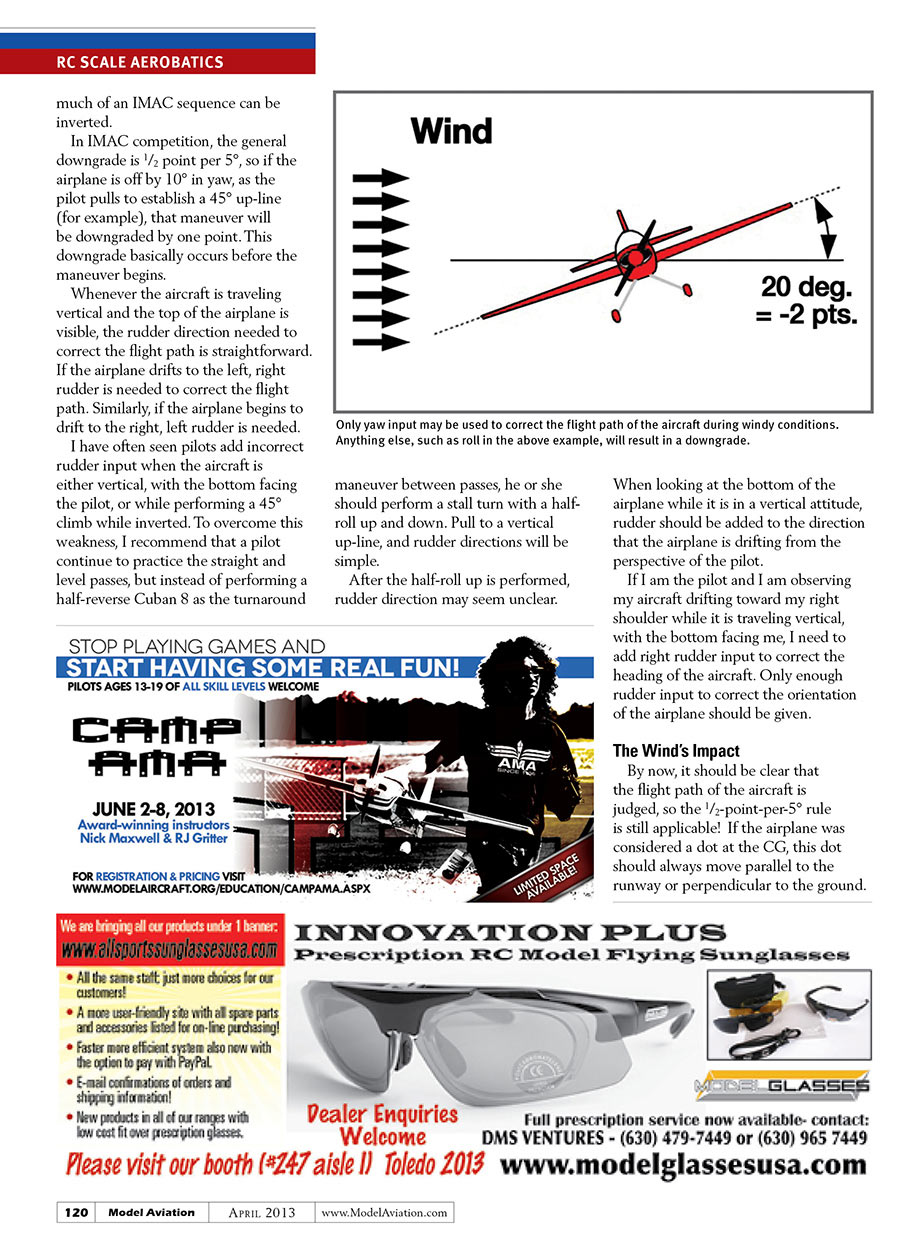
In addition to upright level flight, a pilot should become familiar with using the rudder while the airplane is inverted. Depending on the class, much of an IMAC sequence can be flown inverted. In IMAC competition the general downgrade is 1/2 point per 5°, so if the airplane is off by 10° in yaw as the pilot pulls to establish a 45° up-line (for example), that maneuver will be downgraded by one point. That downgrade effectively occurs before the maneuver begins.
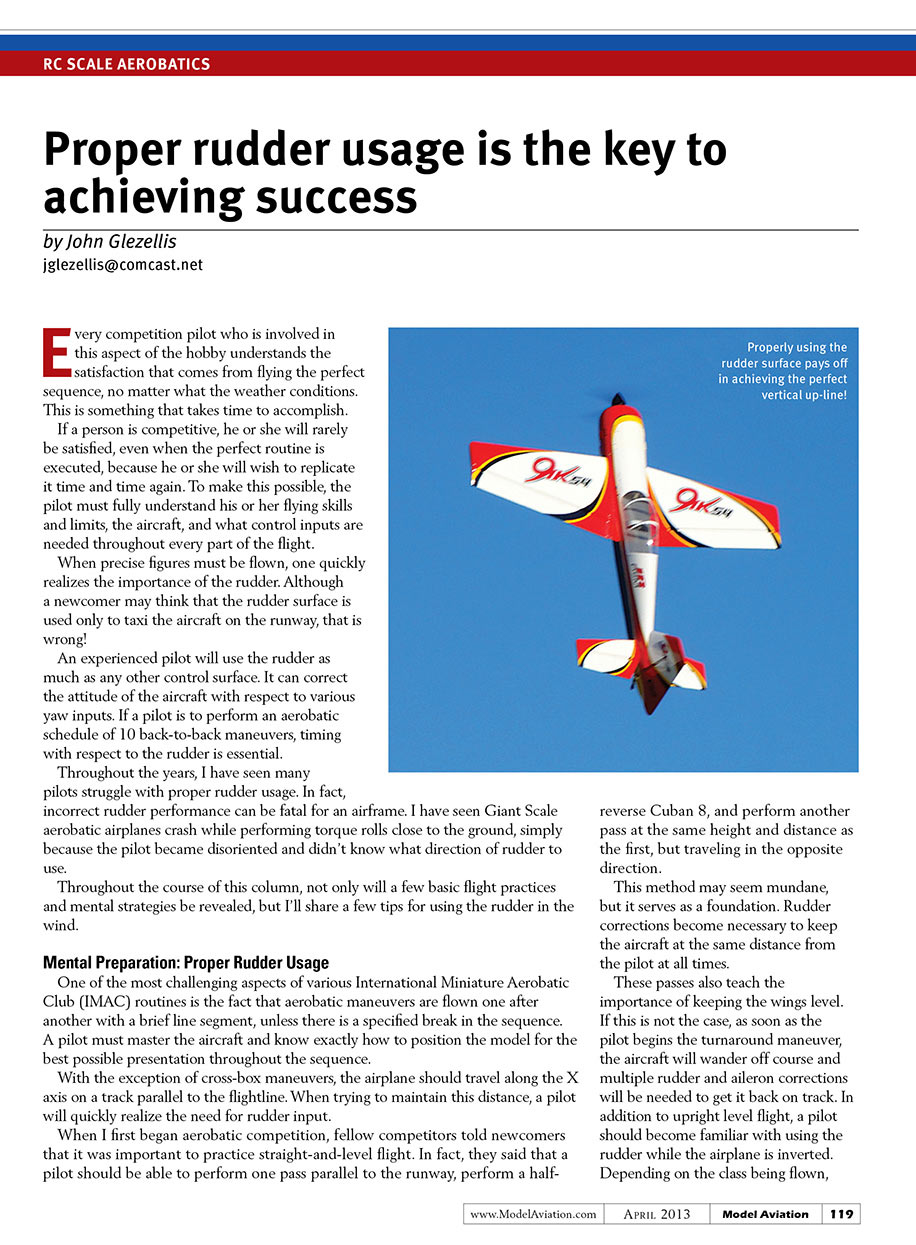
Whenever the aircraft is traveling vertical and the top of the airplane is visible, the rudder direction needed to correct the flight path is straightforward. If the airplane drifts to the left, right rudder is needed to correct the flight path. Similarly, if the airplane drifts to the right, left rudder is needed.
I have often seen pilots add incorrect rudder input when the aircraft is vertical with the bottom facing the pilot or while performing a 45° climb while inverted. To overcome this weakness, practice the straight-and-level passes, but instead of performing a half-reverse Cuban 8 as the turnaround maneuver between passes, perform a stall turn with a half-roll up and down. Pull to a vertical up-line and rudder directions will be simple.
After the half-roll up is performed, rudder direction may seem unclear. When looking at the bottom of the airplane while it is in a vertical attitude, add rudder toward the direction the airplane is drifting from the pilot’s perspective.
For example, if I observe my aircraft drifting toward my right shoulder while it is traveling vertical with the bottom facing me, I need to add right rudder input to correct the heading. Only enough rudder input to correct the orientation of the airplane should be given.
The Wind's Impact
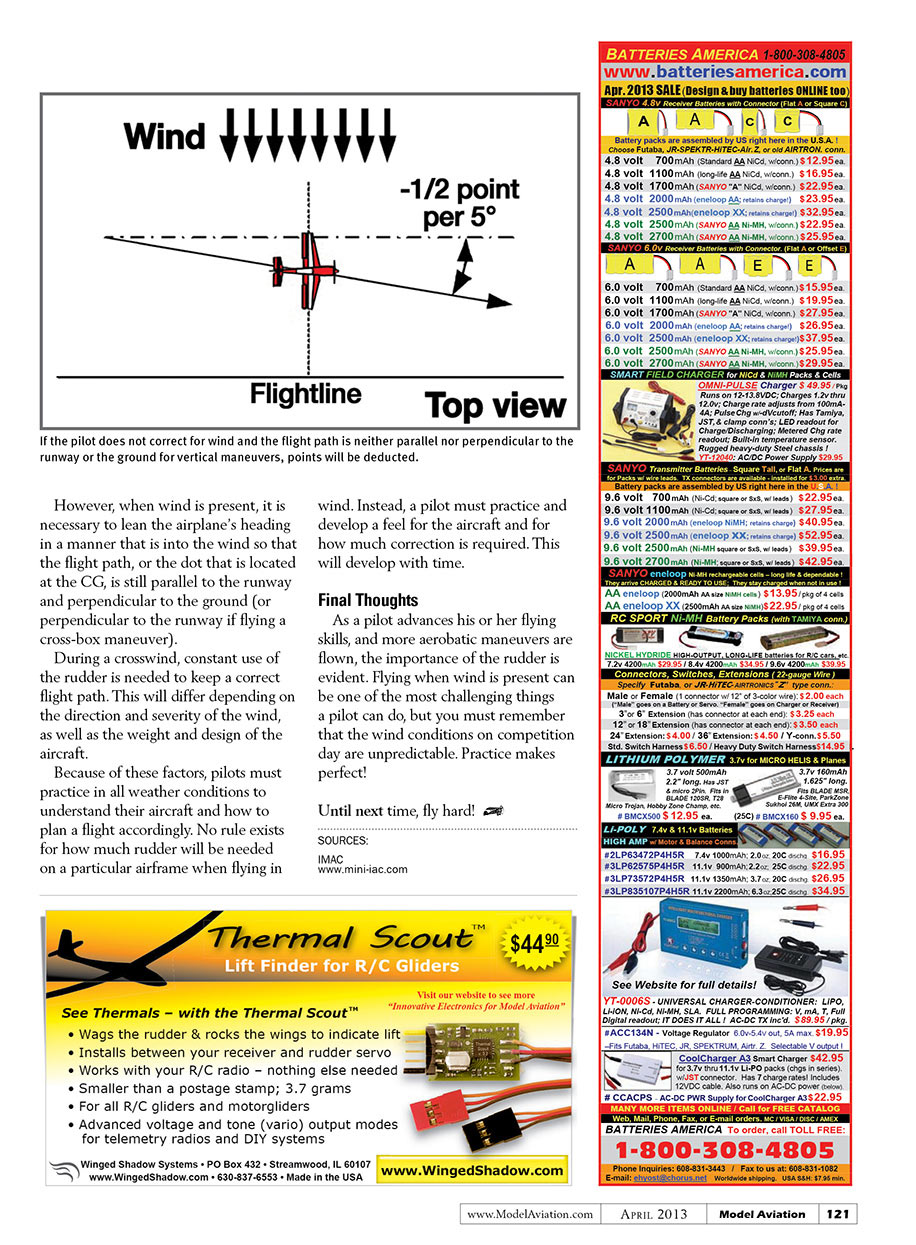
The flight path of the aircraft is what is judged, so the 1/2-point-per-5° rule still applies. If the airplane were considered a dot at the CG, this dot should always move parallel to the runway or perpendicular to the ground.
When wind is present, it is necessary to lean the airplane's heading into the wind so that the flight path — the dot at the CG — remains parallel to the runway and perpendicular to the ground (or perpendicular to the runway if flying a cross-box maneuver).
During a crosswind, constant use of the rudder is needed to keep a correct flight path. The amount and direction of rudder required will vary depending on the wind’s direction and strength, as well as the weight and design of the aircraft.
Because of these variables, pilots must practice in all weather conditions to understand their aircraft and plan flights accordingly. No rule exists for exactly how much rudder will be needed on a particular airframe in wind; a pilot must develop a feel for the aircraft and how much correction is required. This develops with time.
Final Thoughts
As a pilot advances and flies more aerobatic maneuvers, the importance of the rudder becomes obvious. Flying in wind can be one of the most challenging aspects of competition flying. Remember that wind conditions on competition day are unpredictable — practice makes perfect.
Until next time, fly hard!
Sources
- IMAC
- www.mini-iac.com
Transcribed from original scans by AI. Minor OCR errors may remain.

