
RC Scale Masters
By Billy Root
Event overview
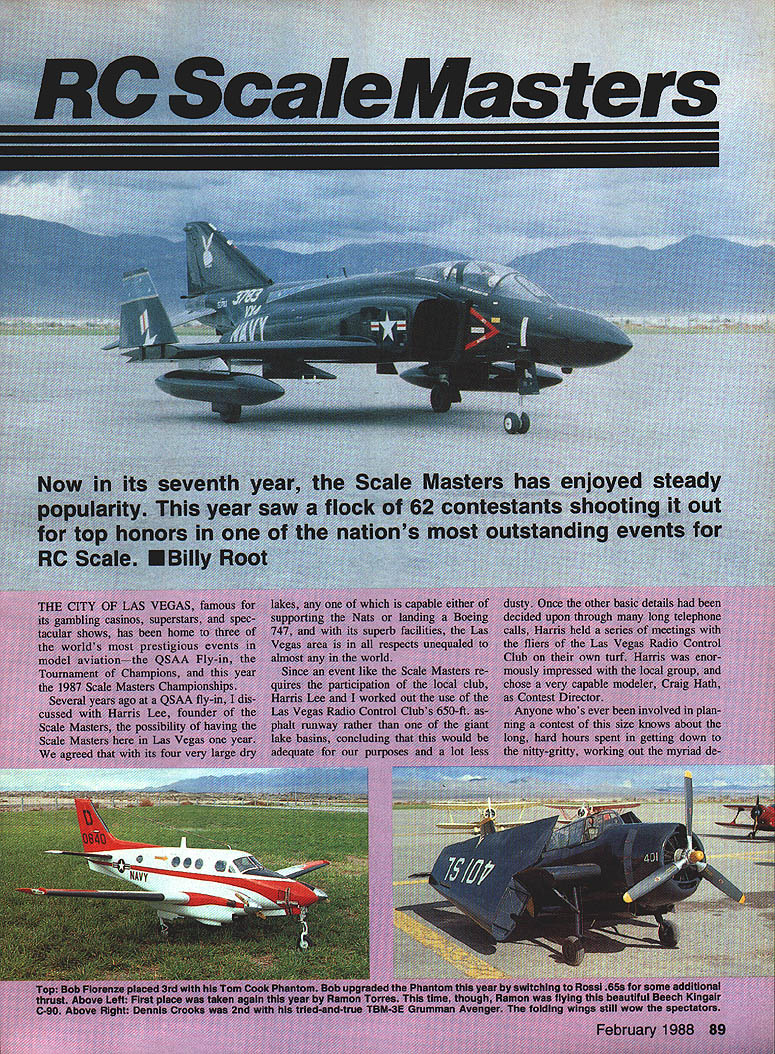
Now in its seventh year, the Scale Masters has enjoyed steady popularity. This year a flock of 62 contestants shot it out for top honors in one of the nation's most outstanding events for RC scale: the 1987 Scale Masters Championships in Las Vegas.
Site and organization
The city of Las Vegas, famous for its gambling casinos, superstars, and spectacular shows, has hosted three of the world's most prestigious events in model aviation — the QSAA Fly-in, the Tournament of Champions, and this year's Scale Masters.
Several years earlier, at a QSAA fly-in, I discussed with Harris Lee, founder of the Scale Masters, the possibility of holding the Scale Masters in Las Vegas. We agreed that with its four very large dry lakes — any one capable of supporting the Nats or landing a Boeing 747 — and its superb facilities, the Las Vegas area is unequaled for such an event.
Because the Scale Masters requires local-club participation, Harris and I arranged to use the Las Vegas Radio Control Club's 650-ft. asphalt runway rather than a giant lake basin. We concluded the runway would be adequate and much less dusty. After many long telephone calls, Harris held a series of meetings with the Las Vegas RC Club fliers on their own turf. He was enormously impressed with the local group and chose a very capable modeler, Craig Hanh, as contest director.
Competitors and models
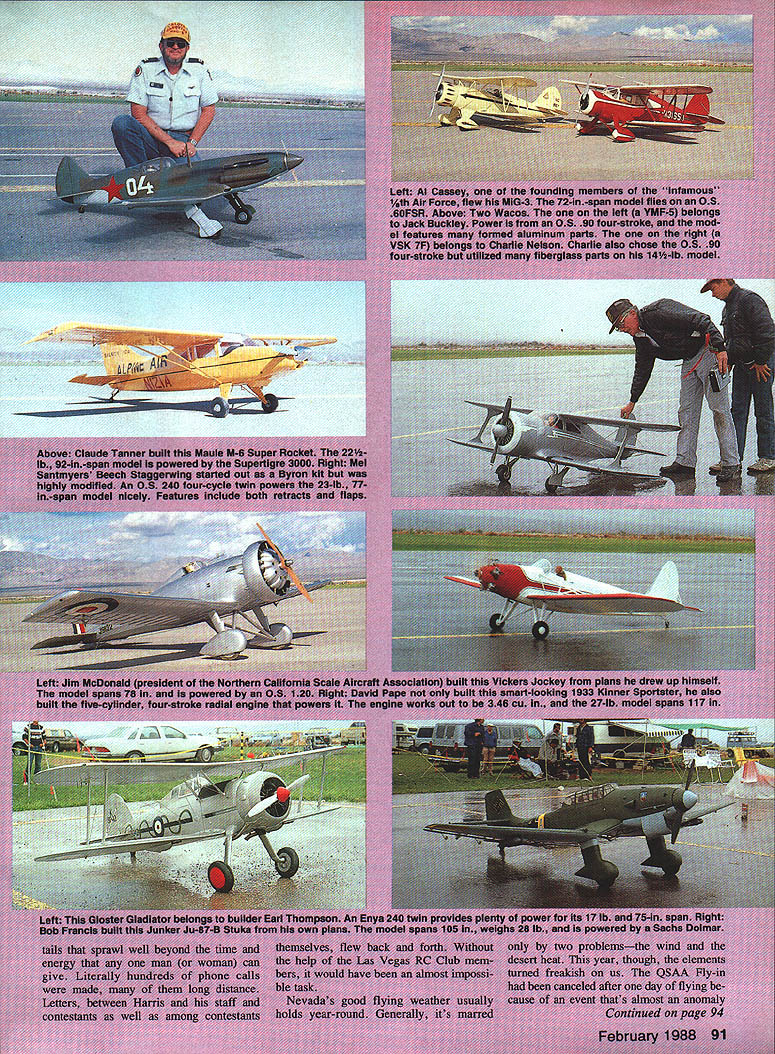
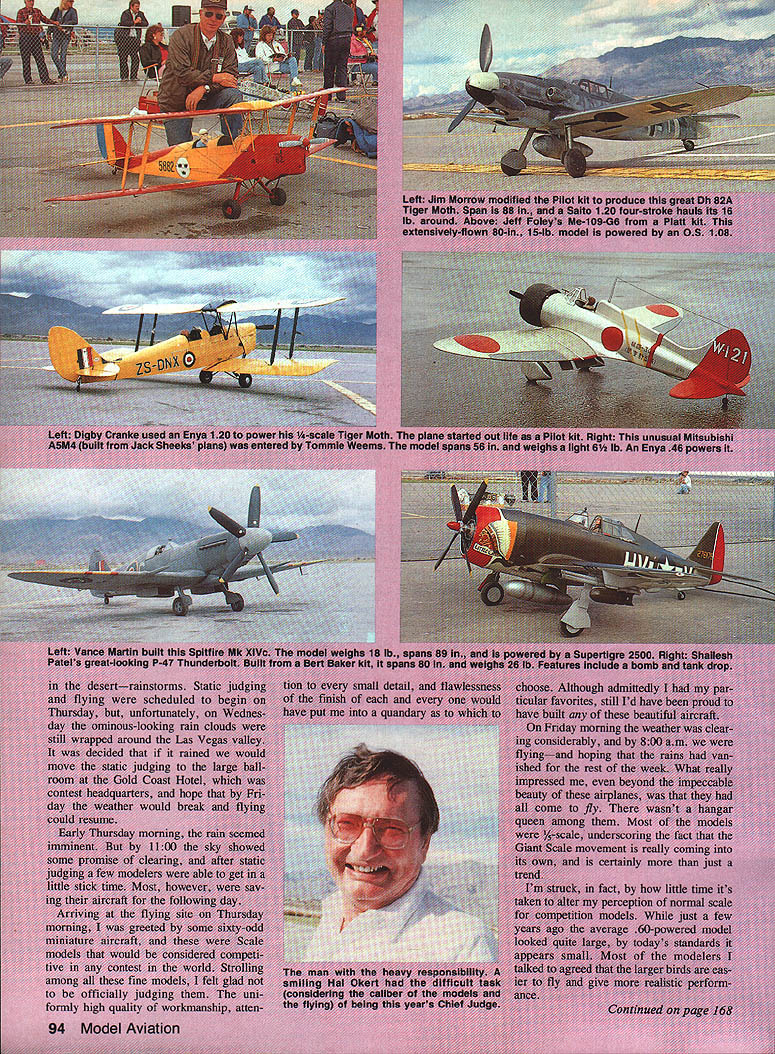
Arriving at the flying site on Thursday morning, I was greeted by some sixty-odd miniature aircraft that would be competitive in any contest in the world. The uniform high quality of workmanship, attention to detail, and flawless finishes of the models made choosing winners a difficult task. Most models were jet-scale, underscoring that the Giant Scale movement is coming into its own and is more than a fad.
What impressed me most — beyond the impeccable beauty of these airplanes — was that they had all come to fly. There weren't hangar queens among them. Many modelers agreed that the larger birds are easier to fly and give more realistic performance.
Weather and schedule
Nevada's good flying weather usually holds year-round, generally marred only by wind and desert heat. This year the elements turned freakish: in the desert, there were rainstorms. Static judging and flying were scheduled to begin on Thursday, but ominous rain clouds hung over the Las Vegas valley on Wednesday. We decided that if it rained we would move static judging to the large ballroom at the Gold Coast Hotel, which was contest headquarters, and hope that by Friday flying could resume.
Early Thursday morning the rain seemed imminent, but by 11:00 the sky showed promise of clearing. After static judging a few modelers got in some stick time, while most saved their aircraft for the following day. On Friday morning the weather cleared considerably and by 8:00 a.m. we were flying — hoping the rains had vanished for the rest of the week.
Competition highlights
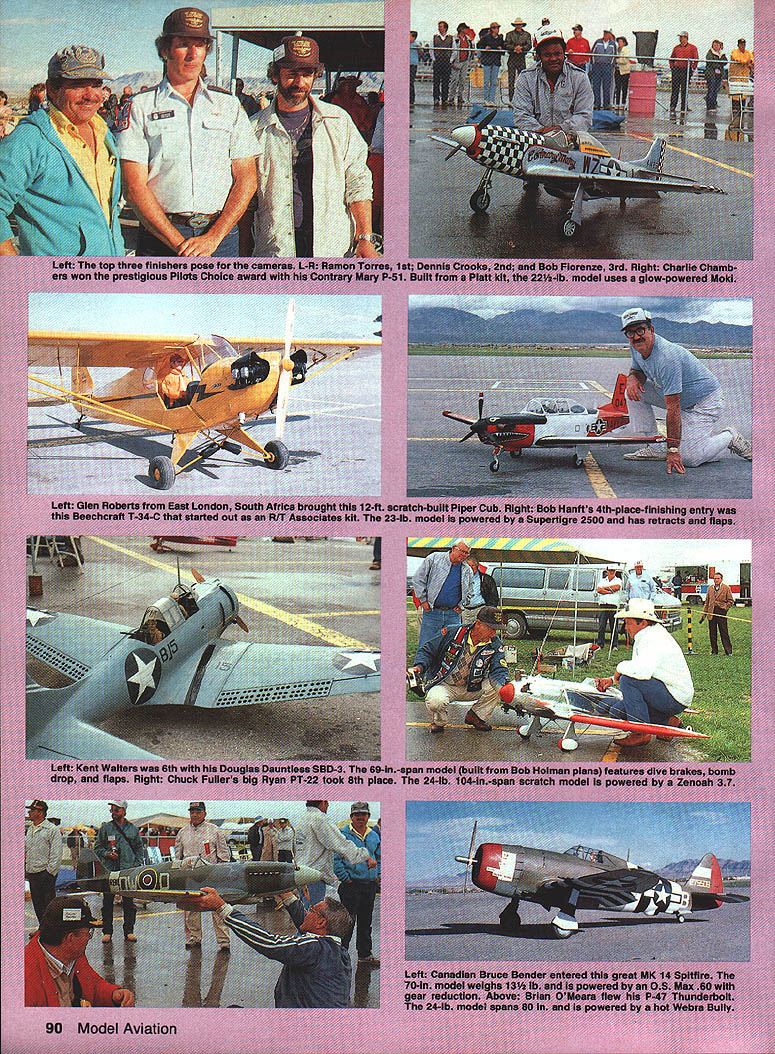
Both Charlie Chambers' P-51 and Glen Roberts' 12-ft. Piper Cub were indubitably among the favorites for the championships. The fact that both winning Scale Masters models stopped a moment as they approached the landing area speaks to their quality. But, once again, all the models deserved plaudits — and every flier a trophy for optimism and esprit de corps.
Watching a plane that had stopped attempt to touch down in the designated area to avoid a timer's judgment, the aircraft crossed the line. On a short course, keeping chase vehicles off the road until ready to roll was a mistake — it tempted drivers to push the speed limit while chasing a fast-moving sailplane at the start attempt.
Rules discussion and lessons learned
After flying, contestants were split on the modified rules: some liked them, some didn't. The contest raised the basic question about the goal: cross-country (X-C) is generally called racing, yet contests are a distance affair. AMA rules encourage setting long courses; this lessens the possibility that the outcome will be determined by speed. Perhaps the term "Racing" should be deleted from the rule book.
The concept of a variable-length course has merit; it is used by both FAI rules and full-scale soaring events and allows the task to closely match weather conditions. Some points learned that the contest should consider:
- Some method of keeping chase vehicles within speed limits is of paramount importance — this problem on short courses can also be a problem on X-C courses.
- Use a race start per current AMA rules. Having a chase vehicle ahead of the start line lessens initial motoring speeds.
- Make the course long enough that multiple thermals are required to complete. This discourages use of speed-type airplanes which compound the problem.
Logistics and thanks
Details sprawled well beyond what any one person could manage. Literally hundreds of phone calls were made, many long-distance. Letters between Harris and his staff and contestants, as well as among contestants themselves, flew back and forth. Without the help of the Las Vegas RC Club members, the event would have been almost impossible to stage.
Results
Charlie Chambers' P-51 and Glen Roberts' 12-ft. Piper Cub finished at the top, but the high quality of all entries and the spirit of the fliers were the real highlights of the Scale Masters Championships.
Transcribed from original scans by AI. Minor OCR errors may remain.

