
RC Scale World Champs
The finest craftsmen in the world of RC scale modeling met in Italy to decide who was the best. The British team took the top honors, and for the first time a ducted‑fan model was the individual winner.
Event overview
Huge, colorful banners stretched across several streets of Gorizia, proudly proclaiming that the premier Radio Control Scale World Championships was being hosted for 1989 by this small city on the Yugoslavian border in northeastern Italy.
From 3 through 10 September, 41 competitors from 14 countries, hundreds of supporters, and thousands of interested spectators descended upon the region to compete, observe, and help out during eight days of intense competition.
Our host group, the Aero Club Giuliano, conducted an outstanding World Championships. From the opening ceremony to the closing banquet, all activities were planned and carried out effectively. Primary devotion was given to the modelers' comfort and satisfaction. General communications, transportation of models, modelers and judges, the food, and the hangar/display facilities all received high marks.
Even the weather cooperated. Most flying was conducted in comfortably warm temperatures and ideal wind conditions. Although the second morning of official flying began with a rather strong breeze, it subsided quickly, leaving the majority of competitors to fly in smooth, almost calm air for the remainder of the event.
Displays and static judging
Each of the 14 countries was provided with three large pedestals on which to display their models in the work hangar. From early morning until late into the evening, interested spectators were continuously in attendance around the perimeter of the display area.
Before static judging began, several days were spent making a general appraisal of the total entry. Workmanship and fidelity to scale on most of the models were truly striking. A majority of the airplanes boasted finishes and details that would have made eye‑catching museum displays. In many cases it was difficult to imagine that the models were intended to be flown as well.
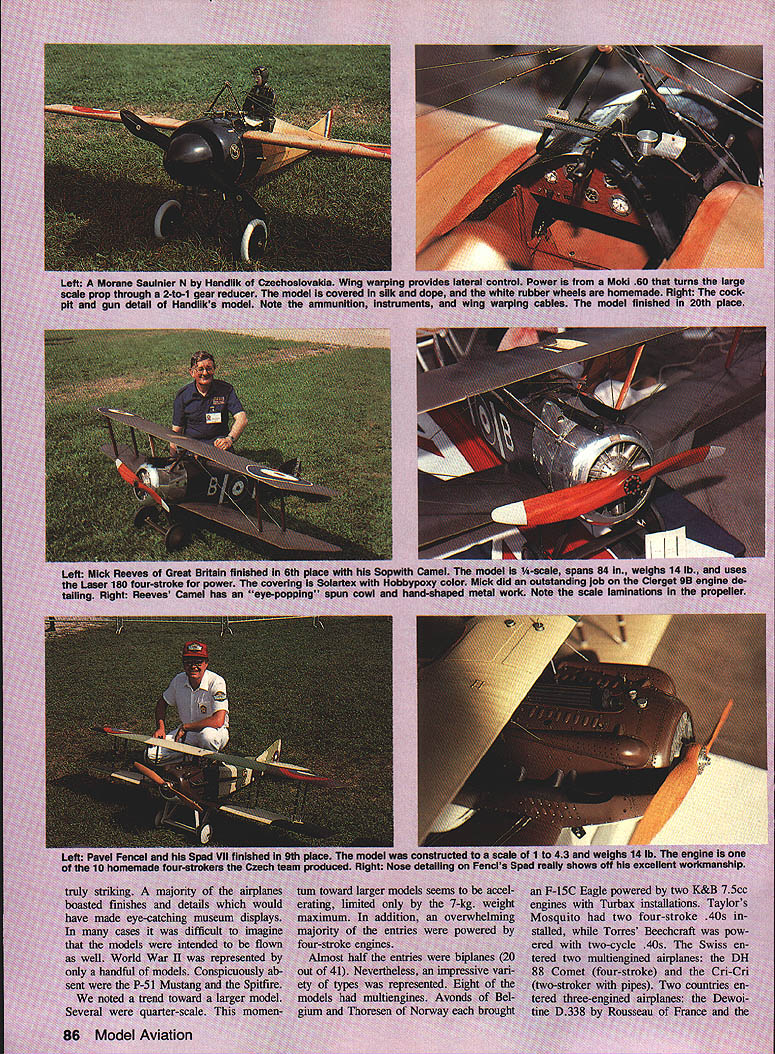
World War II aircraft were represented by only a handful of models. Conspicuously absent were the P‑51 Mustang and the Spitfire. A trend toward larger models was noted—several were quarter‑scale. This momentum toward larger models seems to be accelerating, limited only by the 7‑kg weight maximum. In addition, an overwhelming majority of the entries were powered by four‑stroke engines.
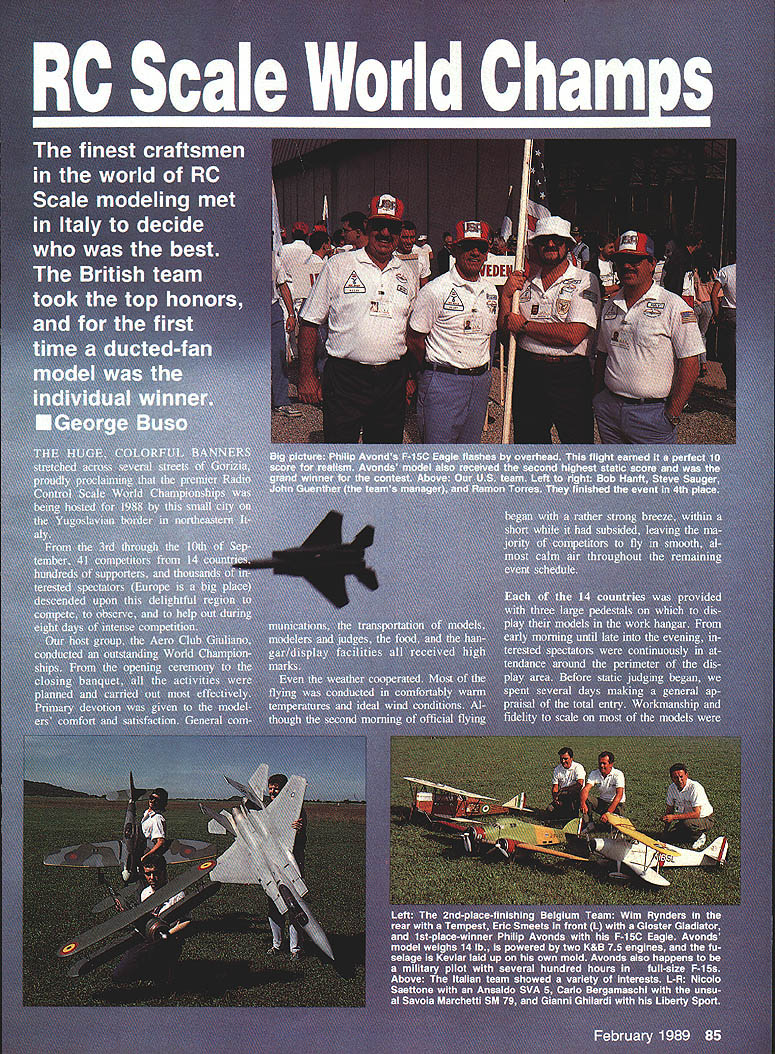
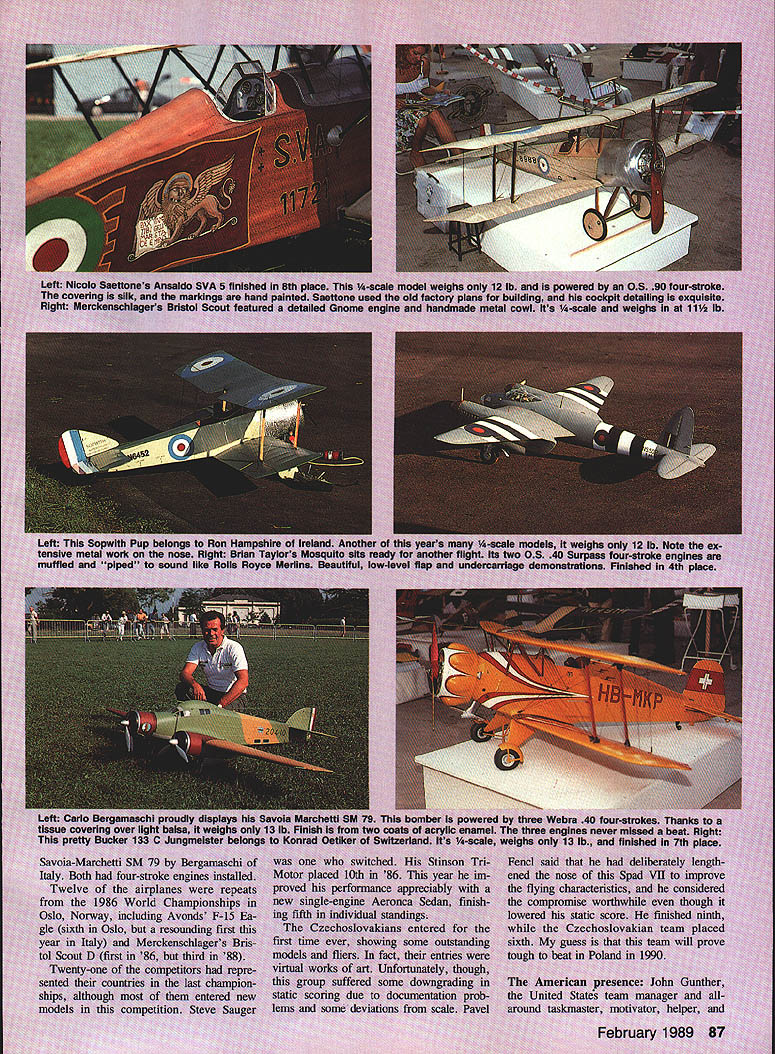
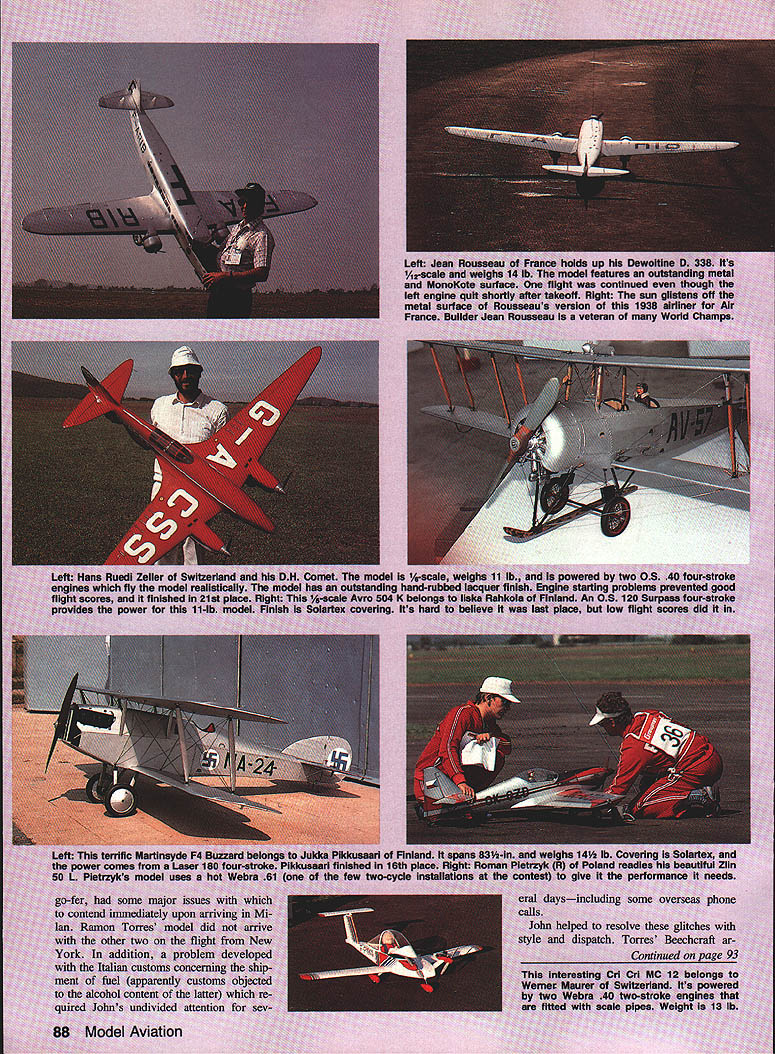
Almost half the entries were biplanes (20 out of 41), yet an impressive variety of types was represented. Eight models were multi‑engine designs. Avonds of Belgium and Thoresen of Norway each brought an F‑15C Eagle powered by two K&B 7.5‑cc engines with Turbax installations. Taylor's Mosquito had two four‑stroke .40s installed, while Ramon Torres' Beechcraft was powered with two two‑cycle .40s. The Swiss entered two multi‑engine airplanes: the DH.88 Comet (four‑stroke) and the Cri‑Cri (two‑stroke with pipes). Two countries entered three‑engined airplanes: the Dewoitine D.338 by Rousseau of France and the Savoia‑Marchetti SM.79 by Bergamaschi of Italy. Both had four‑stroke engines installed.
Twelve airplanes were repeats from the 1986 World Championships in Oslo, Norway, including Avonds' F‑15 Eagle (sixth in Oslo, but a resounding first in Italy) and Merkenschlager's Bristol Scout D (first in '86, but third in '88).
Competitors and teams
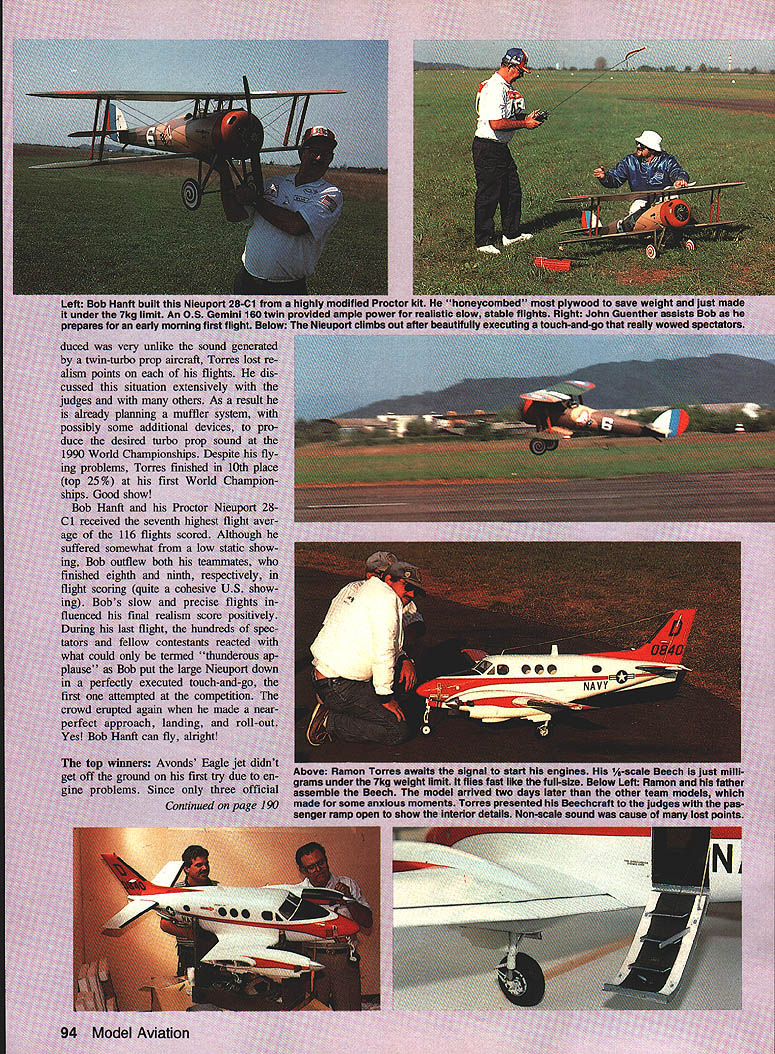
Twenty‑one competitors had represented their countries in the last championships, although most entered new models in this competition. Steve Sauger was one who switched: his Stinson Tri‑Motor placed 10th in '86, and this year he improved appreciably with a new single‑engine Aeronca Sedan, finishing fifth individually.
The Czechoslovakians entered for the first time ever, showing some outstanding models and fliers. Their entries were virtual works of art, but the team suffered downgrading in static scoring because of documentation problems and some deviations from scale. Pavel Fencl said he had deliberately lengthened the nose of his Spad VII to improve flying characteristics; he considered the compromise worthwhile even though it lowered his static score. He finished ninth, while the Czechoslovakian team placed sixth. This team is likely to be a strong contender in future events.
The American presence faced early logistical issues. John Gunther, the United States team manager, had several problems upon arrival in Milan: Ramon Torres' model did not arrive with the other two on the flight from New York, and a problem developed with Italian customs concerning the shipment of fuel (apparently customs objected to the alcohol content). John devoted several days to resolving these matters, including overseas phone calls. The fuel arrived a few days later in a very large shipping box, and once unloaded there was enough Cool Power to fuel every engine at the championships.
Steve Sauger, an experienced competitor, knew what judges look for in static and flight portions. The Aeronca Sedan he copied is hangared at a local airport near his home, providing excellent documentation. His static scores of 9 and 9.5 for scale accuracy were high but not perfect; judges appeared reluctant to award a perfect 10. Later, judges saw a startlingly realistic imitation of the full‑size Aeronca in flight.
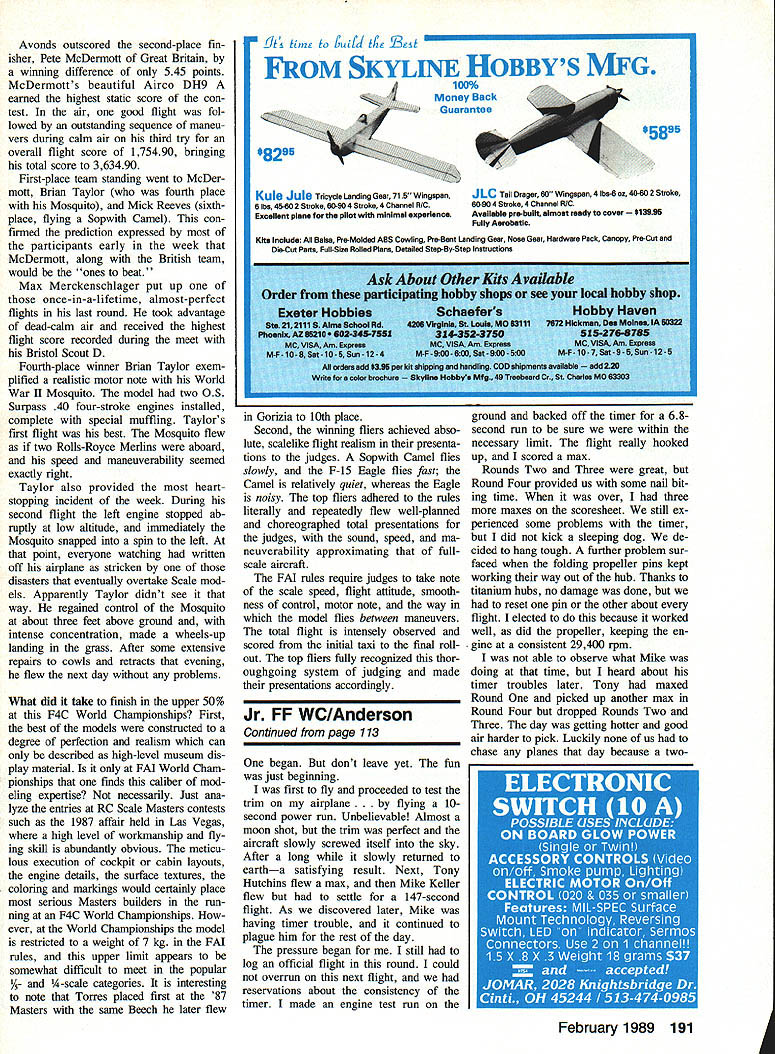
Ramon Torres entered his familiar, immaculately detailed Beechcraft T‑34A. His newer Beech had been demolished in practice, and this aircraft was his original backup, revamped and reportedly one pound lighter. Torres' taxiing, takeoffs, and maneuvers in each of his three flights were thrilling to watch. From his scalelike use of brakes during taxiing, to a perfect turn into the wind on the runway centerline, to a tour de force of "spooling up" the engines with brakes set and then thundering down the runway to a gradual climbout with retracts coming up in sequence, Torres displayed outstanding command of RC scale flying.
Unfortunately, Torres lost points in realism because of his "motor note." His Beechcraft was equipped with two loud, unmuffled two‑cycle .40 engines which were synchronized perfectly but produced a characteristic model airplane noise very unlike the sound of a twin turboprop aircraft. He discussed the situation extensively with judges and others and planned a muffler system and possibly additional devices to produce a more authentic turboprop sound for the 1990 World Championships. Despite this, Torres finished 10th (top 25%) at his first World Championships.
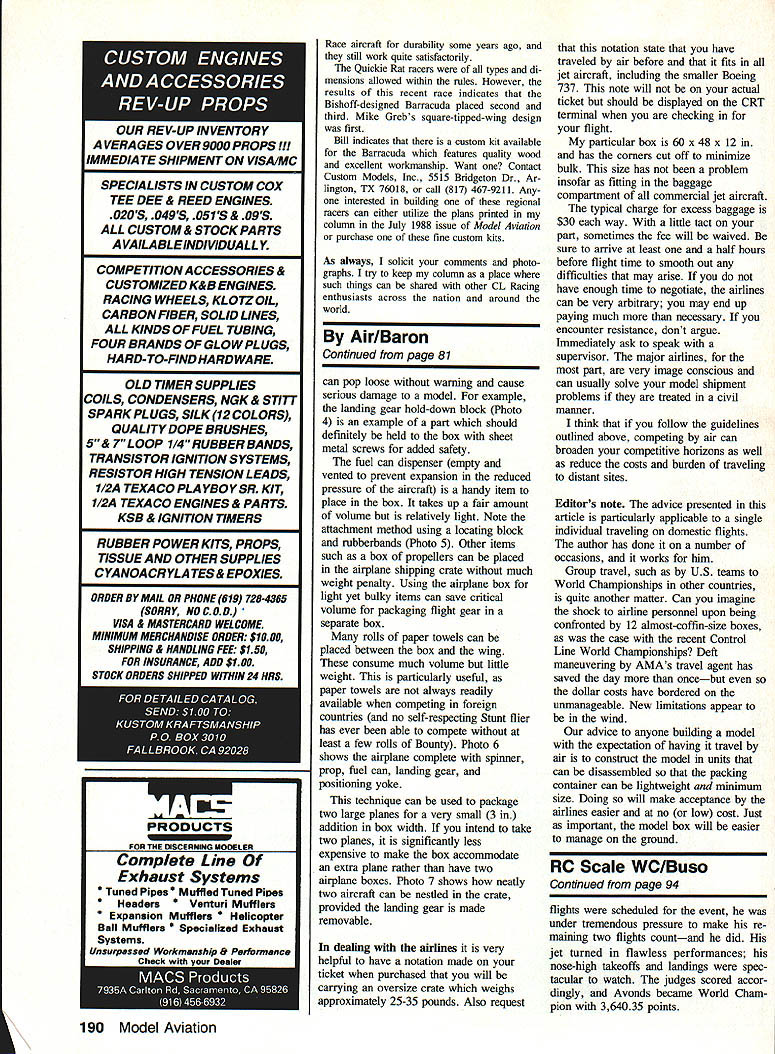
Bob Hanft and his Proctor Nieuport 28‑C1 received the seventh highest flight average of the 116 flights scored. Although he had a modest static showing, Bob outflew both of his teammates, who finished eighth and ninth respectively in flight scoring. Bob's slow and precise flights influenced his final realism score positively. During his last flight, hundreds of spectators and fellow contestants reacted with thunderous applause when Bob executed a perfectly flown touch‑and‑go—the first attempted at the competition—and later made a near‑perfect approach, landing, and rollout.
Top winners and team results
- Individual winner: Avonds (F‑15 Eagle) — World Champion with 3,640.35 points. His jet had engine trouble on the first attempt but produced two flawless flights thereafter, including spectacular nose‑high takeoffs and landings.
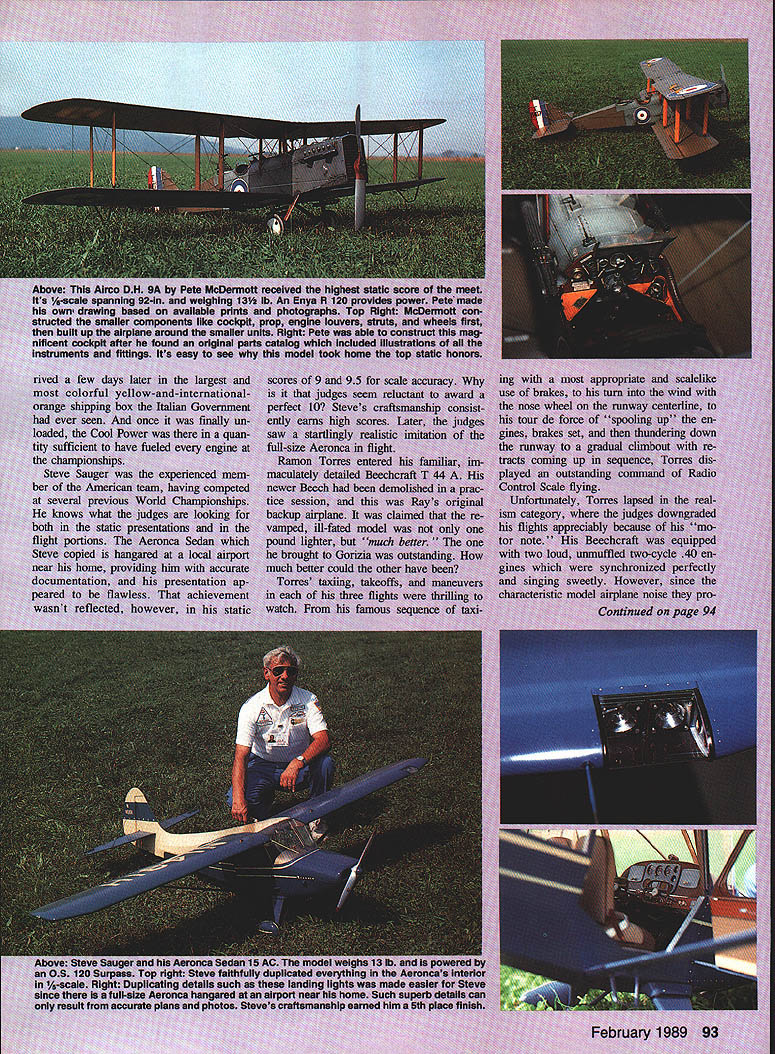
- Second place: Pete McDermott (Great Britain) — Airco DH.9A, total 3,634.90 points. McDermott earned the highest static score of the contest and an outstanding flight score of 1,754.90.
- Third place: Max Merkenschlager — Bristol Scout D (also noted for achieving the highest single flight score during the meet).
- Fourth place: Brian Taylor — Mosquito (two O.S. Surpass .40 four‑stroke engines with special muffling). His first flight was exceptional and produced an authentic motor note; during his second flight the left engine stopped at low altitude, the Mosquito snapped into a spin, but he recovered control at about three feet and executed a wheel landing in the grass. After repairs he flew the next day without problems.
- Fifth place: Steve Sauger — Aeronca Sedan.
- Sixth place: Mick Reeves — Sopwith Camel.
- Tenth place: Ramon Torres — Beechcraft T‑34A.
First‑place team standing went to Great Britain: Pete McDermott, Brian Taylor, and Mick Reeves. Early in the week most participants had predicted that McDermott and the British team would be the ones to beat.
Judging and what it took to place well
What did it take to finish in the upper 50% at this F4C World Championships?
- Exceptional construction and realism. The best models were built to a degree of perfection and realism appropriate for museum display. The level of cockpit/cabin detail, engine detail, surface textures, coloring, and markings was extremely high. Comparable workmanship can be found at serious RC Scale Masters contests (for example, the 1987 event in Las Vegas). At FAI World Championships, models are restricted to a 7‑kg weight limit and FAI scale rules, which can be challenging to meet in popular 1/2‑ and 1/4‑scale categories.
- Absolute scale‑like flight realism. Winning fliers achieved presentations that matched full‑scale aircraft in speed, sound, attitude, and maneuverability. A Sopwith Camel flies slowly and quietly; an F‑15 Eagle flies fast and is noisy. Top fliers adhered literally to the rules and presented well‑planned, choreographed flights for the judges.
FAI rules require judges to note scale speed, flight attitude, smoothness of control, motor note, and how the model flies between maneuvers. The entire flight is observed and scored from initial taxi to final rollout. The top competitors fully recognized this thorough system of judging and tailored their presentations accordingly.
Transcribed from original scans by AI. Minor OCR errors may remain.

