
RC Simulates Proposed Full-Scale Design
A. Richard Akelewicz
Since RC dynamically similar models of actual aircraft have proved their worth in flight testing, the author reasoned that a proposed circular wing aircraft should fly similar to an RC test model. Design changes found necessary in the model would save money and time, and point the way to a successful full-scale prototype.
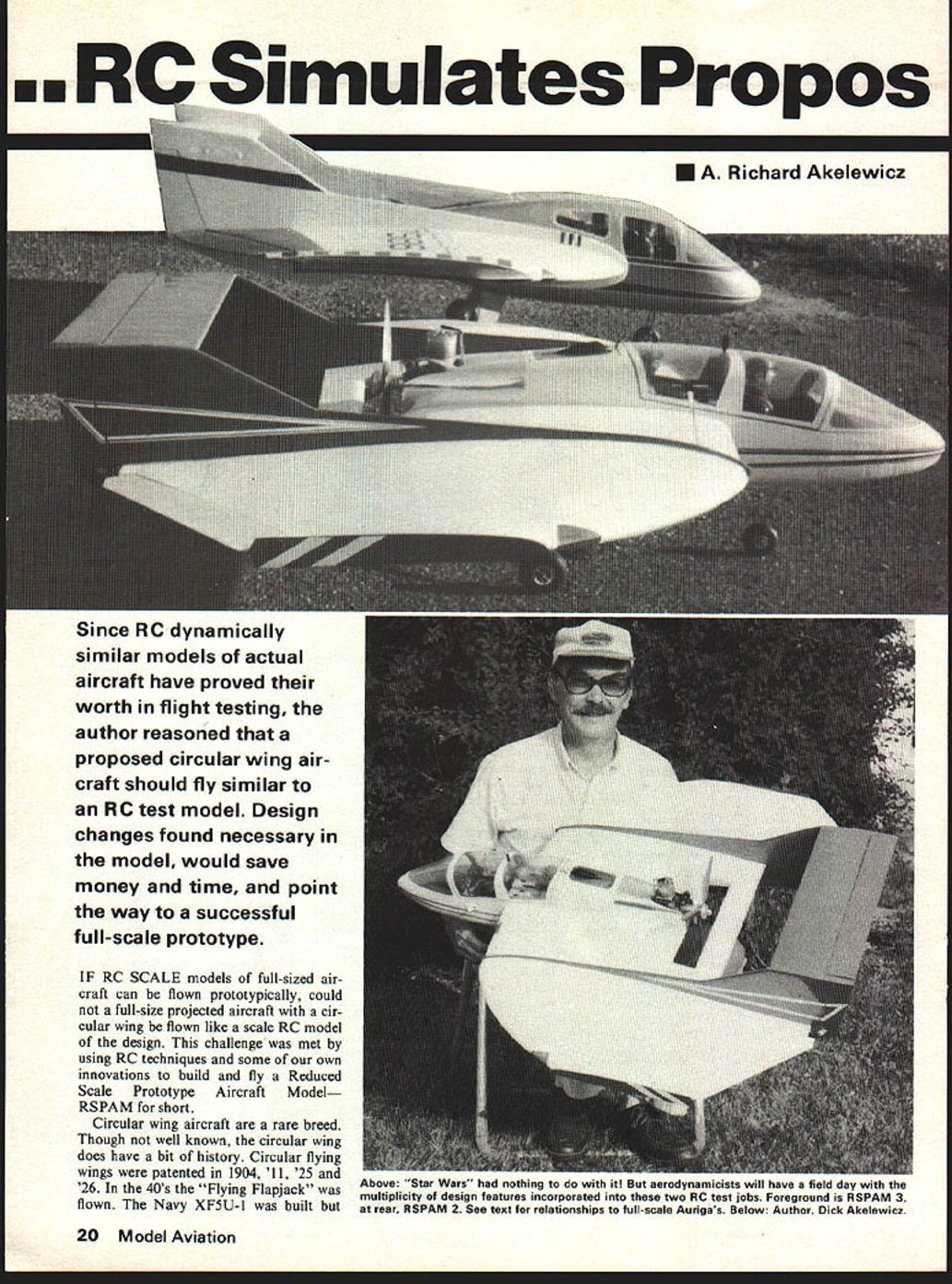
If RC scale models of full-sized aircraft can be flown prototypically, could not a full-size projected aircraft with a circular wing be flown like a scale RC model of the design. This challenge was met by using RC techniques and some of our own innovations to build and fly a Reduced Scale Prototype Aircraft Model—RSPAM for short.
Circular wing aircraft are a rare breed. Though not well known, the circular wing does have a bit of history. Circular flying wings were patented in 1904, ’11, ’25 and ’26. In the ’40s the “Flying Flapjack” was flown. The Navy XF5U-1 was built but...
Undaunted, history perhaps inspired Curtis Kissinger to experiment with the circular wing concept and he patented a version in 1958. After one-man glider and wind-tunnel tests, a CL‑RC combination model, RSPAM 1, was an improved version; a patent was issued in 1975. RSPAM 1 was built after Curtis collaborated to build an RC model, taking control lines out of the CL‑RC combination and using newer RC equipment available. The originally projected aircraft was named Charioteer. The full-scale projected circular-wing design appears unusual, but the aircraft surely flies the way it should. RSPAMs proved the projected aircraft concept: a two-place sport design with a slightly modified circular wing. RSPAM exhibited very stable flight modes with full control, short takeoff and landing, and low-speed handling as a standard mode. Capable of very slow flight as well as relatively high-speed economical cruise, it would have an 18‑ft wing span with very large wing area and a respectable glide. Its aerobatic capability was limited; stalls and spins were an exception.
Also envisioned was AURIGA II and its counterpart RC model RSPAM 3; a four-place version with similar characteristics was considered, designed for short mid-range economical travel with a 21‑ft wingspan. Prior Charioteer/RSPAM 1 versions were also intended to have a 21‑ft wingspan for the original manned experimental aircraft; possible RPV applications were noted. RSPAM 1 provided visible proof that the circular wing could sustain actual flight. Flight testing of the models showed that the full-scale aircraft would fly as intended and quickly pointed out design areas for improvement. Easily modified to match phases of flight testing, the models exceeded the flight characteristics claimed for the full-scale aircraft.
Due to unforeseen circumstances beyond our control, other RC testing of the prototype was delayed, and work on a redesigned Charioteer (RSPAM 1 private-type aircraft) was carried forward. Thus AURIGA I/RSPAM 2 and AURIGA II/RSPAM 3 were developed as the idea gathered sufficient data. New-design development usually went the route Curtis did: sketches, models, gliders and engineering wind-tunnel tests, with the hope that the prototype would fly well. Since the circular wing is a departure from the standard wing type, some were uneasy about building and flying one, although engineering data indicated it would fly. Aeromodel publications over time showed, through various articles, modelers using full-house-scale models already duplicating to some degree the flying characteristics of certain real aircraft. So could the same be done for the circular-wing concept? We could lose a model, but not a real aircraft. As it turned out, we were able to fly the flight envelope as designed and gained experience. RSPAMs first strictly RC model, RSPAM 1, flew in April 1978, simulating slow-flight attitudes with positive control and appropriate control deflections... Put to pasture by a new breed of aircraft—the jet.
Undaunted by this history, or perhaps inspired by it, Curtis Kissinger experimented with the circular wing concept, and patented his version in 1958. After a one-man glider, wind tunnel tests, a CL-RC combination model, and RSPAM 1, an improved version patent was issued in 1975.
RSPAM 1 was built after Curtis and I collaborated to build an RC model, taking the control lines out of the CL-RC combination, and using the newer RC equipment available. This is the originally projected aircraft named Charioteer.
The full-scale projected aircraft of a circular wing design appears to be unusual (it is) but, in fact, it is an aircraft in that it surely flies the way an aircraft should. The RSPAMs prove that.
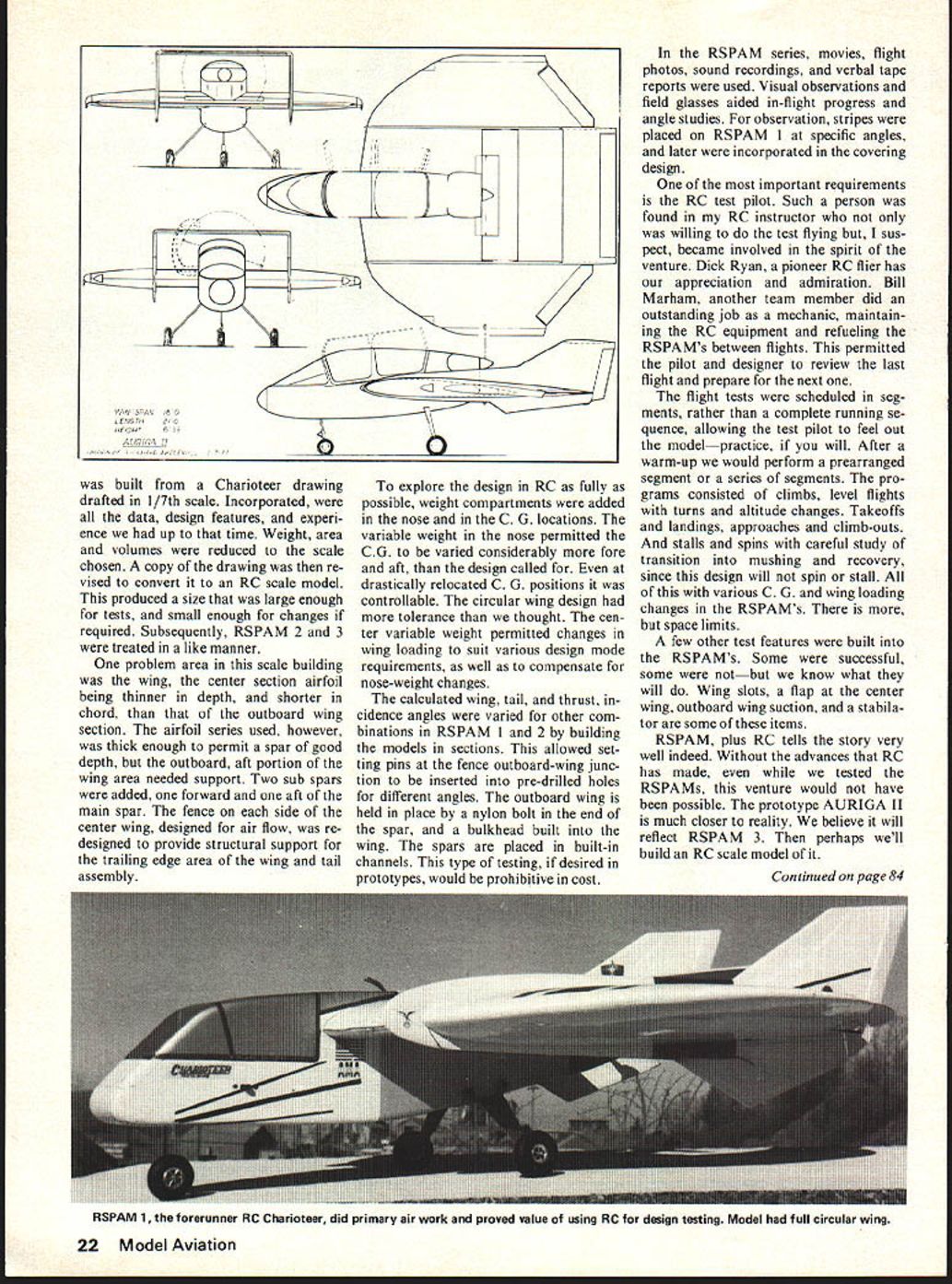
The projected aircraft is a two-place sport design with a slightly modified circular wing. (It the RSPAM) is very stable in all flight modes, with full control. Short takeoff and landing at low speed, or standard mode, will be the pilot’s choice. Capable of very slow flight, it will have a relatively high speed, and an economical cruise. It will not stall or spin. For an 18-ft. wing span, it will have a very large wing area, and a respectable glide. It’s acrobatic, with the exception of stalls and spins. This is AURIGA II—its counterpart RC model is RSPAM 3.
Also envisioned, a four-place version having the same characteristics, but not acrobatic, is designed for short or mid-range economic travel. Wing span will be 21 ft. This is AURIGA I—its counterpart RC model is RSPAM 2.
Prior to these two there is Charioteer/RSPAM 1, also intended to have a 21-ft. wing span. It is our original venture for a manned, experimental aircraft, and a possible RPV application. RSPAM 1 provided us visible proof of the circular wing in actual flight, and sustained our venture of using RC models for flight testing. While the model showed us the big airplane would fly as intended, it quickly pointed out some design areas for improvement. Easily modified, it matched, and in many phases of flight tests, exceeded the flight characteristics claimed for the real aircraft.
Due to unforeseen circumstances beyond our control, other than RC testing, the prototype has been delayed. To carry on the work, I redesigned Charioteer/RSPAM 1 into a private type aircraft. Thus AURIGA I/RSPAM 2 and AURIGA II/RSPAM 3.
A relatively few years ago the idea of gathering sufficient data for a new design usually went the route, as Curtiss did, of sketches, models, gliders, engineering, and wind tunnel tests. Hopefully, the prototype would fly well. Since the circular wing is a departure from the standard type of wing, many cringed at the idea of building one, and more so at flying it, although data and engineering said it would fly.
The aeromodel publications of the time had shown, through various articles, that modelers using full-house in their scale models were already duplicating, to a degree, some of the real aircraft flying characteristics. So we could do the same. At the worst we could lose a model, not a real aircraft. As it turned out, we were able to fly all of the flight envelope of the design, as we gained experience with the RSPAMs.
The first strictly RC model, RSPAM 1 was built from a Charioteer drawing drafted in 1/7th scale. Incorporated, were all the data, design features, and experience we had up to that time. Weight, area and volumes were reduced to the scale chosen. A copy of the drawing was then revised to convert it to an RC scale model. This produced a size that was large enough for tests, and small enough for changes if required. Subsequently, RSPAM 2 and 3 were treated in a like manner.
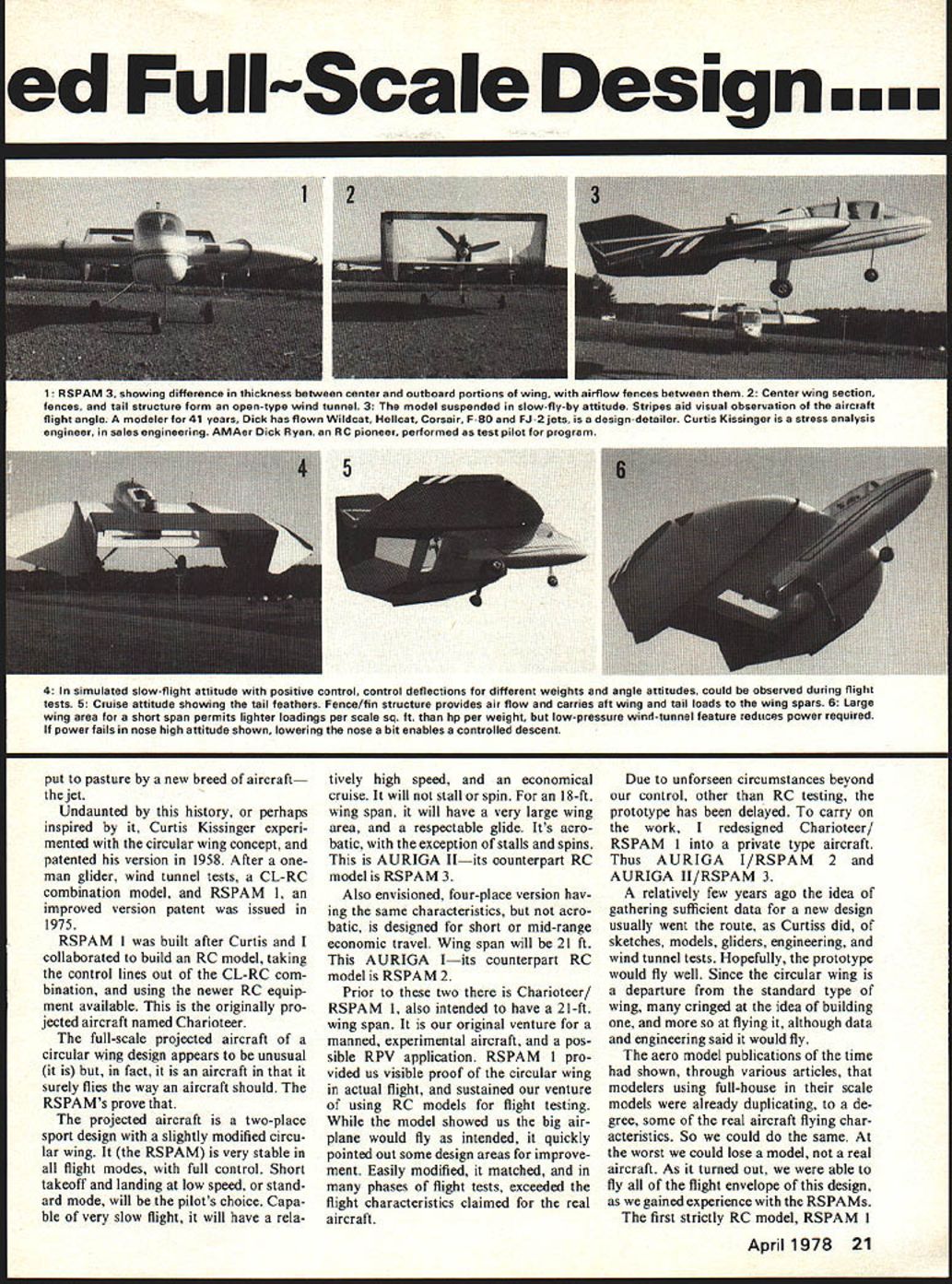
One problem area in this scale building was the wing, the center section airfoil being thinner in depth, and shorter in chord, than that of the outboard wing section. The airfoil series used, however, was thick enough to permit a spar of good depth, but the outboard, aft portion of the wing area needed support. Two sub spars were added, one forward and one aft of the main spar. The fence on each side of the center wing, designed for air flow, was re-designed to provide structural support for the trailing edge area of the wing and tail assembly.
To explore the design in RC as fully as possible, weight compartments were added in the nose and in the C.G. locations. The variable weight in the nose permitted the C.G. to be varied considerably more fore and aft, than the design called for. Even at drastically relocated C.G. positions it was controllable. The circular wing design had more tolerance than we thought. The center variable weight permitted changes in wing loading to suit various design mode requirements, as well as to compensate for nose-weight changes.
The calculated wing, tail, and thrust, incidence angles were varied for other combinations in RSPAM 1 and 2 by building the models in sections. This allowed setting pins at the fence outboard-wing junction to be inserted into pre-drilled holes for different angles. The outboard wing is held in place by a nylon bolt in the end of the spar, and a bulkhead built into the wing. The spars are placed in built-in channels. This type of testing, if desired in prototypes, would be prohibitive in cost.
In the RSPAM series, movies, flight photos, sound recordings, and verbal tape reports were used. Visual observations and field glasses aided in-flight progress and angle studies. For observation, stripes were placed on RSPAM 1 at specific angles, and later were incorporated in the covering design.
One of the most important requirements is the RC test pilot. Such a person was found in my RC instructor who not only was willing to do the test flying but, I suspect, became involved in the spirit of the venture. Dick Ryan, a pioneer RC flier has our appreciation and admiration. Bill Marham, another team member did an outstanding job as a mechanic, maintaining the RC equipment and refueling the RSPAM's between flights. This permitted the pilot and designer to review the last flight and prepare for the next one.
The flight tests were scheduled in segments, rather than a complete running sequence, allowing the test pilot to feel out the model—practice, if you will. After a warm-up we would perform a prearranged segment or a series of segments. The programs consisted of climbs, level flights with turns and altitude changes. Takeoffs and landings, approaches and climb-outs. And stalls and spins with careful study of transition into mushing and recovery, since this design will not spin or stall. All of this with various C.G. and wing loading changes in the RSPAM's. There is more, but space limits.
A few other test features were built into the RSPAM's. Some were successful, some were not—but we know what they will do. Wing slots, a flap at the center wing, outboard wing suction, and a stabilator are some of these items.
RSPAM, plus RC tells the story very well indeed. Without the advances that RC has made, even while we tested the RSPAMs, this venture would not have been possible. The prototype AURIGA II is much closer to reality. We believe it will reflect RSPAM 3. Then perhaps we'll build an RC scale model of it.
The RC RSPAMs
RSPAM 1/Charioteer — Experimental. Wing span, 36" diameter; Length 48"; Weight, 7½ to 10 lbs. K&B .40.
RSPAM 2/AURIGA I: Private type, 4-passenger. Wing span, modified to 42" diameter; Length 49½"; Weight, 7¾ to 11½ lbs. K&B .40 and Super Tigre .46.
RSPAM 3/AURIGA II: Private type, two place. Wing span modified to 36" diameter; Length, 41½"; Weight, 5¾ to 9 lbs. K&B .40.
Fuselage mainframes, thin plywood. Balsa on No. 1, and urethane foam contour on No. 2 and 3. Wings of urethane foam on No. 1 and 2. Styrofoam meat tray ribs with capstrips on No. 3. Covering on all three is colored polymer heat-shrink film.
RC equipment is MRC 5-channel in No. 1 and 3, and RS Systems 6-channel in No. 2.
Comments are welcome. A SASE would be appreciated if you would like a reply.
Transcribed from original scans by AI. Minor OCR errors may remain.

