
New and old sailplanes for small hills
by Dave Garwood
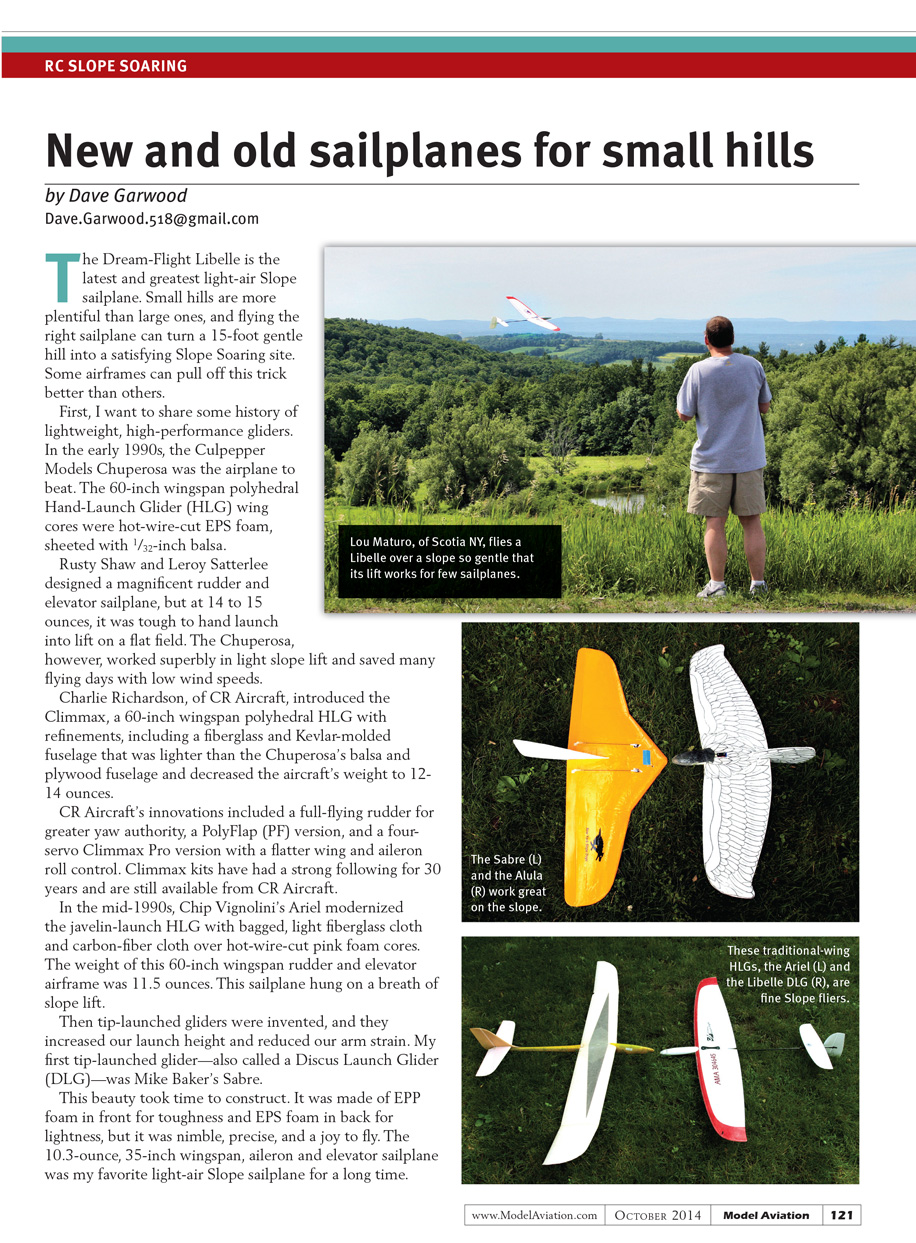
The Dream-Flight Libelle is the latest and greatest light-air slope sailplane. Small hills are more plentiful than large ones, and flying the right sailplane can turn a 15-foot gentle hill into a satisfying slope-soaring site. Some airframes can pull off this trick better than others.
First, I want to share some history of lightweight, high-performance gliders. In the early 1990s, the Culpepper Models Chuperosa was the airplane to beat. The 60-inch-wingspan polyhedral hand-launch glider (HLG) wing cores were hot-wire-cut EPS foam, sheeted with 1/32-inch balsa. Rusty Shaw and Leroy Satterlee designed a magnificent rudder-and-elevator sailplane, but at 14 to 15 ounces it was tough to hand-launch into lift on a flat field. The Chuperosa, however, worked superbly in light slope lift and saved many flying days with low wind speeds.
Charlie Richardson, of CR Aircraft, introduced the Climmax, a 60-inch-wingspan polyhedral HLG with refinements, including a fiberglass- and Kevlar-molded fuselage that was lighter than the Chuperosa’s balsa-and-plywood fuselage and decreased the aircraft’s weight to 12–14 ounces. CR Aircraft’s innovations included a full-flying rudder for greater yaw authority, a PolyFlap (PF) version, and a four-servo Climmax Pro version with a flatter wing and aileron roll control. Climmax kits have had a strong following for 30 years and are still available from CR Aircraft.
In the mid-1990s, Chip Vignolini’s Ariel modernized the javelin-launch HLG with bagged, light fiberglass cloth and carbon-fiber cloth over hot-wire-cut pink foam cores. The weight of this 60-inch-wingspan rudder-and-elevator airframe was 11.5 ounces. This sailplane hung on a breath of slope lift.
Then tip-launched gliders were invented, and they increased our launch height and reduced our arm strain. My first tip-launched glider—also called a discus-launch glider (DLG)—was Mike Baker’s Sabre. This beauty took time to construct. It was made of EPP foam in front for toughness and EPS foam in back for lightness, but it was nimble, precise, and a joy to fly. The 10.3-ounce, 35-inch-wingspan, aileron-and-elevator sailplane was my favorite light-air slope sailplane for a long time.
Enter the Dream-Flight Alula, an all-molded foam 35-inch-wingspan aileron-and-elevator sailplane. Michael Richter’s design work dropped the weight of this light-air aerobatic airframe to 6.2 ounces. Designed for both slope and tip-launched flight, the Alula had a gripper patch under the wing, which came in handy if the pilot needed to fly over an obstacle to reach the slope lift.
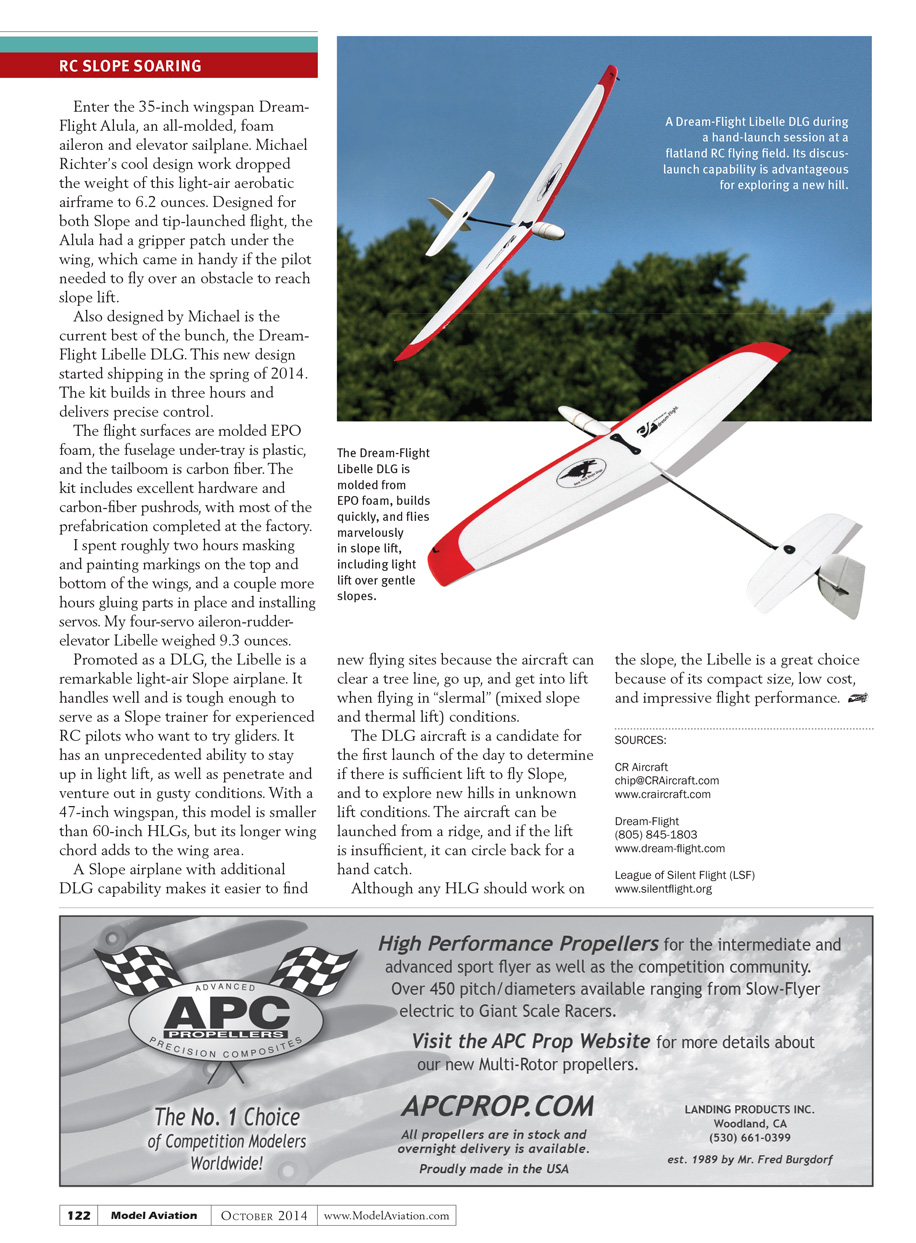
Also designed by Michael is the current best of the bunch, the Dream-Flight Libelle DLG. This new design started shipping in the spring of 2014. The kit builds in three hours and delivers precise control. The flight surfaces are molded EPO foam, the fuselage undertray is plastic, and the tail boom is carbon fiber. The kit includes excellent hardware and carbon-fiber pushrods, with most of the prefabrication completed at the factory. I spent roughly two hours masking and painting markings on the top and bottom of the wings, and a couple more hours gluing parts in place and installing servos. My four-servo aileron-rudder-elevator Libelle weighed 9.3 ounces.
Promoted as a DLG, the Libelle is a remarkable light-air slope airplane. It handles well and is tough enough to serve as a slope trainer for experienced RC pilots who want to try gliders. It has an unprecedented ability to stay up in light lift, as well as penetrate and venture out in gusty conditions. This 47-inch-wingspan model is smaller than 60-inch HLGs, but its longer wing chord adds to the wing area.
A slope airplane with the additional DLG capability makes it easier to find new flying sites because the aircraft can clear a tree line, go up, and get into lift when flying in "slermal" (mixed slope and thermal lift) conditions. The DLG aircraft is a candidate for the first launch of the day to determine if there is sufficient lift to fly the slope, and to explore new hills in unknown lift conditions. The aircraft can be launched from a ridge, and if the lift is insufficient, it can circle back for a hand catch.
Although any HLG should work on the slope, the Libelle is a great choice because of its compact size, low cost, and impressive flight performance.
Sources
- CR Aircraft
chip@CRAircraft.com www.craircraft.com
- Dream-Flight
(805) 845-1803 www.dream-flight.com
- League of Silent Flight (LSF)
Transcribed from original scans by AI. Minor OCR errors may remain.

