
RC Soaring World Championships
Text and photos: Dan Pruss
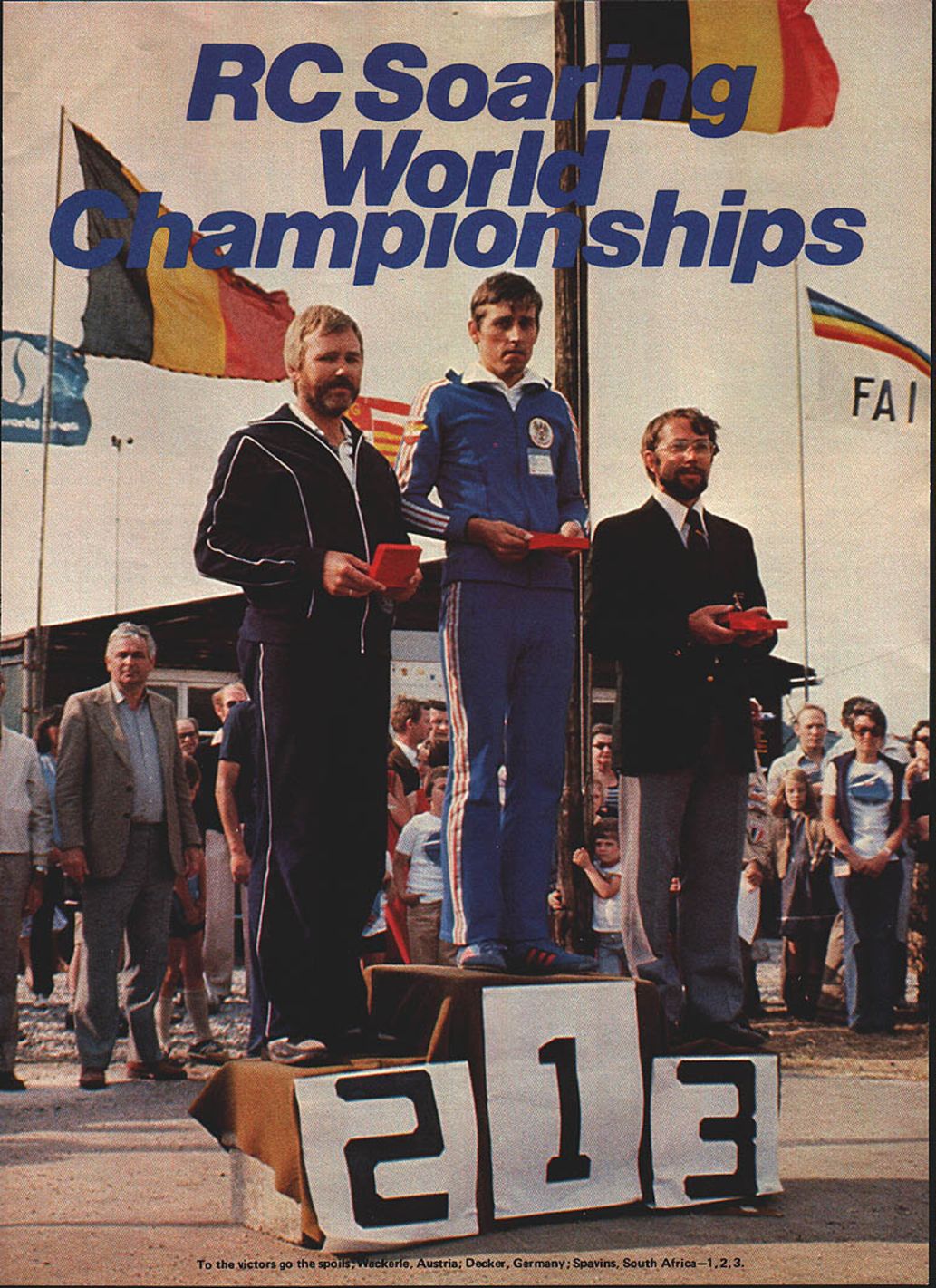
To the victors go the spoils: Wackerle, Austria; Decker, Germany; Spavins, South Africa — 1, 2, 3.
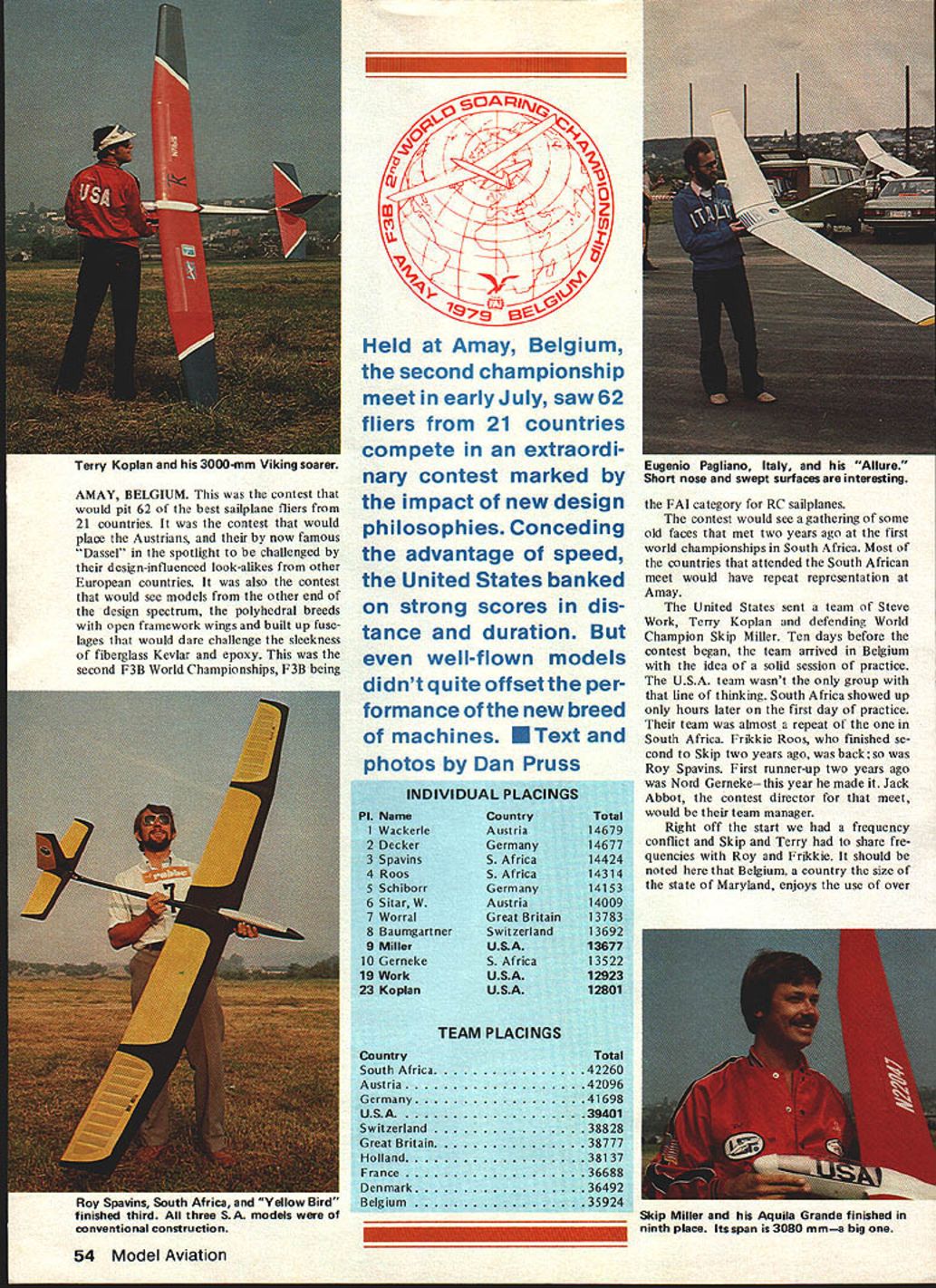
AMAY, BELGIUM — The second F3B World Championships (F3B is the FAI category for RC sailplanes) drew 62 of the best sailplane fliers from 21 countries. The contest put the Austrians and their now-famous "Dassel" designs in the spotlight, and pitted those sleek fiberglass/Kevlar/epoxy ships against the polyhedral, open-framework, built-up-fuselage designs from other countries. It was also a reunion of many faces from the first world championships held two years earlier in South Africa.
U.S. team and other arrivals
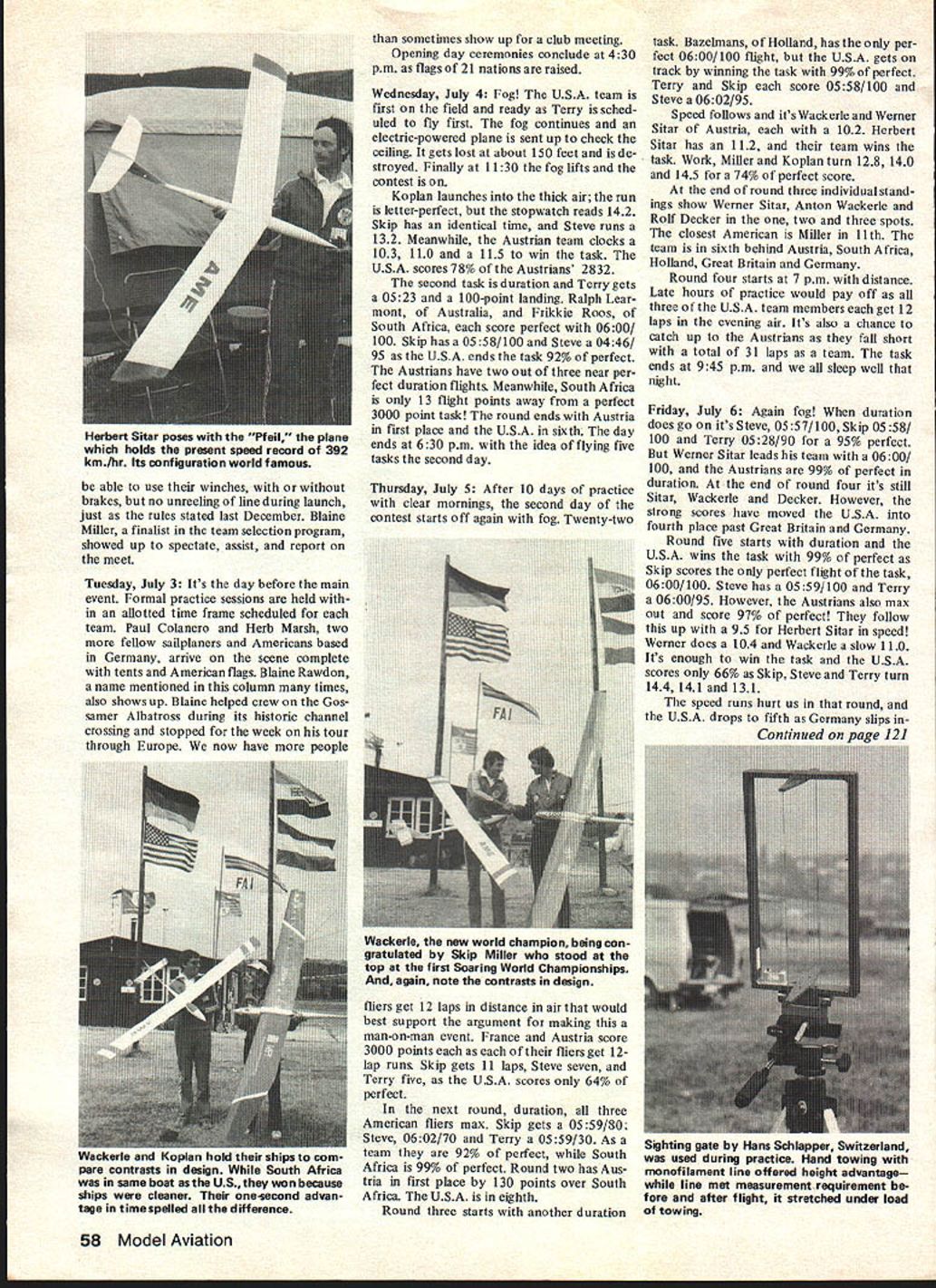
The United States sent Steve Work, Terry Koplan and defending World Champion Skip Miller. The team arrived in Belgium ten days before the contest for a solid period of practice. South Africa arrived just hours later, with Frikkie Roos (second two years earlier), Roy Spavins and Nord Gerneke among the returnees; Jack Abbot, the contest director in South Africa, was their team manager.
Early in practice there was a frequency conflict, forcing Skip and Terry to share frequencies with Roy and Frikkie.
Practice
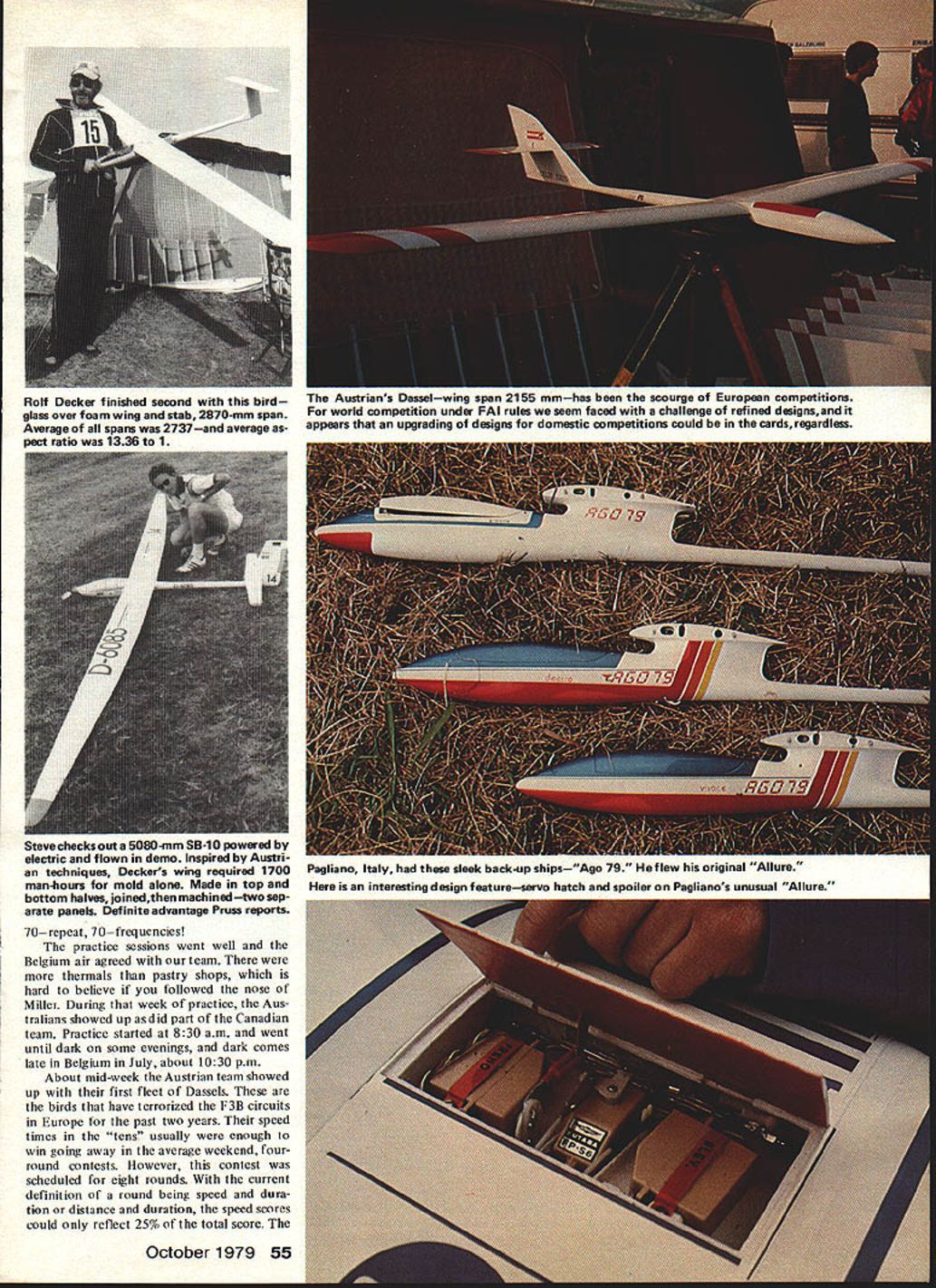
Practice sessions started at 8:30 a.m. and often continued until dark (around 10:30 p.m. in Belgium in July). The Belgians provided plentiful thermals — more thermals than pastry shops, as the team joked. The Australians and part of the Canadian team showed up during the week. Mid-week the Austrian team arrived with their first fleet of Dassels — 2,155 mm wingspan birds that had dominated European F3B competition and whose speed times in the “tens” were normally decisive in shorter contests.
For the world contest, scheduled for eight rounds with the current round definition (speed + duration or distance + duration), speed would account for only 25% of the total score. That changed the game and meant refined designs were being challenged by other approaches.
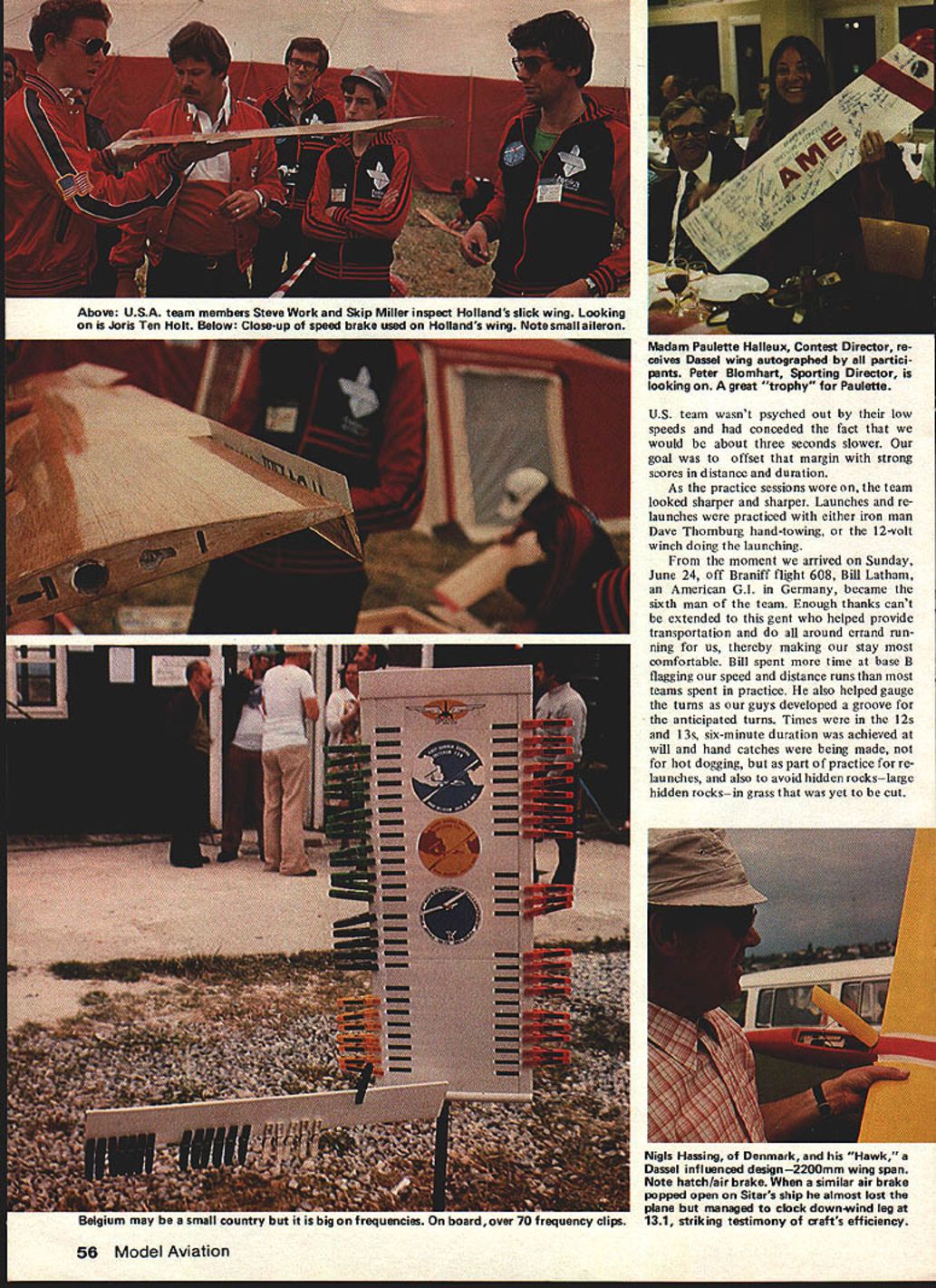
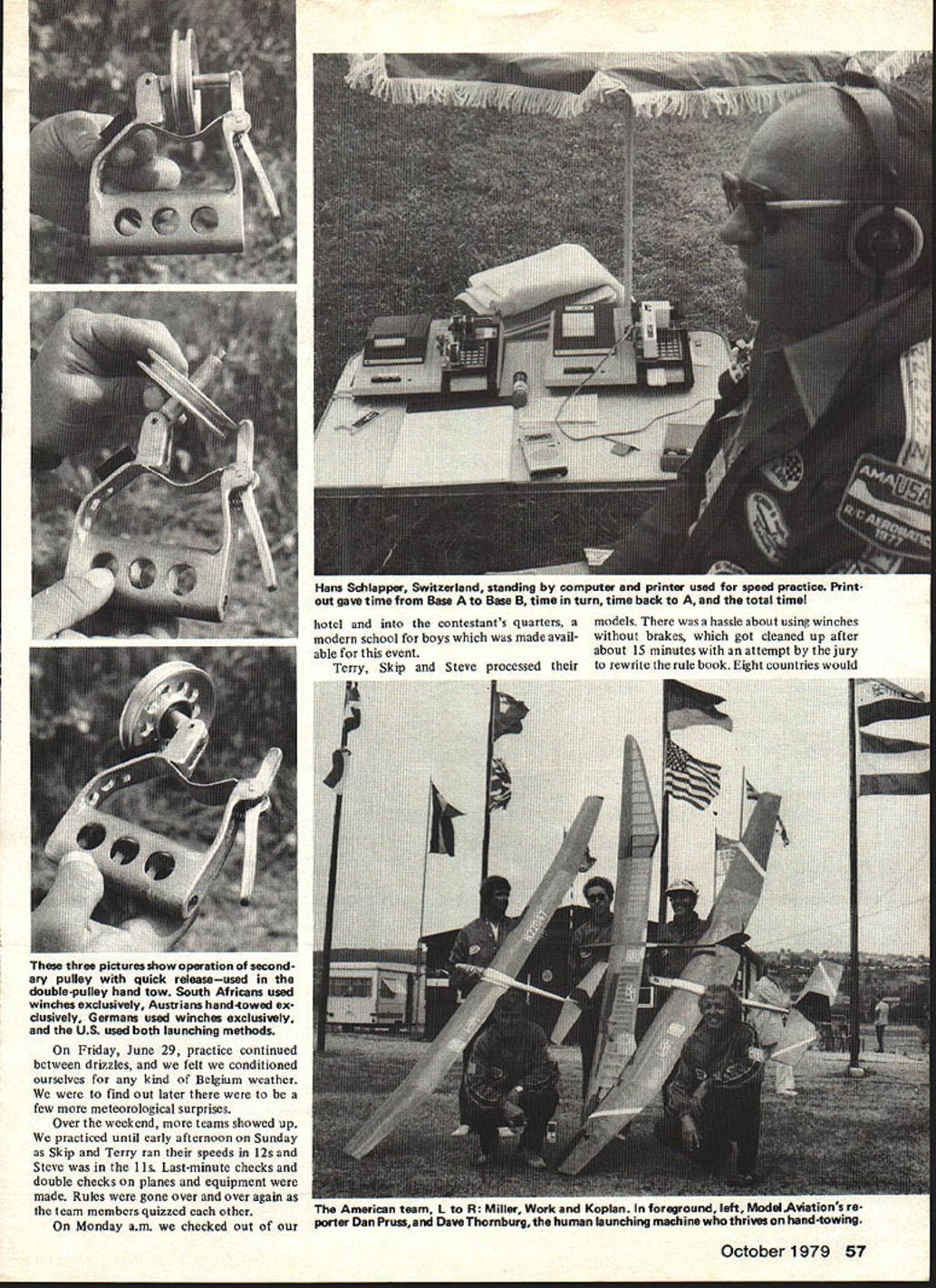
The U.S. team practiced launches and relaunches with either hand-tows by Dave Thornburg or a 12‑volt winch. Bill Latham, an American G.I. based in Germany, became an invaluable sixth member of the team, helping with transportation, flagging speed and distance runs, and assisting at base B. Blaine Miller (a finalist in the team selection) and other American sailplaners based in Germany joined as spectators and crew.
There was a brief controversy about winches without brakes at model processing, which the jury resolved by enforcing the existing rule: winches could be used, with or without brakes, but no unreeling of line during launch. Blaine Rawdon, Paul Colancero and Herb Marsh were among additional American supporters who arrived for practice and opening ceremonies. Flags of 21 nations were raised on opening day.
Competition summary
Wednesday, July 4
Fog delayed the start. The U.S.A. was first on the field; an electric plane sent up to check the ceiling was lost at about 150 feet. After the fog lifted at about 11:30, the contest began.
- Speed: Koplan 14.2, Miller 14.2, Work 13.2; Austrians posted 10.3, 11.0 and 11.5 and won the task. The U.S.A. scored about 78% of the Austrians' 2,832.
- Duration: Terry 05:23/100; Ralph Learmont (Australia) and Frikkie Roos (South Africa) each scored 06:00/100. Skip 05:58/100; Steve 04:46/95. The U.S.A. ended the task about 92% of perfect. Austria led the round; the U.S.A. was sixth. The day ended at 6:30 p.m., with plans to fly five tasks the next day.
Thursday, July 5
Fog again hampered the morning.
- Distance: France and Austria scored 3,000 points each (12 laps each flier). Skip 11 laps, Steve 7, Terry 5; the U.S.A. scored only 64% of perfect.
- Duration: All three Americans maxed: Skip 05:59/80, Steve 06:02/70, Terry 05:59/30 — team 92% of perfect; South Africa 99% of perfect. Austria led by 130 points over South Africa; the U.S.A. was eighth.
- Next duration: Bazelmans (Holland) had the only perfect 06:00/100, but the U.S.A. won the task with 99% of perfect (Terry and Skip 05:58/100, Steve 06:02/95).
- Speed: Wackerle and Werner Sitar (Austria) each 10.2; Herbert Sitar 11.2. Austrians won the task. Work, Miller and Koplan posted 12.8, 14.0 and 14.5 for 74% of perfect.
After round three the individual leaders were Werner Sitar, Anton Wackerle and Rolf Decker. Miller was the closest American in 11th; the U.S.A. team was sixth behind Austria, South Africa, Holland, Great Britain and Germany.
Round four (evening distance) saw all three U.S. fliers get 12 laps; the Austrians fell short as a team, and the task ended at 9:45 p.m.
Friday, July 6
Fog again.
- Duration: Steve 05:57/100, Skip 05:58/100, Terry 05:28/90 — team 95% of perfect. Werner Sitar led his team with 06:00/100 and Austria was 99% of perfect. After round four the U.S.A. moved into fourth, past Great Britain and Germany.
- Round five duration: U.S.A. won the task with 99% of perfect — Skip 06:00/100 (the only perfect of the task), Steve 05:59/100, Terry 06:00/95. Austrians also maxed and scored 97% of perfect.
- Speed in the same round hurt the U.S.A.: Herbert Sitar 9.5, Werner 10.4, Wackerle 11.0. Skip, Steve and Terry turned 14.4, 14.1 and 13.1, giving the U.S.A. only 66% and dropping them to fifth. A bad switch was later found in Terry’s plane.
- Later duration: Terry scored a perfect 06:00/100, Skip 05:57/100, Steve 04:40/100. The U.S.A. was 94% of perfect; South Africa 99%. At the end of the round South Africa took the lead over Austria by 364 points out of a possible ~33,000. Germany was third, Holland fourth, U.S.A. fifth.
Saturday, July 7 — final day
Round seven opened with winds around 8–10 mph. The Austrians continued to excel in speed (Wackerle and Werner Sitar 10.4 and 10.7). Herbert Sitar nearly lost a plane when the canopy opened (acting as a speed brake), yet still clocked 13.1. U.S. speeds were slower (Steve 12.8, Skip 13.3, Terry 13.8), leaving the U.S.A. about 20% off the Austrian pace.
In increased wind, the U.S.A. produced excellent thermal flying and maxed the duration task while Wackerle posted a perfect 06:00/100, yielding a 2,000-point round for him. After that round the U.S.A. held fourth by 445 points. Austria led with South Africa only 337 points behind. Top individual slots were Wackerle, Werner Sitar and Frikkie Roos; Skip Miller was seventh.
Round eight began with 18 mph wind. Skip attempted a downwind bubble technique but drifted out of range; he relaunched and used the remaining 1:45 for a flight score and an 85-point landing. The wind remained strong for the final distance task: Skip flew 8½ laps, Steve 6¾, and Terry, after ballasting his bird to 60 ounces, was one of five to achieve 12 laps. Germany won the task with 80% of perfect; the U.S.A. and Austria were close behind at 76%.
Final results summary
- The Second F3B World Championships concluded with South Africa slipping by Austria to win the team prize.
- Anton Wackerle of Austria won the individual title, edging Rolf Decker (Germany) by two points: 14,679 to 14,677.
- The U.S.A. finished fourth as a team. Individual U.S. placements were Skip Miller 9th, Steve Work 19th, Terry Koplan 23rd.
The meet showed that technology won for Wackerle, but "anti-technology" — balsa and polyhedral — as Nord Gerneke called it, also succeeded for South Africa. South Africa averaged 12.8 seconds in speed (about 84% of the Austrians' 10.8 average); the U.S.A. averaged 13.7 seconds (about 78% of the Austrians'). The U.S.A. outscored 17 other countries, including many flying Austrian-influenced designs, a compliment to Miller, Work and Koplan and their flying ability.
Individual Placings
- 1. Wackerle — Austria — 14,679
- 2. Decker — Germany — 14,677
- 3. Spavins — S. Africa — 14,424
- 4. Roos — S. Africa — 14,314
- 5. Schiborr — Germany — 14,153
- 6. Sitar, W. — Austria — 14,009
- 7. Worral — Great Britain — 13,783
- 8. Baumgartner — Switzerland — 13,692
- 9. Miller — USA — 13,677
- 10. Gerneke — S. Africa — 13,522
- 19. Work — USA — 12,923
- 23. Koplan — USA — 12,801
Team Placings
- South Africa — 42,260
- Austria — 42,096
- Germany — 41,698
- USA — 39,401
- Switzerland — 38,828
- Great Britain — 38,777
- Holland — 38,137
- France — 36,688
- Denmark — 36,492
- Belgium — 35,924
Transcribed from original scans by AI. Minor OCR errors may remain.

