
RC Soaring World Championships
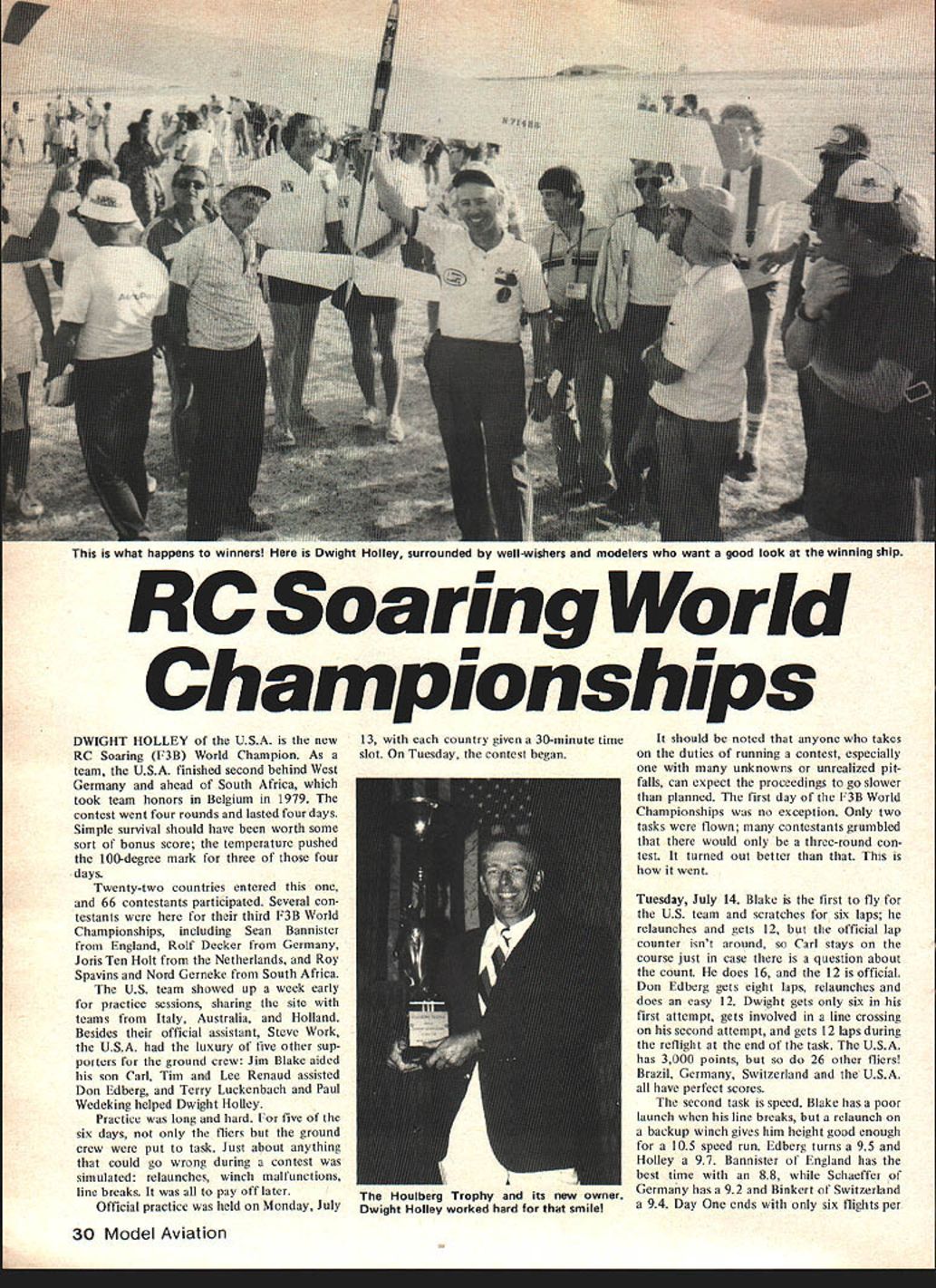
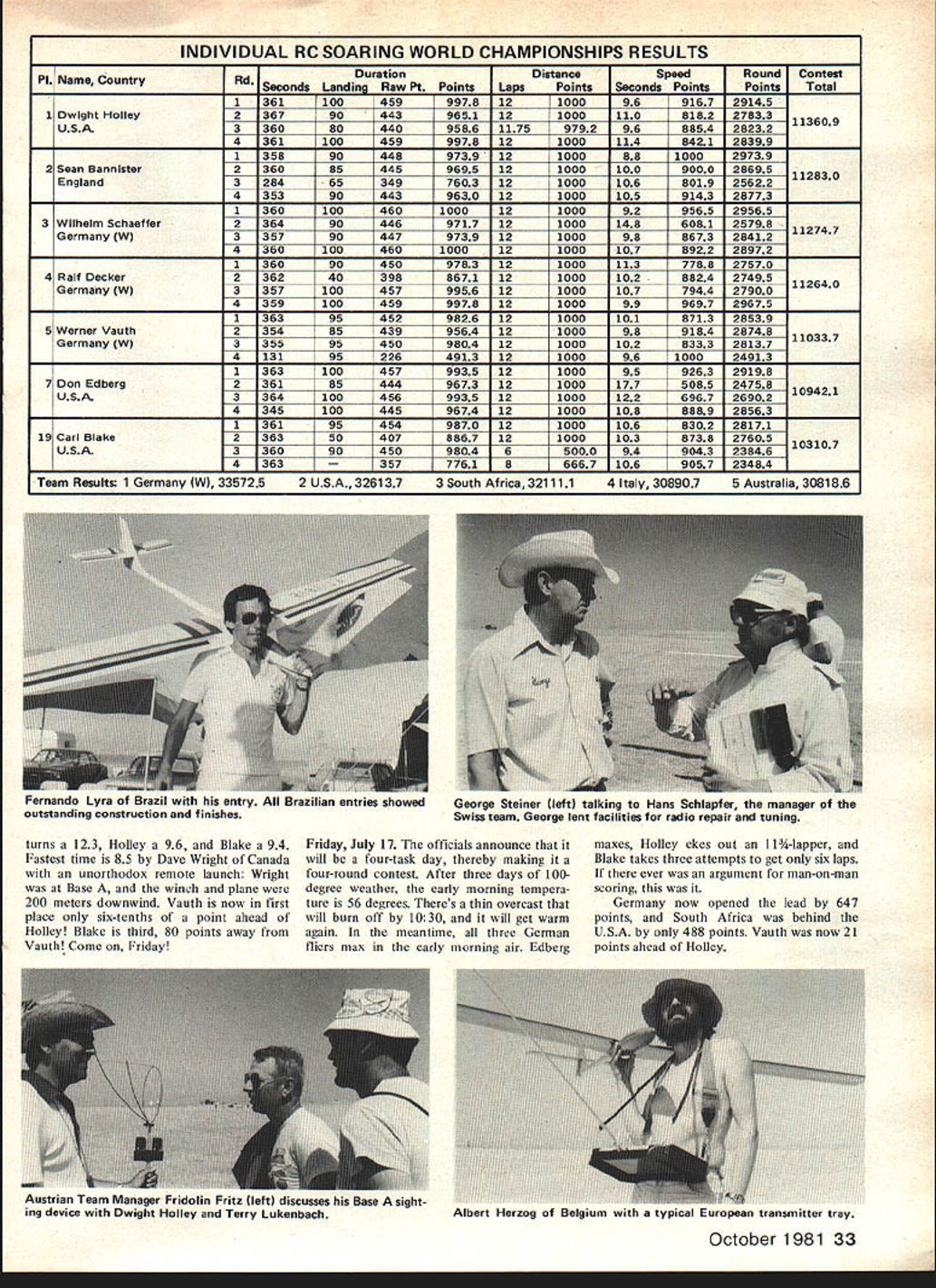
DWIGHT HOLLEY of the U.S.A. is the new RC Soaring (F3B) World Champion. As a team, the U.S.A. finished second behind West Germany and ahead of South Africa, which took team honors in Belgium in 1979. The contest went four rounds and lasted four days. Simple survival should have been worth some sort of bonus score; the temperature pushed the 100-degree mark for three of those four days.
Twenty-two countries entered this event, and 66 contestants participated. Several contestants were here for their third F3B World Championships, including Sean Bannister (England), Rolf Decker (Germany), Joris Ten Holt (the Netherlands), and Roy Spavins and Nord Gerneke (South Africa).
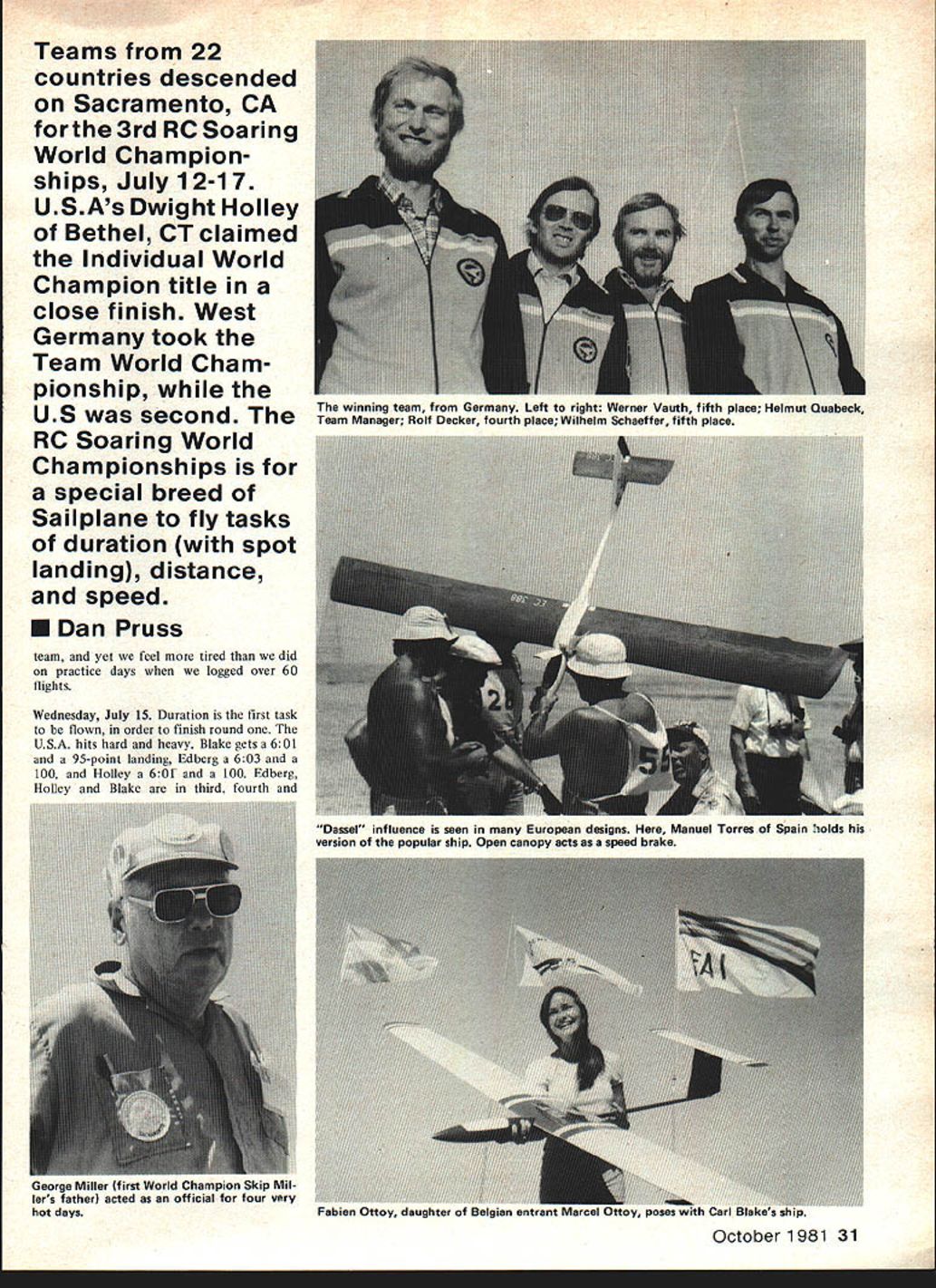
Teams from 22 countries descended on Sacramento, CA for the 3rd RC Soaring World Championships, July 12–17. U.S.A.'s Dwight Holley of Bethel, CT claimed the Individual World Champion title in a close finish. West Germany took the Team World Championship, while the U.S. was second. The RC Soaring World Championships is for a special breed of sailplane to fly tasks of duration (with spot landing), distance, and speed. — Dan Pruss
Practice and preparation
The U.S. team showed up a week early for practice sessions, sharing the site with teams from Italy, Australia, and Holland. Besides their official assistant, Steve Work, the U.S.A. had the luxury of five other supporters for the ground crew:
- Jim Blake (aided his son Carl)
- Tim and Lee Renaud (assisted Don Edberg)
- Terry Luckenbach and Paul Wedeking (helped Dwight Holley)
Practice was long and hard. For five of the six days, not only the fliers but the ground crew were put to task. Just about anything that could go wrong during a contest was simulated: relaunches, winch malfunctions, line breaks. It was all to pay off later.
Official practice was held on Monday, July 13, with each country given a 30-minute time slot. On Tuesday, the contest began.
It should be noted that anyone who takes on the duties of running a contest, especially one with many unknowns or unrealized pitfalls, can expect the proceedings to go slower than planned. The first day of the F3B World Championships was no exception. Only two tasks were flown; many contestants grumbled that there would only be a three-round contest. It turned out better than that. This is how it went.
Tuesday, July 14
Carl Blake was the first to fly for the U.S. team and scratched for six laps; he relaunches and gets 12, but the official lap counter isn't around, so Carl stays on the course just in case of a count question. He does 16, and the 12 is official. Don Edberg gets eight laps, relaunches and does an easy 12. Dwight gets only six in his first attempt, gets involved in a line crossing on his second attempt, and gets 12 laps during the reflight at the end of the task. The U.S.A. has 3,000 points, but so do 26 other fliers! Brazil, Germany, Switzerland and the U.S.A. all have perfect scores.
The second task is speed. Blake has a poor launch when his line breaks, but a relaunch on a backup winch gives him height good enough for a 10.5 speed run. Edberg posts a 9.5 and Holley a 9.7. Bannister of England has the best time with an 8.8, while Schaeffer of Germany posts a 9.2 and Binkert of Switzerland a 9.4. Day One ends with only six flights per team, and yet we feel more tired than we did on practice days when we logged over 60 flights.
Wednesday, July 15
Duration is the first task to be flown, in order to finish round one. The U.S.A. hits hard and heavy. Blake gets a 6:01 and a 95-point landing, Edberg a 6:03 and a 100, and Holley a 6:01 and a 100. Edberg, Holley and Blake are in third, fourth and seventh place, and the U.S.A. team is in first place by 84 points over Germany.
Officials doubled up flight groups for the next duration task, and there are nine planes launching at once. When they all max there are also nine landings at once. There are nine landing zones, but not all are on flat ground because the flying site itself rolls, dips and slopes.
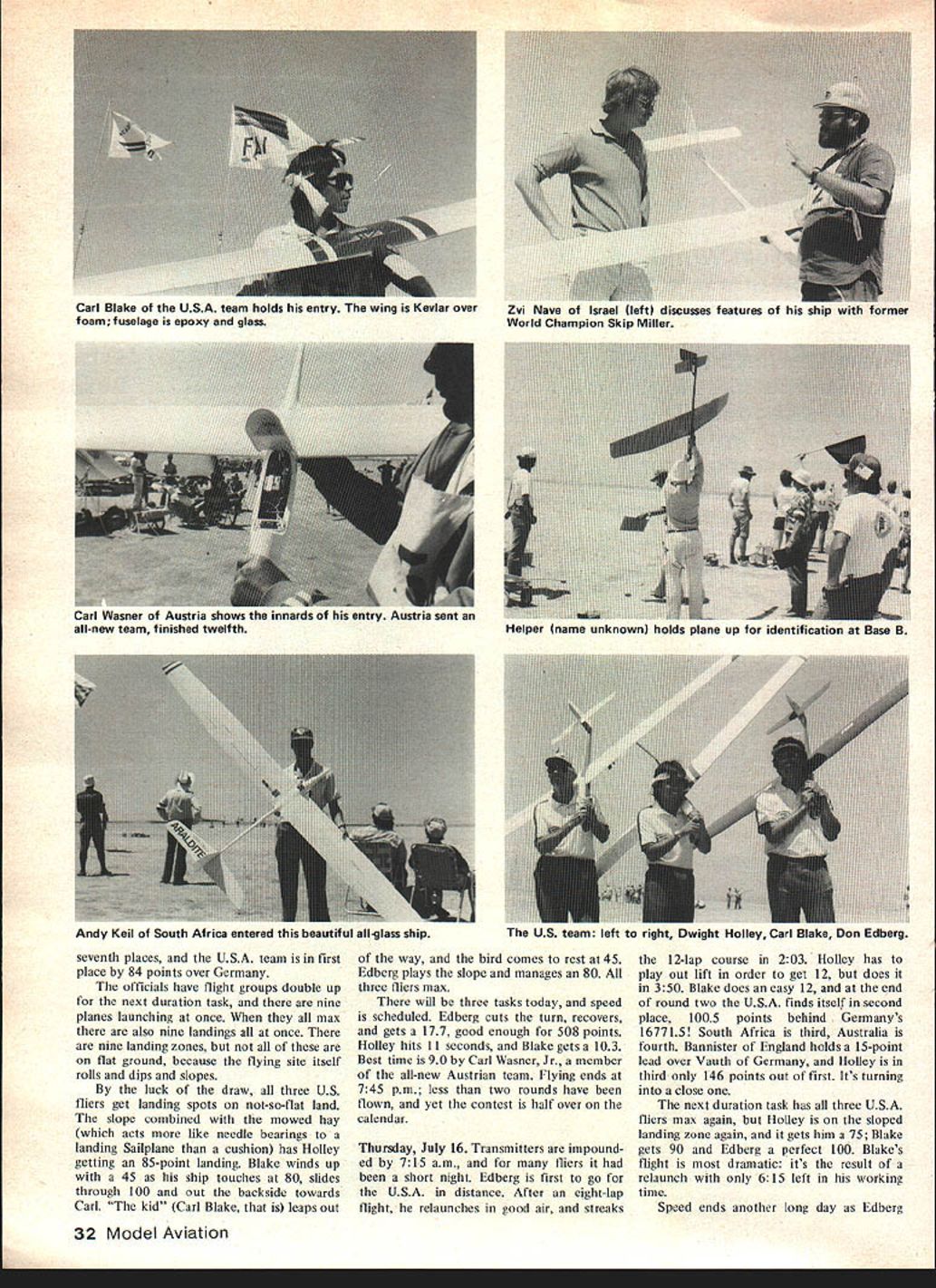
By the luck of the draw, all three U.S. fliers get landing spots on not-so-flat land. The slope combined with the mowed hay (which acts more like needle bearings to a landing sailplane than a cushion) results in Holley getting an 85-point landing. Blake winds up with a 45 as his ship touches at 80, slides through 100 and out the backside towards Carl. Carl leaps out of the way, and the bird comes to rest at 45. Edberg plays the slope and manages an 80. All three fliers max.
There are three tasks scheduled for the day; speed is next. Edberg cuts the turn, recovers, and gets a 17.7, good enough for 508 points. Holley hits 11 seconds, and Blake gets a 10.3. Best time is 9.0 by Carl Wasner, Jr., a member of the new Austrian team. Flying ends at 7:45 p.m.; less than two rounds have been flown, and yet the contest is half over on the calendar.
Thursday, July 16
Transmitters are impounded by 7:15 a.m., and for many fliers it had been a short night. Edberg is first to go for the U.S.A. in distance. After an eight-lap flight, he relaunches in good air and streaks the 12-lap course in 2:03. Holley has to play out lift in order to get 12, but does it in 3:50. Blake does an easy 12, and at the end of round two the U.S.A. finds itself in second place, 100.5 points behind Germany's 1677.5. South Africa is third, Australia fourth. Bannister of England holds a 15-point lead over Vauth of Germany, and Holley is in third only 146 points out of first. It's turning into a close one.
The next duration task has all three U.S.A. fliers max again, but Holley is on the sloped landing zone and gets a 75; Blake gets 90 and Edberg a perfect 100. Blake's flight is most dramatic: it's the result of a relaunch with only 6:15 left in his working time.
Speed ends another long day as Edberg turns a 12.3, Holley a 9.6, and Blake a 9.4. Fastest time is 8.5 by Dave Wright of Canada with an unorthodox remote launch: Wright was at Base A, and the winch and plane were 200 meters downwind. Vauth is now in first place only six-tenths of a point ahead of Holley! Blake is third, 80 points away from Vauth. Come on, Friday!
Friday, July 17
Officials announce it will be a four-task day, thereby making it a four-round contest. After three days of 100-degree weather, the early morning temperature is 56 degrees. There's a thin overcast that will burn off by 10:30, and it will get warm again. In the early air all three German fliers max. Edberg maxes, Holley ekes out an 11½-lapper, and Blake takes three attempts to get only six laps.
Germany opens the lead by 647 points, and South Africa is behind the U.S.A. by only 488 points. Vauth is now 21 points ahead of Holley.
The last round begins at noon. Blake has another rough task: two attempts and only eight laps. Holley chases lift across the course in a classic display of flying and gets 12. So does Edberg, and in 28 minutes the U.S.A. has picked up 2,666 more points. Speed is relatively slow for this round, except for Vauth and Decker of Germany, who turn a 9.6 and a 9.9 for the only nines on the board. Blake, Holley and Edberg post 10.5, 11.4 and 10.8 respectively. Vauth opens his lead by 179 points over Holley, going into the last flight of the contest.
The last task for the U.S.A. was to nail down second place, because South Africa was close behind. Germany's 1,200-point lead was impossible to overcome unless their team faltered.
After Decker and Schaeffer both maxed and really clinched the team spot for Germany, Vauth—who needed only to protect his lead—committed the greatest tactical error of the event. Having a flight in which he needed only to land and claim a World Championship title, Vauth circled downwind in sinking air. No one in the pits or in the grandstands could believe what they were watching. He not only brought his ship in to land out of the landing zone, but he landed more than 100 meters away, which is a zero flight score. An assistant ran to recover the ship, and a relaunch was made with a little over two minutes left in the working time. With just seconds left he landed with a 2:11 and a 95 landing. It was a sad note on which to end after such a consistently good performance.
By the time Vauth's flight ended, Blake had a max, and Edberg had a reflight coming due to a line entanglement on launch. Because no official flight was posted for Vauth, his exact score was uncertain. Holley's final flight was to go for broke. He did: a 6:01 and 100 in as professional a flight as you could ever witness. When the dozens of photographers covered Dwight as he picked up his plane, and a roar came from the galleries, we all knew that the world—more importantly the U.S.A.—had a new F3B RC Soaring World Champion.
Sidelights
- The U.S. team was as well-prepared as any, but the Germans were better tuned to their planes; they'd been flying them for over two years.
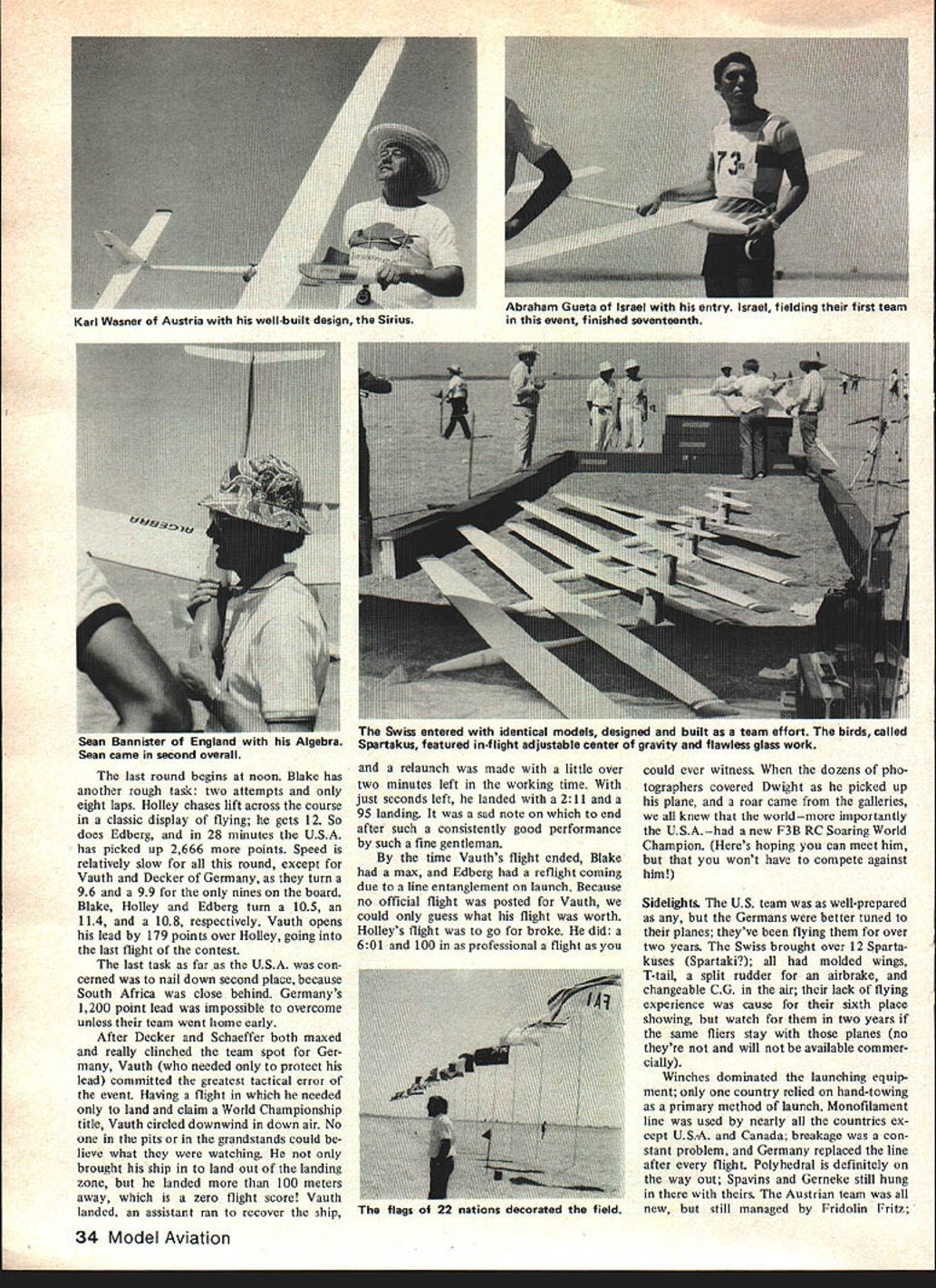
- The Swiss brought over 12 Spartakus (Spartak?), all had molded wings, T-tail, a split rudder for an airbrake, and changeable C.G. in the air. Their lack of flying experience caused their sixth-place showing, but watch for them in two years if the same fliers stay with those planes (no, they're not and will not be available commercially).
- Winches dominated the launching equipment; only one country relied on hand-towing as a primary method of launch.
- Monofilament line was used by nearly all the countries except the U.S.A. and Canada; breakage was a constant problem, and Germany replaced the line after every flight.
- Polyhedral is definitely on the way out; Spavins and Gerneke still hung in there with theirs.
- The Austrian team was all new but still managed by Fridolin Fritz; Wackerle did not fly to defend his title.
- Stretched monofilament and zoom techniques on tow accounted more for the low times in speed than any sailplane design breakthrough.
- The teamwork of Steve Work and Paul Wedeking in setting up winches and getting them ready for relaunches was noteworthy.
It's a shame six rounds couldn't have been flown in order to have had a throwaway for a lot of teams.
There was a lot of inexperienced but darn good help that did the best they could; by Friday they ran the contest worthy of a World Championship label anywhere. Key people like Ray Marvin, Rae Fritz and Rich Schrameck made it work. Scoring was the best ever seen, thanks to Dave Peltz.
In Gratitude.
The site of the 1981 RC Thermal Soaring World Championships is owned by Mr. George Waggell. It is also the regular flying site of the Sierra Eagles Free Flight Club. Two members of the club—Doug Galbreath and Ken Oliver—were particularly helpful in arranging for the site to be made available for the World Championships.
Mr. Waggell admitted to having some prior misgivings about letting the event take place on his land. Permitting a relatively few Free Flights to fly there was one thing, but coping with several hundred people and their cars, tents, mobile homes, and trailers was quite another—he had visions of another Woodstock aftermath, with garbage everywhere.
We left the property clean, however, and except for the hay that was mowed to accommodate the contest, there is now little, if any, sign that a major competition was held there. Mr. Waggell said he enjoyed the activity and the people. He also said that we should donate the money we were going to pay him for renting the property to help offset the expenses of running the event. It was a great gesture of hospitality, and it is truly appreciated. This is to publicly say thanks for the spirit and generosity Mr. Waggell has shown for model flying.
Likewise, another figure behind the scenes should be publicly recognized. Don Dahn of Foster City, CA worked longer and harder than any other single individual at the World Championships. He did everything imaginable from hauling garbage to putting in fence posts, setting up tents to putting up flagpoles, providing drinking water and delivering lunches, running errands for hundreds of items that had to be bought or borrowed, and driving hundreds of miles in the process.
He worked hard, physically, and also solved dozens of logistical problems with an insight and wit that made it all seem easy. His effort was simply beyond what any volunteer should be expected to do. If ever an event reflected what it is possible for a single individual to achieve, this was it. Not that there weren't others who helped—there were many—but Don's effort was clearly the biggest.
He was there to the very end. As Gisele Jackson (our Comptroller from AMA HQ) and I left the field after helping clean it up the day after the event ended, Don Dahn was dumping the last load of trash while his wife, Sylvia, waited patiently. It was somehow fitting. Don had been on the field for a week before the World Championships. He was still there when the rest of us had gone. I'm proud to say I was there to shake his hand as we officially turned the site back to its quiet life as a pasture. This is to say thanks, Don, from all of us who appreciate what you did for RC Soaring last July.
John Worth, AMA Executive Director
Transcribed from original scans by AI. Minor OCR errors may remain.

