
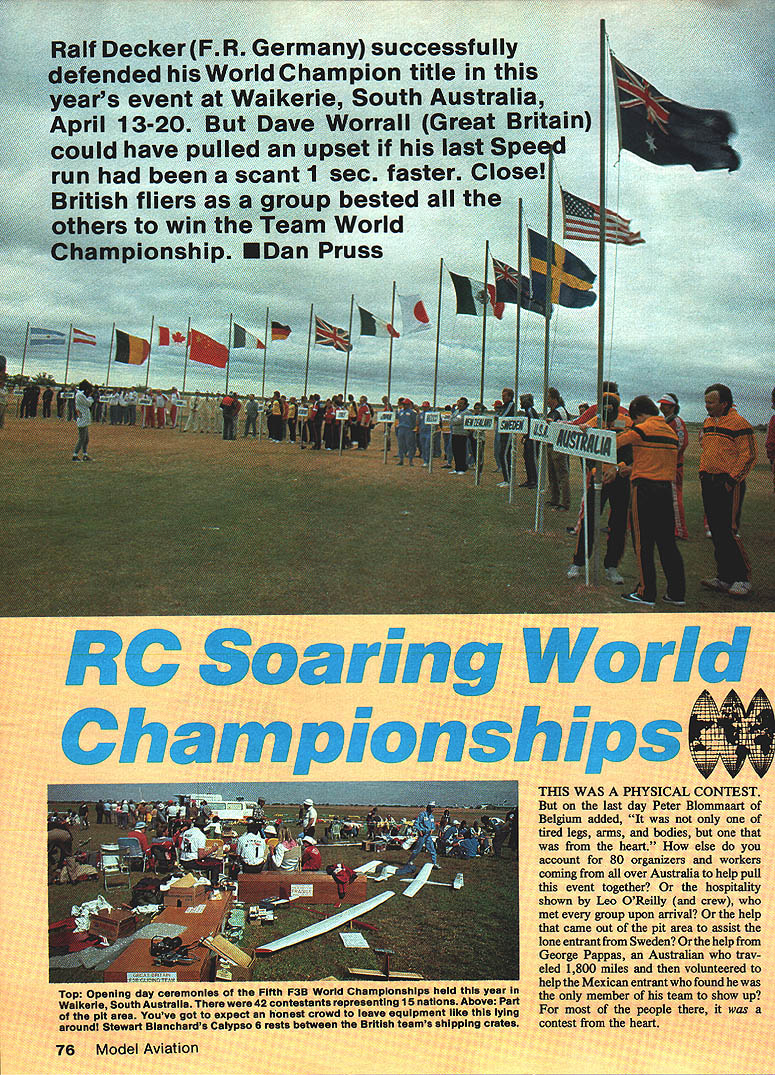
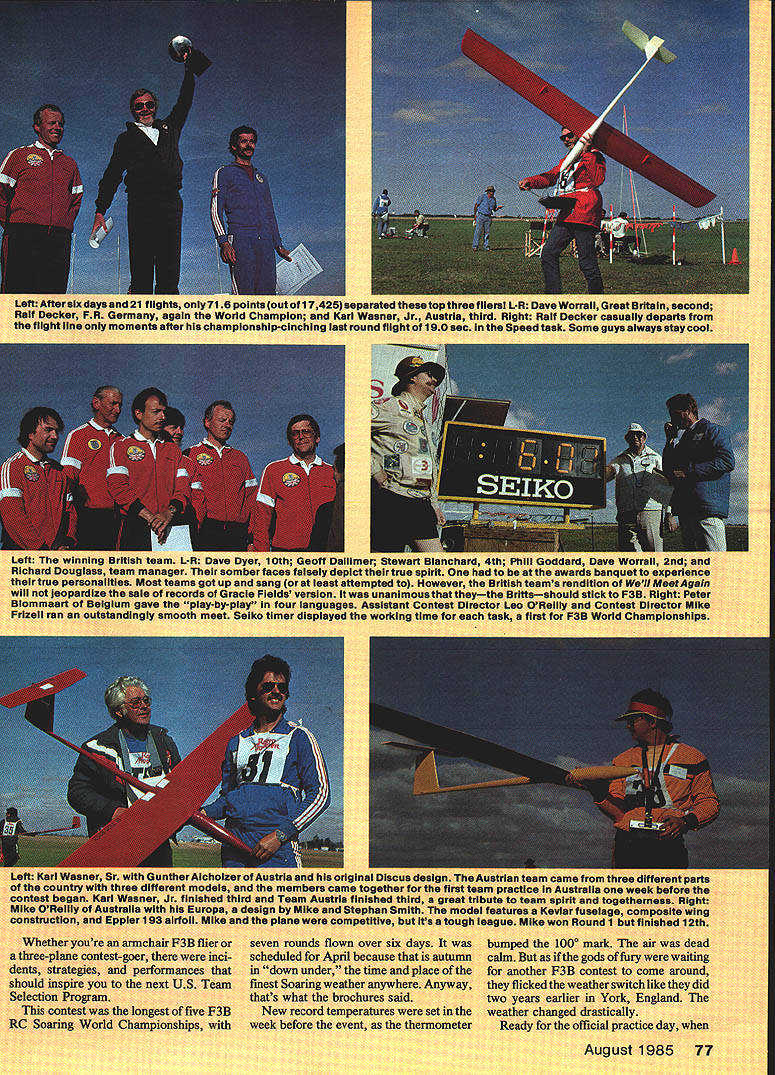
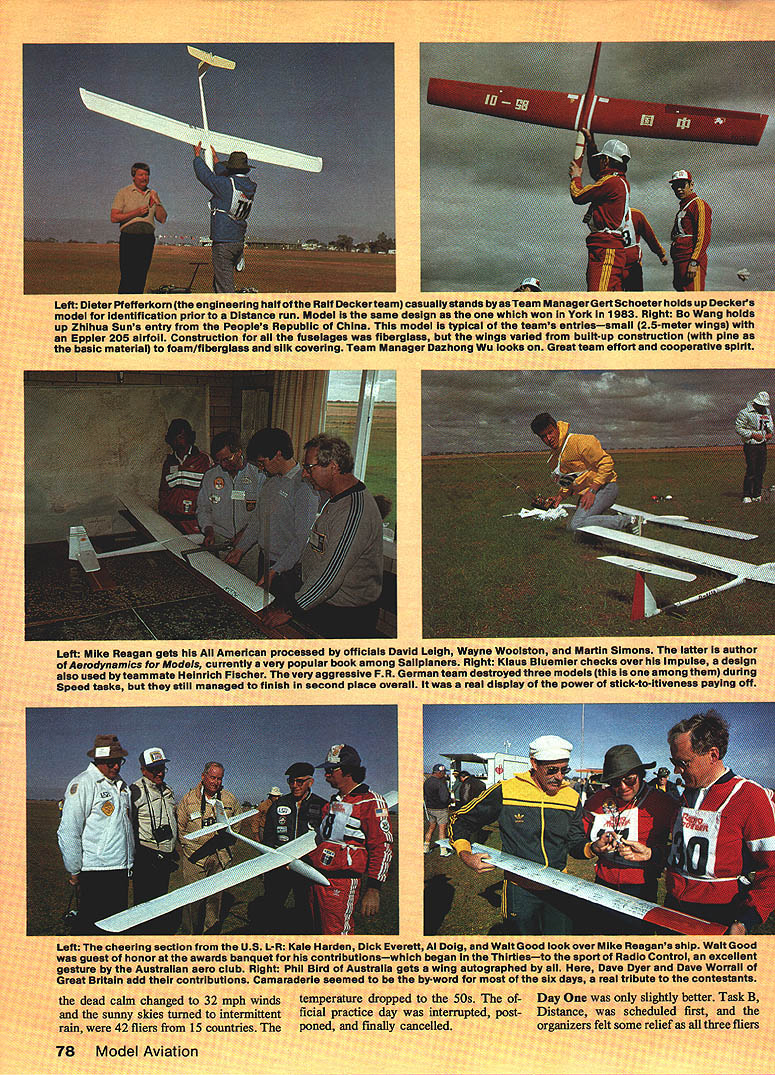
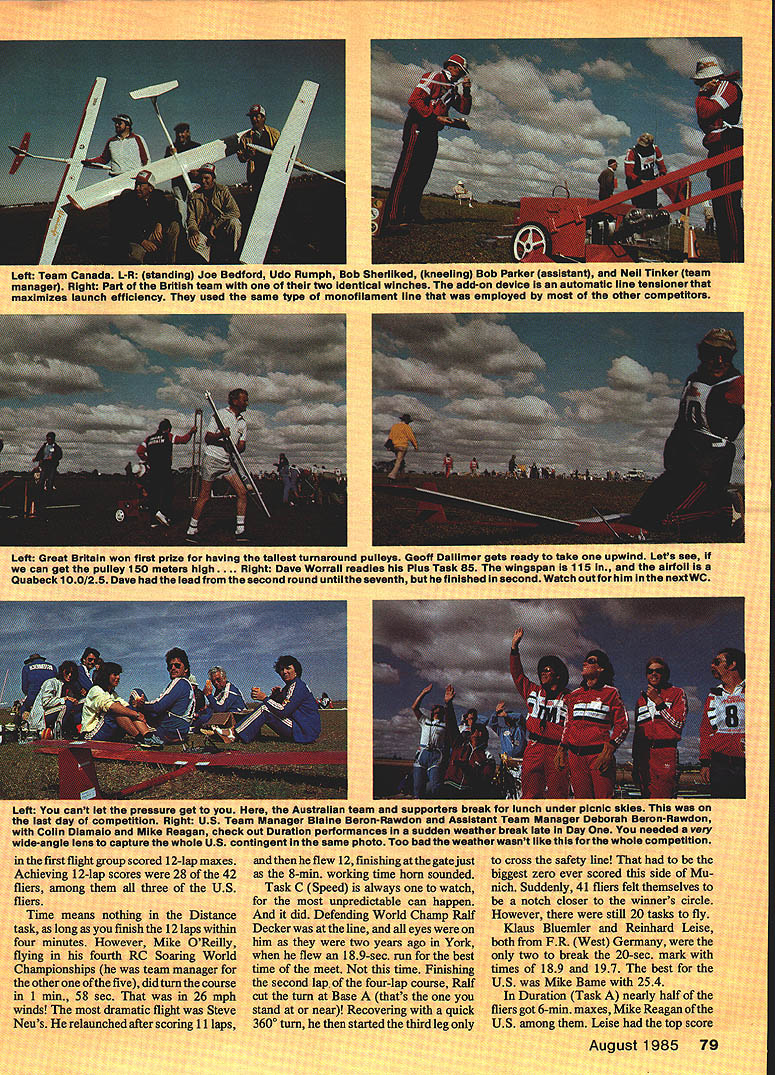
RC Soaring World Championships
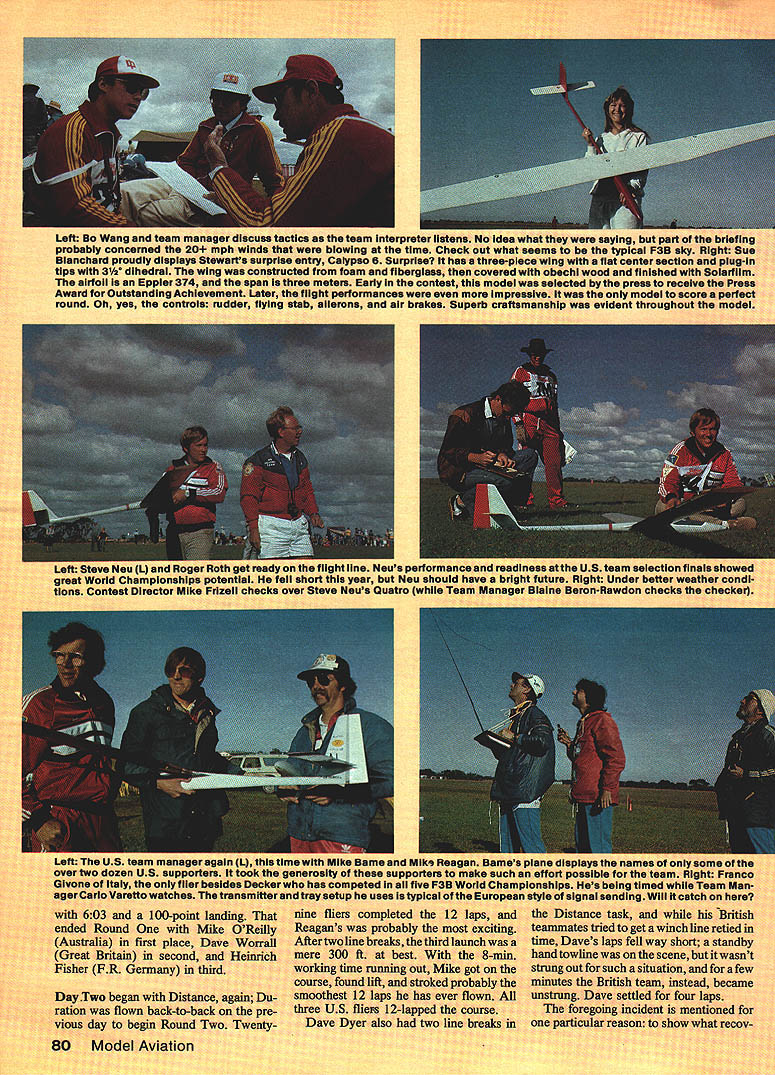
This was a physical contest. On the last day Peter Blommaert of Belgium added, "It was not only one of tired legs, arms, and bodies, but one that was from the heart." How else do you account for 80 organizers and workers coming from all over Australia to help pull this event together? Or the hospitality shown by Leo O'Reilly (and crew), who met every group upon arrival? Or the help that came out of the pit area to assist the lone entrant from Sweden? Or the help from George Pappas, an Australian who traveled 1,800 miles and then volunteered to help the Mexican entrant who found he was the only member of his team to show up? For most of the people there, it was a contest from the heart.
Whether you're an armchair F3B flier, a three-plane contest-goer, or an active competitor, the incidents, strategies, and performances should inspire the next U.S. Team Selection Program.
Weather and practice
This contest was the longest of five F3B RC Soaring World Championships, with seven rounds flown over six days. It was scheduled for April because that is autumn "down under," the time and place of the finest soaring weather anywhere — according to the brochures.
New record temperatures were set in the week before the event as the thermometer bumped the 100° mark and the air was dead calm. But as if the gods of fury were waiting for another F3B contest, they flicked the weather switch as they did two years earlier in York, England. The weather changed drastically.
Ready for the official practice day, the dead calm changed to 32 mph winds and the sunny skies turned to intermittent rain. There were 42 fliers from 15 countries. The temperature dropped to the 50s. The official practice day was interrupted, postponed, and finally canceled.
Day One — Round One
Day One was only slightly better. Task B (Distance) was scheduled first, and the organizers felt relief as all three U.S. fliers completed the task. Time means nothing in the Distance task, as long as you finish the 12 laps within four minutes. Mike O'Reilly, flying in his fourth RC Soaring World Championships, turned the course in 1:58 in 26 mph winds. The most dramatic flight was Steve Neu's: he relaunched after scoring 11 laps and then flew 12, finishing at the gate just as the 8-minute working-time horn sounded. Twenty-eight of the 42 fliers achieved 12-lap scores, including all three U.S. fliers.
Task C (Speed) is always one to watch, and the unpredictable happened. Defending World Champ Ralf Decker was at the line and under scrutiny — two years earlier in York he flew an 18.9-second run for the best time of the meet. Not this time. Finishing the second lap of the four-lap course, Ralf cut the turn at Base A. Recovering with a quick 360° turn, he then started the third leg only to cross the safety line, scoring a zero for that run. Suddenly 41 fliers felt themselves closer to the winner's circle.
There were still other tasks to fly. Klaus Bluemner and Reinhard Leise, both from F.R. Germany, were the only two to break the 20-second mark in Speed in that round with times of 18.9 and 19.7. The best for the U.S. was Mike Bame with 25.4.
In Duration (Task A), nearly half the fliers got 6-minute maxes. Mike Reagan of the U.S. was among them. Leise had the top score with 6:03 and a 100-point landing. That ended Round One with Mike O'Reilly (Australia) in first place, Dave Worrall (Great Britain) in second, and Heinrich Fischer (F.R. Germany) in third.
Day Two — Rounds Two and Three
Day Two began with Distance again; Duration had been flown back-to-back the previous day to begin Round Two. Twenty-nine fliers completed the 12 laps, and Reagan's was probably the most exciting. After two line breaks, his third launch reached only about 300 ft. With the 8-minute working time running out, Mike found lift and flew a smooth 12 laps. All three U.S. fliers 12-lapped the course.
Dave Dyer also had two line breaks in Distance. While his British teammates tried to get a win in retained time, Dave's laps fell way short. A standby hand towline was on the scene but not set up for that situation, and for a few minutes the British team became unstrung. Dave settled for four laps.
The foregoing incident is mentioned to show the recovering ability some pilots have. Dave came back in Speed and flew an 18.7-second run for the best time of the meet. Teammate Dave Worrall, with 19.7, was the only other flier to break 20 seconds that round. Reagan had the best time for the U.S. with 22.2 seconds.
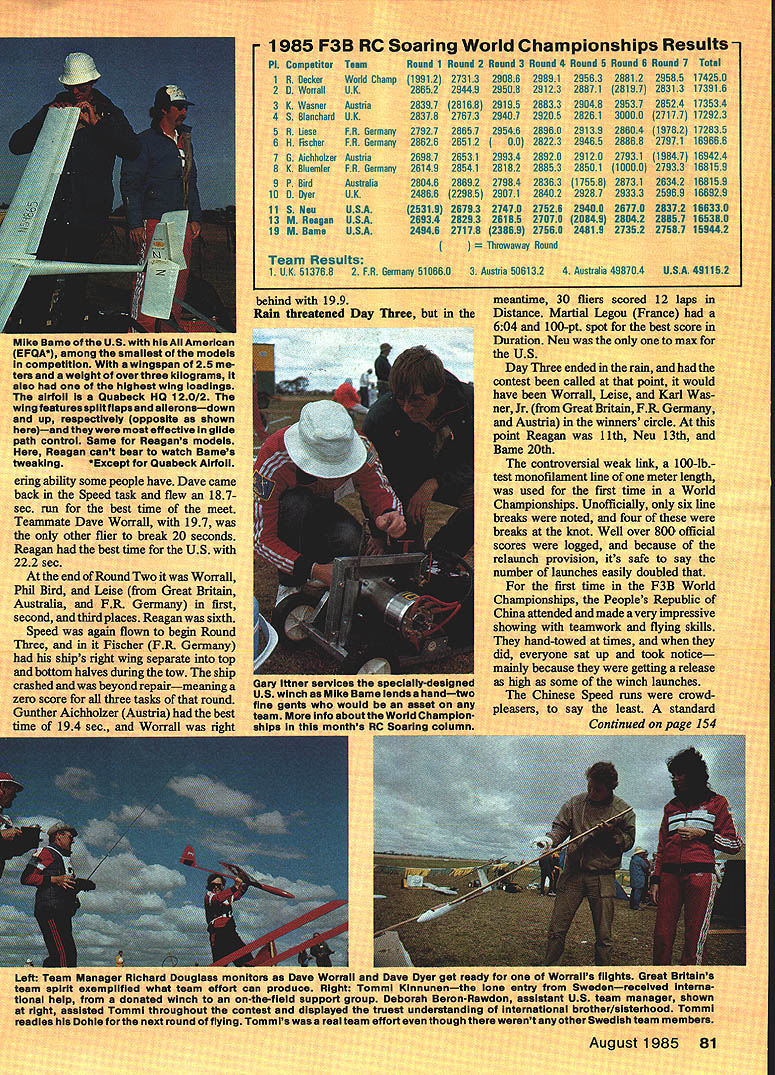
At the end of Round Two the standings were Worrall, Phil Bird, and Leise (from Great Britain, Australia, and F.R. Germany) in first, second, and third places. Reagan was sixth.
Speed again began Round Three. Fischer (F.R. Germany) had his ship's right wing separate into top and bottom halves during the tow; the ship crashed and was beyond repair, meaning zeros for all three tasks that round. Gunther Aichholzer (Austria) had the best time in the round at 19.4 seconds, with Worrall right behind at 19.9.
Day Three — Round Three continued and standing after three rounds
Rain threatened Day Three, but in the meantime 30 fliers scored 12 laps in Distance. Martial Legou (France) had a 6:04 and a 100-point spot for the best Duration score. Neu was the only U.S. flier to max in Duration. Day Three ended in the rain, and had the contest been called at that point, the winners would have been Worrall, Leise, and Karl Wasner Jr. (from Great Britain, F.R. Germany, and Austria). Reagan was 11th, Neu 13th, and Bame 20th at that stage.
A controversial weak link — a 100-lb. test monofilament line of center length — was used for the first time in a World Championship. Unofficially, only six line breaks were noted, four of which were at the knot. Well over 800 official scores were logged; because of the relaunch provision, the number of launches likely doubled that.
Chinese team and technique
For the first time in the F3B World Championships, the People's Republic of China attended and made a very impressive showing with teamwork and flying skills. They hand-towed at times, and when they did everyone took notice — mainly because their release heights rivaled some winch launches.
The Chinese Speed runs were crowd-pleasers. Their standard procedure was: first lap A to B conventionally; then a half-loop and back to Base A inverted; next a split-S back to Base B; followed by a more standard turn, depending on remaining altitude, to finish. The half-loop cost some time, but the team stuck with it. Zhihua Sun turned a respectable time of 23.8 seconds using this sequence.
Rounds Four and Five
Round Four, still windy and under cloudy skies, saw Sun of China score a perfect 6:00/100 in Duration; he was one of only five to do so in the meet. Twenty-six fliers maxed the Distance task. Only one broke 20 seconds in Speed — Decker with 19.0 — and he won the round with 2,989 points out of a possible 3,000. The top eight places remained unchanged from Round Three.
Round Five had 27 fliers score 12 laps in Distance. Speed was won by Stewart Blanchard (Great Britain) with a 19.7-second run (with a plane that would draw attention). Leise had a 19.9, the only other sub-20 time in the round.
Greg Dake (Australia) and Decker had perfect Duration flights; Decker won the round. Reagan had a 4-minute Duration flight but missed a landing — probably the first time in 17 years — relaunched with only 1:50 left on working time, and netted 428 points from a 1:42 flight and a 95-point landing.
With five rounds completed, the throwaway-round provision came into effect. Decker could discard his first-round Speed zero and moved into third place behind Worrall and Leise.
Round Six
In Round Six Bo Wang (P.R. China) and Blanchard both had perfect Duration flights and 12-lap Distance runs. Blanchard wowed the crowd with a 19.4-second Speed run and scored a perfect 3,000 points — the only perfect round of the contest. Wasner and Dyer also broke the 20-second mark. Germany's hope for a repeat of York diminished as Klaus Bluemner flew into the ground coming out of the third turn at Base B.
For five days the wind had generally blown from the same direction, and the fliers were getting a feel for the site and the Speed course as flown from the left side of the sighting device. On the last day the sun shone under clear skies, with a wind shift that forced a course change for Distance and Speed. To avoid the sun being in the pilots' eyes during Speed, the course was placed on the right side of the sighting device. The change psyched out some fliers as they paced off flying positions between the last two tasks.
Final day — Distance and Speed, and the finish
Distance and Speed were the final tasks — a perfect pairing for a climactic finish. Thirty-two fliers 12-lapped the Distance course, most finding it effortless in the sudden good air.
In Speed, Leise launched into good air and decided to play a thermal to get a better entry. He lost the lift, couldn't relocate it in time, and had to land for a relaunch. The landing was fast and aimed at the winch area; only the quick reflexes of an assistant, Martin Schlott, saved the plane from becoming part of the winching apparatus. The landing was hard but the plane seemed okay during the re-launch; however, in the dive prior to release from the line the horizontal stab fluttered and the plane struck the ground. No other team lost planes — certainly not three of them — in such dramatic fashion as F.R. Germany did that day.
Aichholzer (Austria) and Dyer (Great Britain) both missed the turn at Base A under pressure; each team still had a chance for a team award. Meanwhile, Neal and Reagan turned in their best Speed runs of the meet with 21.1 and 21.4 seconds. Blanchard turned another outstanding Speed run (19.7), Samuele Villani (Italy) was right behind at 19.9, and then Decker produced a textbook-perfect 19.0 run that had everybody cheering.
Dave Worrall, who had led from the second round until the seventh, finished second overall. All he needed to win was a 21.6-second Speed time; instead he turned a clean but slow 22.5 seconds — his slowest of the contest. It was, however, good enough to help his team take top honors.
Well done, Ralf Decker. Well done, Team Great Britain.
Results and reflections
After six hard, wearing days and 21 flights apiece, the World Championships was determined by a flight that was less than a second too long. Worth it? Ask those who were there. Winners and losers will tell you an event like this is more than winning or coming close. It's the camaraderie that builds from the first days of meeting and the friendships that are generated that count the most. It's helping out a competitor who could later turn around and outscore you. It's a gathering where a dozen different languages can keep you continents apart — but the common bond of aeromodelling becomes the common denominator.
Yes, this was a contest that was not only a test of bodies and flying skills; it was also a test of hearts.
Team spirit and a disappointing note
While many countries displayed the spirit described above, the two U.S. camps failed to do so among themselves. It was a shame and an embarrassment to the supporters on the scene and to the organizers that the two U.S. "teams" couldn't resolve their differences once the U.S. flag was raised. It didn't happen. This wasn't a case of telling tales out of school — it was apparent to all, and it degenerated into one of the ugliest displays of poor team spirit in the history of the five F3B World Championships.
There is more to the last chapter, and perhaps those from the support crews and up should tell it. They owe at least that much to those who paid their way.
Transcribed from original scans by AI. Minor OCR errors may remain.

