
RC Soaring World Champs
Overview
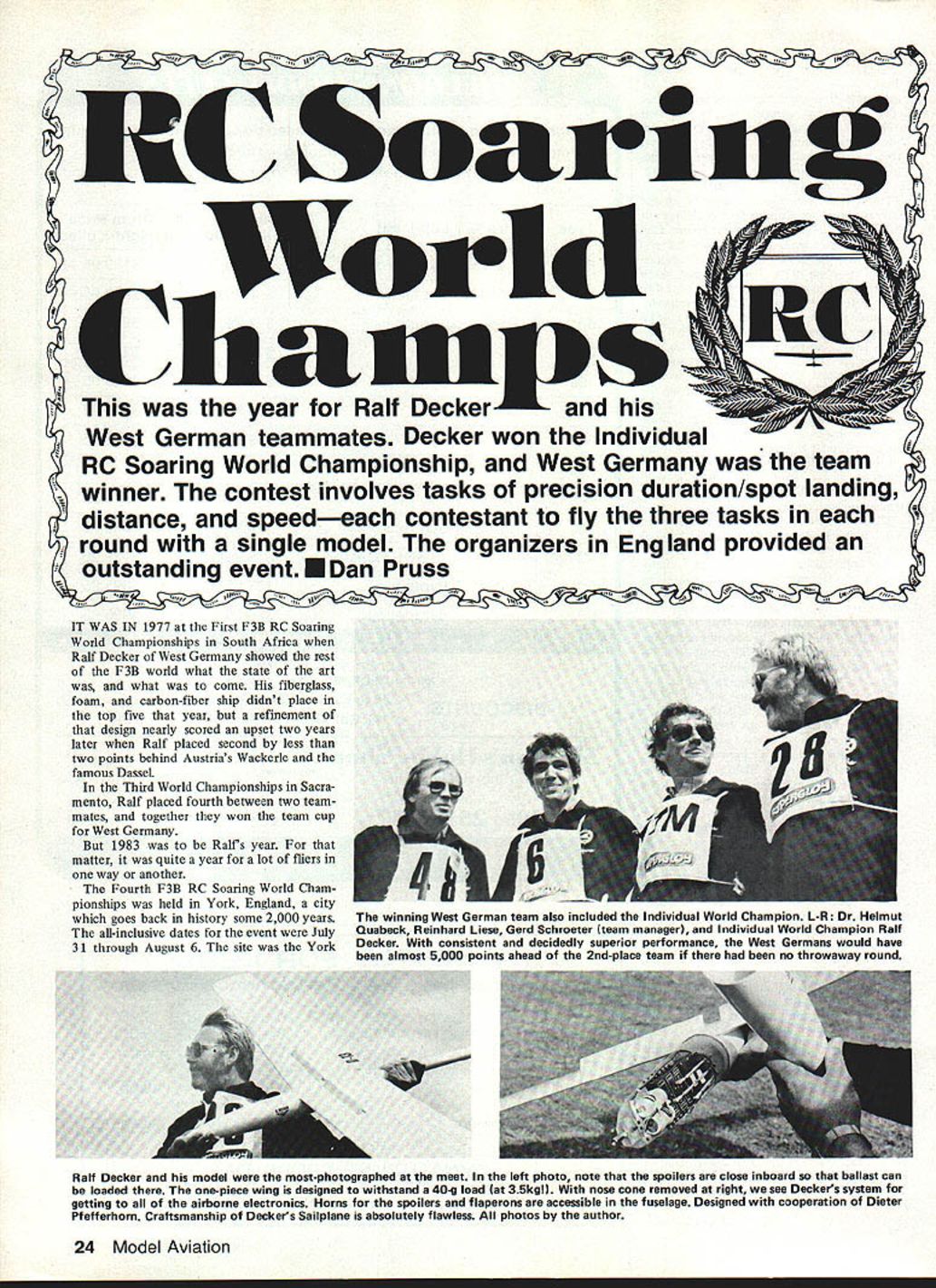
This was the year for Ralf Decker and his West German teammates. Decker won the Individual RC Soaring World Championship, and West Germany was the team winner. The contest involved three tasks each round — precision duration/spot landing, distance, and speed — with each contestant flying all three tasks in a round using a single model. The organizers in England provided an outstanding event.
Event and site
- Dates: July 31–August 6
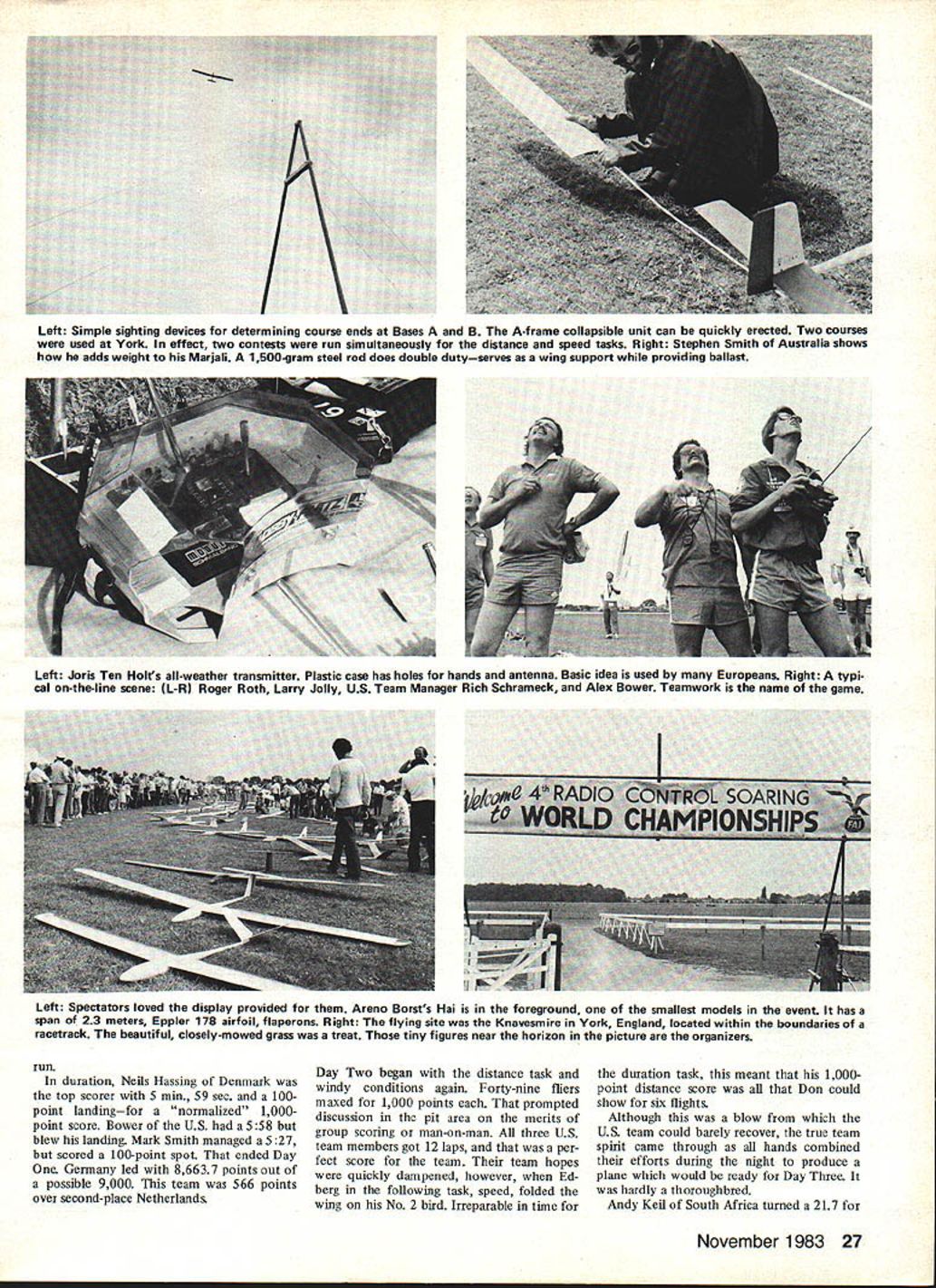
- Location: York racetrack, York, England (an expanse of grass comparable to about 50 soccer fields)
- Facilities: Sheltered pit areas, repair stations, food and lodging at York University (less than two miles away)
- Participation: 26 countries, 68 fliers (the largest number ever for an F3B World Championship at the time)
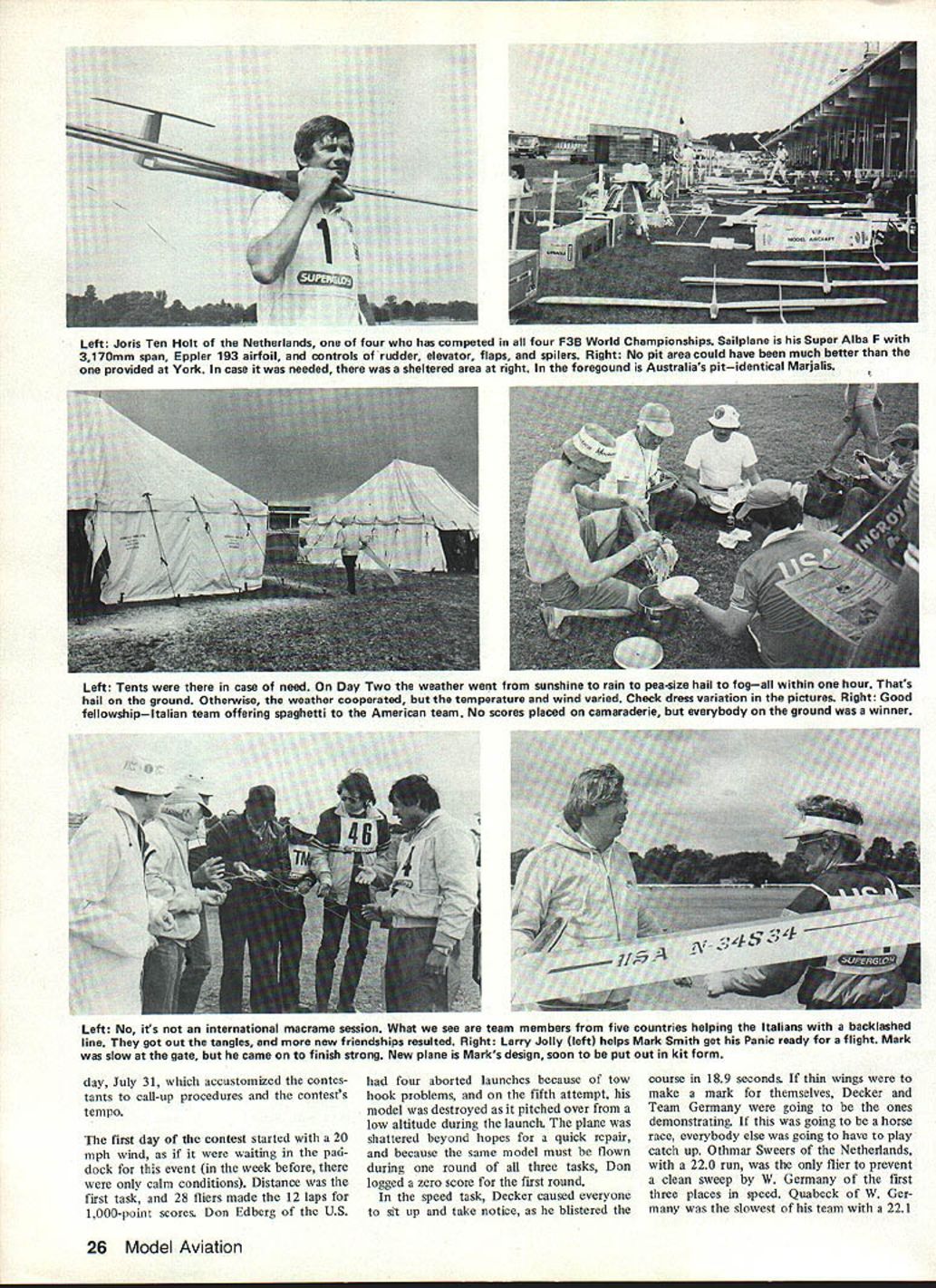
- Notable attendees: Sean Bannister (England), Ralf Decker (West Germany), Franco Givoni (Italy), Joris Ten Holt (Netherlands)
Format and schedule
- Tasks each round: distance (12 laps = 1,000 points), speed, duration/spot landing (6:00 max, 100-point landing)
- Flying hours: roughly 9:30 a.m. to 4:00 p.m.; an extra Saturday could be used to make up weather-scrubbed tasks
- Two speed-distance courses were set up; distance flights launched in groups of ten
- Official practice day: Sunday, July 31 — used to accustom contestants to call-up procedures and contest tempo
Round-by-round highlights
#### Round One (Day One)
- Opening conditions: 20 mph wind (after a calm week)
- Distance: 28 fliers maxed (12 laps for 1,000 points)
- Incidents: Don Edberg (U.S.) suffered four aborted launches due to tow-hook problems; on his fifth launch his model pitched over and was destroyed, forcing a zero for Round One because the same model must be flown for all three tasks in a round
- Speed: Ralf Decker blistered the course in 18.9 seconds; Othmar Sweers (Netherlands) posted 22.0 and prevented a West German sweep of the top three; Helmut Quabeck (West Germany) ran 22.1
- Duration: Niels Hassing (Denmark) was top with 5:59 and a 100-point landing (normalized to 1,000 points). Alex Bower (U.S.) had 5:58 but missed the landing; Mark Smith (U.S.) had 5:27 with a 100-point spot
- End of Day One team standings: West Germany in front with 8,663.7 points out of a possible 9,000, 566 points ahead of the Netherlands
#### Round Two (Day Two)
- Distance: 49 fliers maxed for 1,000 points
- U.S. team: all three members maxed in distance, but Don Edberg folded the wing on his No. 2 bird in speed and could not repair it in time for duration, leaving him with only his distance score for the round
- Team spirit: U.S. ground crew rebuilt a plane overnight to fly in Round Three
- Speed: Andy Keil (South Africa) posted 21.7, the best among those mentioned
- Duration: Stephan Meier (Switzerland) flew 6:00 with a perfect spot for 1,000 points; Alex Bower 5:54/95
- End of Day Two: West Germany held nearly a 1,200-point lead; Decker had 5,925.2 out of a possible 6,000
#### Round Three (Day Three)
- Distance: 43 fliers maxed
- Speed: Helmut Quabeck turned a 22.0 for 1,000 points; Dale Gregory (Australia) 22.2; Andy Keil 22.3; Mark Smith 23.0; Don Edberg (with rebuilt plane) 25.2; Alex Bower 28.0
- Duration: Bengt Johansson (Sweden) won with a perfect flight; Smith 5:00/85; Bower 5:52/0; Edberg 3:49/100
- Standings after Round Three: West Germany led by about 2,800 points over the Netherlands; the U.S. was 19th
#### Round Four (ending Day Three)
- Duration (start of Round Four): Decker 5:59/100 (1,000 points); Mike Gundry (South Africa) similar; Mark Smith 5:56/95 and later finished third in Round Four; Edberg 4:37/95; Bower 4:07/0
#### Round Four (Day Four)
- Distance: over half the fliers maxed; some completed 12 laps with last-minute relaunches. Decker’s distance run was 1:42
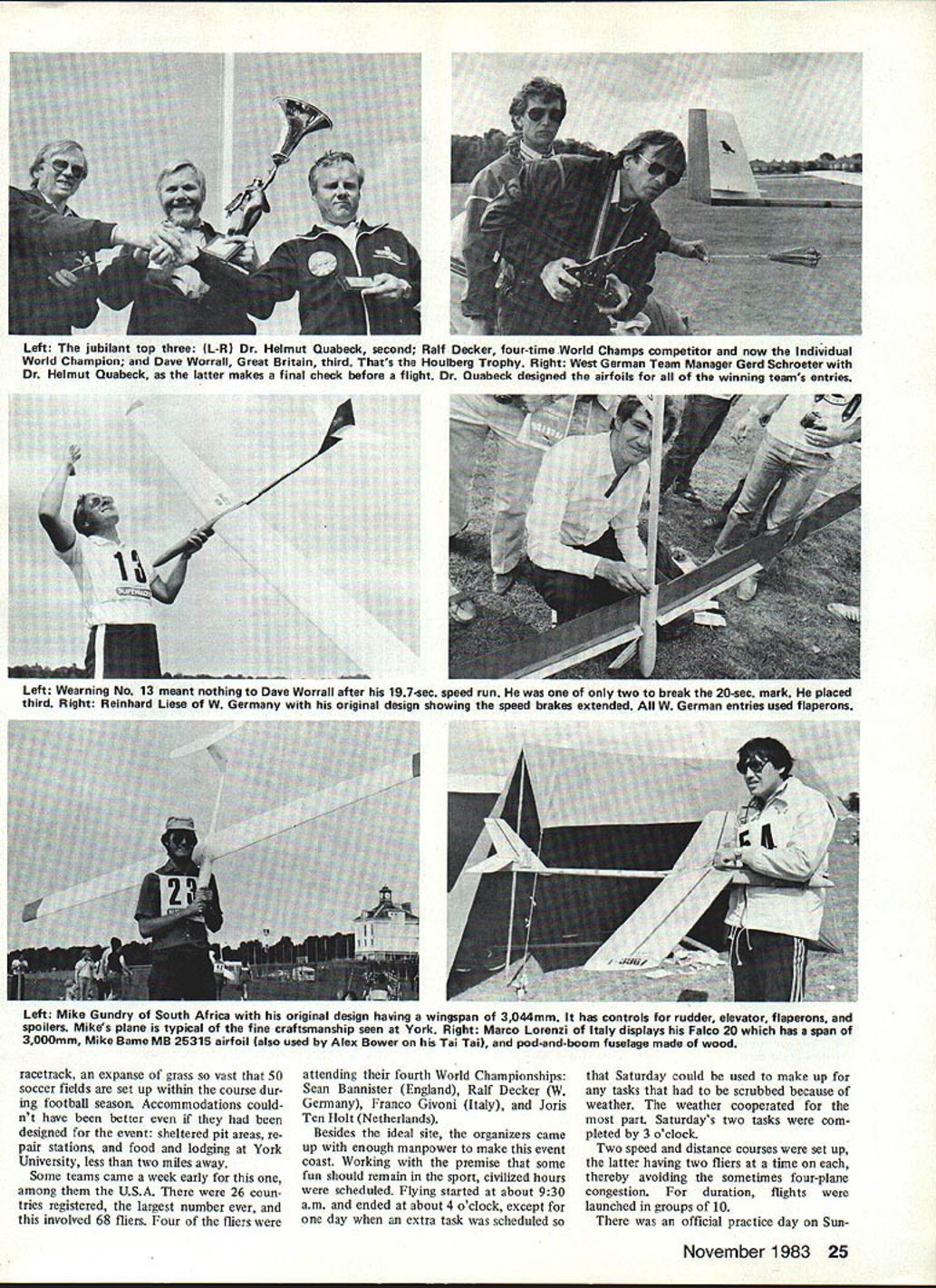
- Speed: Decker 24.1 (slow for him); Quabeck 21.4; Liese 20.8 (947 points in that round); Dave Worrall (Great Britain) broke 20 seconds with 19.71 and took the top score for Round Four (2,943.3 points), moving him to fourth overall behind Decker, Quabeck, and Liese
- Impact: U.S. improved from 19th to 12th; Great Britain jumped from seventh to second; Australia held third
#### Round Five
- U.S. consistency improved: Mark Smith 23.0 (speed) and 5:15/90 (duration); Alex Bower 23.1 and 4:47/90; Don Edberg 25.7 and 5:53/100
- Result: U.S. moved up to 11th place; Mark Smith moved into sixth individually
#### Round Six (final round)
- All three U.S. team members maxed the distance (12 laps)
- Bower repeated 23.1 in speed and logged 5:53/100 in duration (plane clipped his leg on landing)
- Smith 25.3 and 5:59/100, narrowly beaten by Mike O’Reilly (Australia) who had 6:00/100
- Edberg 26.7 and 6:00/90
- Decker secured the championship well before the last flight; Worrall overtook Liese to prevent a West German 1–2–3 sweep, but West Germany’s team score left only the battle for second place
Equipment, designs and launch systems
- One-design sailplanes used by some teams:
- Australia and New Zealand used the Marjali
- Finland used the Samum (with Optima as backup)
- Israel used the Dohle (a Quabeck design)
- Popular kits: Camaro and Focus dominated among kitted birds
- Airfoils: West German team used airfoils from Dr. Quabeck’s profile list. Quabeck used a 9% airfoil with 1.5% camber; Decker used an 8% section increasing to 9% at the tips with 2.5% camber
- Winches: no single winch dominated; West German team used the same winch they had taken to Belgium four years earlier
- Opinions on winches varied among teams: from banning winches to unrestricted use; many favored some type of standardization
Teamwork, pit life and officiating
- Notable ground crew and support:
- Roger Roth (U.S.) — servicer
- Larry Jolly (U.S.) — servicer
- Team Manager: Rick Schrameck (U.S.)
- Examples of sportsmanship: Steve Neu (Torrey Pines Gulls) fixed an ailing radio for Andy Keil; the U.S. team helped Andy rebuild a broken wing in time for the next task; the pit area cheered when Don Edberg’s rebuilt plane flew successfully
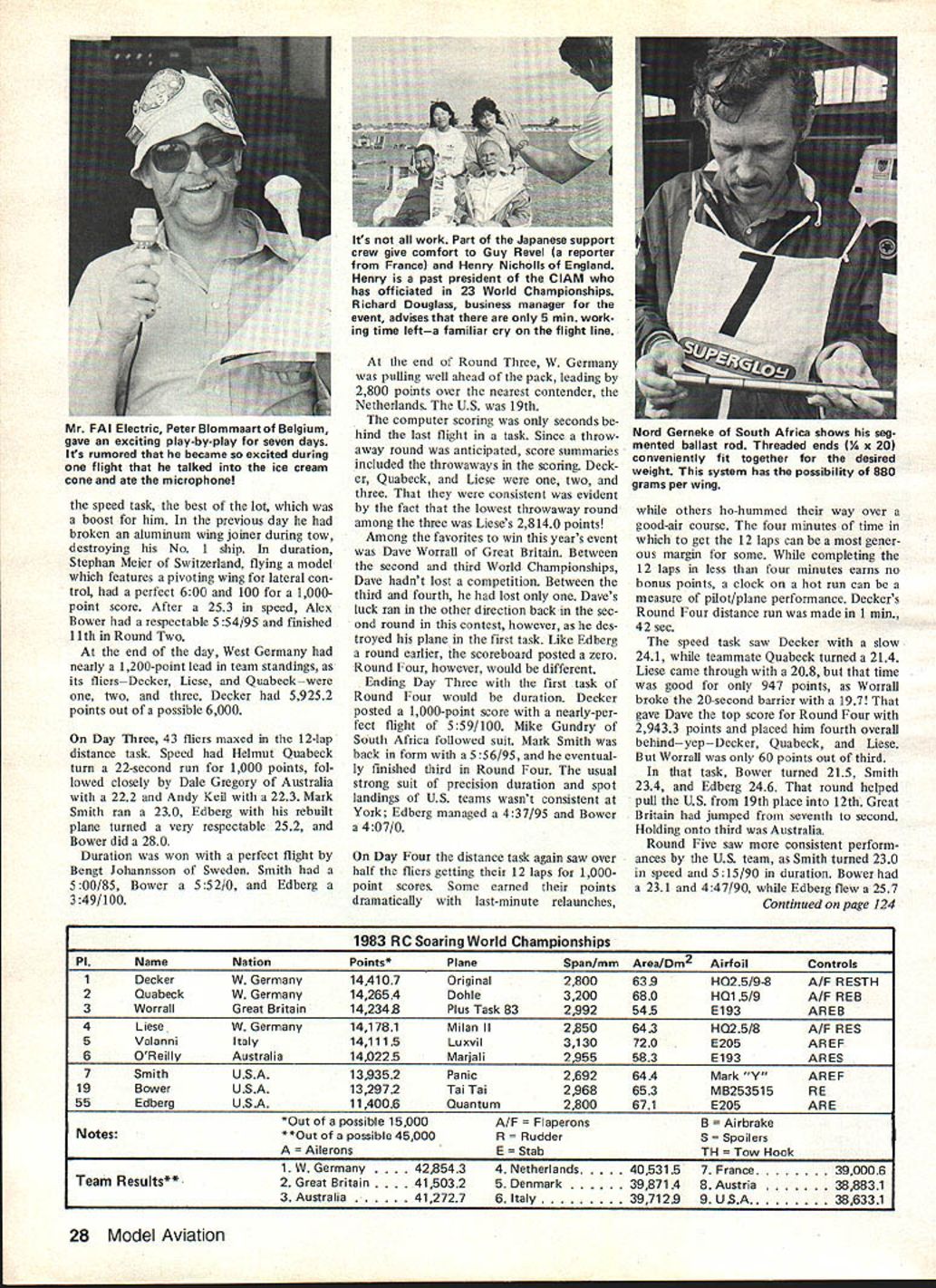
- Event commentary: Peter Blommaart (Belgium) ran play-by-play throughout the contest, keeping spectators and contestants engaged
Organizers and officials
Nearly 70 people were involved on the officiating side. Key organizers included:
- Geoff Dallimer — chairman
- George Stringwell — contest director
- Richard Douglass — business manager
- Mike Proctor — contest manager
- Extracurricular coordinator: Ann Proctor (organized activities for wives and supporters)
Final notes
- Individual winner: Ralf Decker (West Germany)
- Team winner: West Germany
- The event was run professionally and with a spirit of camaraderie; organizers, officials, ground crews and volunteers made the championship a memorable and smoothly executed contest.
Transcribed from original scans by AI. Minor OCR errors may remain.

