
RC Soaring World Champs
By Byron Blakeslee
Introduction
It's the Olympics of model soaring. For RC glider fanatics it's like the Super Bowl and World Series combined. This is the Big One.
The 1987 World Championships were held the last week in July at the Achmer Gliderport near Osnabrück in northern West Germany. Sixty-nine contestants representing 24 countries participated. They flew three-man teams except New Zealand (two fliers) and Canada (represented by Udo Rumpf alone).
Event summary
The weather played a big part in the flying — and it was abysmal. It was rainy, cloudy, and cold the whole week. Flying continued in the rain and was stopped only when the rain or low clouds obscured the sailplanes from view. The sun was out no more than perhaps five percent of the time. Weather delays forced organizers to have longer flying days than scheduled — sometimes from 8 a.m. until after 9 p.m. On a couple of days the best air was after 7 p.m.
Seven rounds were originally scheduled, but a slow start and the weather limited competition to six rounds. This allowed one throw-out round; had only five rounds been flown there would have been no throw-out and the final placings would likely have been much different.
Competition format
The standard F3B schedule flown consists of:
- Duration: six-minute precision duration with a maximum of 100 points for landing.
- Speed: four-lap speed (two round trips) over a 150-meter course.
- Distance: scored on the basis of laps flown in a four-minute period.
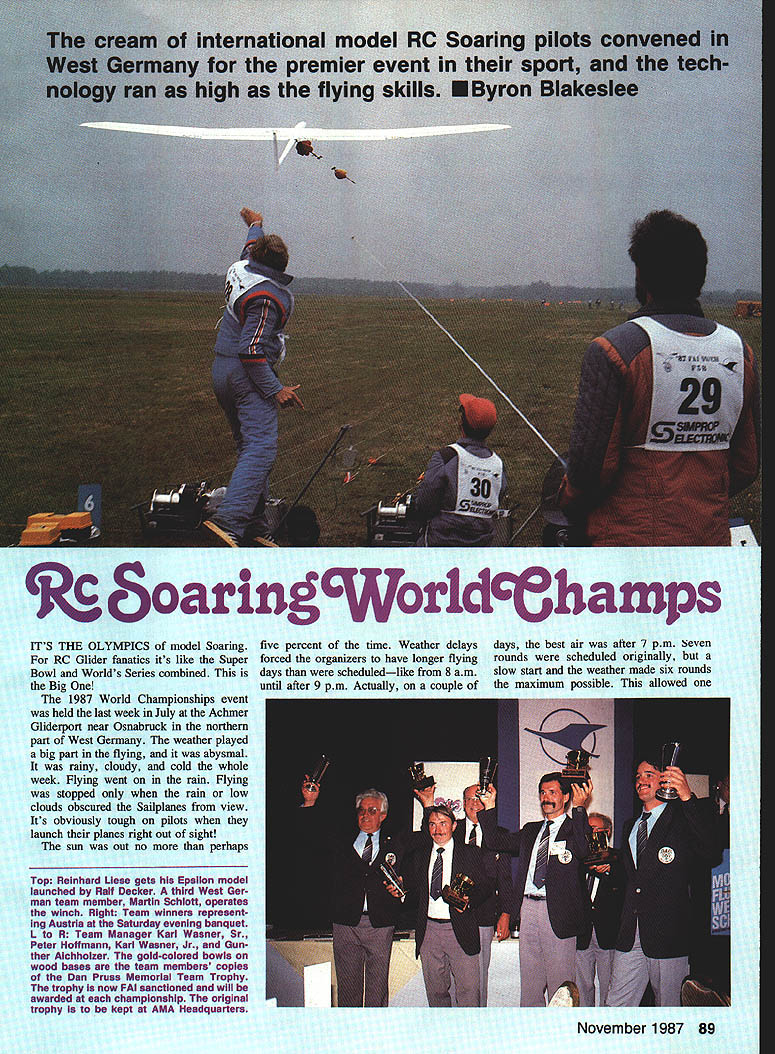
Duration and distance are flown man-on-man. The winner of a flight group is given 1,000 points and others receive a percentage of 1,000 according to their score divided by the winner's. A duration flight group consisted of eight fliers/planes; distance was flown four at a time. Winches were set up only a couple feet apart and planes were launched very close together, so pilots had to concentrate on flying cleanly and avoiding entanglements.
During speed tasks each plane had an audible signal indicating lap completion — different tones for each plane — while pilots received input from two spotters and the team manager tracked working time and total flight time. With people running and shouting in several languages, the event is something you have to experience to learn how to cope with.
Competition highlights and team performance
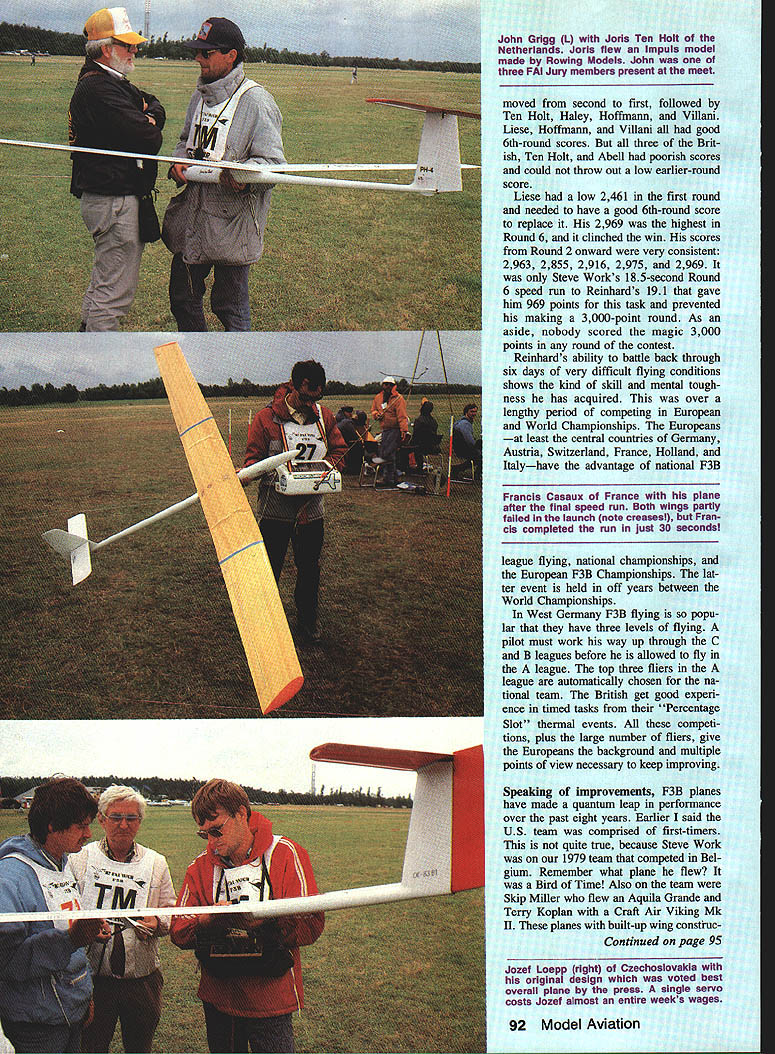
Notice the closeness of the scores: Steve Work finished 18th, just 4.5 percentage points behind winner Reinhard Liese. The U.S. team's total was only about 4.1% behind Austria. The U.S. team didn't finish as high as hoped — bad luck was a factor. Rich Spicer crashed during practice before the contest and Steve Lewis had radio trouble toward the end. Still, the U.S. team turned in a very creditable performance: pilots and support people were well prepared, well equipped, and well organized. What they lacked was hard-core F3B competition experience, which can only be gained by competing against the best.
On the plus side, Steve Work had the fastest speed time of the contest — 18.5 seconds in Round 6 — and also the low time in Round 4. He flew a Comet made by Hans Mueller of West Germany; some competitors flew new all-glass ships. Steve's low times were the result of skillful piloting and flying an efficient course.
A few notable competitors and stories:
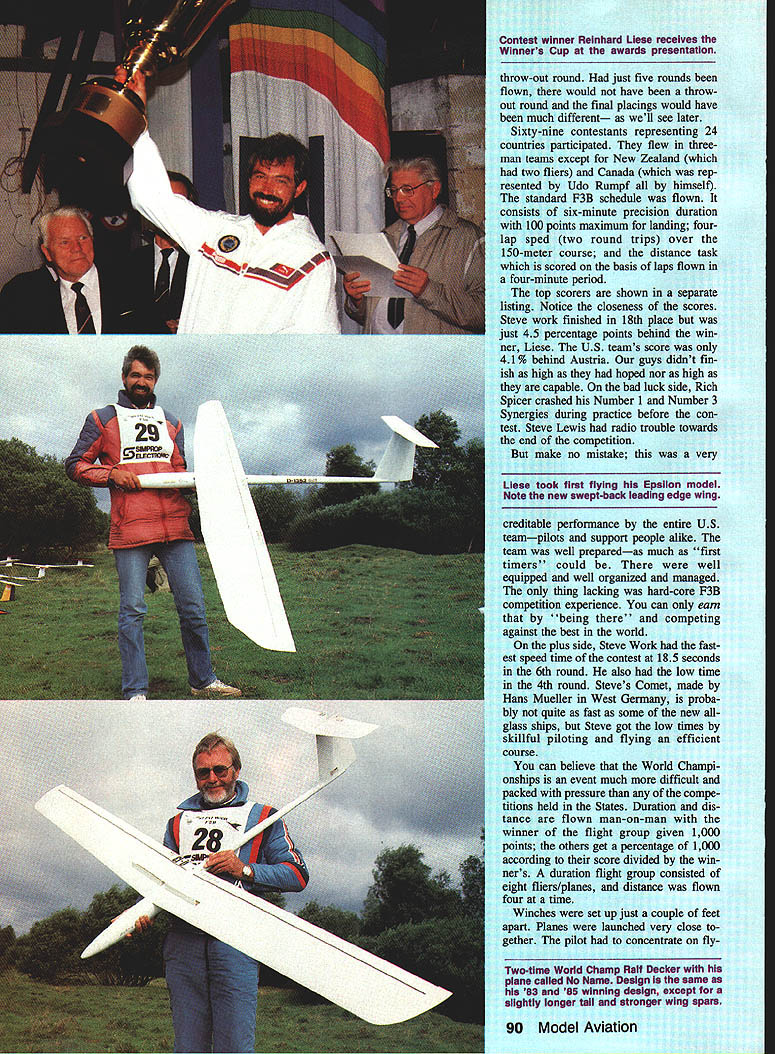
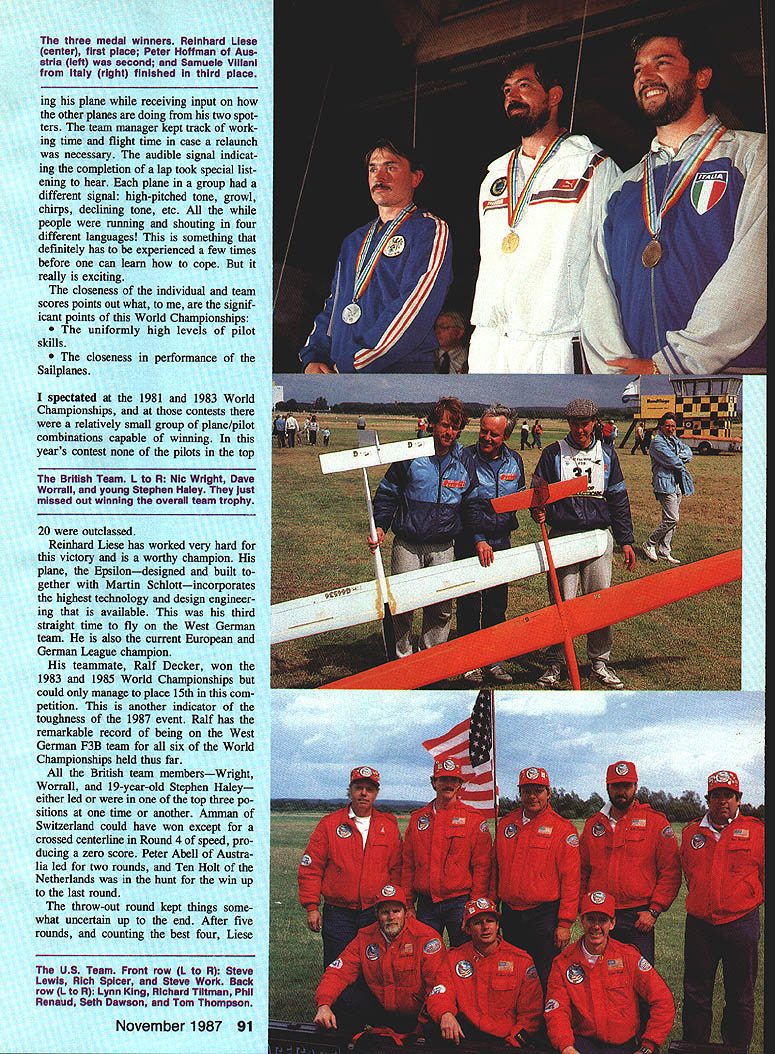
- Reinhard Liese (West Germany) won flying an Epsilon model, designed and built with Martin Schlott. This was his third straight time on the West German team; he is also the current European and German League champion.
- Ralf Decker (West Germany), winner in 1983 and 1985, placed 15th in 1987, illustrating the toughness of the event.
- The entire British team (Wright, Worrall, and 19-year-old Stephen Hanley) led or were in the top three at various times.
- Rainer Ammann (Switzerland), Peter Abell (Australia), and Joris Ten Holt (Netherlands) were all in contention at different points.
- Several pilots had a round they could not discard, and the throw-out round kept final placings uncertain until the end.
Liese had a low first-round score of 2,461 and needed a strong Round 6 to replace it. His Round 6 score of 2,969 — the highest in that round — clinched the win. His scores from Round 2 onward were remarkably consistent: 2,963, 2,855, 2,916, 2,975, and 2,969. No one scored a perfect 3,000 in any round of the contest.
Technology and equipment
F3B planes have made a quantum leap in performance over the past eight years. Older ships with built-up wing construction and MonoKote covering (like Bird of Time, Aquila Grande, and Craft Air Viking Mk II) are, compared with 1987 ships, like 1930s fabric-covered biplanes compared to an F-15. Advances in strength, speed, lift-to-drag, and overall capability are astounding — and this technology is being passed along for broader use.
In Europe today several ready-made sailplanes are competitive in world-class contests. Examples seen at the championships:
- Hans Mueller Comet (flown by Steve Work).
- Rowing Impuls F3B (flown by Joris Ten Holt and others).
- Fiber Glas Flugel Albatros — an all-glass, up-to-date ship flown by Guenther Aichholzer of Austria. The Albatros is not inexpensive: about 1,300 DM (roughly $700 at the time).
The launch
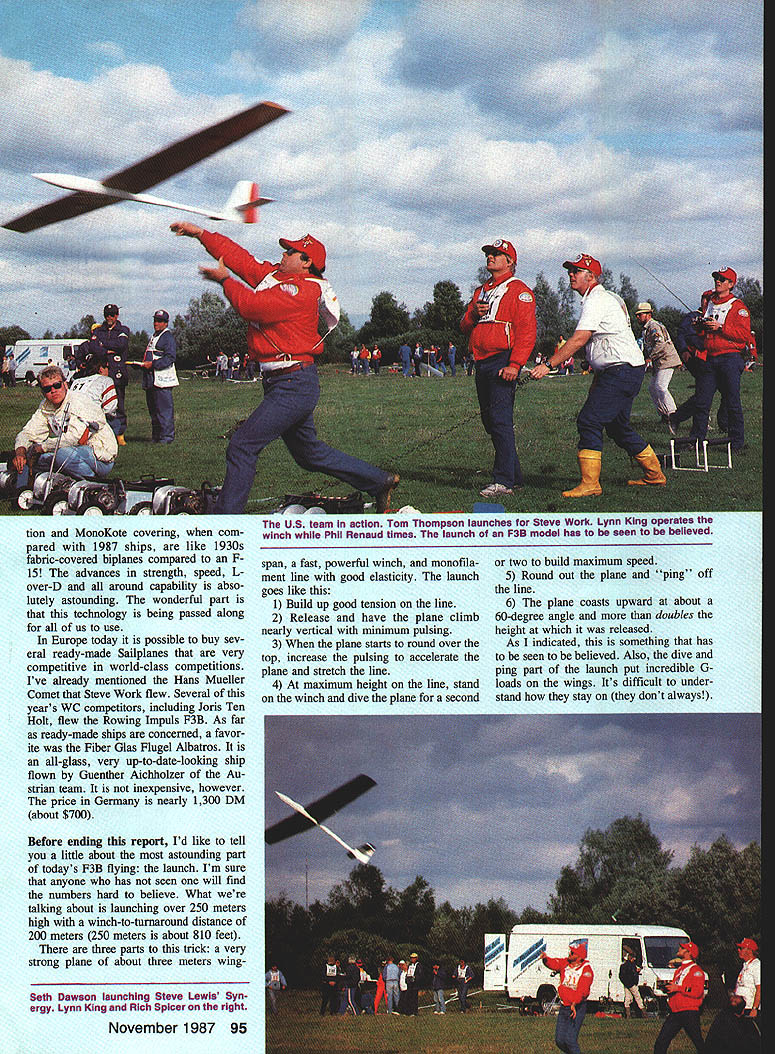
The most astounding part of today's F3B flying is the launch — over 250 meters with a winch-to-turnaround distance of about 200 meters (250 meters ≈ 810 feet). Three elements make this possible: a very strong plane (about three meters wingspan), a fast, powerful winch, and monofilament line with good elasticity.
The launch sequence:
- Build up good tension on the line.
- Release and have the plane climb nearly vertical with minimum pulsing.
- When the plane starts to round over the top, increase the pulsing to accelerate the plane and stretch the line.
- At maximum height on the line, stand on the winch and dive the plane briefly to build maximum speed.
- Round out the plane and "ping" off the line.
- The plane coasts upward at about a 60-degree angle and more than doubles the height at which it was released.
The dive-and-ping subjects the wings to incredible G-loads, and wings don't always stay on. There is discussion about toning down launching to allow less technical airplanes and lower-cost winches. If a standard winch could be developed and adopted, it would broaden the sport's appeal.
Observations and closing
The closeness of individual and team scores highlights two significant points from this World Championships:
- The uniformly high level of pilot skills.
- The close performance among sailplanes.
European competitors — especially those from Germany, Austria, Switzerland, France, Holland, and Italy — have an advantage because of national F3B leagues, national championships, and the European F3B Championships in off-years. In West Germany, F3B flying is so popular that pilots progress through C and B leagues before being allowed in the A league; the top three A-league fliers are automatically chosen for the national team. The British gain valuable experience from timed "Percentage Slot" thermal events. These competitions and the large number of active fliers give Europeans a broad base for continual improvement.
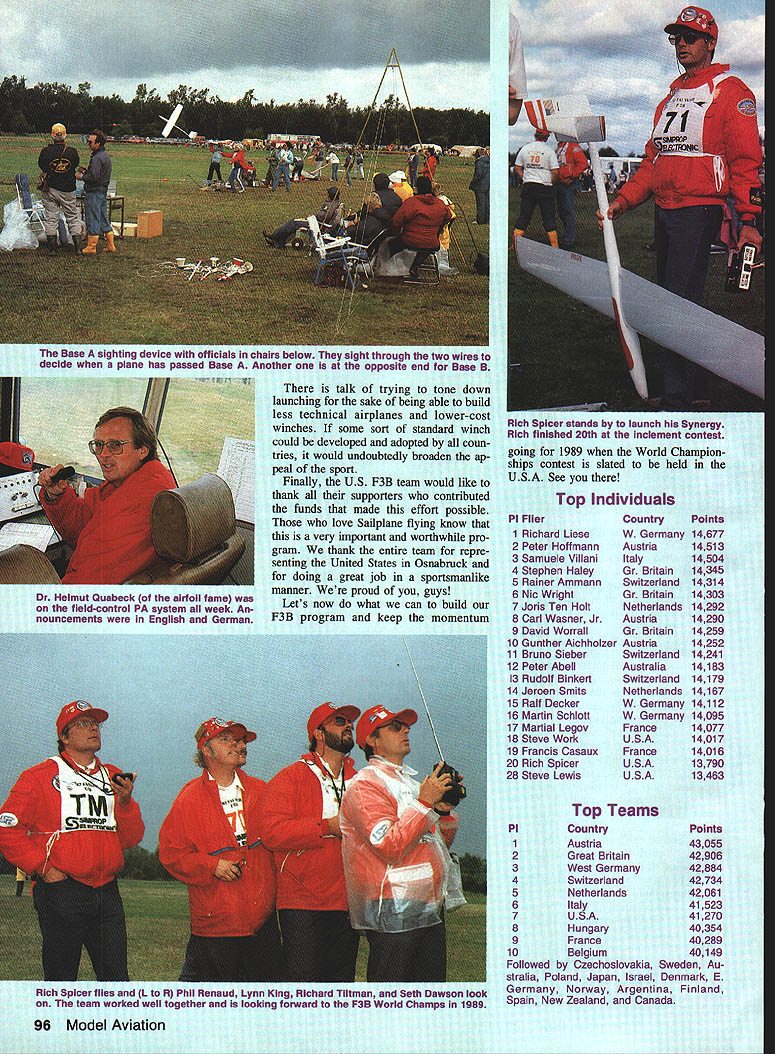
Finally, the U.S. F3B team thanks all supporters who contributed funds to make this effort possible. The team represented the United States in Osnabrück in a sportsmanlike manner — we’re proud of them. Let's build the U.S. F3B program and keep the momentum for 1989 when the World Championships are slated to be held in the U.S.A.
Top Individuals
- Reinhard Liese, W. Germany — 14,677
- Peter Hoffmann, Austria — 14,513
- Samuele Villani, Italy — 14,504
- Stephen Haley, Great Britain — 14,345
- Rainer Ammann, Switzerland — 14,314
- Nic Wright, Great Britain — 14,303
- Joris Ten Holt, Netherlands — 14,292
- Karl Wasner, Jr., Austria — 14,290
- David Worrall, Great Britain — 14,259
- Gunther Aichholzer, Austria — 14,252
- Bruno Sieber, Switzerland — 14,241
- Peter Abel, Australia — 14,183
- Rudolf Binkert, Switzerland — 14,179
- Jeroen Smits, Netherlands — 14,167
- Ralf Decker, W. Germany — 14,112
- Martin Schlott, W. Germany — 14,095
- Martial Legov, France — 14,077
- Steve Work, U.S.A. — 14,017
- Francis Casaux, France — 14,016
- Rich Spicer, U.S.A. — 13,790
- Steve Lewis, U.S.A. — 13,463
Top Teams
- Austria — 43,055
- Great Britain — 42,906
- West Germany — 42,884
- Switzerland — 42,734
- Netherlands — 42,061
- Italy — 41,523
- U.S.A. — 41,270
- Hungary — 40,354
- France — 40,289
- Belgium — 40,149
Followed by: Czechoslovakia, Sweden, Australia, Poland, Japan, Israel, Denmark, East Germany, Norway, Argentina, Finland, Spain, New Zealand, and Canada.
Transcribed from original scans by AI. Minor OCR errors may remain.

