
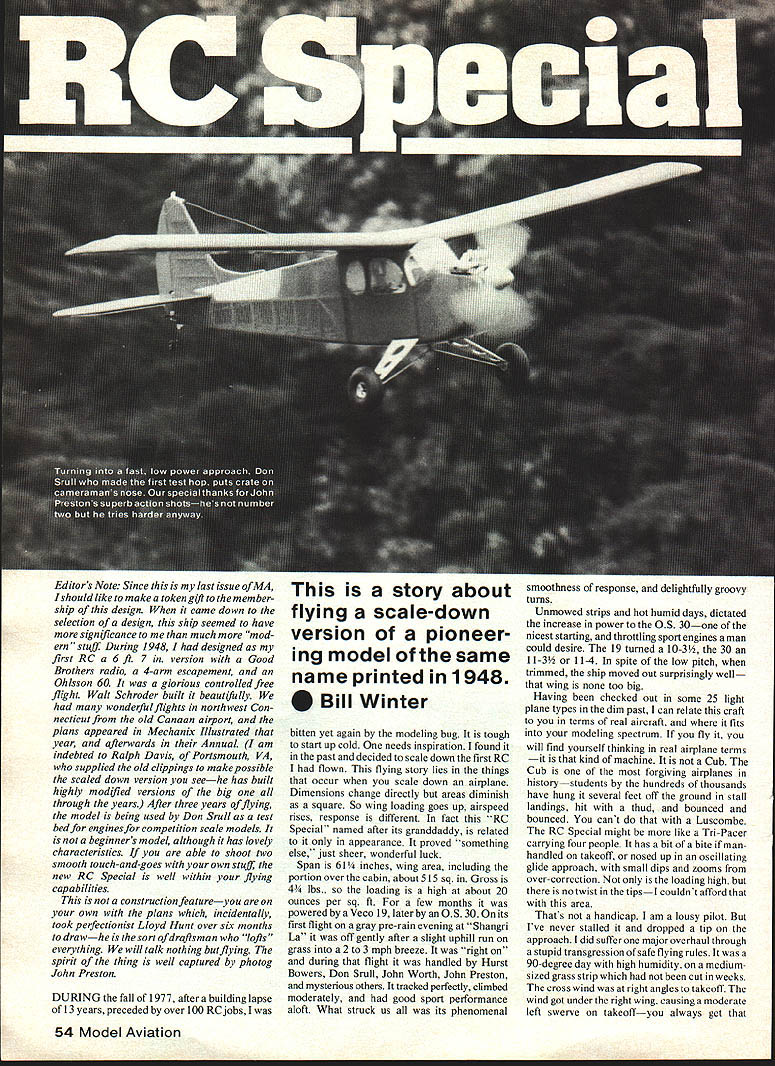
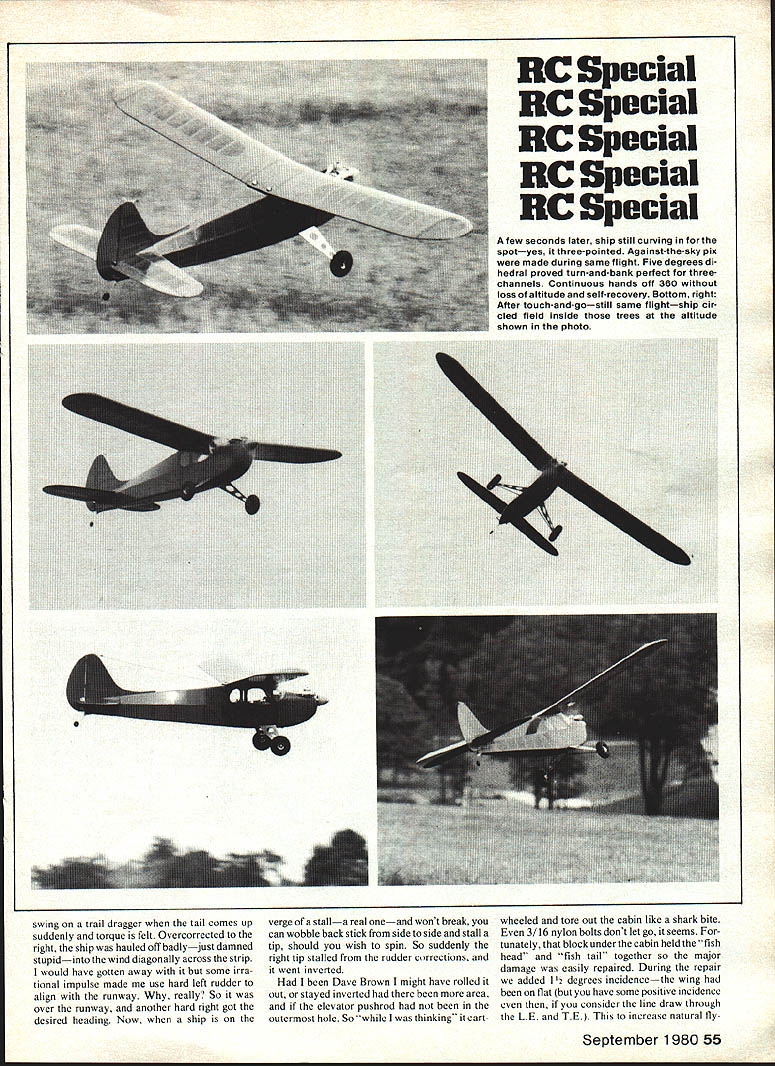
RC Special
Editor's Note
Since this is my last issue of MA, I should like to make a token gift to the membership of this design. When it came down to the selection of a design, I think this seemed to have more significance to me than much more "modern" stuff. During 1948 I had designed, as my first RC, a 6 ft. 7 in. version with a Good Brothers radio, a 4-arm escapement, and an Ohlsson 60. It was a glorious controlled free flight. Walt Schroder built it beautifully. We had many wonderful flights in northwest Connecticut from the old Canaan airport, and the plans appeared in Mechanix Illustrated that year, and afterwards in their Annual.
I am indebted to Ralph Davis, of Portsmouth, VA, who supplied the old clippings to make possible the scaled-down version you see—he has built highly modified versions of the big one all through the years. After three years of flying, the model is being used by Don Srull as a test bed for engines for competition scale models. It is not a beginner's model, although it has lovely characteristics. If you are able to shoot two smooth touch-and-goes with your own stuff, the new RC Special is well within your flying capabilities.
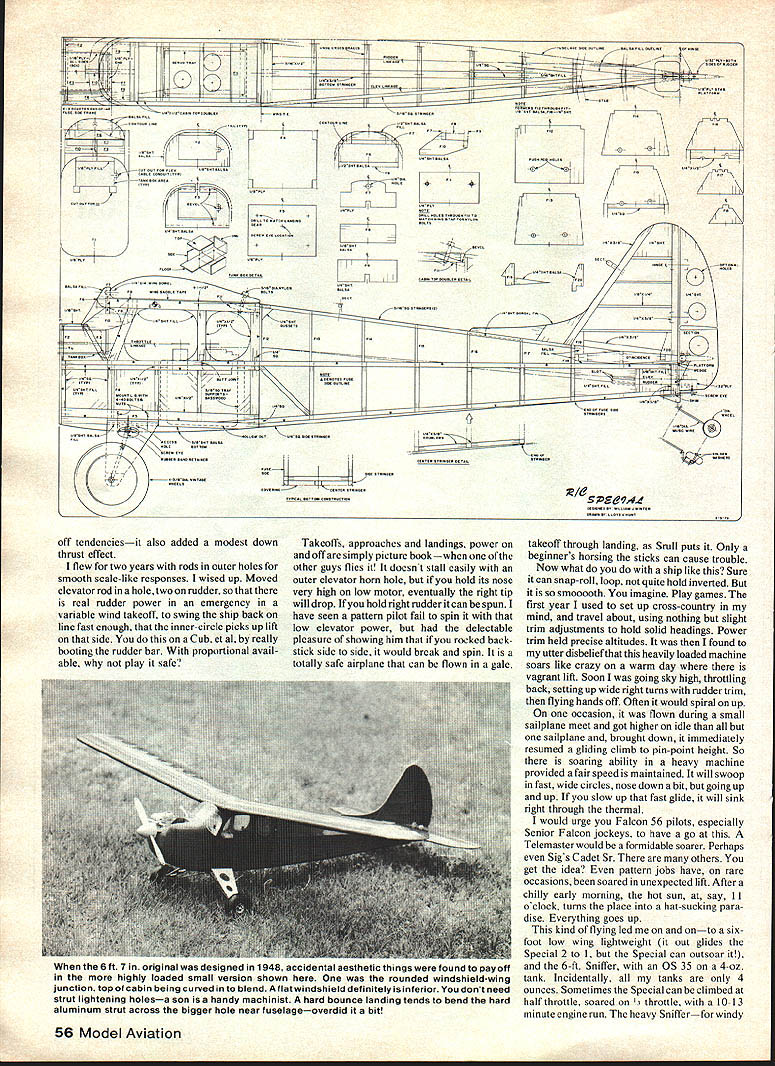
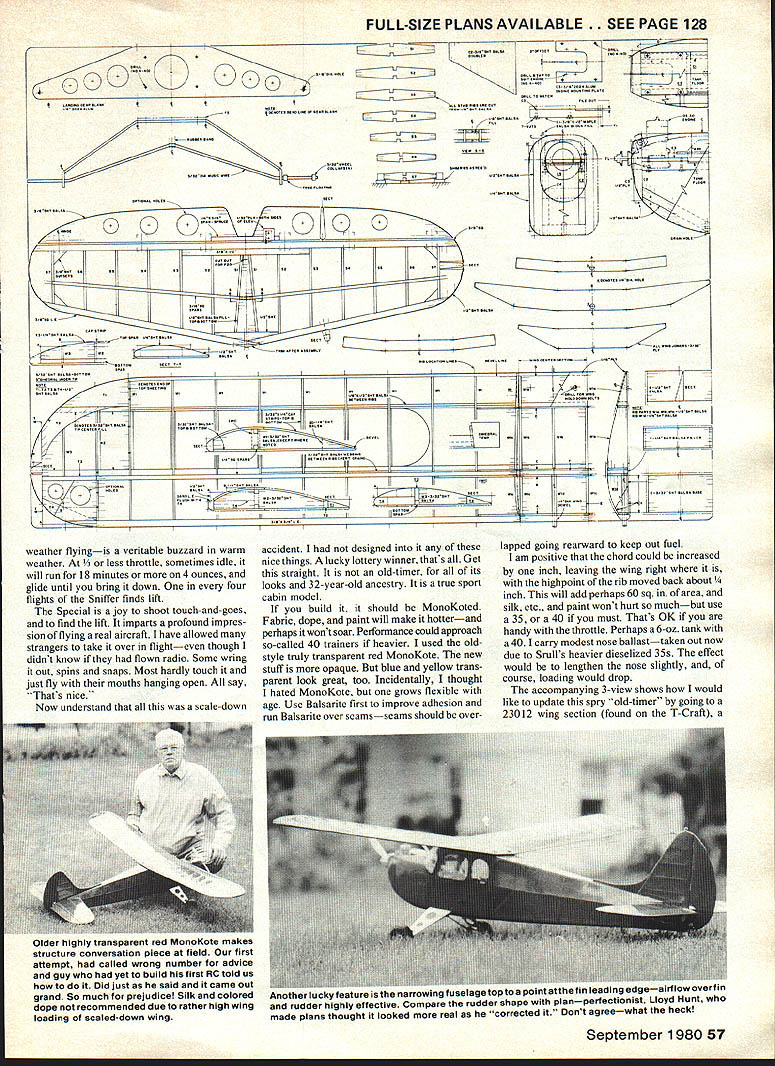
This is not a construction feature—you are on your own with the plans which, incidentally, took perfectionist Lloyd Hunt over six months to draw—he is the sort of draftsman who "lofts" everything. We will talk nothing but flying. The spirit of the thing is well captured by photographer John Preston.
This is a story about flying a scale-down version of a pioneering model of the same name printed in 1948.
Bill Winter
Background
I've been bitten yet again by the modeling bug. It is tough to start up cold. One needs inspiration. I found it in the past and decided to scale down the first RC I had flown. This flying story lies in the things that occur when you scale down an airplane. Dimensions change directly but areas diminish as a square. So wing loading goes up, airspeed rises, and response is different. In fact the "RC Special," named after its granddaddy, is related to it only in appearance. It proved "something else," just sheer, wonderful luck.
Specifications
- Span: 61-1/4 in.
- Wing area: about 515 sq. in.
- Gross weight: 4-1/4 lb.
- Wing loading: about 20 oz. per sq. ft.
- Engines used: Veco .19 (early), later O.S. .30
- Typical props: .19 turned a 10-3/4, .30 turned 11-3/8 to 11-4
First Flight and Handling
On its first flight on a gray pre-rain evening at "Shangri La" it was off gently after a slight uphill run on grass into a 2–3 mph breeze. It was "right on." During that flight it was handled by Hurst Bowers, Don Srull, John Worth, John Preston, and others. It tracked perfectly, climbed moderately, and had good sport performance aloft. What struck us all was its phenomenal smoothness of response and delightfully groovy turns.
Unmowed strips and hot humid days dictated the increase in power to the O.S. .30—one of the nicest starting and throttling sport engines a man could desire. In spite of the low pitch, when trimmed the ship moved out surprisingly well—that wing is too big.
Real-Airplane Comparisons
Having been checked out in some 25 light plane types in the dim past, I can relate this craft to you in terms of real aircraft, and where it fits into your modeling spectrum. If you fly it, you will find yourself thinking in real airplane terms—it is that kind of machine.
It is not a Cub. The Cub is one of the most forgiving airplanes in history—students by the hundreds and thousands have hung several feet off the ground, stalled, landed, hit, thud, bounced and bounced on. Luscombe, Tri‑Pacer, carrying four people has a bit of bite when handled on takeoff—nosed up oscillating on approach, small dips, zooms with over-correction; loading high, no twist tips—I couldn't afford area. That's a handicap.
I'm a lousy pilot. I've never stalled it and dropped a tip on approach. I did suffer a major overhaul through a stupid transgression of safe flying rules.
The Accident and Repairs
One 90-degree day with high humidity, on a medium-sized grass strip cut like weeds, a crosswind at right angles on takeoff got under the right wing causing moderate left swerve on takeoff—you always get swing with a taildragger when the tail comes up suddenly and torque is felt. I overcorrected right and the ship hauled off badly—just damned stupid—into wind diagonally across the strip. It would have gotten away, but some irrational impulse made me use hard left rudder to align the runway. So, over the runway another hard right got the desired heading. Now the ship was on the verge of a real stall. It can wobble back on the stick side to side; a stalled tip should wish to spin. Suddenly the right tip stalled, rudder corrections went inverted, and the model cartwheeled, tearing out the cabin like a shark bite. Even 3/16 nylon bolts don't let go, it seems. Fortunately, the block under the cabin held the "fish head" and "fish tail" together so the major damage was easily repaired.
During the repair we added 1/2 degree incidence—the wing had been on flat (but you have some positive incidence then, if you consider the line drawn through the leading and trailing edges). This increased natural flying characteristics and added a modest down-thrust effect.
I flew for two years with the elevator rod in the outer hole for smooth, scale-like responses. I wised up. I moved the elevator rod inboard one hole, and the rudder two holes, so that there is real rudder power in an emergency on a variable-wind takeoff to swing the ship back on line fast enough that the inner circle picks up lift on that side. You do this on a Cub, etc., by really booting the rudder bar. With proportional available, why not play it safe?
Stall and Spin Characteristics
Takeoffs, approaches and landings, power on and off, are simply picture-book—when one of the other guys flies it! It doesn't stall easily with the outer elevator-horn hole, but if you hold its nose very high on low motor, eventually the right tip will drop. If you hold right rudder it can be spun. I have seen a pattern pilot fail to spin it with that low elevator power, but I had the delectable pleasure of showing him that if you rocked back-stick side to side it would break and spin. It is a totally safe airplane that can be flown in a gale.
Takeoff through landing—as Srull puts it—only a beginner horsing the sticks can cause trouble.
What to Do with a Ship Like This
Sure it can snap-roll, loop, and not quite hold inverted. But it is so smooth you imagine play games. The first year I used to set up 35s cross-country in my mind and travel about, using nothing but slight trim adjustments to hold solid headings. Power trim held precise altitudes. It was then I found, to my utter disbelief, that this heavily loaded machine soars like crazy on a warm day where there is vagrant lift. Soon I was going sky high, throttling back, settling up wide right turns with rudder trim, then flying hands off. Often it would spiral on up.
On one occasion it was flown during a small sailplane meet and got higher on idle than any of the sailplanes, and, brought down, it immediately resumed a gliding climb to pin-point height. So there is soaring ability in a heavy machine provided a fair speed is maintained. It will swoop in fast, wide circles, nose down a bit, but go up and up. If you slow up that fast glide, it will sink right through the thermal.
I would urge Falcon .56 pilots, especially Senior Falcon jockeys, to have a go at this. A Telemaster would be a formidable soarer. Perhaps even Sig's Cadet Sr. There are many others. Even pattern ships have, on rare occasions, been soared in unexpected lift. After a chilly early morning, the hot sun—say at 11 o'clock—turns the place into a hat-sucking paradise. Everything goes up.
This kind of flying led me on and on—to a six-foot low-wing lightweight (it out-glides the Special two to one), but the Special can be soared with one of the 6-1 Sniffers, with an O.S. .35 on a 4-oz. tank. Incidentally, all my tanks are only 4 ounces. Sometimes the Special can be climbed at half throttle, soared on one-quarter throttle, with a 10–13 minute engine run. The heavy Sniffer—for windy weather flying—is a veritable buzzard in warm weather. At half or less throttle, sometimes idle, it will run for 18 minutes or more on 4 ounces, and glide until you bring it down. One in every four flights of the Sniffer finds lift.
The Special is a joy to shoot touch-and-goes and to find the lift. It imparts a profound impression of flying a real aircraft. I have allowed many strangers to take it over in flight—even though I didn't know if they had flown radio. Some wing it out, spin and snap. Most hardly touch it and just fly with their mouths hanging open. All say, "That's nice."
Now understand that all this was a scale-down accident. I had not designed into it any of these nice things. A lucky lot, never, that's all. Get this straight. It is not an old-timer, for all of its looks and 32-year-old ancestry. It is a true sport cabin model.
Construction and Finish Suggestions
If you do build it, it should be MonoKoted. Fabric, dope and paint will make it hotter—and perhaps it won't soar. Performance could approach so-called .40 trainers if heavier. I used the old-style truly transparent red MonoKote. The new stuff is more opaque. But blue and yellow transparent look great, too. Incidentally, I thought I hated MonoKote, but one grows flexible with age. Use Balsarite first to improve adhesion and run Balsarite over seams—seams should be overlapped going rearward to keep out fuel.
I am positive that the chord could be increased by one inch, leaving the wing right where it is, with the high point of the rib moved back about 1/4 inch. This will add perhaps 60 sq. in. of area, and silk, etc., and paint won't hurt so much—but use a .35, or a .40 if you must. That's OK if you are handy with the throttle. Perhaps a 6-oz. tank with a .40. I carry modest nose ballast—taken out now due to Srull's heavier dieselized .35s. The effect would be to lengthen the nose slightly, and, of course, loading would drop.
I prefer an inch more prop diameter than recommended by the engine manufacturer, and one to two inches less pitch, as fine tuning will reveal. You don't want a bomb. Or do you?
Modernizing the Special
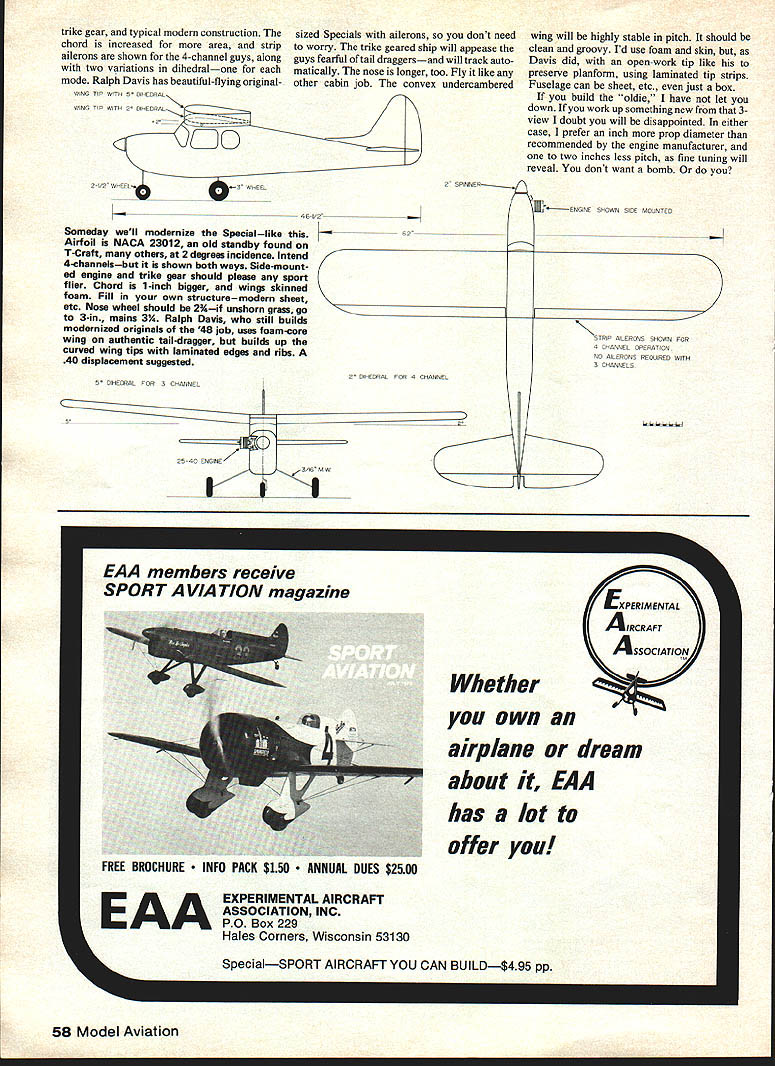
Someday we'll modernize the Special—like this:
- Airfoil: NACA 23012 (an old standby, found on T‑Craft and many others), at 2° incidence.
- Intended: 4-channel, though it is shown both ways.
- Power: side-mounted engine.
- Gear: trike gear to please sport fliers; trike will track automatically.
- Wing: chord increased by 1 in.; wings skinned with foam or foam-core; laminated tip strips or an open wingtip to preserve planform.
- Fuselage: sheet construction or a simple box—fill in your own structure.
- Wheels: nose wheel about 2½ in.; if operating from unshorn grass, go to 3 in. mains.
- Displacement: Ralph Davis, who still builds modernized originals of the ’48 job, uses a foam-core curved wing on an authentic tail‑dragger, but builds up to the .40 displacement suggested.
If you build the oldie, I have not let you down. If you work up something new from that 3‑view I doubt you will be disappointed.
Transcribed from original scans by AI. Minor OCR errors may remain.

