
RC Unlimiteds Race: The Pylons
Greg Lucas
The roar of the engines, the sight of highly polished warbirds, the thrill of a hard-fought race are all reasons to attend the full-scale Reno air races. What makes the races truly special, however, is the chance to see a piece of aviation history in the making.
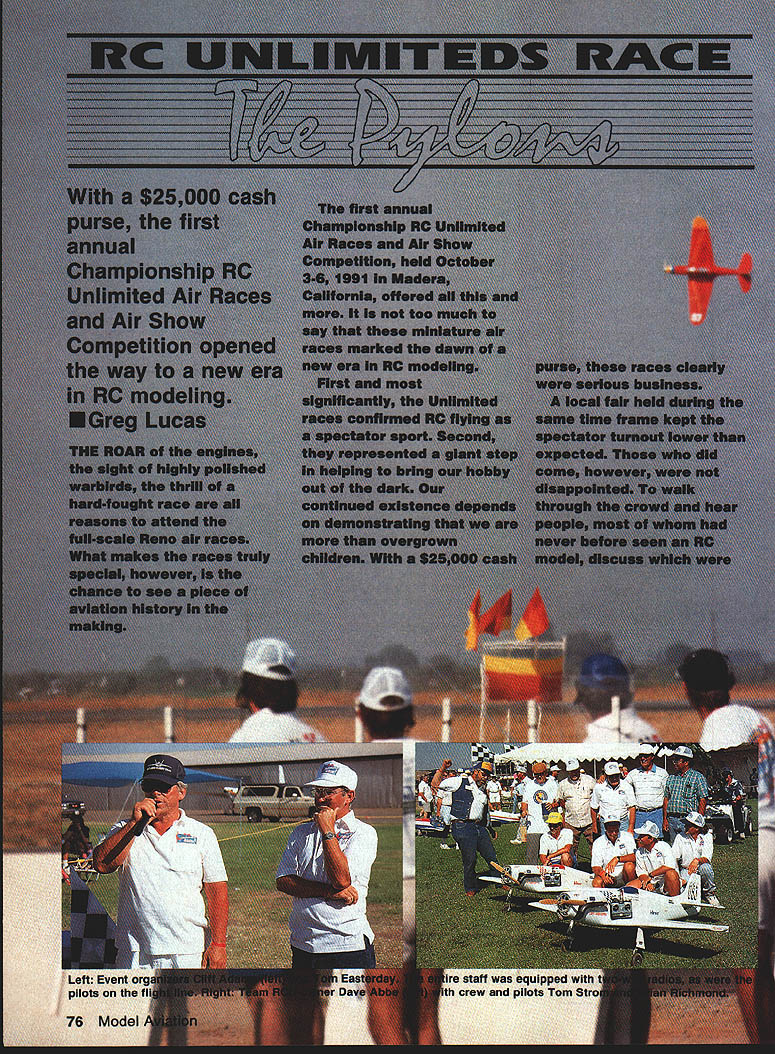
The first annual Championship RC Unlimited Air Races and Air Show Competition, held October 3–6, 1991, in Madera, California, offered all this and more. It is not too much to say that these miniature air races marked the dawn of a new era in RC modeling.
First and most significantly, the Unlimited races confirmed RC flying as a spectator sport. Second, they represented a giant step in helping to bring our hobby out of the dark. Our continued existence depends on demonstrating that we are more than overgrown children. With a $25,000 cash purse, these races clearly were serious business.
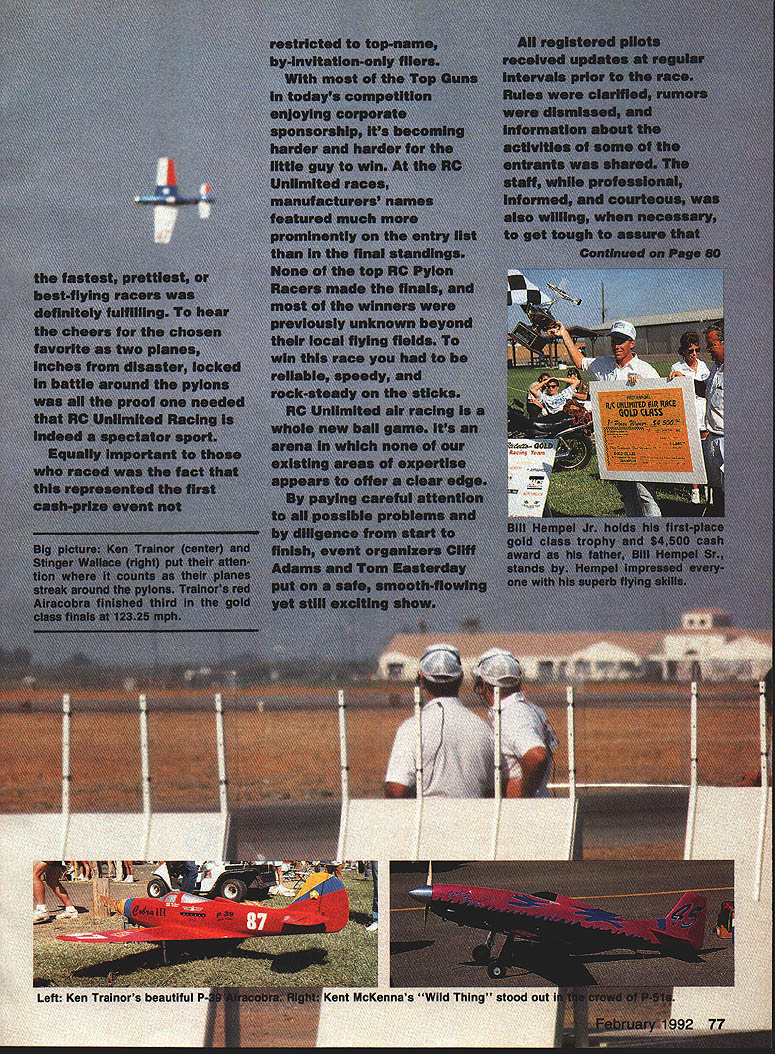
A local fair held during the same time frame kept the spectator turnout lower than expected. Those who did come, however, were not disappointed. To walk through the crowd and hear people, most of whom had never before seen an RC model, discuss which were the fastest, prettiest, or best-flying racers was definitely fulfilling. To hear the cheers for the chosen favorite as two planes, inches from disaster, locked in battle around the pylons was all the proof one needed that RC Unlimited Racing is indeed a spectator sport.
Equally important to those who raced was the fact that this represented the first cash-prize event not restricted to top-name, by-invitation-only fliers. With most of the Top Guns in today's competition enjoying corporate sponsorship, it's becoming harder and harder for the little guy to win. At the RC Unlimited races, manufacturers' names featured much more prominently on the entry list than in the final standings. None of the top RC pylon racers made the finals, and most of the winners were previously unknown beyond their local flying fields. To win this race you had to be reliable, speedy, and rock-steady on the sticks. RC Unlimited air racing is a whole new ball game. It's an arena in which none of our existing areas of expertise appears to offer a clear edge.
By paying careful attention to all possible problems and by diligence from start to finish, event organizers Cliff Adams and Tom Easterday put on a safe, smooth-flowing yet still exciting show. All registered pilots received updates at regular intervals prior to the race. Rules were clarified, rumors were dismissed, and information about the activities of some of the entrants was shared. The staff, while professional, informed, and courteous, was also willing, when necessary, to get tough to assure that things ran safely and fairly.
The entire staff was equipped with two-way radios and in constant touch. Race Control kept continually abreast of the goings-on and answered questions promptly. Pilots, too, had radios on the flight line, so they could reach their callers on the pylons and be informed of any impending problems by Race Control. Organizers, take note: this is how it should be done. No event that I know of has used a system like it.
Enough cannot be said about how well this race was run. Four days of flying went off without a hitch—an achievement that's hard to beat. You'd have thought that the organizers had been running the event for years.
The rules.
Aircraft requirements
- Planes must be propeller-driven scale representations of full-size racers that qualified for the Unlimited class at the Reno National Championship Air Races.
- Wingspan must be 100 inches, scaled to the prototype's unclipped wingspan.
- Weight must not exceed 55 lb.
- No more than 30% of the engine and/or muffler may extend outside the airframe.
The name of the game, of course, is Unlimited. The organizers strove to parallel full-size racing in every respect. Fliers had been given a list of 15 possible aircraft subjects. Nearly all of these prototypes were represented, but with a not surprising bias toward P-51s. The availability of kits and plans played a large part in most builders' choices. I'd like to see manufacturers expand their offerings in the future.
The closest we came to a disappointment was that none of the four registered Pond Racers showed up ready to race. This Burt Rutan design had been newly approved for the official list of prototypes. With its minimal frontal area, the Pond Racer will be hard to beat in future events.
Event administration and technical inspection
Day one—Thursday—began, as did all four race days, with an 8:30 a.m. pilots' meeting. The rules were reviewed, and entrants were told what was expected of them and how Race Control and the pilot-caller radios worked. A question-and-answer period ended the meeting.
All the pilots seemed just a bit nervous. Some may have been worried about the upcoming technical inspections, in which the program was followed closely. With George Steiner, Cal Orr, and Jack Albrecht running, respectively, the scanner, frequency control, and impound, it's no wonder that a single glitch was blamed on interference of any kind.
When asked to CD the race, John Elliott wanted to know whether his decisions of go and no-go would be final. They were. No matter how expert your workers, if they don't know what is going on at any given moment, they can't react. No chance of that here.
Right at the start, pilots experienced collapsed landing-gear problems that would plague a few racers throughout the event. Competitors put in hours of panic repairs and sometimes missed races. Retrieval vehicles stayed busy picking up lamed airplanes.
Qualifying (Thursday–Friday)
Friday things heated up. Licensing continued throughout the day and qualifying began. Pilots flew against the clock to decide who would race in the gold, silver, and bronze classes.
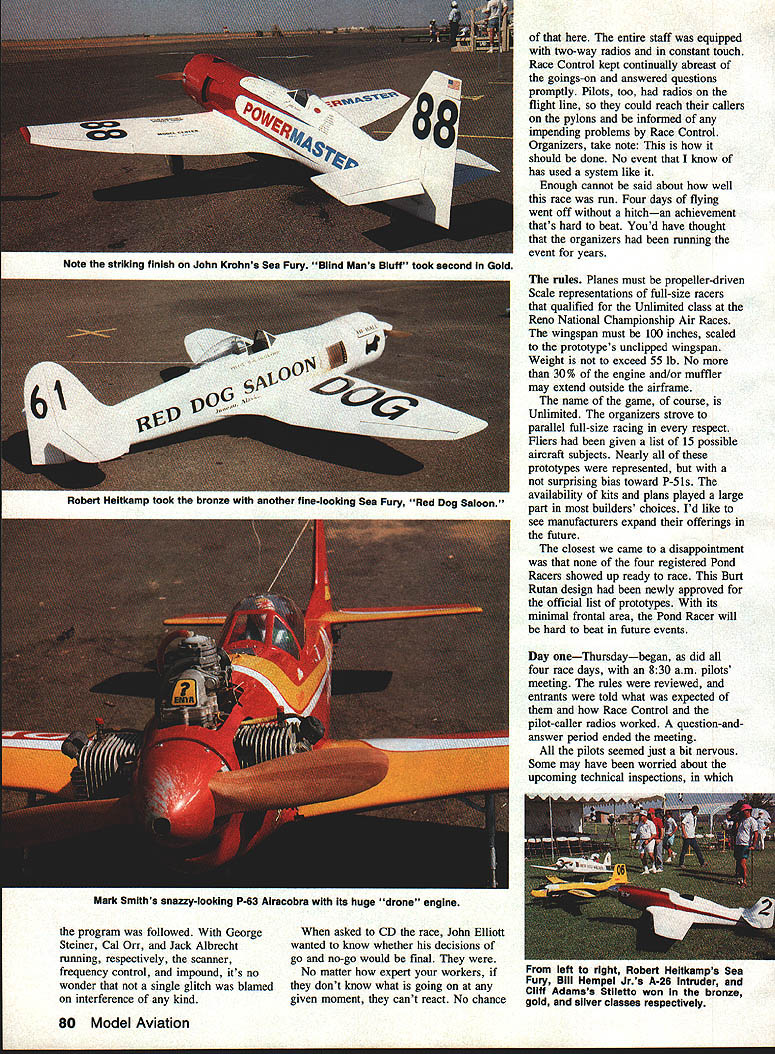
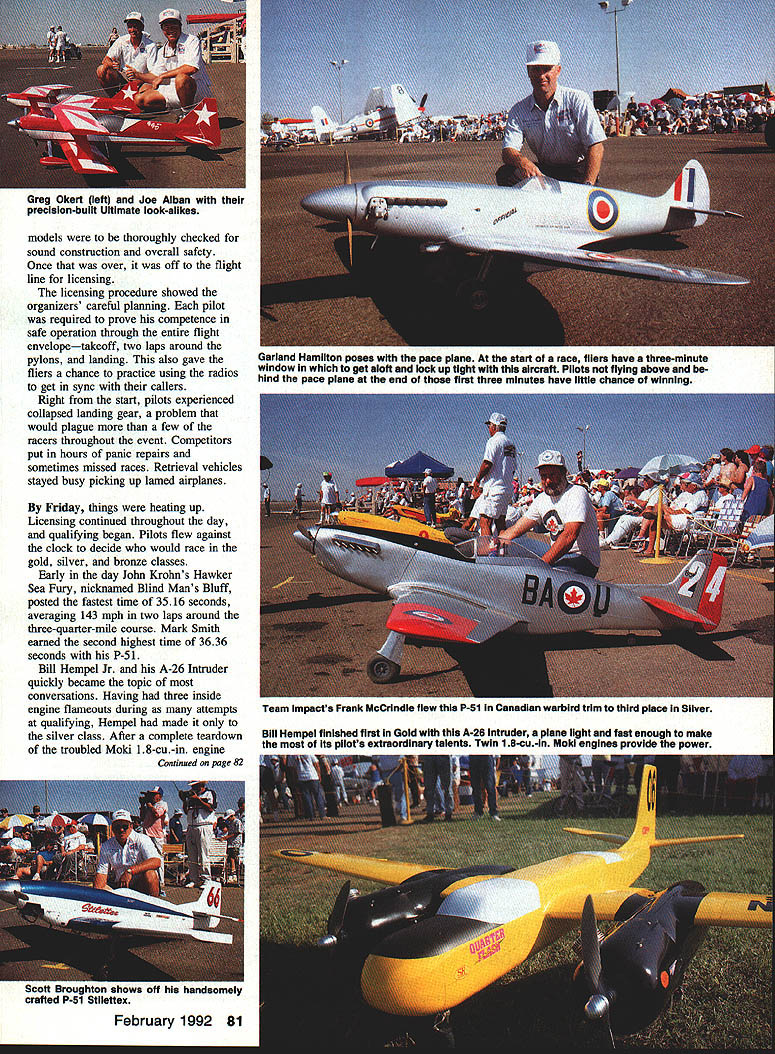
Early in the day John Krohn's Hawker Sea Fury, nicknamed "Blind Man's Bluff," posted the fastest time, 35.16 seconds, averaging 143 mph for two laps around the three-quarter-mile course. Mark Smith earned the second-highest time, 36.36 seconds. Bill Hempel Jr.'s A-26 Intruder quickly became the topic of conversation. Having three inside-engine flameouts during attempts at qualifying, Hempel made silver class. After a complete teardown, the troubled Moki 1.8-cu-in engine was found to have a clogged carburetor; he gave it one last try—and turned 38.91 seconds for the third-fastest time of the day.
Two things were being said about Bill Hempel Jr. The first thing people said was that Hempel's A-26 looked like a Sunday flier with its 100-inch wingspan. Hempel's somewhat tongue-in-cheek response was to add panel lines to the fuselage. Two protests were filed about the model, but both were rejected. While its thin wings and piped Moki engines lacked the muscle and sound of those P-51s with their huge gas-powered engines, there was no question that the A-26 had been built to the letter of the rules.
The second thing people said about Bill Hempel Jr. was that this guy could really fly.
By the end of the day, 30 planes had won the right to compete in Saturday's heat races—in the gold, silver, and bronze classes. The successful pilots left the field to make repairs and plan their strategy.
Only one plane had been lost in a crash. When Bill Schoeneman's P-63 Airacobra clipped the start/finish flag, he was left to think about next year.
Saturday — Heat races
Saturday marked the first day of racing.
Flying against the clock around the pylons is one thing; RC Unlimited Racing is quite another.
Each of the five heat-race rounds was divided into six races—two in the bronze class, two in silver, and two in gold. Pilots flew a total of four times each.
When the pace plane took off at the start of the race, pilots had a three-minute window in which to get airborne and maneuver their models above and behind the pace plane. More than a few races were won or lost at this point. It's hard to win a race if you can't lock up tight with the pace plane, since you start out half a lap behind.
When the pace plane pulled vertical at the rear of the course, pilots had half a lap in which to descend to the course and cross the start line—and the race was on.
At Giant Scale meets, most pilots seem more interested in looking at and talking about their labors of love than in flying. Here the opposite was true. Not that the workmanship wasn't superb. Many of the models represented more than a year of intensive planning and construction. Cliff Adams's Stiletto, John Krohn's Sea Fury, and Robert McClung's Dago Red, to name just a few, had finishes as fine as you'll see. Yet when they crossed the start line, to a man these pilots flew to win. Stinger Wallace of Lufkin, Texas, spoke for all when he said, "I came to race."
And race they did. The adrenaline was so heavy you could taste it. It was not uncommon for the lead to change hands more than a few times during a race. Amid the whirl of sound and motion, the occasional mishap seemed to provoke as much spectator reaction as did any of the close-fought races.
No time was wasted on small talk in the pits. As noted above, many of the landing gear seemed to be held on with toothpicks. By the final races, some may have been. John Krohn had two bad engine runs that threatened to keep him out of the finals despite his holding the fastest qualifying time. And every time I walked past David Bridi's pit area, pilot Richard Verano and at least four crew members were deep inside his F7F Tigercat.
Paul Curley of Marina Del Rey, California suffered a wing failure on Friday but was patched up and ready to fly again by race time. Ralph Braun brought four matching P-51s. He was so well equipped and staffed that he probably could have built four more right on the field.
Though the mood was predominantly competitive, everyone managed to be friendly and helpful. Whenever any part was needed for a repair, it somehow found its way to the needy party.
When Saturday's racing was over, three things were certain:
- RC Unlimited Racing is here to stay. (Many pilots already were planning changes for next year.)
- Bill Hempel Jr. is one phenomenal pilot.
- Everyone was having a lot of fun.
Sunday — Finals and results
Sunday saw the final two rounds of heat races followed by the dash for cash. At morning's count there were six fewer planes on the field: one had dropped out in the gold class, three in silver, and two in bronze.
Piloting the Bridi F7F Tigercat, Richard Verano suffered the most spectacular crash of the contest. Having lost an engine on the rear of the course, Verano immediately climbed for altitude, then slowed down too much while rounding the third pylon and spun in from about 150 feet. It was sad to see the big, 123-in. plane go in after the great effort spent on making and keeping it competitive.
The landing-gear problem had become so acute that some crews carried their planes to the flight line hoping to squeeze out a takeoff, but fully expecting the gear to collapse on landing.
On a more upbeat note, in the gold class Bill Hempel Jr. easily won three out of four heats. Mark Smith and John Krohn raced wing tip to wing tip for most of six laps—the best display of pylon races I've seen. In the silver class, Bob Walensa also won three out of four heats, then went on to the final duel with race promoter Cliff Adams. The bronze class racers seemed more evenly matched, with no one winning more than two heats.
The finals: bronze, silver, and gold
Each class had five planes and two alternates. The pits were as hectic as ever. Although they were thrilled to make it to the finals, pilots still had to prepare their planes. Jovial personalities such as John Eaton and Stinger Wallace kept the others entertained during the serious work of repairs, tweaking, and prop changes.
By the rules, the two alternate planes should be running and ready to take off within the three-minute window in case any of the five finalists prove unable to launch. In the bronze race, after everyone had gotten a good start, the Braun Racing Team plane collided with Larry Sutherland's Mustang while rounding pylon one. The Braun racer was totaled. Larry continued around the course but was flagged by Race Control. Although a huge disappointment for Larry, this was the only reasonable decision possible from the standpoint of safety.
Robert Heitkamp went on to win the bronze with his beautiful Sea Fury, nicknamed Red Dog. John Eaton and Bill Coulter finished second and third. Heitkamp, who'd traveled all the way from Juneau, Alaska, was grinning from ear to ear as the planes were towed past the crowd during the victory parade.
In the silver class, Cliff Adams led by a wide margin from start to finish. As usual, he evaded the spotlight, repeatedly asking the tow driver to "hurry it up" during the parade. Bob Walensa of Sacramento, California placed second with his Stiletto Gold, followed by Team Impact's Frank McCrindle with a P-51 in Canadian warbird trim.
The start of the gold race was straight out of Hollywood, bringing sadness for some and joy for others. First, Mark Smith discovered that landing gear repairs had pushed his P-51 One Shot, already weighed down with a huge "drone" engine, over the 55-lb. limit. The plane was disqualified, and Tom Strom joined fellow Team RCD member Brian Richmond to take Smith's place.
Next, Stinger Wallace became the latest victim of landing gear failure when his prop and underbelly met the runway on takeoff. This turn of events put second alternate John Krohn, whose engine was now running smoothly, back in the race.
When the pace plane pulled vertical one last time, it was obvious that the cream had risen to the top. Bill Hempel Jr. crossed the start line leading what looked like a swarm of bees. Hempel's combination of superb flying skills and the light, fast A-26 kept him in the lead all the way. Only four seconds behind was Mr. Lucky, John Krohn, who averaged 146.91 mph to Hempel's winning average speed of 152.32 mph. After the ups and downs he had endured, the normally quiet, reserved Krohn was as happy as a pig in manure.
Last in the money was Ken Trainor, turning 123.25 mph with a red P-39 Airacobra. Brian Richmond had finished third by averaging 142.31 mph, but a pylon cut relegated him to fourth place.
Still, that wasn't enough to spoil the day for RCD owner Dave Abbe, who was elated that both his team entries had made the gold race. Dave later told me that Richmond and Strunk had used 18 of the 20 gear struts they'd brought to the race. Obviously the hard strut with scissor configuration is impracticable for all but the smoothest landings. If I may offer a solution, adding a short, coiled piece of music wire at the strut attach point provides the necessary flex for our scale craft (read "hard") landings while maintaining the scale look we want.
Air Show Competition and other highlights
More, you say? How about Brian Sanders making unannounced 450-mph low passes down the runway in the full-sized Reno racer Dreadnaught? One lucky person won a ride in this ultimate hot rod. The added bonus of the entire race reminds me that anyone who hasn't seen the full-scale Reno races ought to catch them before they are no more. We also were treated to a few passes by a venerable B-25, stirring memories in some and awe in others.
Greg Oertel and Joe Alban won the Air Show Competition flying 1/4-scale Ultimate biplanes. This event was hampered by having only three entries, two of which suffered unplanned contact with Mother Earth. The noncompeting Aero Flight Team—event promoters Cliff Adams and Tom Easterday, Doug Wilber, and pace plane pilot Garland Hamilton—set the standard for future events, taking their smoke-equipped Su-26 Sukhoi through a routine that has thrilled crowds on the West Coast for the past few years. These guys make it all look effortless. They love to please—and please they do, from Cliff's skywriting heart to Garland's touch-and-go at the bottom of a loop.
Building and advice
Have you started building yet? Sure, it takes a lot of work, and 100 inches is a big plane. It also can get expensive. But where else can you find this kind of excitement and have a chance at winning a chunk of change to boot? Bill Hempel took home a check for $4,500, plus nearly $300 in heat-race money. He probably had invested less than that in his plane. Not bad.
I would caution anyone who's considering building one of the approved twin-engine prototypes to first check with the sponsors; some rules changes may be forthcoming.
Whether you're the local hot dog who wants to see how you rate against some of the best, or whether you'd simply like to be a part of RC history, come on out next year. No invitation necessary.
Transcribed from original scans by AI. Minor OCR errors may remain.

