
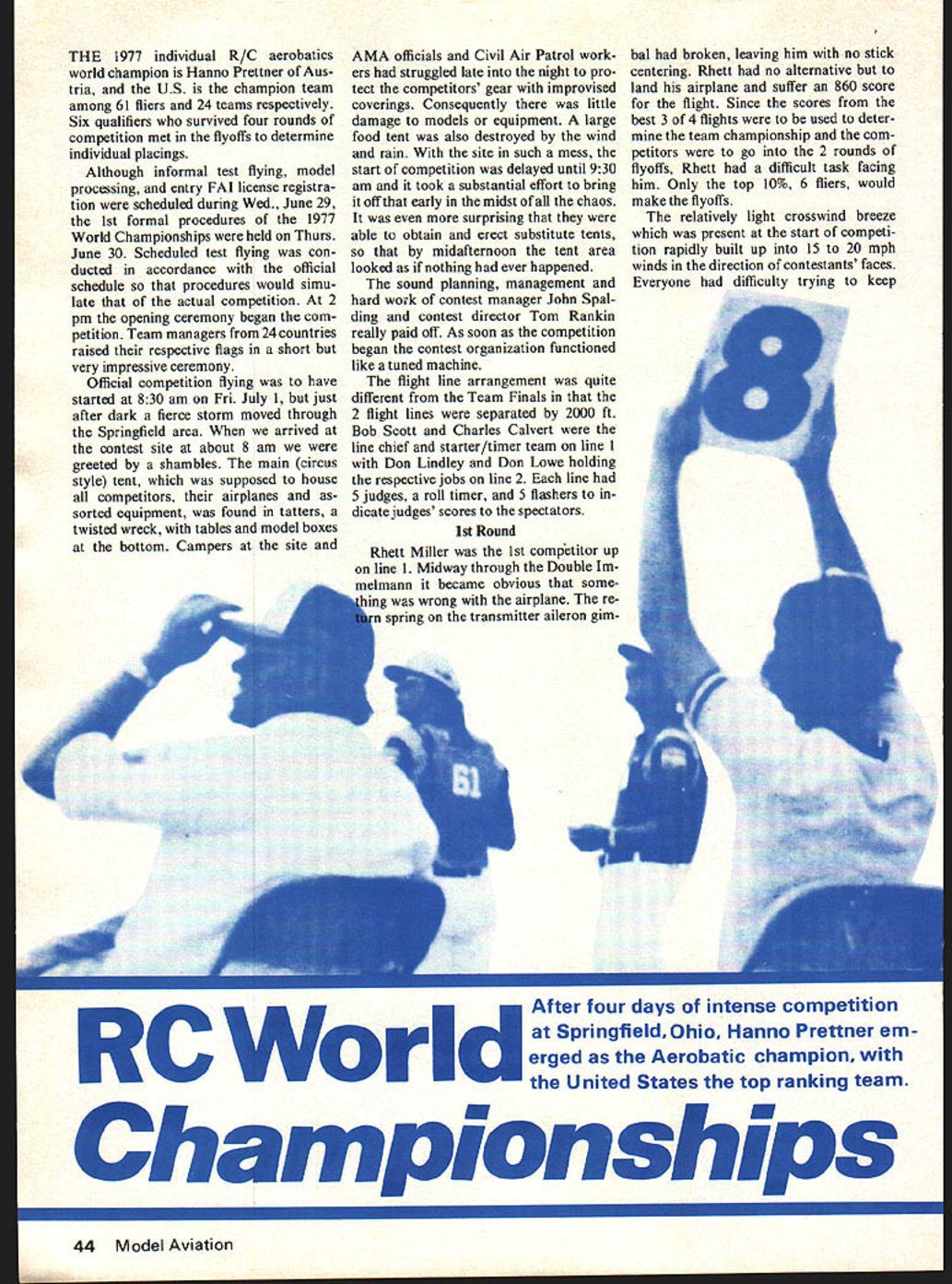
RC World Championships
THE 1977 individual R/C aerobatics world champion is Hanno Prettner of Austria, and the U.S. is the champion team among 61 fliers and 24 teams respectively. Six qualifiers who survived four rounds of competition met in the flyoffs to determine individual placings.
Although informal test flying, model processing, and entry FAI license registration were scheduled during Wed., June 29, the 1st formal procedures of the 1977 World Championships were held on Thurs., June 30. Scheduled test flying was conducted in accordance with the official schedule so that procedures would simulate that of the actual competition. At 2 pm the opening ceremony began the competition. Team managers from 24 countries raised their respective flags in a short but very impressive ceremony.
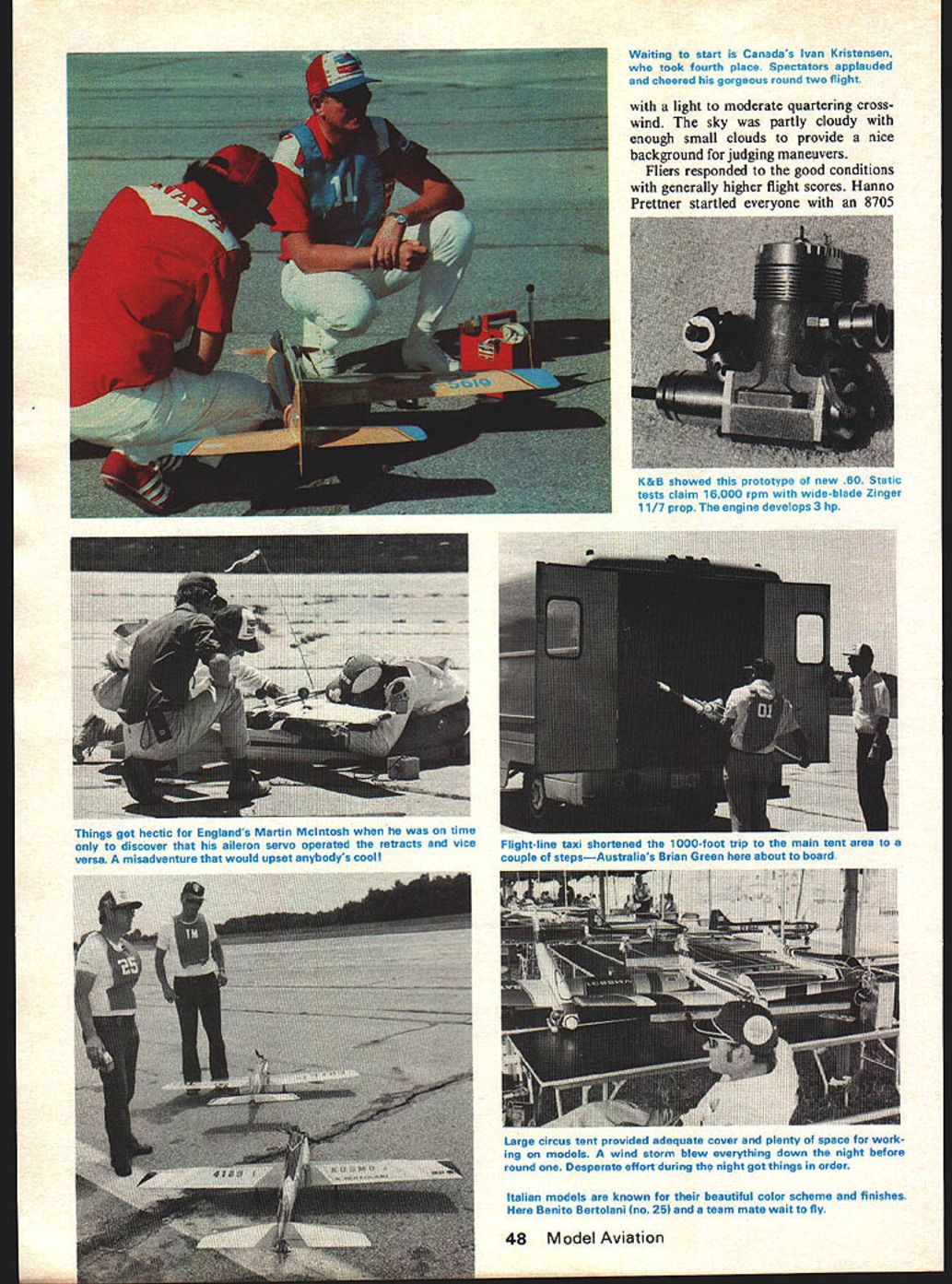
Official competition flying was to have started at 8:30 am on Fri., July 1, but just after dark a fierce storm moved through the Springfield area. When we arrived at the contest site at about 8 am we were greeted by a shambles. The main (circus style) tent, which was supposed to house all competitors, their airplanes and assorted equipment, was found in tatters, a twisted wreck, with tables and model boxes at the bottom. Campers at the site and AMA officials and Civil Air Patrol workers had struggled late into the night to protect the competitors' gear with improvised coverings. Consequently there was little damage to models or equipment. A large food tent was also destroyed by the wind and rain. With the site in such a mess, the start of competition was delayed until 9:30 am and it took a substantial effort to bring it off that early in the midst of all the chaos. It was even more surprising that they were able to obtain and erect substitute tents, so that by midafternoon the tent area looked as if nothing had ever happened.
The sound planning, management and hard work of contest manager John Spalding and contest director Tom Rankin really paid off. As soon as the competition began the contest organization functioned like a tuned machine.
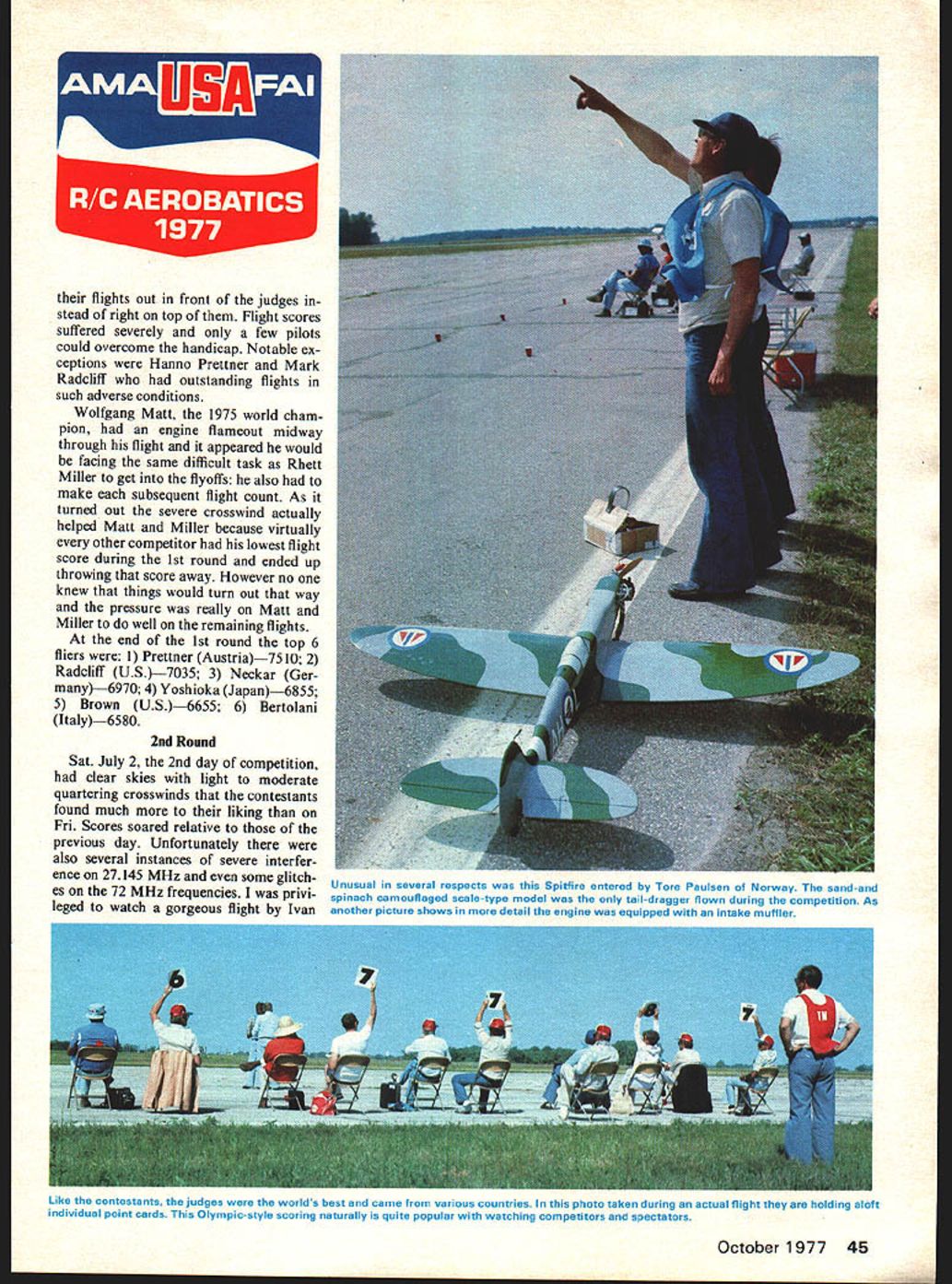
The flight line arrangement was quite different from the Team Finals in that the 2 flight lines were separated by 2000 ft. Bob Scott and Charles Calvert were the line chiefs and starter/timer on line 1 with Don Lindley and Don Lowe holding the respective jobs on line 2. Each line had 5 judges, a roll timer, and 5 flashers to indicate judges' scores to the spectators.
1st Round
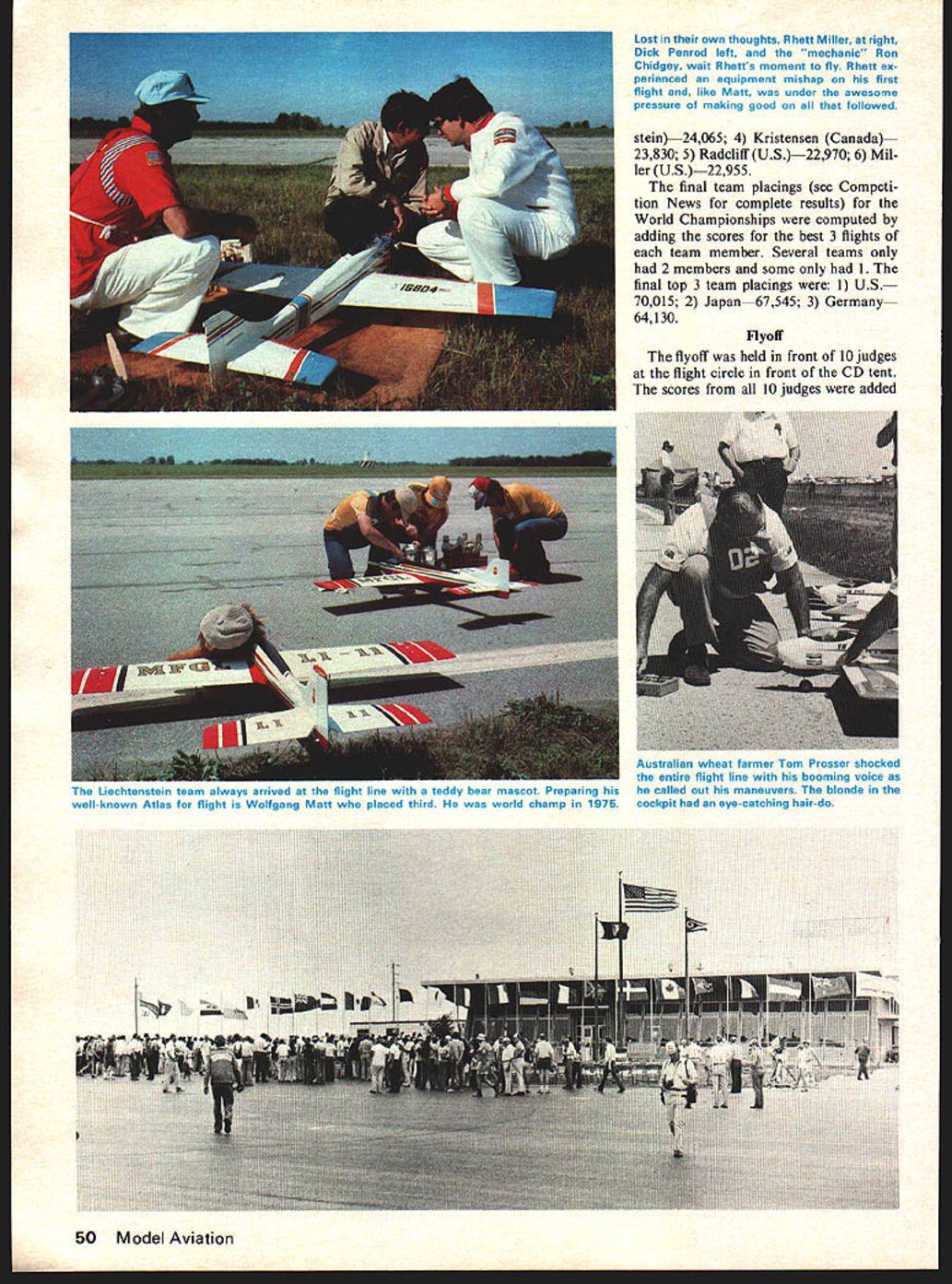
Rhett Miller was the 1st competitor up on line 1. Midway through the Double Immelmann it became obvious that something was wrong with the airplane. The return spring on the transmitter aileron gimbal had broken, leaving him with no stick centering. Rhett had no alternative but to land his airplane and suffer an 860 score for the flight. Since the scores from the best 3 of 4 flights were to be used to determine the team championship and the competitors were to go into the 2 rounds of flyoffs, Rhett had a difficult task facing him. Only the top 10%, 6 fliers, would make the flyoffs.
The relatively light crosswind breeze which was present at the start of competition rapidly built up into 15 to 20 mph winds in the direction of contestants' faces. Everyone had difficulty trying to keep their flights out in front of the judges instead of right on top of them. Flight scores suffered severely and only a few pilots could overcome the handicap. Notable exceptions were Hanno Prettner and Mark Radcliff who had outstanding flights in such adverse conditions.
Wolfgang Matt, the 1975 world champion, had an engine flameout midway through his flight and it appeared he would be facing the same difficult task as Rhett Miller to get into the flyoffs; he also had to make each subsequent flight count. As it turned out the severe crosswind actually helped Matt and Miller because virtually every other competitor had his lowest flight score during the 1st round and ended up throwing that score away. However no one knew that things would turn out that way and the pressure was really on Matt and Miller to do well on the remaining flights.
At the end of the 1st round the top 6 fliers were: 1) Prettner (Austria)—7510; 2) Radcliff (U.S.)—7035; 3) Neckar (Germany)—6970; 4) Yoshioka (Japan)—6855; 5) Brown (U.S.)—6655; 6) Bertolani (Italy)—6580.
2nd Round
Sat. July 2, the 2nd day of competition, had clear skies with light to moderate quartering crosswinds that the contestants found much more to their liking than on Fri. Scores soared relative to those of the previous day. Unfortunately there were also several instances of severe interference on 27.145 MHz and even some glitches on the 72 MHz frequencies. I was privileged to watch a gorgeous flight by Ivan Kristensen that left the spectators cheering and applauding with each maneuver. His score of 8195 was the highest of the competition until that point. Rhett Miller and Wolfgang Matt both had 7700+ flight scores and began to move up in the standings.
The top six after the 2nd round were: 1) Prettner (Austria) — 15,580; 2) Kristensen (Canada) — 14,560; 3) Brown (U.S.) — 14,535; 4) Radcliff (U.S.) — 14,350; 5) Neckar (Germany) — 14,160; 6) Naruke (Japan) — 14,140
3rd Round
Sun. July 3, the 3rd day of competition, was blessed with clear skies and light variable winds. The winds were so light that contestants were taking off and landing in both directions. International rules allow a competitor to take off and land in one direction, with a choice of which direction to perform the 1st airborne maneuver, the figure M. So it was not uncommon to see a competitor take off from right to left and start the figure M from left to right. It certainly kept the judges on their toes. The light winds resulted in generally higher scores by all competitors. Hanno Prettner and Dave Brown both had 8200+ scores to lead the way.
Matt and Miller continued to bear up under the pressure and they advanced to 12th and 31st place respectively. Rhett would have been much higher but his initial score of only 860 compared to Matt's 4570 held him back.
The top 6 after the 3rd round were: 1) 1) Prettner (Austria) — 23,825; 2) Brown (U.S.) — 22,755; 3) Kristensen (Canada) — 22,555; 4) Radcliff (U.S.) — 21,905; 5) Naruke (Japan) — 21,740; 6) Neckar (Germany) — 21,440
After formal flying was over there was a party for all fliers, supporters and officials at the main tent area. The Irish team broke out many quarts of Irish whiskey and served Irish coffee to all comers. Several American sponsors had chipped in to buy beer and soft drinks. Several pleasant hours were spent talking to new friends from all over the world.
4th Round
Mon. July 4 was to be a long day. Since the final round of flying, the 2 rounds of flyoffs and the awards ceremonies were to be completed that day, flying started at 7:30 am and the usual 1 1/2 hr. lunch break was canceled. It was a day much like Sat. With a light to moderate quartering crosswind. The sky was partly cloudy with enough small clouds to provide a nice background for judging maneuvers.
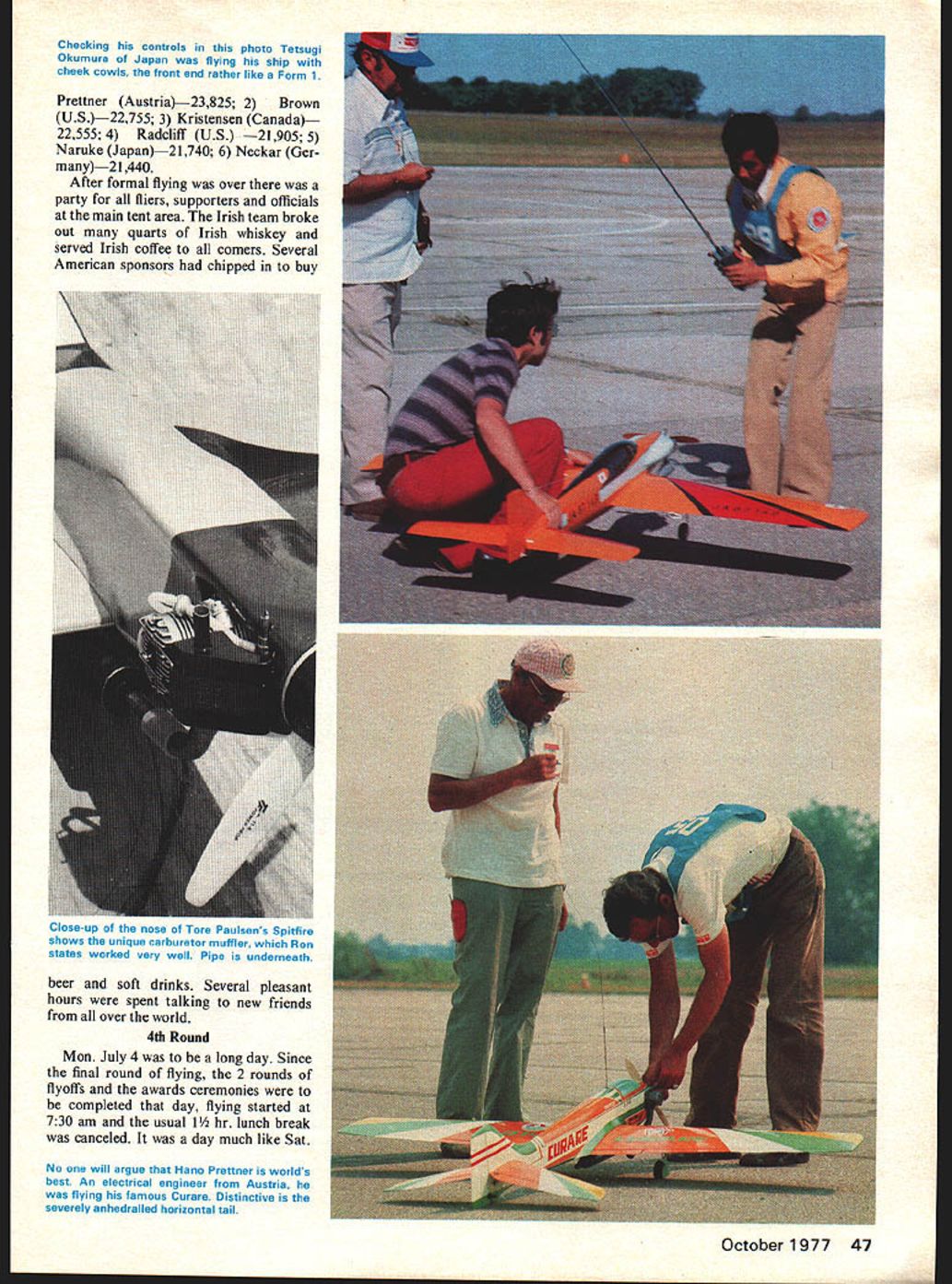
Fliers responded to the good conditions with generally higher flight scores. Hanno Prettner startled everyone with an 8705. and made it impossible for anyone to catch him in the flyoffs. Wolfgang Matt had the second highest score of the World Championships, an 8510 to wrap up a place in the flyoffs. Rhett Miller put in an uncharacteristically low flight, a 7195 and just made it into the flyoffs.
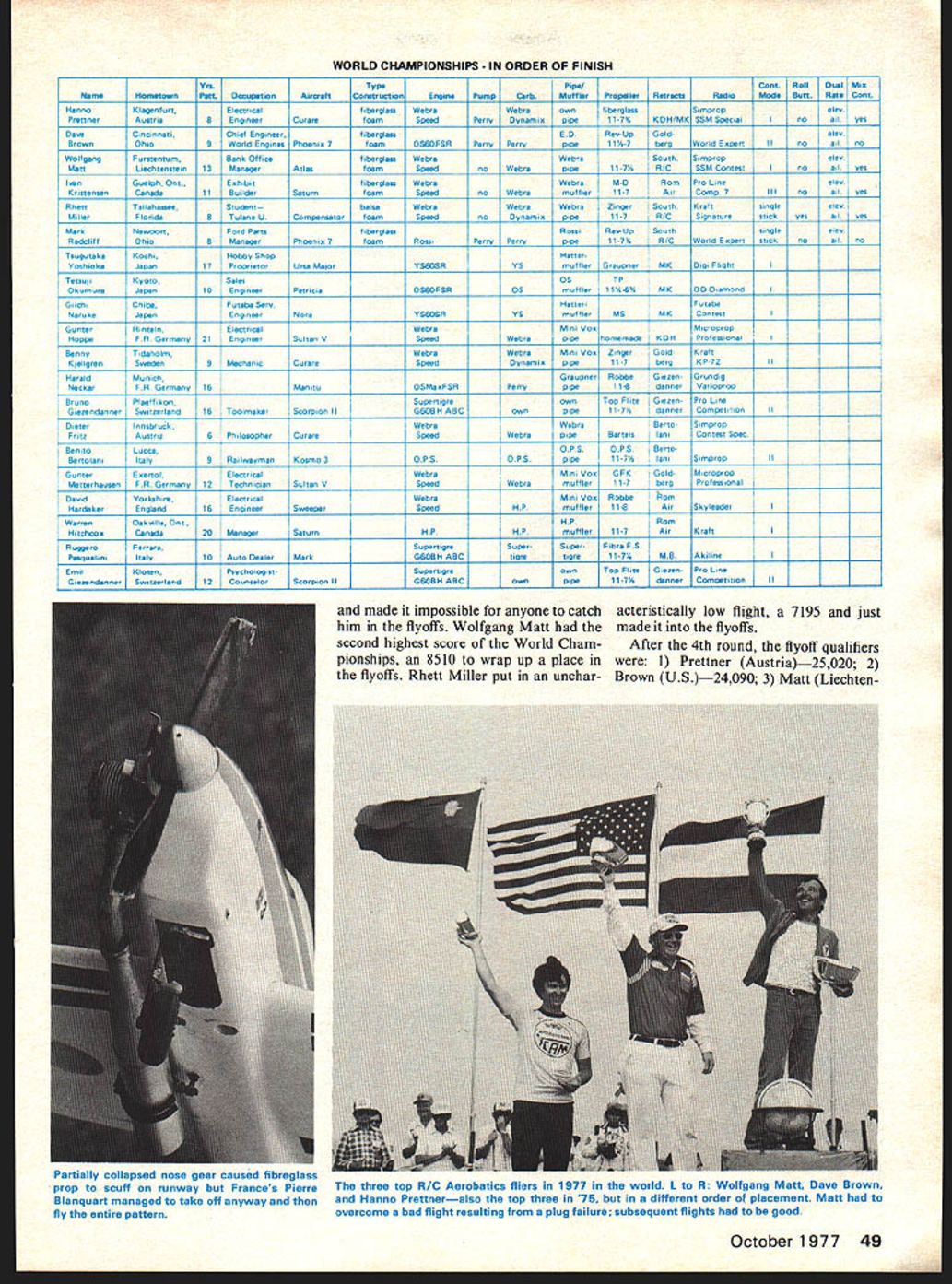
After the 4th round, the flyoff qualifiers were: 1) Prettner (Austria)—25,020; 2) Brown (U.S.)—24,090; 3) Matt (Liechten- stein)—24,065; 4) Kristensen (Canada)—23,830; 5) Radcliff (U.S.)—22,970; 6) Miller (U.S.)—22,955.
The final team placings (see Competition News for complete results) for the World Championships were computed by adding the scores for the best 3 flights of each team member. Several teams only had 2 members and some only had 1. The final top 3 team placings were: 1) U.S.—70,015; 2) Japan—67,545; 3) Germany—64,130.
Flyoff
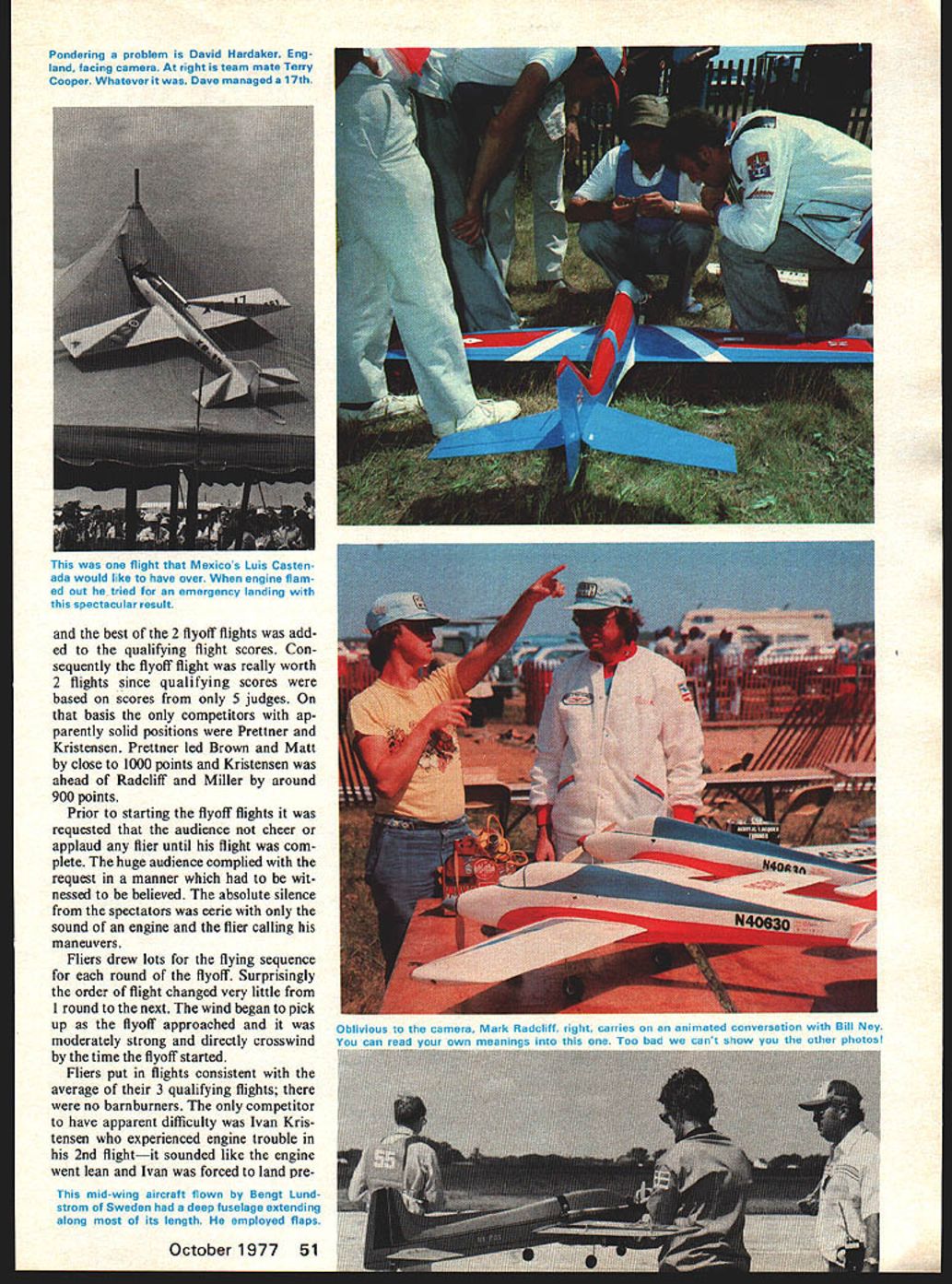
The flyoff was held in front of 10 judges at the flight circle in front of the CD tent. The scores from all 10 judges were added. and the best of the 2 flyoff flights was added to the qualifying flight scores. Consequently the flyoff flight was really worth 2 flights since qualifying scores were based on scores from only 5 judges. On that basis the only competitors with apparently solid positions were Prettner and Kristensen. Prettner led Brown and Matt by close to 1000 points and Kristensen was ahead of Radcliff and Miller by around 900 points.
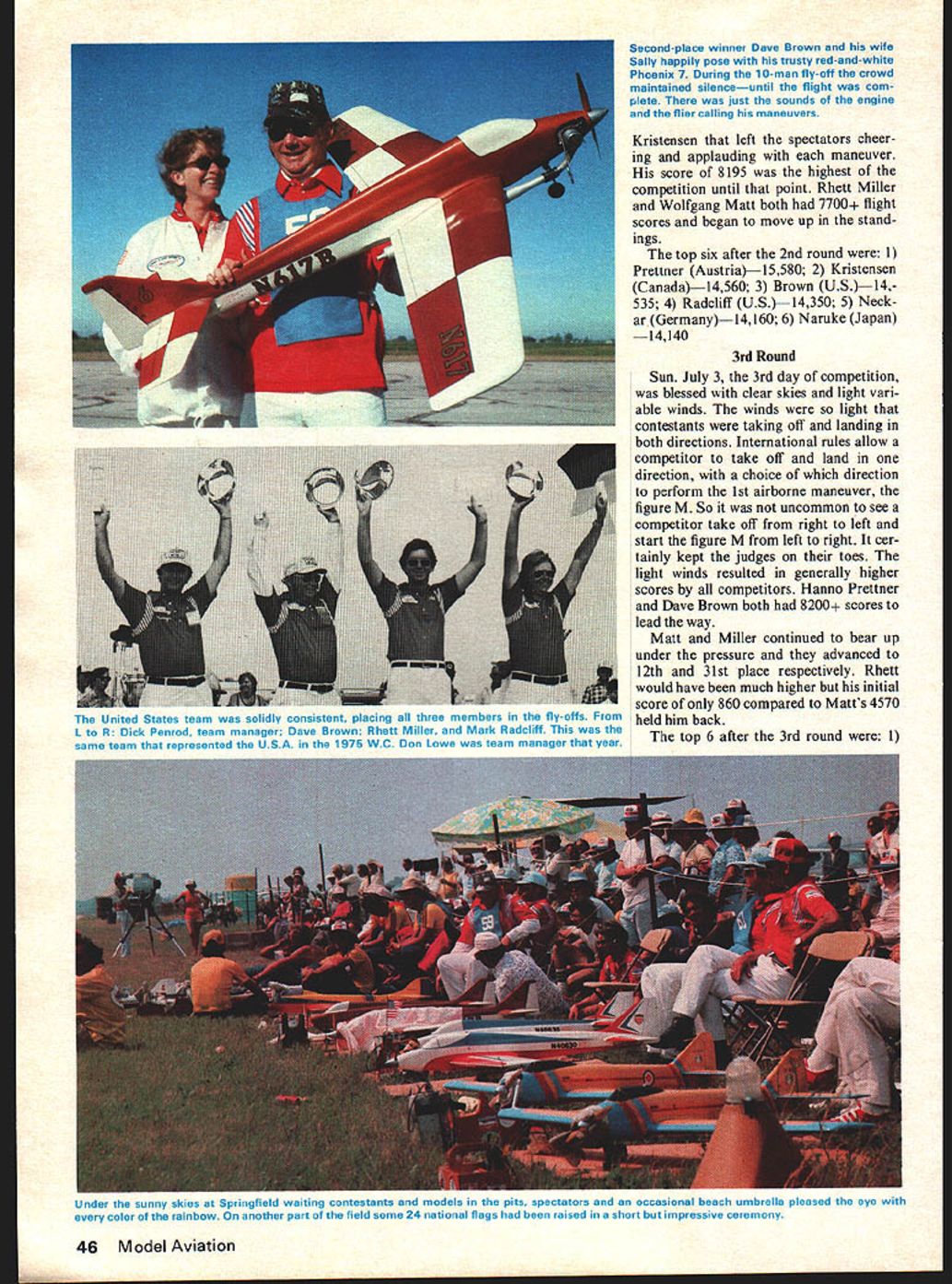
Prior to starting the flyoff flights it was requested that the audience not cheer or applaud any flier until his flight was complete. The huge audience complied with the request in a manner which had to be witnessed to be believed. The absolute silence from the spectators was eerie with only the sound of an engine and the flier calling his maneuvers.
Fliers drew lots for the flying sequence for each round of the flyoff. Surprisingly the order of flight changed very little from 1 round to the next. The wind began to pick up as the flyoff approached and it was moderately strong and directly crosswind by the time the flyoff started.
Fliers put in flights consistent with the average of their 3 qualifying flights; there were no barnburners. The only competitor to have apparent difficulty was Ivan Kristensen who experienced engine trouble in his 2nd flight—it sounded like the engine went lean and Ivan was forced to land prematurely. to avoid damage to the engine. Hanno Prettner was the last man to fly in the 1977 World Championships.
The final individual placings (see Competition News for complete results) for the 10th R/C Aerobatics World Championships were: 1) Hanno Prettner (Austria) — 41,395; 2) Dave Brown (U.S.) — 40,255; 3) Wolfgang Matt (Liechtenstein) — 40,195; 4) Ivan Kristensen (Canada) — 38,990; 5) Rhett Miller (U.S.) — 38,735; 6) Mark Radcliff (U.S.) — 38,485.
The awards ceremonies were held in front of the CD tent in the midst of hundreds of happy competitors, supporters, sponsors, officials and spectators. Suddenly it was all over. There was a feeling in the air that it had ended too soon because many people were milling about long after the awards had been presented. They seemed unwilling to let go of the great aura associated with a World Championship.
My job had just begun. Imagine trying to report about events with the importance of the Team Finals and the World Championships. Dick McGraw and I took more than 1100 photographs and captions had to be prepared for those worthy of publication. The contestant information sheets were converted to the Team Finals/World Championship matrix presented here.
Special thanks are due to Sgt Bill Grigsby of the Ft. Walton Beach Police Dept. who spent many hrs processing film (32 rolls!) for me; to Dick McGraw for covering the Team Finals by himself and the World Championships with me; and to all the competitors and officials who graciously put up with our questions and picture taking.
It was a lot of work but I'd do it again tomorrow, because I was part of the 1977 R/C Aerobatic World Championships.
Transcribed from original scans by AI. Minor OCR errors may remain.

