
RC World Championships
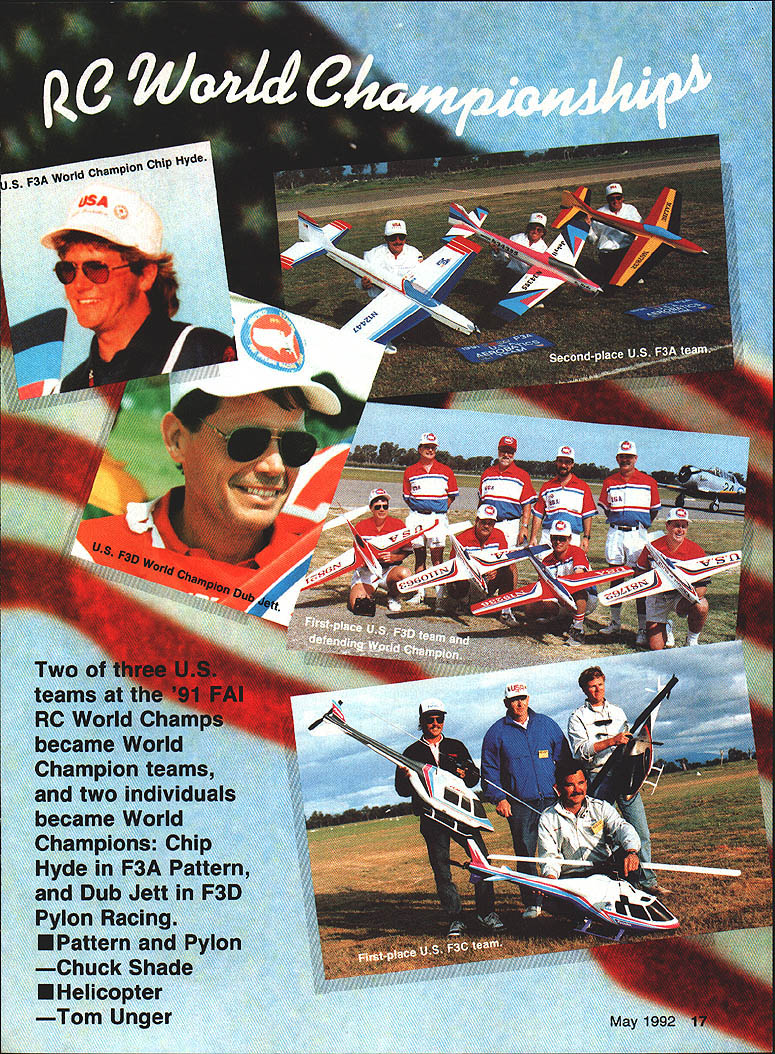
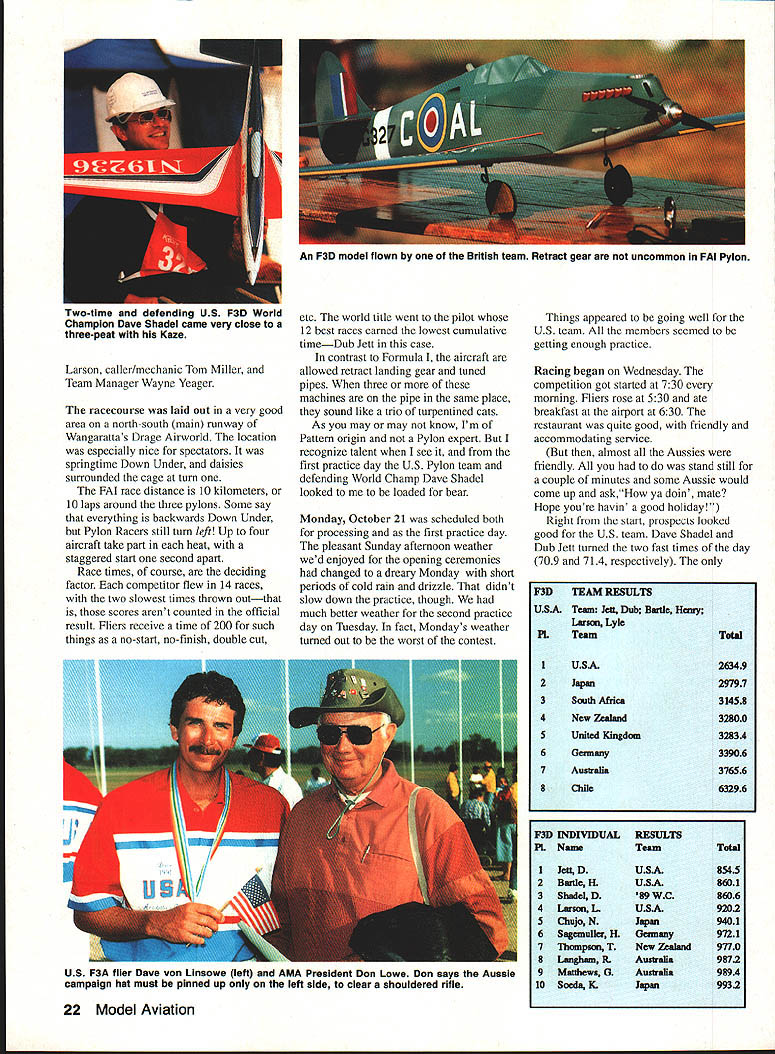
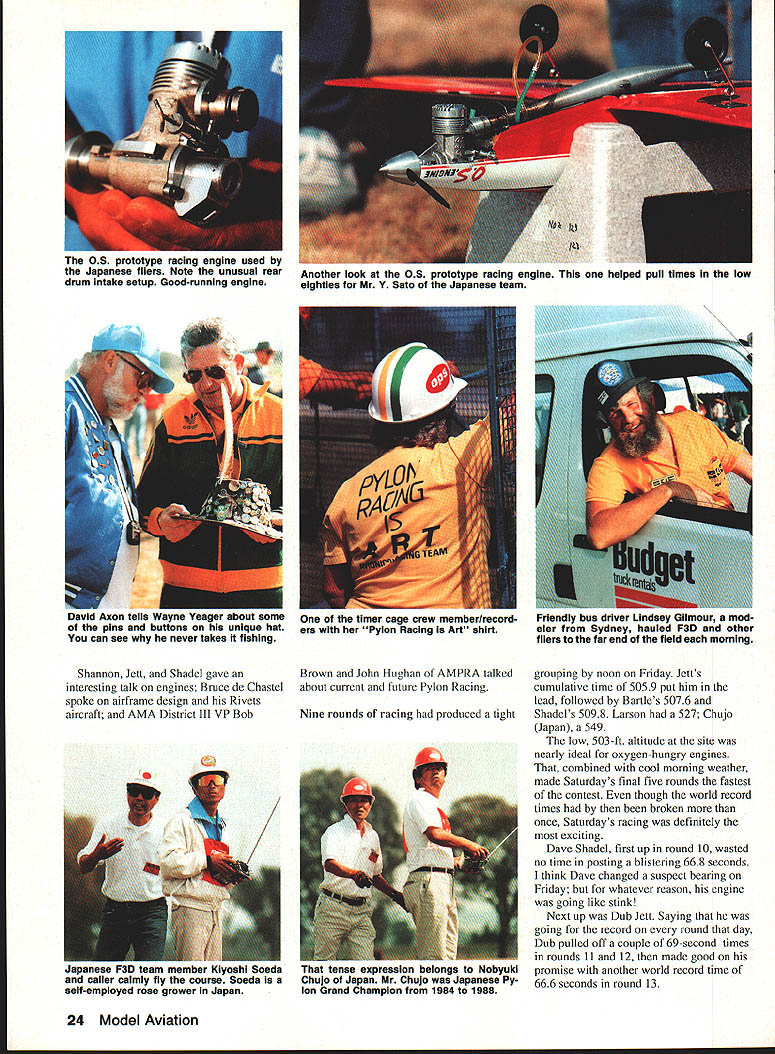
Two of three U.S. teams at the 1991 FAI RC World Championships became World Champion teams, and two individuals became World Champions: Chip Hyde in F3A Pattern and Dub Jett in F3D Pylon Racing.
- Pattern and Pylon — Chuck Shade
- Helicopter — Tom Unger
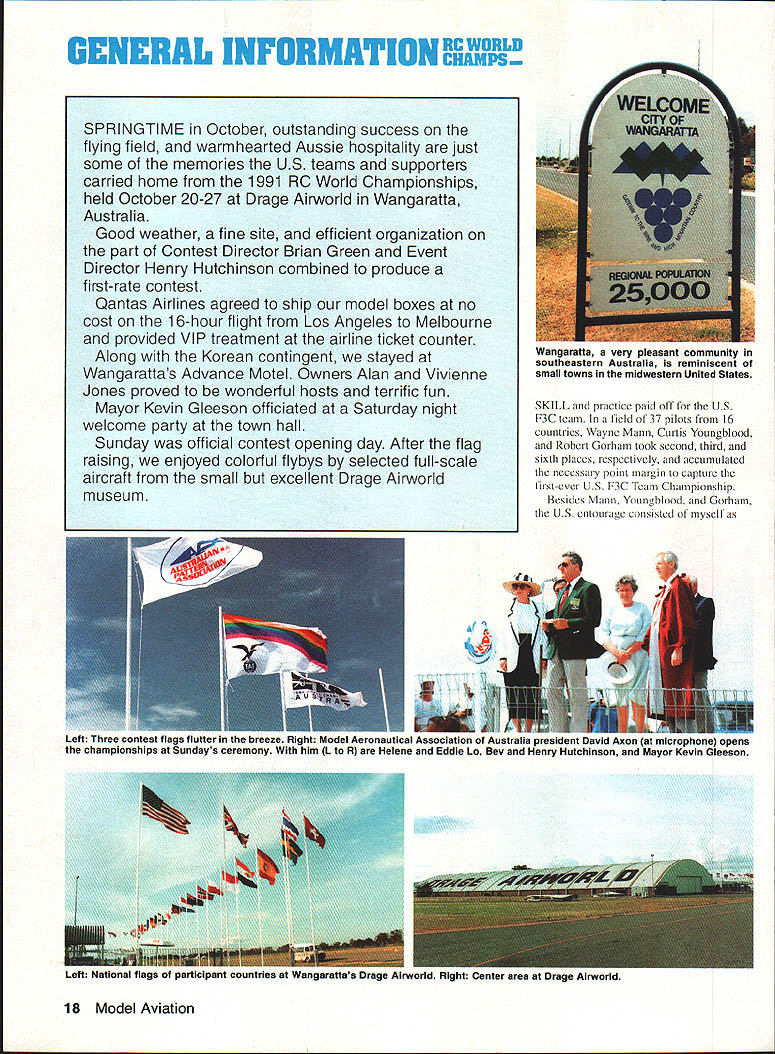
SPRINGTIME in October, outstanding success on the flying field, and warmhearted Aussie hospitality are some of the memories the U.S. teams and supporters carried home from the 1991 RC World Championships, held October 20–27 at Drage Airworld in Wangaratta, Australia.
Good weather, a fine site, and efficient organization by Contest Director Brian Green and Event Director Henry Hutchinson combined to produce a first-rate contest. Qantas Airlines agreed to ship model boxes at no cost on the 16-hour flight from Los Angeles to Melbourne and provided VIP treatment at the airline ticket counter.
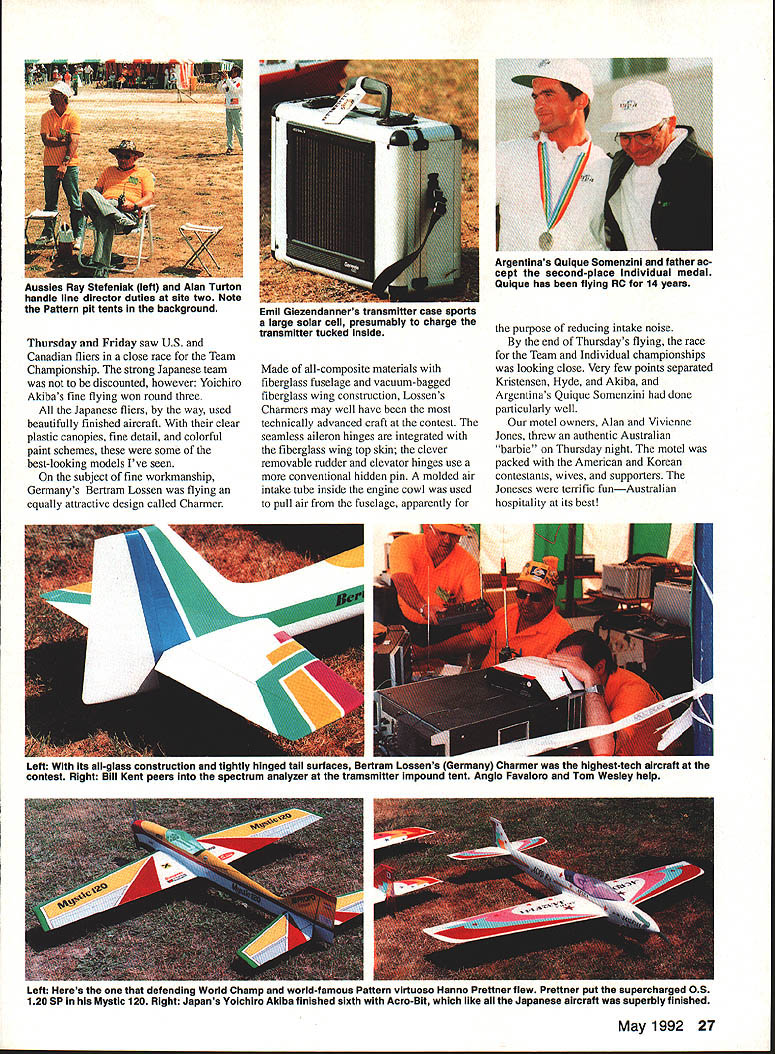
Along with the Korean contingent, the U.S. teams stayed at Wangaratta's Advance Motel. Owners Alan and Vivienne Jones proved to be wonderful hosts. Mayor Kevin Gleeson officiated at a Saturday-night welcome party at the town hall.
Sunday was official contest opening day. After the flag raising, there were colorful flybys by selected full-scale aircraft from the Drage Airworld museum.
Helicopter (F3C)
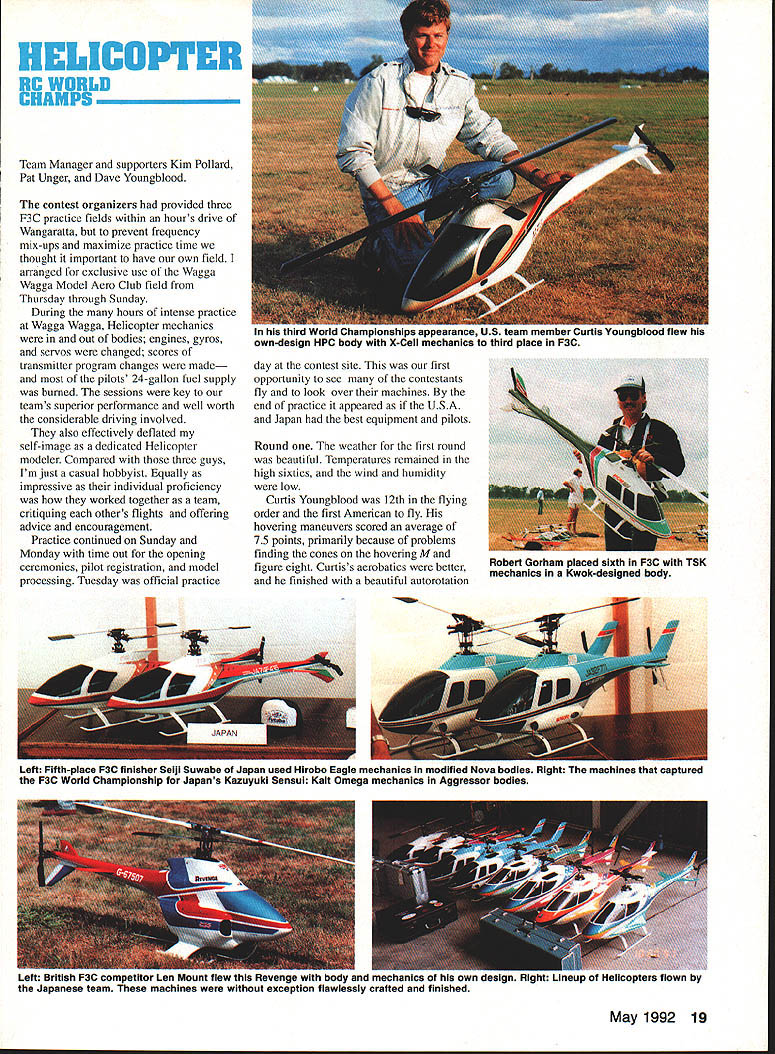
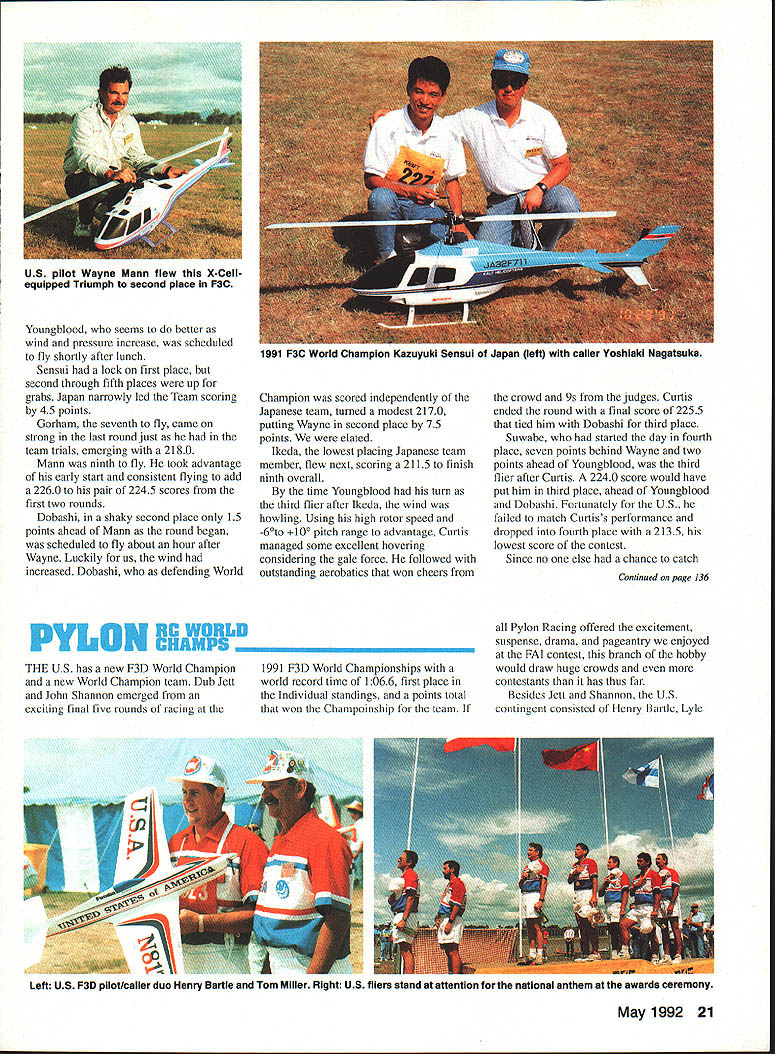
Team manager and supporters Kim Pollard, Pat Unger, and Dave Youngblood, together with contest organizers, provided three F3C practice fields within a few hours' drive of Wangaratta to prevent frequency mix-ups and maximize practice time. The team arranged exclusive use of the Wagga Wagga Model Aero Club field Thursday through Sunday. During intense practice sessions mechanics swapped bodies, engines, gyros, servos, and skids; transmitter program changes were made; and pilots burned through fuel supplies. The driving and effort paid off in superior performance and excellent team cohesion—pilots critiqued each other's flights, offered advice, and encouraged one another.
Practice continued Sunday and Monday, with time out for opening ceremonies, pilot registration, and model processing. Tuesday was the official practice day at the contest site—the first opportunity to see contestants fly and inspect machines. By the end of practice it appeared the U.S. and Japan had the best equipment and pilots. Monday featured the worst weather of the week, but Tuesday brought much better conditions.
The first round's weather was beautiful: temperatures in the high sixties with low wind and humidity. Curtis Youngblood (the first American to fly) had some problems finding cones while hovering but finished with a beautiful autorotation. Over the four contest rounds wind conditions varied from calm to gusty (up to 18–20 mph), which affected scores and flying order importance.
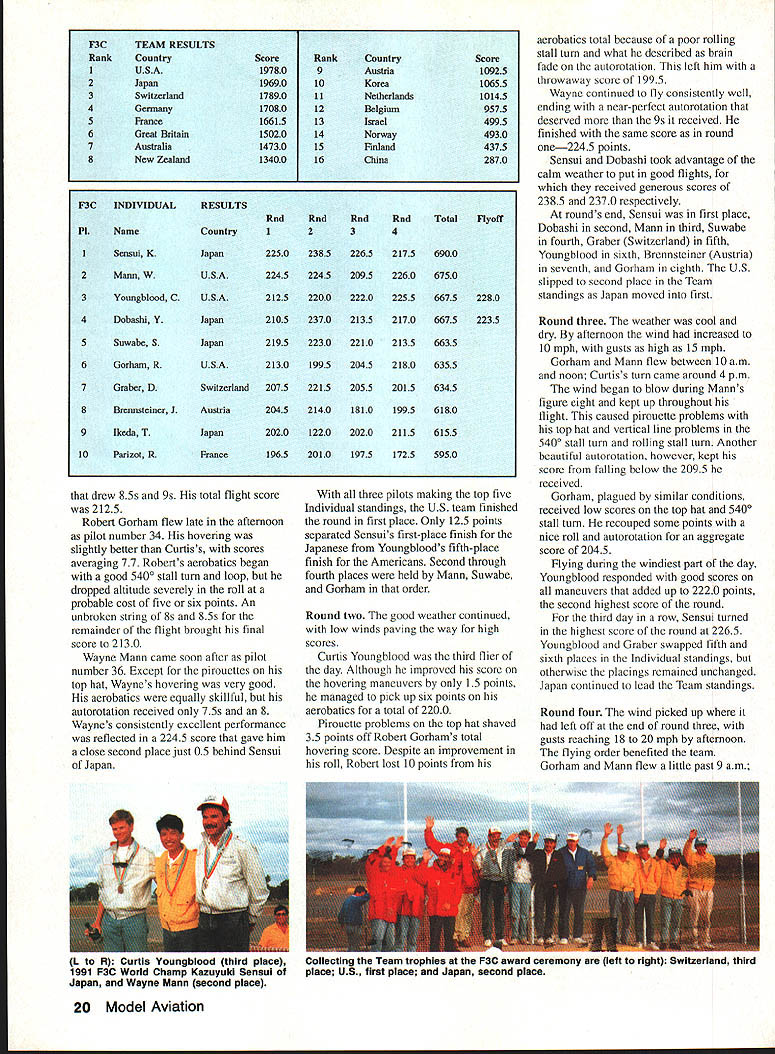
F3C Team Results
- USA — 1978.0
- Japan — 1969.0
- Switzerland — 1789.0
- Germany — 1708.0
- France — 1661.5
- Great Britain — 1502.0
- Australia — 1473.0
- New Zealand — 1340.0
- Austria — 1092.5
- Korea — 1065.5
- Netherlands — 1014.5
- Belgium — 957.5
- Israel — 499.5
- Norway — 493.0
- Finland — 437.5
- China — 287.0
F3C Individual Results (Top 6)
- Kazuyuki Sensui, Japan — Champion (Total approx. 690.0)
- Wayne Mann, USA — 2nd (approx. 675.0)
- Curtis Youngblood, USA — 3rd (approx. 667.5; won flyoff for 3rd)
- Y. Dobashi, Japan — 4th (approx. 667.5; lost flyoff)
- Seiji Suwabe, Japan
- Robert Gorham, USA
(Note: Sensui clinched the individual title; Mann and Youngblood contributed strongly to the U.S. team victory.)
Round Summaries and Team Performance
- Round 1: U.S. pilots placed second, third, and sixth individually, giving the U.S. an early Team lead. Wayne Mann, Curtis Youngblood, and Robert Gorham performed well despite some hovering and cone-finding problems for Curtis.
- Round 2: Calm weather produced high scores. Sensui and Dobashi put up very strong performances; Japan moved ahead in the Team standings.
- Round 3: Wind increased (10–15 mph gusts). Youngblood posted the second-highest score of the round; Sensui again had the highest.
- Round 4: Winds reached 18–20 mph. Wayne Mann flew early and added a high score; Curtis Youngblood flew in strong winds and performed superbly. Sensui's final-round score left the U.S.A. with the F3C Team Championship by a nine-point margin. Curtis won the flyoff for third place over Dobashi.
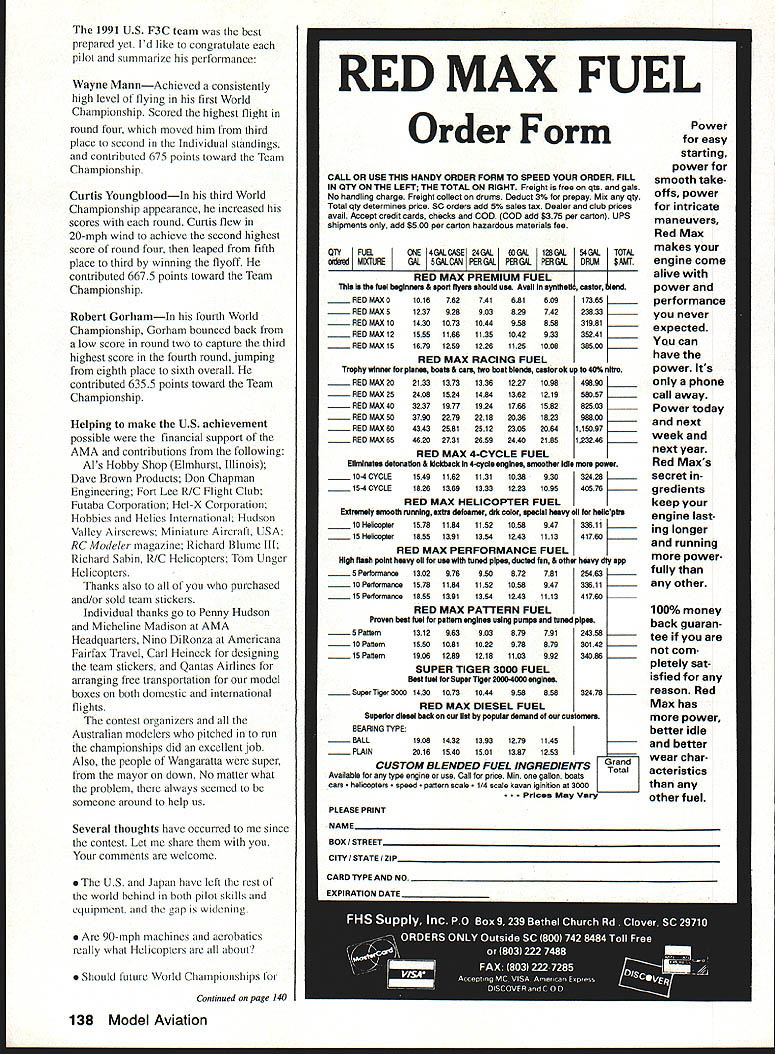
The 1991 U.S. F3C team was the best prepared yet. Individual contributions:
- Wayne Mann — consistently high flying; his late high score pushed him to second individual and contributed 675 points to the team.
- Curtis Youngblood — improved each round; flew in high winds and won the flyoff for third; contributed 667.5 points.
- Robert Gorham — bounced back from a low round to finish sixth individually; contributed 635.5 points.
Special thanks were noted to AMA, sponsors, Qantas, and numerous individuals and shops who supported the team. The banquet and awards were well run by the organizers and Australian helpers.
Pylon Racing (F3D)
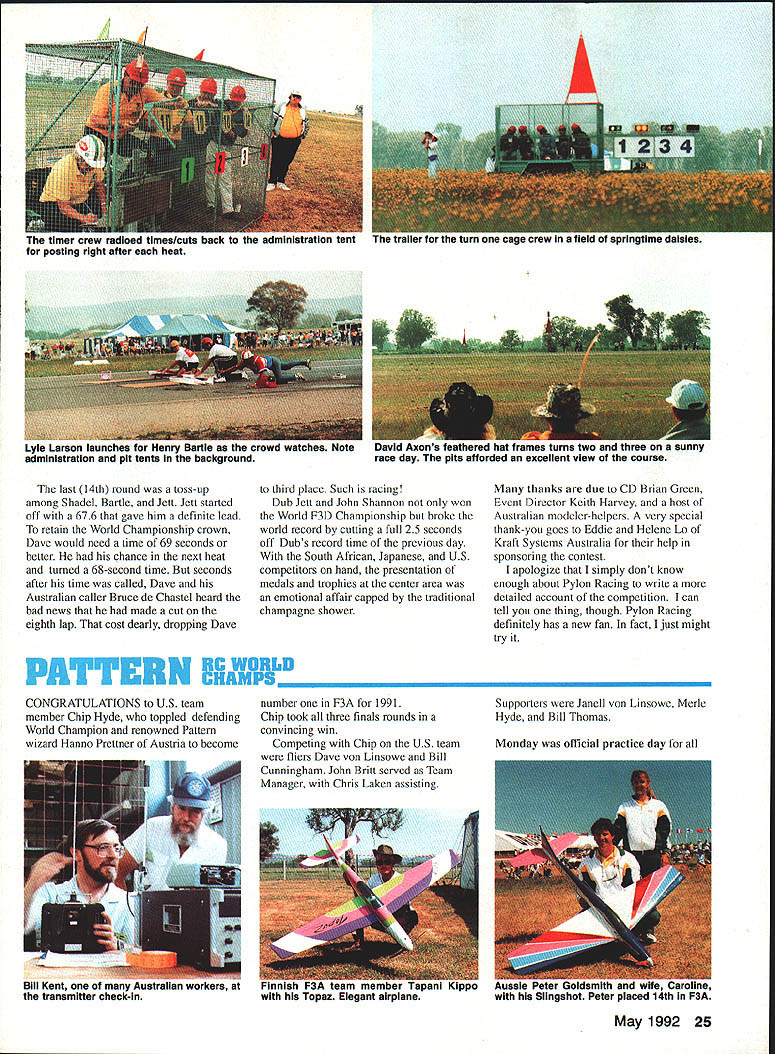
Racing began Wednesday, with daily starts at 7:30 a.m. Early in the competition Dub Jett and Dave Shadel posted some of the fastest times. Nine rounds by noon Friday produced a tight grouping: Jett led with a cumulative time around 505.9, Bartle and Shadel close behind.
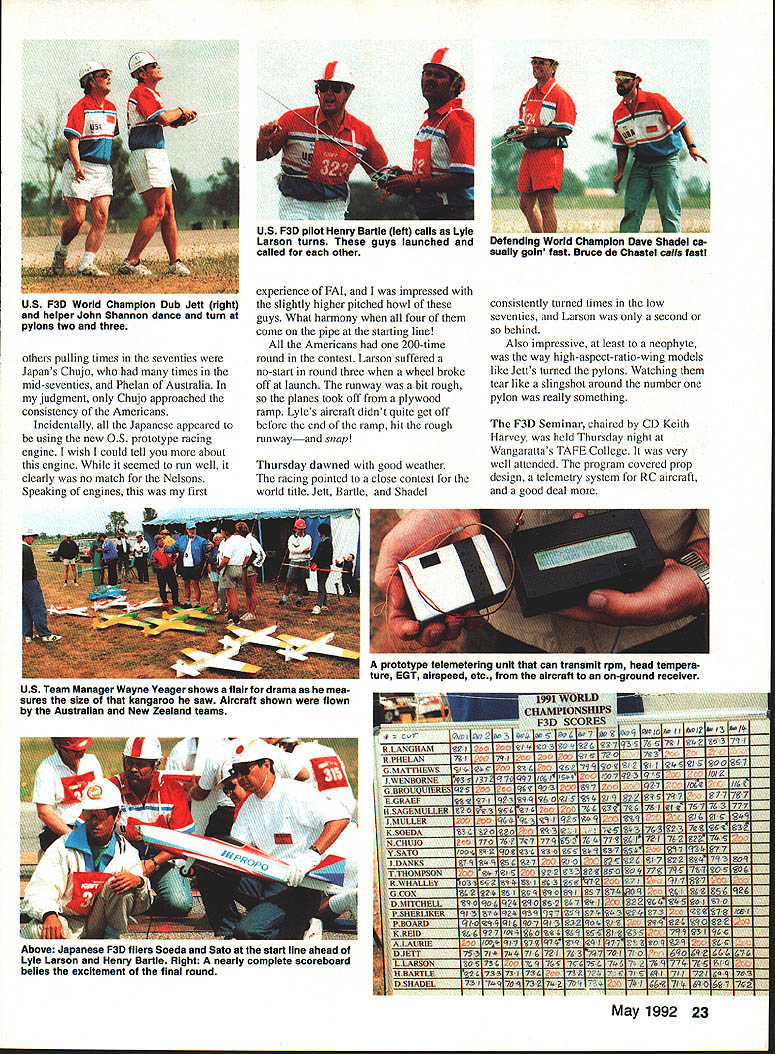
Low site altitude and cool morning weather on Saturday produced the fastest rounds. Dave Shadel posted blistering times (including a 66.8 in round 10). Dub Jett consistently posted very fast times—he recorded a world-record 66.6 in round 13 and, in the final rounds, produced times that secured him the World Championship. The final round was decisive: a cut on an eighth lap dropped Dave Shadel to third. Dub Jett and his partner John Shannon won the World F3D Championship and broke the world record, with an emotional medals presentation capped by the traditional champagne shower.
F3D Highlights
- World Champion: Dub Jett (USA) — set new world-record times during the contest.
- Strong contenders: Dave Shadel (USA), Bartle (name referenced as close competitor), Larson, Chujo (Japan).
- The F3D Seminar, chaired by CD Keith Harvey, covered prop design, telemetry systems, engines, and airframe design; speakers included Shannon, Jett, Shadel, Bruce de Chastel, and others.
The author admitted limited technical depth on pylon racing but confirmed becoming a new fan of the class.
Pattern (F3A)
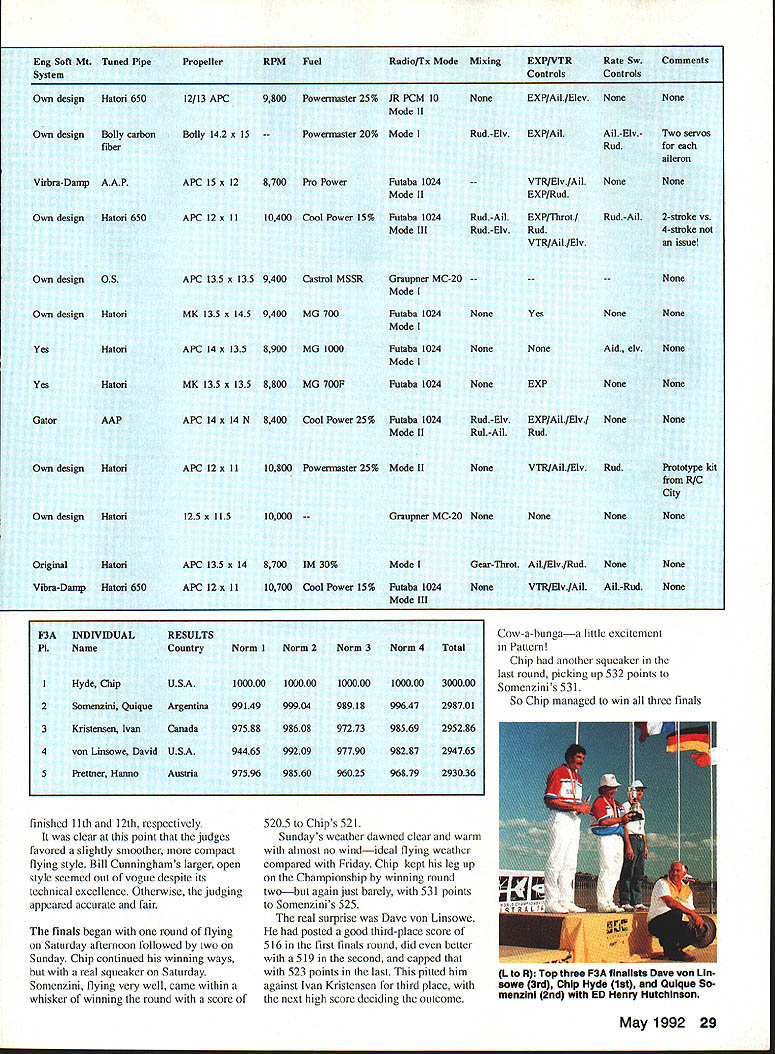
CONGRATULATIONS to U.S. team member Chip Hyde, who toppled defending World Champion Hanno Prettner (Austria) to become F3A World Champion for 1991. Chip won all three finals rounds convincingly.
U.S. team members: Chip Hyde, Dave von Linsowe, Bill Cunningham. Team Manager: John Britt; assistant Chris Laken. Supporters included Janell von Linsowe, Merle Hyde, and Bill Thomas.
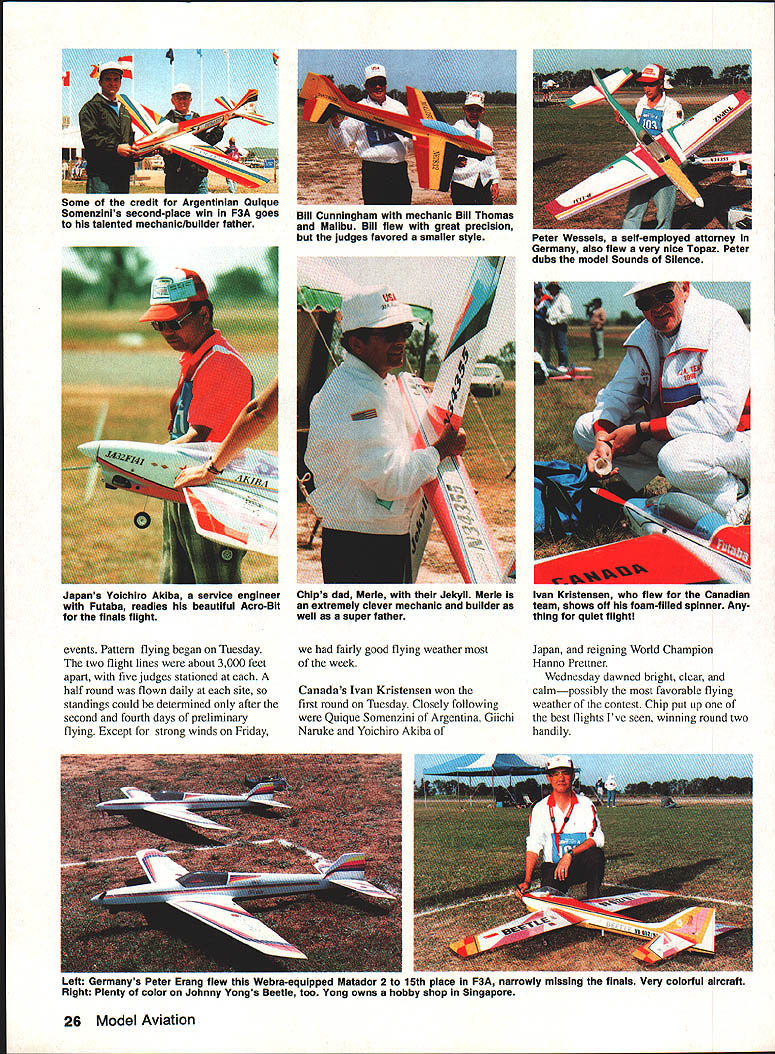
Monday was official practice; pattern flying began Tuesday. Two flight lines were used with five judges at each site. Weather was mostly good except for strong winds on Friday.
Wednesday featured exceptional flying by Chip Hyde, who won round two decisively. Yoichiro Akiba (Japan) won round three. By the end of preliminaries Canada, the U.S., and Japan were all very close.
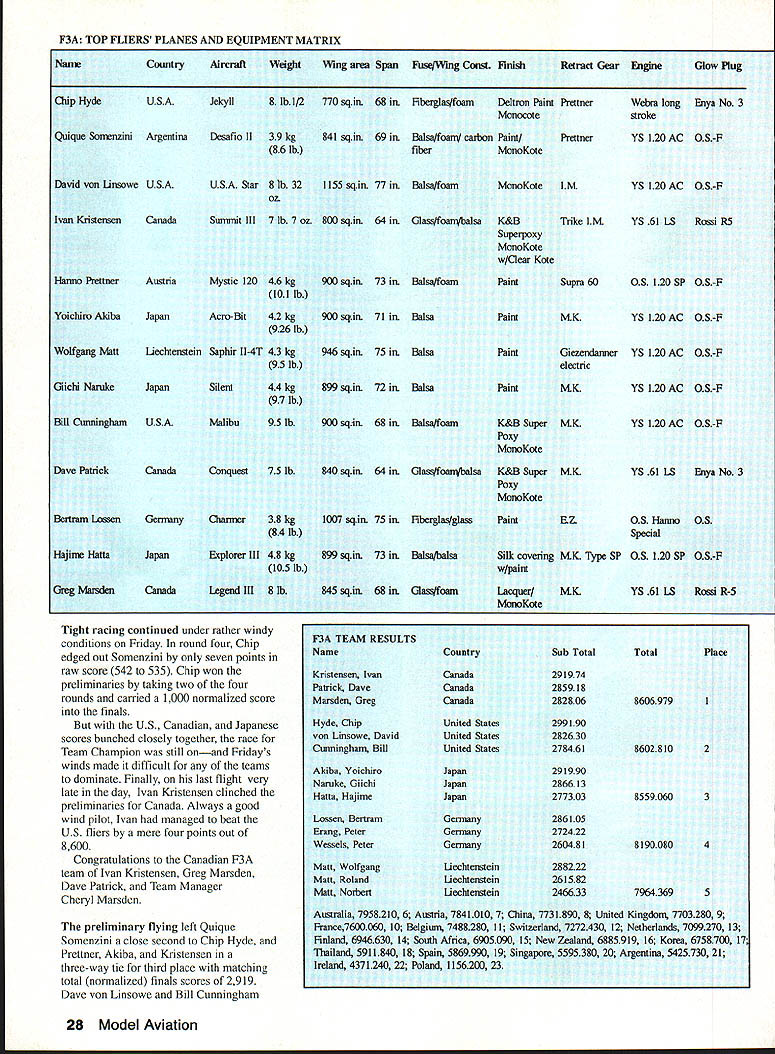
F3A Team Results (Top 5)
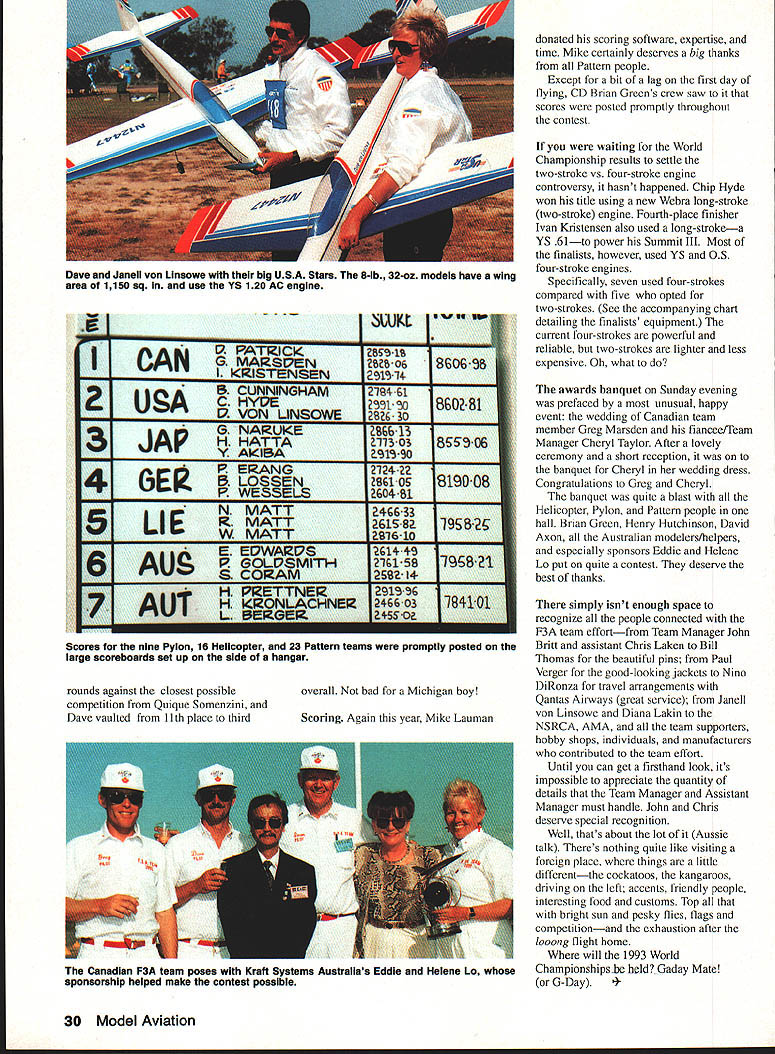
- Canada — Total 8606.979 (Ivan Kristensen, Dave Patrick, Greg Marsden) — Place 1
- United States — Total 8602.810 (Chip Hyde, David von Linsowe, Bill Cunningham) — Place 2
- Japan — Total 8559.060 (Yoichiro Akiba, Giichi Naruke, Hajime Hatta) — Place 3
- Germany — Total 8190.080 (Bertram Lossen, Peter Ersng, Peter Wessels) — Place 4
- Liechtenstein — Total 7964.369 (Wolfgang Matt, Roland Matt, Norbert Matt) — Place 5
Other team placements (summary): Australia 6; Austria 7; China 8; United Kingdom 9; France 10; Belgium 11; Switzerland 12; Netherlands 13; Finland 14; South Africa 15; New Zealand 16; Korea 17; Thailand 18; Spain 19; Singapore 20; Argentina 21; Ireland 22; Poland 23.
F3A Individual Results (Top 5)
- Chip Hyde, USA — Norm totals: 1000.00 / 1000.00 / 1000.00 / 1000.00 — Total (normalized) 3000.00 — World Champion
- Quique Somenzini, Argentina — Total (normalized) 2987.01
- Ivan Kristensen, Canada — Total (normalized) 2952.86
- David von Linsowe, USA — Total (normalized) 2947.65
- Hanno Prettner, Austria — Total (normalized) 2930.36
Finals: Chip won the finals rounds by narrow margins over Somenzini. Dave von Linsowe posted strong final-round scores and challenged for the podium. Judges favored a slightly smoother, more compact flying style.
The awards banquet included an unusual happy event: the wedding of Canadian team member Greg Marsden and Team Manager Cheryl Taylor, followed by the banquet with all classes represented.
Notes on engines and equipment: Chip Hyde won using a Webra long-stroke two-stroke engine. Among finalists, seven used four-strokes and five used two-strokes, reflecting no clear final verdict in the two-stroke vs. four-stroke debate.
Closing, Thanks, and Observations
Many thanks were due to CD Brian Green, Event Director Keith Harvey, the Australian modelers/helpers, and especially sponsors Eddie and Helene Lo of Kraft Systems Australia. Qantas received thanks for free model box transport. Numerous individuals and organizations contributed to team efforts and logistics.
A few concluding observations and questions raised by the contest:
- The U.S. and Japan have pulled ahead of the rest of the world in both pilot skills and equipment; the gap appears to be widening.
- Are 90-mph machines and acrobatics really what Helicopters are all about?
- Should future World Championships for F3A, F3C, and F3B be held together?
- Why did much of the model helicopter industry fail to respond to requests for financial support?
- Why was only F3A included in the public awards ceremony on closing day?
- We need to begin raising money for the 1993 F3C team now!
There is nothing quite like visiting a foreign place—the cockatoos, kangaroos, driving on the left, accents, friendly people, interesting food and customs. Top all that with bright sun and pesky flies, competition, and the long flight home. Where will the 1993 World Championships be held? G'day mate!
Transcribed from original scans by AI. Minor OCR errors may remain.

