
Ready for 1991?
By George M. Myers
Acknowledgements
This article was compiled to organize the thousands of facts about changes in the hobby for 1991. It turned out to be a much larger job than I had expected. Products, services and prices change continually. Some equipment lines have proliferated; others have been terminated. I could have bought an engine with what it cost in phone calls and postage, and built an airplane in the time I spent collecting data for this article.
The job might have taken much longer than it did, but for the help provided by Dave Abbe (RCD), Bob Aberle, Jack Albrecht (Airtronics), Steve Helms (Futaba), Tom Runge (Ace RC), George Steiner, and Pete Waters (KMI), all of whom read and commented on the many drafts and filled in missing information, I am grateful.
Thanks to Carl Wheeley, who supported the development of the idea and made space available for its publication, and to the sticker stations who responded to my request for information. And thanks to members of several local clubs who invited me, as Frequency Coordinator for District II, to address them on the subject of 1991 changes. Your questions were an important element in the preparation of this article.
Speaking collectively for all who contributed, we hope that you will find this data compact and understandable. Better read it now, before it becomes obsolete!
IT'S 1991! WHAT DO I DO NOW?
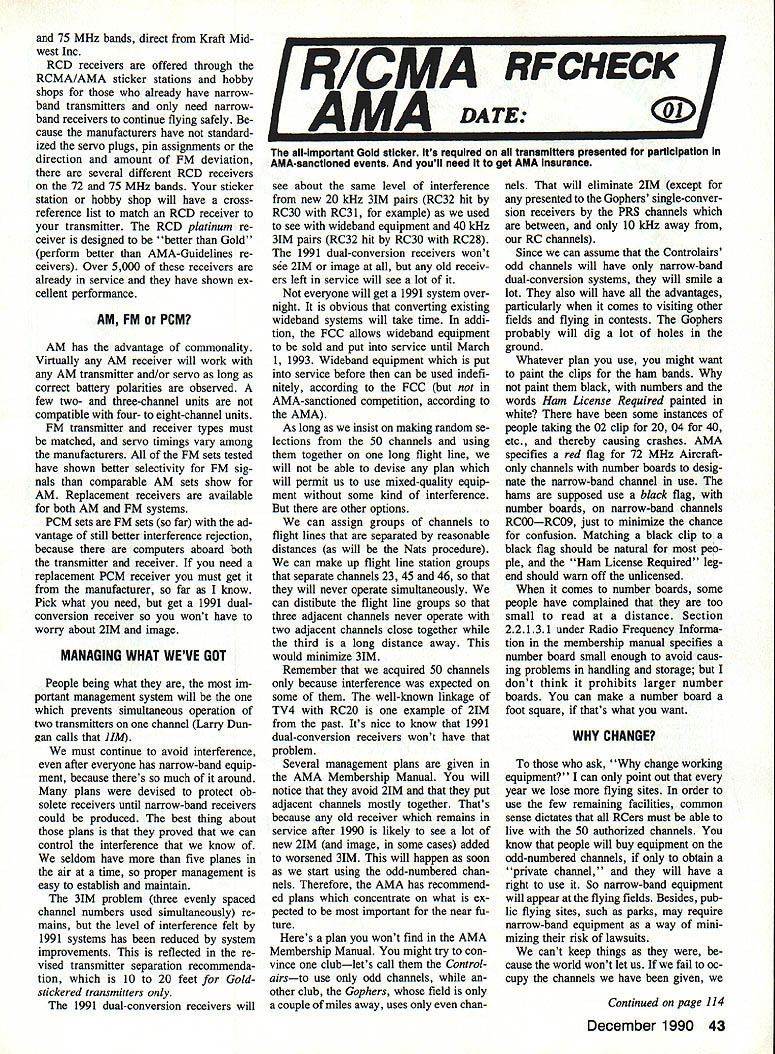
The AMA Executive Council decided that, effective January 1, 1991, the AMA Safety Code will be amended to require RCMA/AMA Gold stickers on transmitters presented for participation in AMA‑sanctioned events. Thus, use of the Gold sticker at sanctioned events has also been made a condition of AMA insurance. (See MA, 7/90, p. 136, Col. 1 and "Safety Code, Insurance" in your membership manual.)
In accordance with its phase‑in plan, AMA will sanction the use of all 50 channels, RC11 through RC60, in all AMA‑sanctioned events after January 1, 1991.
You might believe that, as a noncontest flier, you can ignore the Gold sticker and narrow‑band requirements. But these decisions have a serious impact on your flying, even if you never compete. You will encounter people at public flying sites who will be using radios that access all 50 legal channels. They will create new interference for old receivers. It is very likely that managers of public flying sites will soon require narrow‑band equipment as a way of minimizing their risk of injury lawsuits.
The reasonable options left for you are:
- Bring your obsolete system up to 1991 specifications by replacing your obsolete receiver and by having the transmitter narrow‑banded and stickered.
- Buy a completely new RC system that meets the AMA Guidelines (see the AMA Membership Manual under Radio Frequency Information).
WHAT IT COSTS TO STAY IN THE GAME
Assume you have a recent RC system (generally one built after 1987) for which the transmitter is narrow‑band but the receiver is not. You can fly it as is if you want to take the risk. Your narrow‑band transmitter may protect your friends, but your wideband receiver is likely to leave you exposed to their interference.
To bring the system up to 1991 performance:
- Get a sticker for the transmitter and a 1991 receiver for your airplane for about $50–$75 through the manufacturer's exchange program.
- If you have old wideband equipment in regular use and it isn't supported by a manufacturer's exchange program, you can have the transmitter aligned and stickered and buy a 1991 replacement receiver for about $100.
- If you have wideband equipment sitting on a shelf (dead batteries, brittle wires, obsolete plugs), mating a new receiver may require new pigtails, switch harnesses, servos and batteries. If you make pigtails yourself you might keep total cost around $150; realistically budget about $300.
New narrow‑band transmitters and narrow‑band receivers can be purchased for $80 and up, depending on the number of channels and features. Prices do not include flight batteries or servos. Check the AMA News section and your favorite magazines and catalogs for systems and certified lab results meeting AMA Guidelines for 1991 performance.
TRANSMITTERS
Some transmitters may not need modification—just a sticker. RCMA/AMA sticker stations can examine a transmitter with a spectrum analyzer, make necessary alignments and affix the sticker.
The FCC permits manufacturers to modify old transmitters. Many manufacturers have made simple modifications to assure narrow‑band performance of older transmitters and to make them compatible with AMA Guidelines for 1991. Manufacturer programs to modify transmitters are listed later in this article.
RECEIVERS
There is no practical, cost‑effective way to modify most old receivers to make them compatible with the new conditions. Most old receivers are single‑conversion, 455 kHz IF types. When all 50 channels are used, single‑conversion receivers will suffer both image (45‑ and 46‑channel separation) and 2M (23‑channel separation) problems.
The best solution is a 1991 narrow‑band dual‑conversion receiver. Manufacturers now have receiver exchange and/or replacement programs that provide same‑brand 1991 dual‑conversion receivers at low cost. Dual‑conversion receivers are free from 2M and image interference concerns and resist 31M better than old receivers.
The most common question is, "How do I know if my receiver is single or dual‑conversion?" Look at the label on your receiver—if it says dual‑conversion, it is; if not, it isn't.
Some systems are no longer supported by their manufacturers, but replacement narrow‑band dual‑conversion receivers are offered by manufacturers and third‑party vendors such as Ace RC, Kraft Midwest, and RCD.
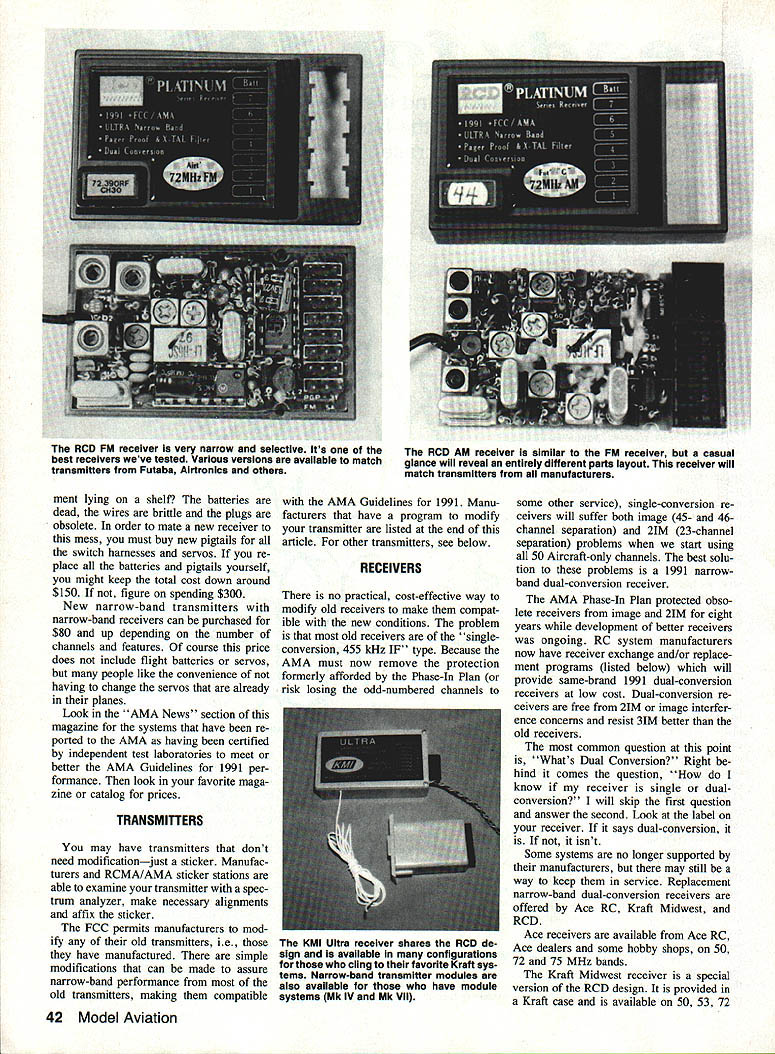
Ace receivers are available from Ace RC, Ace dealers and some hobby shops on 50, 72 and 75 MHz bands. Kraft Midwest offers a special version of the RCD design (available on 50, 53, 72 and 75 MHz). RCD receivers are offered through RCMA/AMA sticker stations and hobby shops for those who already have narrow‑band transmitters and only need narrow‑band receivers to continue flying safely.
Because manufacturers have not standardized servo plugs, pin assignments or FM deviation amount and direction, there are several different RCD receivers on the 72 and 75 MHz bands. Your sticker station or hobby shop will have a cross‑reference list to match an RCD receiver to your transmitter. The RCD "Platinum" receiver is designed to be "better than Gold" and has shown excellent performance in service.
AM, FM or PCM?
- AM: Advantage is commonality. Virtually any AM receiver will work with any AM transmitter and servo as long as correct battery polarities are observed. A few two‑ and three‑channel units are not compatible with four‑ to eight‑channel units.
- FM: All FM sets tested have shown better selectivity than comparable AM sets. Replacement receivers are available for both AM and FM systems.
- PCM: PCM sets are FM sets with additional microprocessing (computers aboard transmitter and receiver), providing still better interference rejection. If you need a replacement PCM receiver, you generally must get it from the manufacturer.
Pick what you need, but get a 1991 dual‑conversion receiver so you won't have to worry about 2M and image interference.
MANAGING WHAT WE'VE GOT
The most important management system will be the one that prevents simultaneous operation of two transmitters on one channel (Larry Dungan calls that TIM).
We must continue to avoid interference even after everyone has narrow‑band equipment, because there will still be a lot of equipment around. Many plans were devised to protect obsolete receivers until narrow‑band receivers could be produced. Those plans proved that we can control known interference. We seldom have more than five planes in the air at a time, so proper management is easy to establish and maintain.
The 3IM problem (three evenly spaced channel numbers used simultaneously) remains, but the level of interference from 1991 systems has been reduced by system improvements. The revised transmitter separation recommendation is 10 to 20 feet for Gold‑stickered transmitters only.
1991 dual‑conversion receivers will see about the same level of interference from new 20 kHz 3IM pairs (e.g., RC32 hit by RC30 with RC31) as we used to see with wideband equipment and 40 kHz 3IM pairs (e.g., RC32 hit by RC30 with RC28). The 1991 dual‑conversion receivers won't see 2IM or image at all, but any old receivers left in service will see a lot of it.
Not everyone will get a 1991 system overnight. Converting existing wideband systems will take time. The FCC allows wideband equipment to be sold and put into service until March 1, 1993. Wideband equipment put into service before then can be used indefinitely (per the FCC), though not in AMA‑sanctioned competition (per the AMA).
If we insist on making random selections from the 50 channels and using them together on a long flight line, we will not be able to use mixed‑quality equipment without interference. Other options include:
- Assigning groups of channels to flight lines separated by reasonable distances (as will be done at the Nats).
- Making up flight line station groups that separate problematic channels (e.g., 23, 45 and 46) so they never operate simultaneously.
- Distributing flight line groups so that three adjacent channels never operate with two adjacent channels close together while the third is far away—this minimizes 3IM.
Remember: we acquired 50 channels because interference was expected on some of them. For example, TV4 was linked with RC20 in the past, producing 2IM. It's good that 1991 dual‑conversion receivers won't have that problem.
Several management plans are given in the AMA Membership Manual; they avoid 2IM and place adjacent channels together. That focus protects any old receivers that remain in service, since those receivers will be most vulnerable to the new 2IM and image problems once odd channels are used.
One plan you won't find in the manual: convince one nearby club to use only odd channels and another club, a couple miles away, to use only even channels. That would eliminate 2IM except for PRS channels that lie between and 10 kHz away from RC channels. The odd‑channel club with narrow‑band dual‑conversion systems would have many advantages; the even‑channel club might be less happy.
Practical tips:
- Paint clips for ham bands black, and mark them with numbers and the legend "Ham License Required" in red to avoid confusion. AMA specifies a red flag for 72 MHz aircraft‑only channels; hams should use a black flag with number boards on narrow‑band channels RC00—RC99.
- Number boards in the membership manual are intentionally small for handling and storage, but you may use larger number boards (even a foot square) if desired.
WHY CHANGE?
To those who ask, "Why change working equipment?" — every year we lose more flying sites. To use the remaining facilities, common sense dictates that all RCers must be able to use the 50 authorized channels.
People will buy equipment on the black market and third‑party channels to obtain a "private channel," and they will use it. Narrow‑band equipment will appear at flying fields regardless. Public flying sites such as parks may require narrow‑band equipment to minimize their risk of lawsuits.
If we fail to occupy the channels we have been given, we will lose them to other users who will then interfere with any obsolete RC systems we keep in service. Upgrading equipment is necessary to protect your investment in the hobby.
WHO DOES THE WORK?
You do the work. You must send your equipment somewhere to have it serviced, and you must pass on the word to those who don't belong to AMA, since they may not get this magazine.
There is value in clubs with open enrollment: when you invite "just anybody" to join your club, you have an opportunity to exert some control over members. Closed clubs have no control over outsiders and still get blamed for their transgressions. While outsiders are members, you have some leverage (dues paid, newsletters read). With them outside, you have less influence and they may resist advice.
The following firms are able to test transmitters, install RCMA/AMA Gold stickers where justified, and may undertake necessary alignments. I surveyed as many sticker stations as possible before the deadline; some data may already be out of date. Beware of firms that cannot install a valid RCMA/AMA sticker. A phony sticker, or no sticker, can mean no AMA insurance even if the equipment is FCC‑legal.
LISTED IN ORDER OF RCMA/AMA STICKER NUMBERS
Included is a brief summary of services offered. The information comes from responses to my telephone calls and letters received before the deadline.
- Ace RC, Inc. (002)
116 West 19th Street, P.O. Box 5118, Higginsville, MO 64037; tel. 1‑816/584‑7121; fax 1‑816/584‑7766. Services: 72 MHz transmitters serviced (Ace RC only). Transmitter narrow‑banding and crystal changes (prices vary by model). 2 MHz narrow‑band receivers offered: Ace RC Model 91 dual‑conversion AM receiver (built or kit), priced $79.95–$111.95. Also services on 27, 50, 53 and 75 MHz. P&H: $3.
- Airtronics, Inc. (003)
11 Autry, Irvine, CA 92718; tel. 1‑714/830‑8769. Services: 72 MHz transmitters (Airtronics only). Converter/exchange programs to better than 1991 AMA Guidelines since Oct 1988. Exchange packages and NB dual‑conversion receivers available (FM, PCM options). Planned Infinity 10 synthesized transmitter for 50, 53, 72 and 75 MHz. P&H: $2.
- Beemer West RC Distributors, Inc. (005)
17252 E. Falcon Drive #3, Fountain Hills, AZ 85269‑4640. Services: (no detailed service list provided in responses).
- Cannon Electronics, Inc. (006)
2828 Cochran Street, Suite 281, Simi Valley, CA 93065; tel. 1‑805/581‑5061; fax 1‑805/527‑9114. Services: 72 MHz transmitters serviced (Cannon only). Small custom AM equipment; conversion pricing varies by era (e.g., 1971–1979, 1980–1990). Receivers: Cannon Super‑Micro and Super‑Nova. Systems available on 27, 35, 40, 50, 53, 72 and 75 MHz. P&H: $4.25–$9.75 depending on item.
- Tower Hobbies (019)
P.O. Box 543, Champaign, IL 61820; tel. 1‑800/637‑6050; fax 1‑217/356‑6608. Services: 72 MHz transmitters and receivers—new equipment only. Most kits and accessories available.
- World Engines (020)
8960 Rossach Road, Cincinnati, OH 45236; tel. 1‑513/793‑5900; fax 1‑513/793‑7337. Repair and warranty service by BJ Electronics, 1466 Windward Drive, Mason, OH 45040; tel. 1‑513/398‑5423. 72 MHz transmitters serviced: World Engines and Polk's 720 only. Sticker: $15. Frequency change: $25. 72 MHz receivers offered: World Engines HPRM72F Expert DBM crystal filter dual‑conversion — $69.95. P&H: UPS or postage at cost.
- Kraft Midwest Inc. (021)
115 E. Main St., Northville, MI 48167; tel. 1‑313/348‑0085; fax 1‑313/348‑4175. Services: 72 MHz transmitters serviced (all except Cannon, MRC, or RS). Transmitter crystal changes and alignment ($35–$55). 72 MHz narrow‑band receivers: KMRDC‑7A dual‑conversion AM (4–7 channels) $85–$120 depending on type; shares RCD design and components. Offers RCD AM or FM dual‑conversion receivers tuned to your transmitter—$69.95. Supports 27, 35, 40, 50, 53, 72, 75 MHz and industrial services. P&H: $5.50–$8.50 (includes insurance).
- Polk's/Aristocraft (017)
346 Bergen Ave., Jersey City, NJ 07304; tel. 1‑800/255‑POLK; fax 1‑201/332‑0521. Services: 72 MHz transmitters and receivers (Aristocraft only). No retail sales.
- Radio Controlled Devices, Inc. (RCD) (Sticker Station 122)
1780 East Chase Ave., El Cajon, CA 92020‑8304; tel. 1‑619/447‑6146; fax 1‑619/447‑6375. Services: Manufactures dual‑conversion narrow‑band AM and FM receivers. RCD "Platinum" NBAM and NBFM dual‑conversion receivers offered through hobby shops and sticker stations—$69.95. Fits many brands including Ace RC, Airtronics, Acoms, Cannon, Cirrus, Futaba, Kraft, JR, Polk's/Aristocraft, Tower Hobbies, World Engines. 75 MHz receivers also offered.
- Joe Dumond / Kraft Greater Southwest (125)
2501 North Josey Lane, Suite 118, Carrollton, TX 75006; tel. 1‑214/242‑5588. Services: 72 MHz transmitters serviced (all major brands). Align and tune transmitter with sticker — $19.95; align and tune receiver and transmitter with sticker — $25. Frequency change — $25 plus crystals. 72 MHz receivers offered: RCD dual‑conversion AM or FM — $69.95; Kraft KMRDC4‑7A — $85–$110. P&H: actual cost of shipping plus insurance.
- Galaxy Science and Hobby Center (124)
756 Northland Mall, Appleton, WI 54914; tel. 1‑414/730‑9220. Services: 72 MHz transmitters serviced (all except MRC) — $40–$50. 72 MHz receivers: RCD AM and FM — $69.95. Also services 27 and 75 MHz. P&H: $5–$9 UPS.
- John Hill RC Squadron, Inc. (119)
tel. 1‑408/988‑1214, 1‑408/281‑1549; fax 1‑408/988‑1345. Services: 72 MHz transmitters (all except MRC, RS, and Kraft). Alignment $25–$50 depending on work. 72 MHz receivers: RCD receivers — $69.95. Services on 27, 50, 53, 72 and 75 MHz. P&H: $5.50–$8.50 (including insurance).
- World / Other local sticker stations and independent technicians
Numerous independent stations and hobby shops across the country provide stickering, transmitter alignment and receiver replacement. Many offer RCD or Kraft receivers as replacements, and most publish current cross‑reference lists to match receivers to transmitters. Typical P&H and alignment fees vary by location.
(Notes: The list above reflects responses received before the publication deadline. Some entries were abbreviated or not fully detailed in my notes. If a firm is not listed here, contact your local hobby shop or the AMA for the most current sticker station directory.)
Final thoughts
Be proactive—upgrade or sticker your equipment and help educate non‑AMA fliers. Proper management, cooperation between clubs, and sensible use of the available channels will reduce interference and help preserve flying sites. If in doubt, consult your local sticker station or the AMA Membership Manual (Radio Frequency Information) for further guidance.
Transcribed from original scans by AI. Minor OCR errors may remain.

