
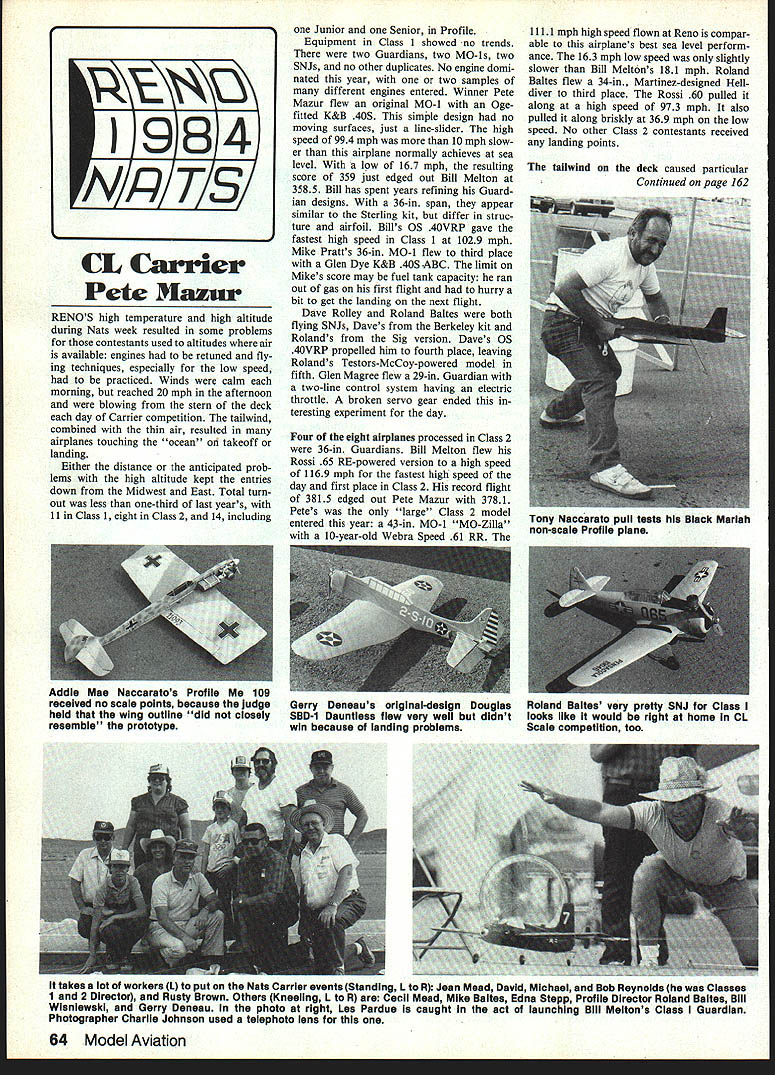
Reno 1984 Nats: CL Carrier
Overview
Reno's high temperature and high altitude during Nats week caused problems for contestants used to lower altitudes where air is more available: engines had to be retuned and flying techniques, especially for low-speed flight, had to be practiced. Winds were calm each morning but reached 20 mph in the afternoon and blew from the stern of the deck each day of Carrier competition. The tailwind, combined with the thin air, resulted in many airplanes touching the "ocean" on takeoff or landing.
Either the distance to Reno or the anticipated problems with the high altitude kept entries down from the Midwest and East. Total turnout was less than one-third of last year's: 11 in Class 1, eight in Class 2, and 14 in Profile (including one Junior and one Senior).
Class 1
Equipment in Class 1 showed no clear trends. There were two Guardians, two MO-1s, two SNJs, and no other duplicates. No engine dominated; one or two samples of many different engines were entered.
Top finishes:
- 1st — Pete Mazur: original MO-1 with an Oge-fitted K&B .40S. High speed 99.4 mph (about 10 mph slower than sea level), low speed 16.7 mph, score 359.
- 2nd — Bill Melton: refined Guardian design (36 in. span) with an OS .40VRP. Bill achieved the fastest high speed in Class 1 at 102.9 mph and scored 358.5.
- 3rd — Mike Pratt: 36 in. MO-1 with Glen Dye K&B .40S-ABC. Limit may have been fuel tank capacity; he ran out of gas on his first flight and had to hurry on the next landing.
- 4th — Dave Rolley: SNJ from the Berkeley kit powered by OS .40VRP.
- 5th — Roland Baltes: SNJ from the Sig version powered by a Testors–McCoy engine.
Other notes: Glen Magree flew a 29-in. Guardian with a two-line control system and electric throttle; a broken servo gear ended that experiment for the day.
Class 2
Four of the eight airplanes processed in Class 2 were 36-in. Guardians.
Top finishes:
- 1st — Bill Melton: 36-in. Guardian with Rossi .65 RE. Fastest high speed of the day at 116.9 mph, record flight score 381.5.
- 2nd — Pete Mazur: only "large" Class 2 model (43-in. MO-1 "MO-Zilla") with a 10-year-old Webra Speed .61 RR. High speed 111.1 mph, low speed 16.3 mph, score 378.1.
- 3rd — Roland Baltes: 34-in. Martinez-designed Helldiver powered by Rossi .60. High speed 97.3 mph, low speed 36.9 mph.
No other Class 2 contestants received any landing points.
Junior Profile
Junior Profile contestant Jane Johnson struggled to become airborne from the deck on her first two attempts due to the thin air combined with the tailwind. After a group effort by her father Art and other contestants to provide a borrowed fuel tank, prop, and engine, the pit crew got her in the air on the third attempt; that official flight won the first-place trophy.
Senior Profile
Robbie Mehnen flew a Naccarato-designed Zero to first place in Senior Profile with 182.5 points. His 100-point landing was achieved by only two Open contestants all day.
Open Profile
Open Profile began as a battle between Pete Mazur's five-year-old GS Bearcat (plain-bearing Tune-Hill .36) and Bill Melton's original 38-in. Guardian Mk IX.
Top finishes:
- 1st — Pete Mazur (GS Bearcat): high 89.8 mph, low 14.7 mph, score 260.8.
- 2nd — Glen Magree (Rolley Wildcat, ST .36-S): second-place with 220.2 points; one of two Open contestants to make a 100-point landing. High speed 69.8 mph, low 17.2 mph.
- Bill Melton (Guardian Mk IX): faster high 90.4 mph but slower low 10.1 mph; his TWA .36 snagged just enough to touch down before reaching the deck, costing points.
Other entries: Tony and Addie Naccarato both flew Profile. Tony's nonscale 28-in. Black Mariah (very low aspect ratio, long fuselage) posted an impressive 15.6 mph low speed in the breeze but a 50-point landing removed him from contention. Addie's 32-in. ME-109-2T, similar in nose/tail moments and stubby wings to the Black Mariah, was not given scale bonus points by Event Director Roland Baltes because it was judged not to closely resemble the prototype. Tony and Addie formally protested, but CL Category Director Jim Filliott supported the Event Director's decision. As a consequence, Tony agreed to work with the Navy Carrier Society to develop guidelines for judges and contestants. Addie flew without scale points and took third place with 209.1 points, including a 95-point landing.
Bob Reynolds flew an original 37-in. Skyparite with an OS .25 SRV/FF engine. The concept was interesting, but the engine limited high speed to 53.9 mph.
No strong equipment trends appeared in Open Profile; a wide variety of airplanes and engines were entered. The only common engine was the K&B .5, with five samples among the 12 Open entries.
Organization and Awards
Bob Reynolds gave up the opportunity to fly in order to direct Class 1 and Class 2, and Roland Baltes limited his other activities to direct Profile. Both did an excellent job. Rules were strictly enforced according to the book, and the events ran smoothly with a lot of expert help. The relaxed atmosphere and small turnout made the event feel as friendly as any local contest.
The Navy Carrier Society held its annual meeting Friday evening at the Convention Center and presented the traditional Eugene Ely Award to 1984 Navy Carrier Champion Pete Mazur. The trophy is awarded annually by the NCS to the person with the highest total score for all three classes of competition.
Transcribed from original scans by AI. Minor OCR errors may remain.

