

Reno 1984 Nats: CL Combat
Charlie Johnson
Site problems and logistics
The Combat events could easily have turned into another fiasco like Riverside in 1977 because of site problems. The "nice" site at Stead used for other Control Line events was unavailable due to a softball tournament. An alternate site near the airfield consisted of dirt, rocks, sagebrush, red ants—and more dirt. Event Director Rich Lopez negotiated flying space in the same area the RC helicopters were using, and the situation was resolved—at least until Wednesday afternoon, when the RC folks decided the site would have to be moved again.
The new, acceptable site was only two miles from our room at Circus Circus Hotel/Casino, and we could see people practicing from our twenty-first-floor vantage point. In fact, people were practicing at 6:00 a.m., and that early noise prompted another move about 300 yards down the hill into a valley. Screaming engines are music to our ears—but not to the ears of local residents, who were awakened by the wail of Fox, Rossi, and Nelson.
Altitude and model performance
Warnings about decreased model and engine performance at Reno's higher altitude proved partly true. The best-performing models lost some edge, but marginal performers (which flew lower) lost more. For some reason, straight-wing airplanes seemed to fly better at altitude, while double-taper models fared worse. Several double-taper designs that had flown very well at sea level were now racing across the circle and showing extra wobbles and bobbles.
Rules, streamers, and an on-the-spot test
There seems to be an unwritten code among Combat fliers: the rule book is read only as a last resort. During the contest someone complained, in front of AMA President John Grigg and others, that the "rope" used as a leader on the streamers was "way too strong." Rich Lopez didn't let it go. He asked what the rule book specified for the pull-test range; the person didn't know. Rich then had him hold a pull-test scale with some of the leader attached—the leader broke at the specified amount.
This year we had the best streamers: every one was sewn down the middle to keep it from being ripped off in a single pass. For pilots able to line up and take nibbles, it was a field day. The streamers seemed to explode when hit by the prop, making cuts easy to see for judges and spectators. The only problem was that on engines with a space between the thrust washer and front bearing, the streamer string tended to get wound up there.
Events and format
All events were run full double-elimination, except for 1/2A, where a first-round-losers bracket was flown. Full double-elimination means everyone flies until they have lost two matches. There were 51 entries. Fast Combat resulted in a total of 105 losses. The double-elimination system also gave those still in competition time to go back to their hotel and regroup for the following day; on the finals day the first couple of rounds went very fast.
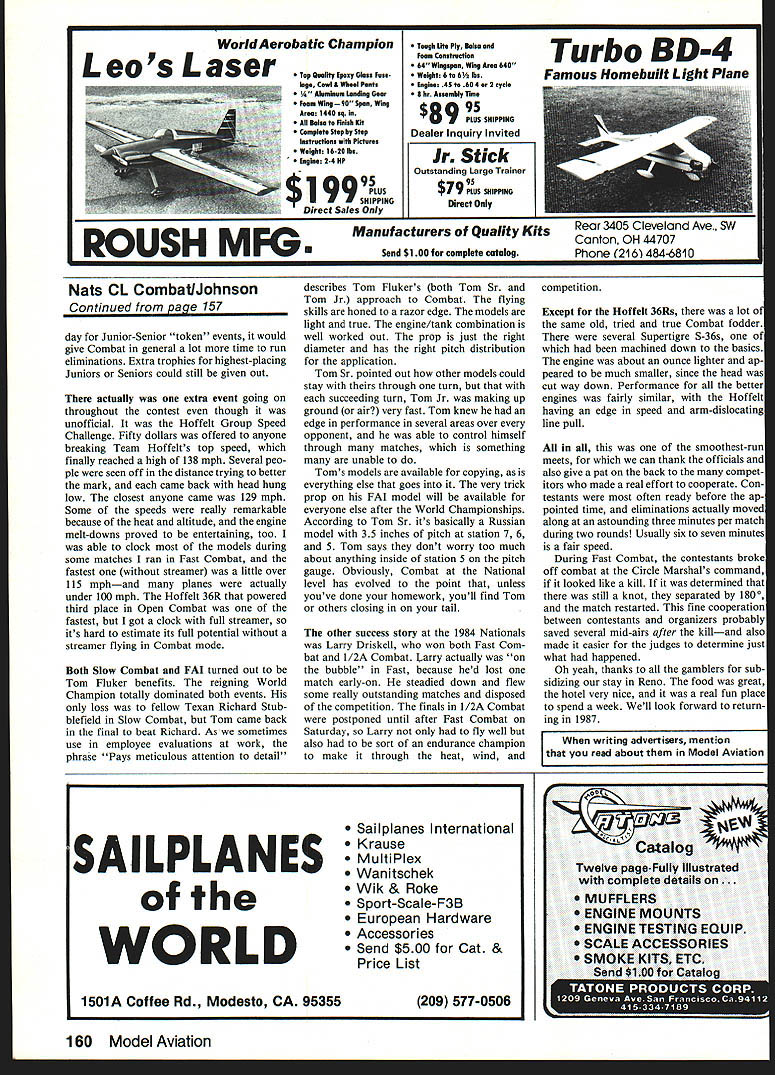
Entries were relatively limited in the lower age groups, with four in Junior Slow and three in Senior. With the exception of a Junior or two, most could have flown Open. Michael Willcox, for example, was 3-0 while flying against adults in FAI Combat. We keep hoping for a big Junior–Senior turnout, but it never happens; several young entrants said they would have preferred flying against the Open fliers.
Hoffelt Group Speed Challenge (unofficial)
There was an unofficial Hoffelt Group Speed Challenge throughout the contest. Fifty dollars was offered to anyone breaking Team Hoffelt's top speed, which finally reached 138 mph. Several attempts came back short; the closest anyone got was 129 mph. Given the heat and altitude, some speeds were remarkable and engine melt-downs provided entertainment as well. During some Fast Combat matches I clocked most models; the fastest one (without streamer) was a little over 115 mph, while many planes were under 100 mph. The Hoffelt 36R that powered third place in Open Combat was among the fastest, though my clock was taken with the streamer attached, so its full potential is hard to estimate.
Winners and notable competitors
- Tom Fluker dominated both Slow Combat and FAI. The reigning World Champion's only loss in Slow Combat was to fellow Texan Richard Stubblefield, but Tom came back in the final to win. Tom Sr. and Tom Jr. pay meticulous attention to detail—flying skills, model setup, engine/tank combinations, and carefully chosen props make the difference. Tom Jr. was especially good at closing ground (or air) with each succeeding turn.
- Tom's FAI prop is notable and will be available after the World Championships. According to Tom Sr., it is basically a Russian design with about 3.5 inches of pitch at stations 7, 6, and 5; they don't worry much about anything inside station 5 on the pitch gauge.
- Larry Driskell won both Fast Combat and 1/2A Combat. Larry was "on the bubble" in Fast after an early loss but steadied and flew outstanding matches. His 1/2A Combats were postponed until after Fast Combat on Saturday, so he also had to be an endurance champion to survive the heat, wind, and competition.
Except for the Hoffelt 36Rs, much of the engine fleet was the familiar tried-and-true equipment. Several Super Tigre 36s appeared, one machined down to the basics and about an ounce lighter. Performance among the better engines was similar, with Hoffelt engines having an edge in speed and arm-dislodging line pull.
Organization and conduct
This Nationals was one of the most professionally run. Rich Lopez had prepared well, recruiting competent officials and putting the whole show together. The contestants cooperated: most were ready before the appointed time, and eliminations moved along at an astounding three minutes per heat during two rounds (versus the usual six to seven minutes).
During Fast Combat contestants broke off combat at the Circle Marshall's command, or if a kill seemed likely. If there remained a knot, the pilots were separated by 180° and the match restarted. This cooperation between contestants and organizers likely prevented several mid-airs and made it easier for judges to determine what had happened.
Final notes and thanks
All in all, this was one of the smoothest-run meets. Thanks to the officials and the many competitors who cooperated. Thanks also to the gamblers for subsidizing our stay in Reno—the food was great, the hotel very nice, and it was a real fun place to spend a week. We'll look forward to returning in 1987.
When writing advertisers, mention that you read about them in Model Aviation.
Transcribed from original scans by AI. Minor OCR errors may remain.

