
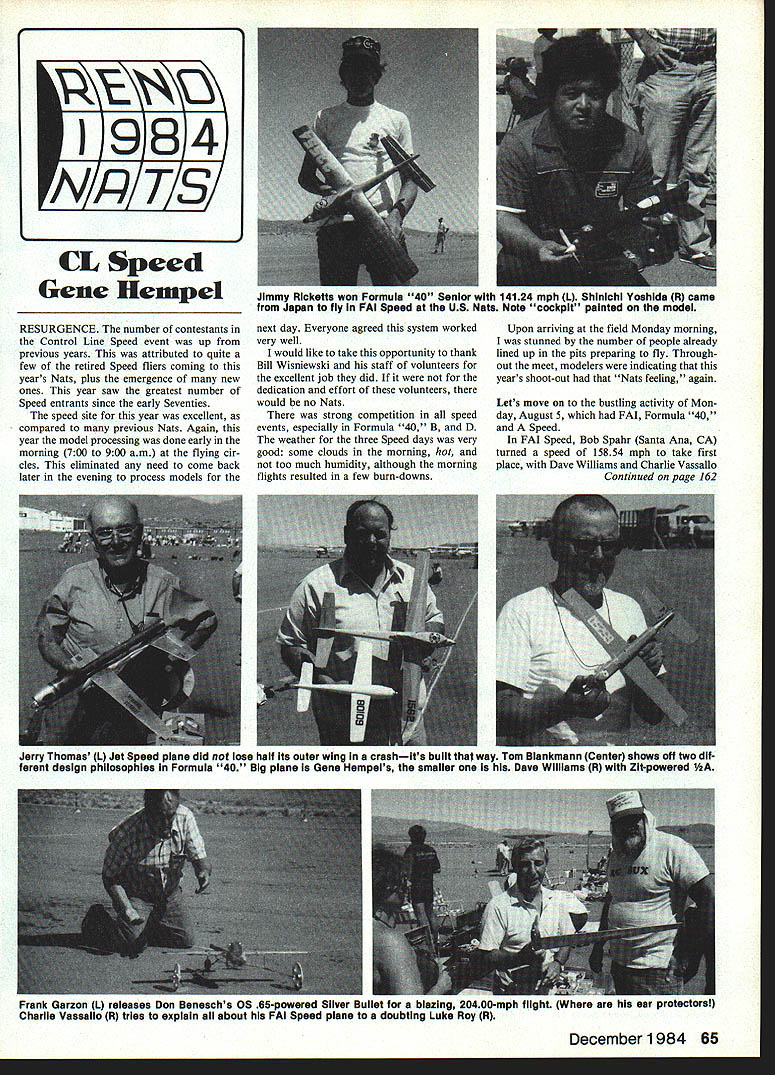
Reno 1984 Nats: CL Speed
By Gene Hempel
Resurgence and site
The number of contestants in the Control Line Speed events was up from previous years. This was attributed to a number of retired speed fliers returning to this year's Nats, plus the emergence of many new competitors. This year saw the greatest number of Speed entrants since the early 1970s.
The speed site for this year was excellent compared to many previous Nats. Model processing was again done early in the morning (7:00 to 9:00 a.m.) at the flying circles, eliminating the need to come back later in the evening to process models for the next day. Everyone agreed this system worked very well.
I would like to thank Bill Wisniewski and his staff of volunteers for the excellent job they did. If it were not for the dedication and effort of these volunteers, there would be no Nats.
There was strong competition in all speed events, especially in Formula "40", B, and D. The weather for the three Speed days was very good: some clouds in the morning, hot, and not too humid, although the morning flights resulted in a few burn-downs. Upon arriving at the field Monday morning, I was stunned by the number of people already lined up in the pits preparing to fly. Throughout the meet, modelers indicated that this year's shoot-out had that "Nats feeling" again.
Organization and rules
Bob Reynolds directed Class I and Class II, and Roland Baltes limited his activities in other events to direct Profile. Both did an excellent job. Rules (according to the book) were strictly enforced, and the events ran smoothly with a lot of expert help. The relaxed atmosphere and relatively small turnout made the event feel as friendly as any local contest.
The Navy Carrier Society held its annual meeting Friday evening at the Convention Center and presented the traditional Eugene Ely Award to 1984 Navy Carrier Champion Pete Mazur. The trophy is awarded annually by the NCS to the person with the highest total score for all three classes of competition.
Monday, August 5 — FAI, Formula "40", A Speed
FAI Speed
- 1st: Bob Spahr (Santa Ana, CA) — 158.54 mph
- 2nd: Dave Williams — 142.84 mph
- 3rd: Charlie Vassallo — 141.94 mph
The majority of the FAI Speed fliers used the old-style Rossi .15 engines, though there are quite a few new .15–.152-size engines on the market, which should help increase interest in flying FAI speed. Most props used were of the single-blade design. Flying FAI Speed really takes a dedicated modeler.
Formula "40"
This year's Formula "40" event had 23 Open entrants and one Senior. Many fliers were attempting all three official flights, making the contest very tight.
Top Open results:
- 1st: Wisniewski team (Bellflower, CA) — 152.35 mph
- 2nd: Glenn Lee (Batavia, IL) — 149.69 mph
- 3rd: Tom Taverna (Chicago, IL) — 148.58 mph
- 4th: Gene Hempel (Garland, TX) — 148.52 mph
The K&B .6 engine dominated this event. Most Formula "40" fliers used various glass props, including a few homemade glass props; the Kelly 8 x 8 or 8 x 7 glass props were still common.
Senior:
- Jim Ricketts (Sioux Falls, SD) — 124.14 mph
Formula "40" is one of the easiest Speed events to fly. Fuel is furnished by contest management. It is a two-line model with no wing area restrictions, and there are a number of .6 engines available today. All that’s needed is the modeler — come join the fun!
A Speed
There were 14 entries in A Speed this year.
Top results:
- 1st: Fred Margarido (Fremont, CA) — 168.63 mph
- 2nd: Jerry Rocha — 159.09 mph
- 3rd: Jim Rhoades (Salt Lake City, UT) — 156.46 mph
Engines used included Rossi .15, OPS .15, K&B .15, and ST .15. Fuel ratios varied accordingly — typically 75–80% nitro, 5–10% alcohol, with 18–19% synthetic oil. Rev-Up 6 x 7-1/4 and 6 x 8 were the most common props, with a few single-blade props mixed in. Some fliers experienced problems with engines "coming up on the pipe"; if you waited until later in the day to place a flight, speeds tended to drop.
Seniors:
- David Hooke (Mountainhome, PA) — 114.97 mph
- Jim Ricketts (Sioux Falls, SD) — 92.46 mph
Contestants wondered, "Where are the Seniors hiding?"
Tuesday, August 6 — 1/2A Speed and B Speed
1/2A Speed
- 1st: Dave Williams (Yorba Linda, CA) — 121.73 mph (ZIT .049)
- 2nd: Charles Legg (Council Bluffs, IA) — 118.53 mph
- 3rd: Warren Kurth (Davenport, IA) — 112.74 mph
Warren Kurth still holds the title of heavyweight, all-metal 1/2A-powered Speed model. There were no Juniors or Seniors attempting official flights in 1/2A Speed or 1/2A Profile Proto, which was very disappointing. We missed Al Stegnes (Cleveland, OH) with his yellow, Cox-powered TD .049 — he can make those .049s really hum.
B Speed
B Speed had slower speeds compared to last year's Nats.
Top results:
- 1st: Wisniewski team — 187.36 mph
- 2nd: Chris Sackett — 176.20 mph
- 3rd: Tom Laureman — 171.55 mph
Bill Wisniewski used a K&B .49 engine with a 7 x 10½ molded glass prop. The majority of B Speed models used some type of metal suction tanks. Rev-Up 7 x 10 Speed props were common. There were also quite a few 2 x 19 Tigre-powered models similar to those described in the 1983 Speed column.
There seemed to be more test flying by Speed fliers. The weather started cool in the morning with some lingering thunderclouds, so many fliers waited until later in the day to place their flights.
Senior:
- Don Hoeke — 157.38 mph (using an X-29 ST setup as described in the February and April 1983 issues of Model Aviation)
Wednesday, August 7 — Big Blocks and Jet Speed
Big Blocks / Heavy classes
Don Benesch (Copiague, NY) turned a speed of 204.00 mph. Don is the present record-holder for B Speed with his all-metal creation, the Silver Bullet. Frank Garzon (Central Islip, NY) was close behind with a 201.26 mph flight. The Wisniewski team placed third at 197.29 mph with their new K&B .65 engine; Bill did not indicate whether the engine would go into production.
Both Don Benesch and Frank Garzon were using the NAX .65 engine with 9 x 12 glass-fiber props. This engine will turn 200.00 mph right out of the box! Fuel used had roughly 78% nitro, 3% alcohol, and 19% synthetic oil. These speeds were very respectable.
Jet Speed (official Jet results)
After winter practice and careful test flying, the Jet class produced close competition:
- 1st: Chris Sackett — 187.20 mph
- 2nd: Jerry Thomas (Puyallup, WA) — 185.11 mph (using a new symmetrical model)
- 3rd: Larry Hunt (Merced, CA) — 180.11 mph
The only Senior to make an official Jet flight was Aimee Olson (Fargo, ND) — 121.90 mph.
North American Speed Society banquet and awards
There was an excellent get-together for refreshments and dinner at the Peppermill Casino and restaurant, sponsored by the North American Speed Society and headed by Chris Sackett. Chris should be commended for promoting Speed flying. The highlights were the awarding of the NASS Perpetual Speed trophy and the High Time trophies for Junior, Senior, and Open Speed flights made at the 1984 Nats.
Awards:
- NASS Perpetual Speed trophy: Wisniewski team (Bill, Rick, and Dave)
- High Time Junior and Senior trophy: Jim Ricketts
- High Time Open trophy: Don Benesch
Congratulations to the winners!
Closing
I hope to visit many of you at the FAI Control Line World Championship at Chicopee, MA in September 1984. I will be the Event Director for F2A Speed, which is an opportunity of a lifetime for me to participate in. See you in February with my regular column.
Transcribed from original scans by AI. Minor OCR errors may remain.

