
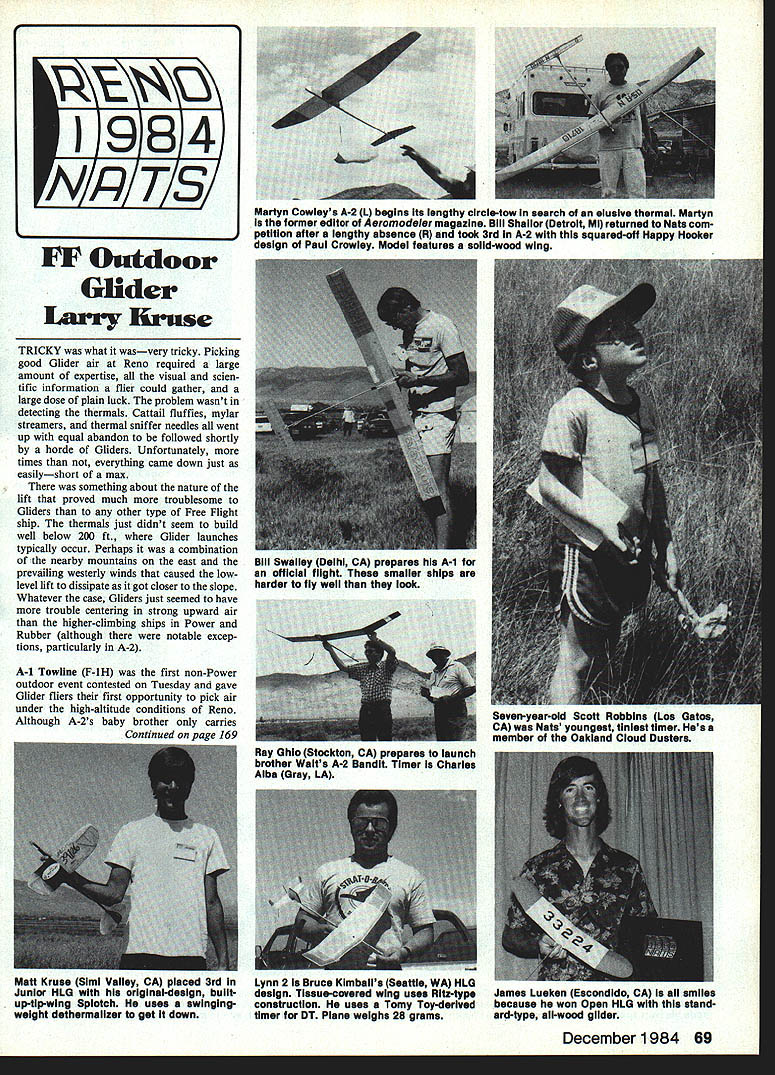
Reno 1984 Nats: FF Outdoor Glider
By Larry Kruse
TRICKY was what it was—very tricky. Picking good glider air at Reno required a large amount of expertise, all the visual and scientific information a flier could gather, and a large dose of plain luck. The problem wasn't in detecting thermals. Cattail fluffies, mylar streamers, and thermal‑sniffer needles all went up with equal abandon and were followed shortly by a horde of gliders. Unfortunately, more often than not, everything came down just as easily—short of a max.
There was something about the nature of the lift that proved much more troublesome to gliders than to any other type of free‑flight ship. The thermals just didn't seem to build well below about 200 ft., where glider launches typically occur. Perhaps it was a combination of the nearby mountains on the east and the prevailing westerly winds that caused the low‑level lift to dissipate as it got closer to the slope. Whatever the case, gliders seemed to have more trouble centering in strong upward air than the higher‑climbing ships in Power and Rubber (although there were notable exceptions, particularly in A‑2).
A‑1 Towline (F‑1H)
A‑1 Towline (F‑1H) was the first non‑Power outdoor event contested on Tuesday and gave glider fliers their first opportunity to pick air under the high‑altitude conditions of Reno. A‑1 ships carry slightly over half the weight of an A‑2 (F1A) ship and have a 120‑second max rather than 180. Carrying a maximum wing area into the tow, the little ships are easy to tow, tending to veer readily and pop off at inopportune times.
- Open results:
- Martyn Cowley — 545 sec (closest to a max)
- Steve Geraghty — 477 sec (2nd)
- Yasuo Yoshioka (Tokyo, Japan) — 3rd
- Junior results:
- Aaron Markos — 368 sec (would have been sixth Open)
- Scott Cover — 246 sec (2nd)
- Brad Douglas — 3rd
- Senior results:
- Thomas Bailey — 394 sec (winner; upset Bryan Fulmer by 53 sec)
- Bryan Fulmer — 2nd
- Suzanne Kusik — 3rd
Bailey's 394 would have placed him fourth in Open.
Hand‑Launched Glider (HLG)
Hand‑launched glider continued to show the weak‑thermal syndrome on Thursday. A great deal of practice flying—practice piggybacking, cattail‑fluffy blowing, and streamer work—took place before experienced fliers risked official flights. Any apparent lift often caused groups of flingers to abandon mylar streamers and race through creosote bushes to get under the thermal; more times than not, the piggybacking efforts were disappointed and the lift simply went away.
- Junior results:
- Aaron Markos — 240 sec (1st)
- Bill Primbs — 188 sec (2nd)
- Matt Kruse — 148 sec (3rd)
- Senior results:
- David Martin — 328 sec (1st)
- Mike Scuro — 280 sec (tied 2nd)
- Shawn Whitely — 280 sec (tied 2nd)
- Dan Primbs — edged Paul Funk for 3rd
- Open results:
- James Lueken — four maxes (1st)
- Bruce Kimball — 2nd (flew a relatively light, built‑up wing that proved buoyant in spotty air)
- Mike Stoy — 3rd (former Nats winner; also flew a built‑up wing)
It may be important to note that the HLG‑WASP IV has proven itself in many conditions over the years as an outstanding outdoor glider, and it adapted well to high‑altitude flying. The performance of built‑up wings in this contest suggests they may have a future in hand‑launch clinics after decades of domination by solid‑wood wings.
A‑2 Towline (F1A)
A‑2 Towline (F1A) marked a continuation of the strong contest, and there was no fly‑off necessary in Open A‑2. Circle towing was far more commonplace than in the past few years, but even those with a well‑practiced technique were somewhat hampered by the brush and small bushes present on the field.
Observations and Conclusion
In all, glider flying at Reno was well attended and competitive, even though flight times were not as high as one might have anticipated. Interestingly, although much of the talk concerned how engines might perform at high altitude, it was the non‑powered gliders that were most affected by the thin air.
Transcribed from original scans by AI. Minor OCR errors may remain.

