
Reno 1984 Nats: FF Power
Larry Kruse
Rumors
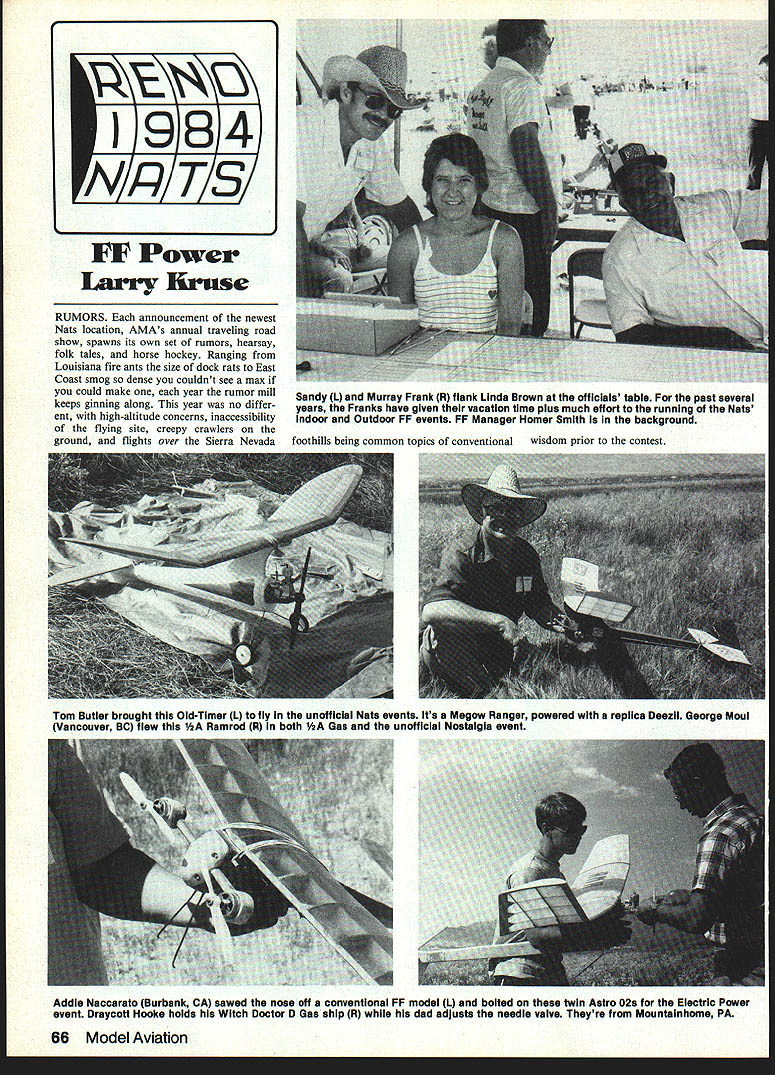
Each announcement of the newest Nats location — AMA's annual traveling road show — spawns its own set of rumors, hearsay, folk tales, and horse hockey. Ranging from Louisiana fire ants the size of dock rats to East Coast smog so dense you couldn't see a max if you could make one, each year the rumor mill keeps ginning along. This year was no different, with high‑altitude concerns, inaccessibility of the flying site, creepy crawlers on the ground, and flights over the Sierra Nevada foothills being common topics of conventional wisdom prior to the contest.
To be fair, some credence must be given to the worries — fliers have braved tangled undergrowth, Lake Charles cornfields, Lincoln trees, Chicopee. However, in recent years Free Flight sites have generally posed fewer such hazards. At this juncture I'll pause and allow West Coast fliers used to Valhalla and Taft to laugh derisively.
The site
Located a few miles south of the Reno city limits, accessible via a well‑traveled — albeit somewhat rough — dirt road, the site is a wide valley running north‑south between two slopes of the Sierra Nevada mountains. The west opened out essentially flat. The area was covered with tall, coarse grass punctuated by a small stream that caused some initial consternation. The east launch area had creosote bushes, sage, and several fences bounding private property which provided obligatory obstacles; retrieval extended to a clear base of mountains roughly a mile away.
Free Flight camp and layout
The Free Flight camp was set up toward the south end of the valley and also accommodated RC Soaring events approximately half a mile north. An initial concern was that DTing airplanes would either drop into the RC area or retrieval would have to be accomplished by sloshing across the nearby stream. Neither concern materialized to any appreciable degree — light to non‑existent winds created very little drift, and what did drift went toward the east and the nearby mountain slopes. In fact, a problem did occur repeatedly with models DTing onto cars, campers, tents and the flight line.
As one California flier observed, it was a lot like Taft without the heat.
Participation
As a testament to the faith and fortitude of the Free Flight family, AMA records show 790 FF event entries, 321 registered. Gas events were second only to RC Sailplanes Open in overall numbers. Free Flight drew good representation compared with the past several years.
Open AMA Gas dominance — Randy Archer
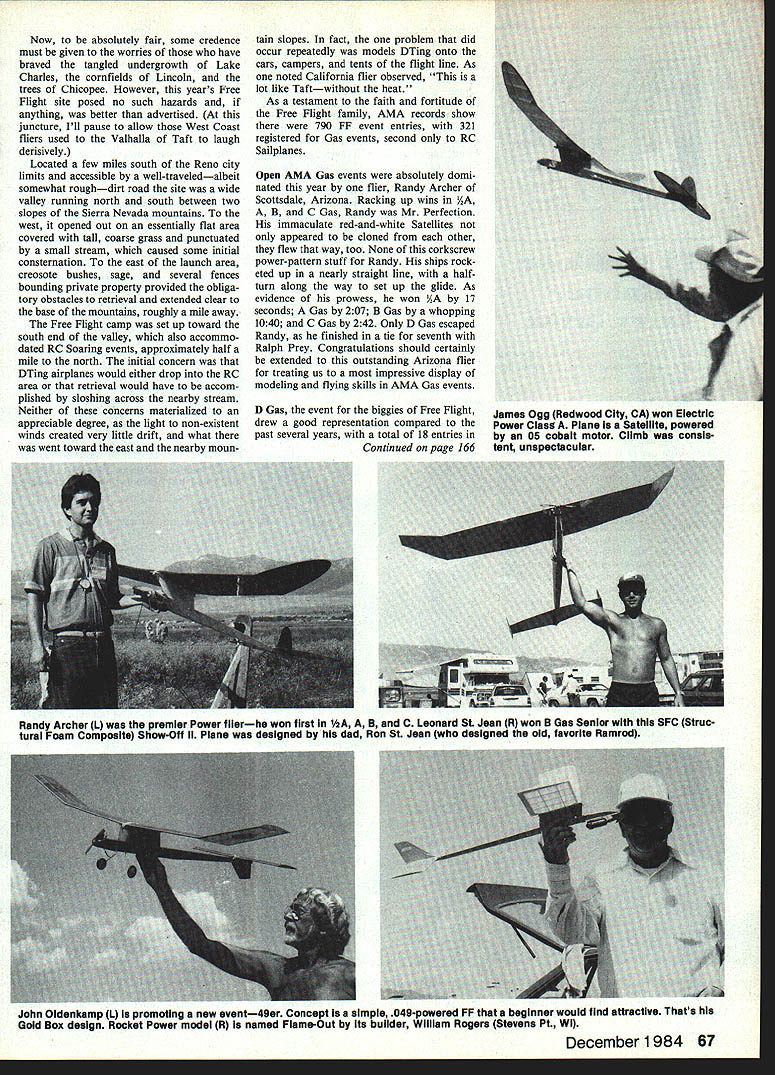
Open AMA Gas events were absolutely dominated by one flier, Randy Archer of Scottsdale, Arizona. Racking up wins in 1/2A, A, B, and C Gas, Randy was Mr. Perfection with an immaculate red‑and‑white Satellite. None of the corkscrew power‑pattern stuff for Randy — his ships rocketed up in a nearly straight line with a half‑turn along the way to set up the glide. As evidence of his prowess:
- 1/2A by 17 seconds
- A Gas by 2:07
- B Gas by 10:40
- C Gas by 2:42
Only D Gas escaped Randy; he finished in a tie for seventh in D with Ralph Prey.
D Gas, the event for the biggies of Free Flight, drew a strong field with a total of 18 entries.
NASS Peppermill event
There was an excellent get‑together for refreshments and dinner at the famous Peppermill Casino and restaurant, sponsored by the North American Speed Society (NASS), headed by Chris Sackett. The highlight was the awarding of the NASS Perpetual Speed trophy plus the High Time trophies for Junior, Senior, and Open Speed flights made at the 1984 Nats.
- NASS Perpetual Speed trophy: the Wisniewski team (Bill, Rick, and Dave)
- High Time Junior and Senior trophy: Jimmy Ricketts
- High Time Open trophy: Don Benesch
Congratulations to all!
I hope to visit with many of you at the FAI Control Line World Championship at Chicopee, MA in September 1984. I will be the Event Director for F2A Speed. See you in February with my regular column.
Gas events — Senior and Open summaries
Senior and Open combined events drew familiar names and strong performances. Thousand‑square maneuvers powered by a honkin' .60 can be a handful; Juniors are generally absent from Senior/Open.
- Senior D: Leonard St. Jean won flying a .40. The St. Jean clan has gone largely to foam composites (primarily foam covered with Saran wrap). Paul Funk was second.
- Open D: Toby Blizzard (Phoenix) won, 82 seconds ahead of Doug Galbreath. Dick Bloomquist was third with a total of 795 seconds.
- C Gas (Open): 26 entries (all flew). Randy Archer won; Doug Galbreath finished second, narrowly ahead of Sal Taibi (Taibi third at 878). Senior C: Bryan Fulmer first; Paul Funk second.
- B Gas: Senior B saw Leonard St. Jean beat Bryan Fulmer (Bryan totaled 406). In Open B, Archer took first; Dave Wineland was second with 963, and Dick Covalt third with 824.
- A Gas: Winners in both A and 1/2A were similar. Open A winners (top three): Aaron Markos first, Brad Denny second, Melinda Anderson third — Melinda placed third in both 1/2A and A. Senior A: Leonard St. Jean first, Bryan Fulmer second, Kent Delbon third.
- Open A: Doug Galbreath again finished second; Toby Blizzard was third at 849 seconds.
- 1/2A Gas: This class felt like a time warp back to old NATS days, with 63 fliers putting up flights and the air often literally full of airplanes. Open 1/2A: Randy Archer 848, E.M. Thompson 831, Phil Hainer 753. Senior 1/2A: Leonard St. Jean completed his hat trick in Gas Power, beating Paul Funk and Bryan Fulmer.
FAI Power (FIC)
FAI Power (FIC), one of the most exacting power events (limited to 7‑second engine runs), drew several top competitors. Results were dominated by California fliers:
- 1st: John Hannah (Pacific Palisades) — 1,118
- 2nd: Joe Lobina (Fresno) — 1,114
- 2nd: Dick Lyons (Camarillo) — 1,114 (tied with Lobina)
- 3rd: E.M. Thompson (Sacramento)
Rocket Power
Despite no commercial fuel or engine production for many years, Rocket Power continues to survive and provided some of the closest competition at Reno:
- 1st: Gene Jensen — 328
- 2nd: Irv Aker — 326
- 3rd: Terry Thorkildsen — 323
These were the tightest‑bunched scores of all outdoor FF events.
Electric Power
Electric Power is slowly gaining ground. Classes were:
- Class A: six battery cells or less
- Class B: more than six cells
Class A grew from just a few entries in prior years to 13 this year.
- Open Class A winner: James Ogg — 659 (eclipsing Don Hughes by 3:51)
- Don Hughes: runner‑up (3:51 behind Ogg)
- Leonard Bedford: third — 120
- Senior Class A: Robbie Mehmen and Frank Goddard finished one‑two (Mehmen first).
Class B:
- 1st: Leonard Bedford — 356
- 2nd: Addie Naccarato — 338
- 3rd: Tony Naccarato — 227
Payload
Payload, the smaller sibling of the former Cargo event, still has life. Results:
- 1st: Terry Thorkildsen — 401 seconds
- 2nd: Fred Anderson — 321 seconds
- 3rd: Ralph Spencel — 242 seconds (with his "Shazam" design)
Thanks and acknowledgments
Before leaving power to move on to Rubber and Glider events, it is necessary to thank some very key people without whom Free Flight would be much poorer. Each year my wife and I arrive at the Free Flight site to check in and get oriented. Invariably, the friendly faces we see are Homer Smith and Murry and Sandy Frank, each in his accustomed place, running the officials' table with efficiency, humor, and endless patience. Unless you've observed this over a period of time, you have no appreciation of the thousands of hours these people have given so the rest of us may enjoy our hobby. Gentlemen, thank you; it is nearly enough to repay you for your unselfish contribution.
Transcribed from original scans by AI. Minor OCR errors may remain.

