
Nats Overview/Convention
By John Worth
UNDERSTANDING what the 1984 Nats was like requires looking at it from many viewpoints. All kinds of descriptions apply, more or less: great, lousy, terrific, terrible, happy, sad, marvelous, awful. A lot depended upon the particular event and the weather. Whatever the situation for any individual, the fact is that over 700 awards were made in a total of 76 competition events (the most ever).
Weather
The weather was both excellent and terrible.
- Free Flight enjoyed four practically perfect days of light breezes.
- RC Scale suffered from windy, dusty conditions.
- RC Pattern and Pylon experienced both good and bad weather; when bad, the wind was across the runway instead of along it.
In general, the weather for the week was a mixed bag of good and bad.
Sites and separation
In contrast to the previous year in New England, where most Nats events were close together, the 1984 events were spread over many miles in four separate areas:
- Control Line Combat and RC Helicopters shared a park site to the west of Reno.
- All other Control Line events, plus RC Pattern, Pylon, and Scale, shared Stead Airfield to the northwest.
- Indoor was held at the Nats headquarters building south of downtown.
- Free Flight and RC Soaring were about 10 miles farther south.
The separation made it hard for anyone to see all of the Nats. It involved a lot of driving and close attention to the daily schedule to be at the right place at the right time. The distances also caused many behind-the-scenes problems for officials, contestants, and spectators.
Manpower shortage
The biggest problem at this Nats was a shortage of manpower. A typical Nats has 300 or more volunteers; this one had only about 200. At least 60 who had pre-registered by mail didn't show, and the effects were felt from one end of the Nats to the other.
This shortage highlighted our vulnerability to volunteer availability. The situation has prompted much talk and study about how to avoid a repeat. The 1984 shortage recalls the disruption after the U.S. Navy ended its Nats sponsorship in 1972 — when hundreds of Navy workers were suddenly unavailable. In the years after 1972, many volunteers rallied to fill the gaps, but 1984 was the first time we scraped the bottom of the barrel. As a result, many events operated with contestants themselves flying and working. There were many complaints from those not used to doing so, though Free Flighters were unbothered — they have run their own events since 1973.
This suggests two options: other categories either must follow the Free Flight example or the Nats must secure a bigger budget to bring in more outside help. A larger budget raises questions about funding sources, especially since contestant complaints about high entry fees are already vocal.
Site problems and event reports
Several site-specific problems occurred:
- The original Combat site was suddenly unavailable a week before the Nats because Little League games had been scheduled there. Combat moved 10 miles away to share the RC Helicopter site. The flying site was adequate, but it was too far from the rest of the Control Line activity.
- Free Flight and RC Soaring had earlier changed locations when dry lake beds filled with water. A large ranch south of Reno was secured as a substitute. Two weeks before the Nats, heavy rains soaked the area, creating swampy concern; surprisingly, much of it remained sandy and dusty with rough roads in and out.
- Despite concerns, Free Flighters were generally happy with the ranch site. Some said it would be suitable for a World Championship. A meandering creek nearby bothered a few, but most avoided setting up near it. There was a big Free Flight turnout, mostly great weather, forgiving grass for crashes and dethermalizing with minimal model damage, and no corn to lose models in. The general Free Flight sentiment was enjoyment and satisfaction.
- The main Control Line site at Stead Airfield was good. The ramp area had recently paved asphalt, but winds and blowing dust near the end of the week spoiled an otherwise positive situation.
- On the field to the north of Stead, RC Pattern, Pylon, and Scale suffered from a runway that was 90° to the wind, compounded by wind and sand during the last few days. The layout also prevented good spectator parking and viewing for these RC events, creating many complaints, but little could be done on short notice.
Nats headquarters and Indoor events
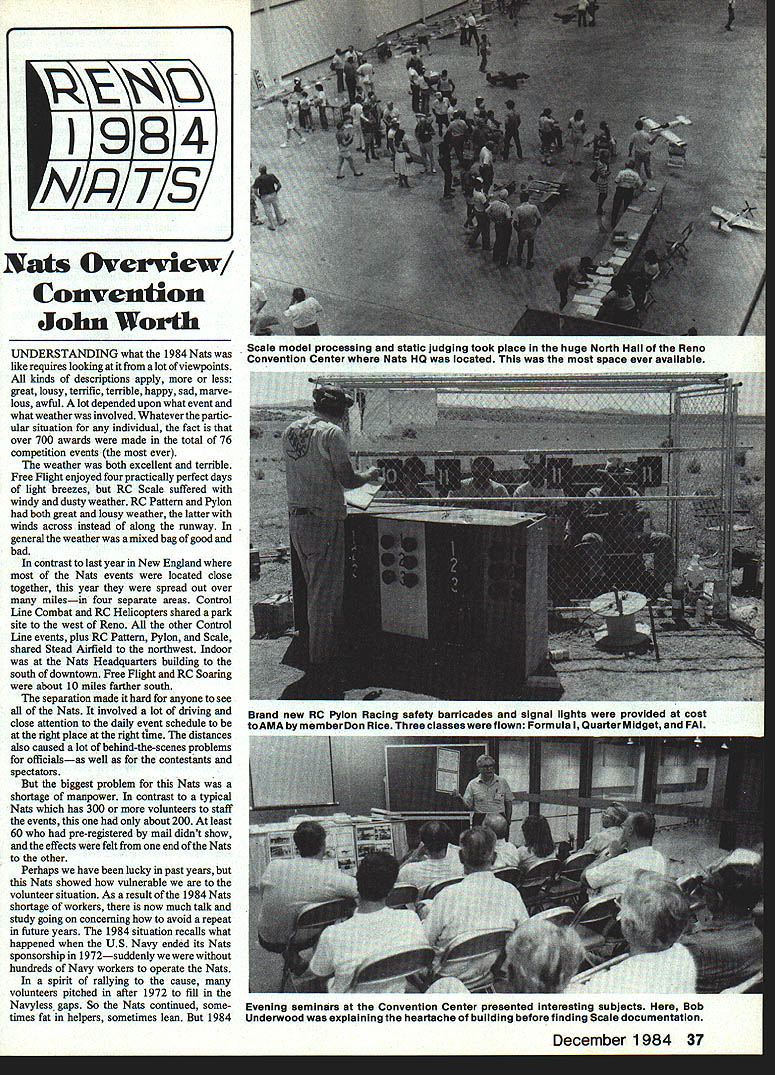
Compared with the field problems, the Nats headquarters at the Reno Convention Center was the best ever. It was huge, clean, well lighted, and modern — a clear improvement over many decrepit military buildings used in other years. There was room for everything, and dozens of models were on display at times.
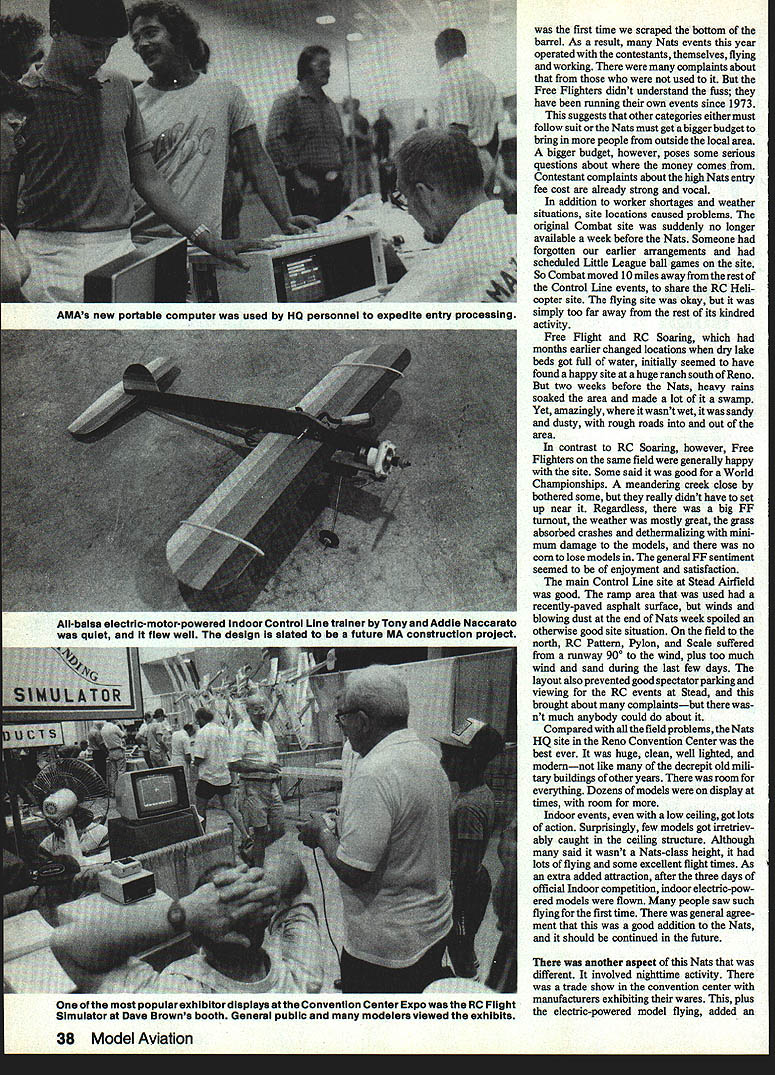
Indoor events, even with a low ceiling, got lots of action. A few models became irretrievably caught in the ceiling structure, and although many said the ceiling height wasn't ideal for a Nats-class competition, the flying quality, attendance, and excitement were notable. After the three days of official indoor competition, indoor electric-powered models were flown, and many saw such flying for the first time. There was general agreement that electric indoor flying was a positive addition and should be continued.
Nighttime activity and trade show
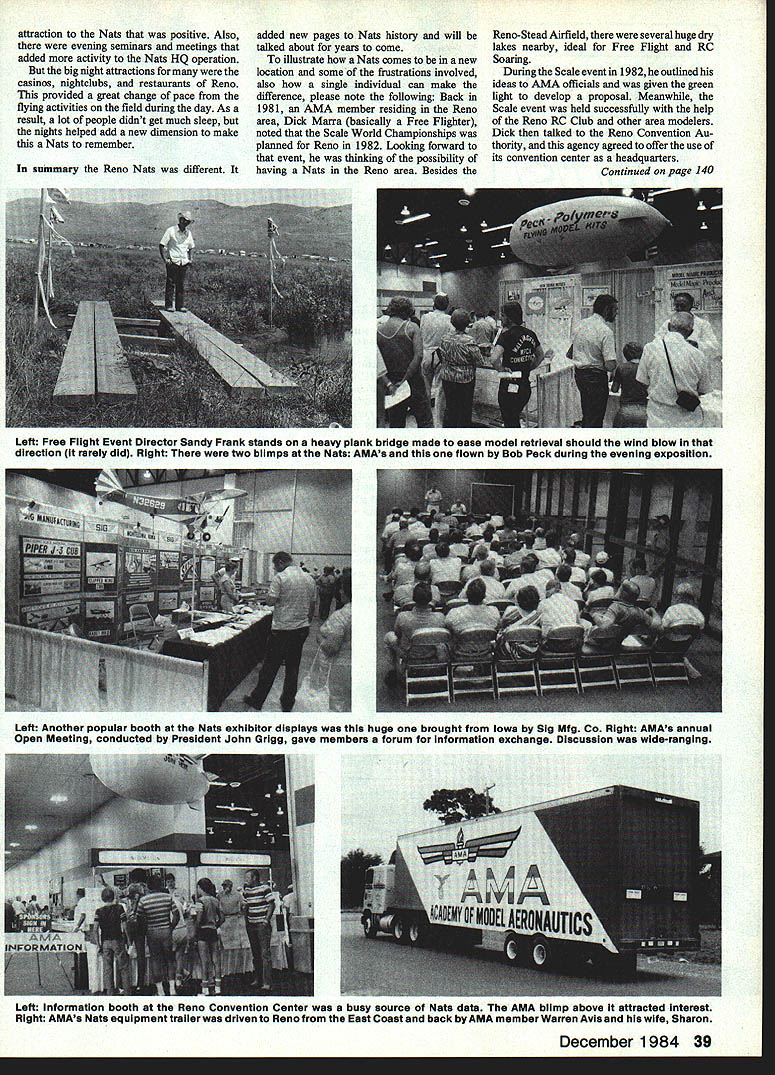
This Nats featured a trade show in the convention center with manufacturers exhibiting. The show, together with indoor electric flying, added attractive indoor activity. Evening seminars and meetings increased Nats HQ activity.
For many, the big night attractions were Reno's casinos, nightclubs, and restaurants. These provided a large change of pace from daytime flying; as a result, many people got little sleep. The nights added a new dimension that made this Nats memorable.
How Reno came to host the Nats — the role of Dick Marra
The move to Reno illustrates how a Nats comes to be in a new location and how a single individual can make a difference. Back in 1981, AMA member Dick Marra (basically a Free Flighter) began planning for a Reno Nats. He recognized the potential of Reno-Stead Airfield and several nearby dry lakes for Free Flight and RC Soaring.
During the Scale event in 1982, Dick outlined his ideas to AMA officials and was given the green light to develop a proposal. The Scale event that year succeeded with help from the Reno RC Club and other area modelers. Dick then secured the use of the Reno Convention Center as headquarters.
In 1983, rain filled the dry lakes, but Dick persevered and found a large ranch as a substitute. He also secured a separate RC Helicopter site at a local park when the need arose to separate that event from RC Soaring. Dick negotiated use of Stead Airfield, food concessions, trash containers, block booking of hotels, and many other details. He arranged for local modelers to help and recruited a local manpower coordinator (who unfortunately moved to California just before the Nats).
At the Nats and during the week before, Dick was constantly on the go solving last-minute problems. He, like many other officials, emptied trash cans, cleaned rooms, loaded vans, soothed neighbors bothered by traffic and dust at the Free Flight site, and put up and took down signs. He and his son, Laith, put in so many hours, day and night, that they became indispensable.
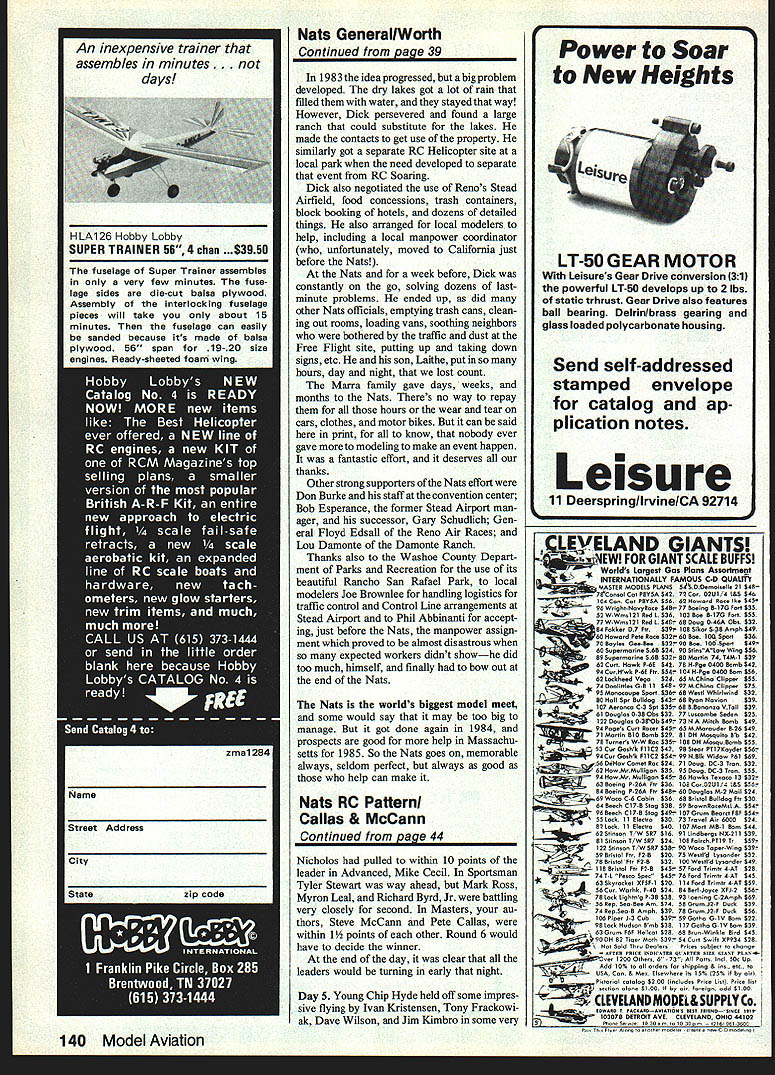
The Marra family gave days, weeks, and months to the Nats. There is no way to fully repay them for the hours, wear and tear on vehicles and clothing, and personal sacrifice. It can be said publicly that nobody ever gave more to modeling to make an event happen. It was a fantastic effort and deserves everyone's thanks.
Acknowledgments
Other strong supporters included:
- Don Burke and his staff at the convention center
- Bob Esperance, former Stead Airport manager, and his successor, Gary Schadlich
- General Floyd Edsall of the Reno Air Races
- Joe Damonte of the Damonte Ranch
- The Washoe County Department of Parks and Recreation for use of Rancho San Rafael Park
- Local modelers Joe Brownlee (logistics, traffic control, and Control Line arrangements at Stead Airport)
- Phil Abbinnati, who accepted the manpower assignment just before the Nats and carried the burden when many expected workers didn't show
Conclusion
The Nats is the world's biggest model meet, and some would say it may be too big to manage. But the 1984 Reno Nats got done, even under difficult circumstances, and prospects looked good for more help in Massachusetts for 1985. The Nats goes on: memorable always, seldom perfect, but always as good as those who help can make it.
Transcribed from original scans by AI. Minor OCR errors may remain.

