
RC Helicopters
Larry Jolly
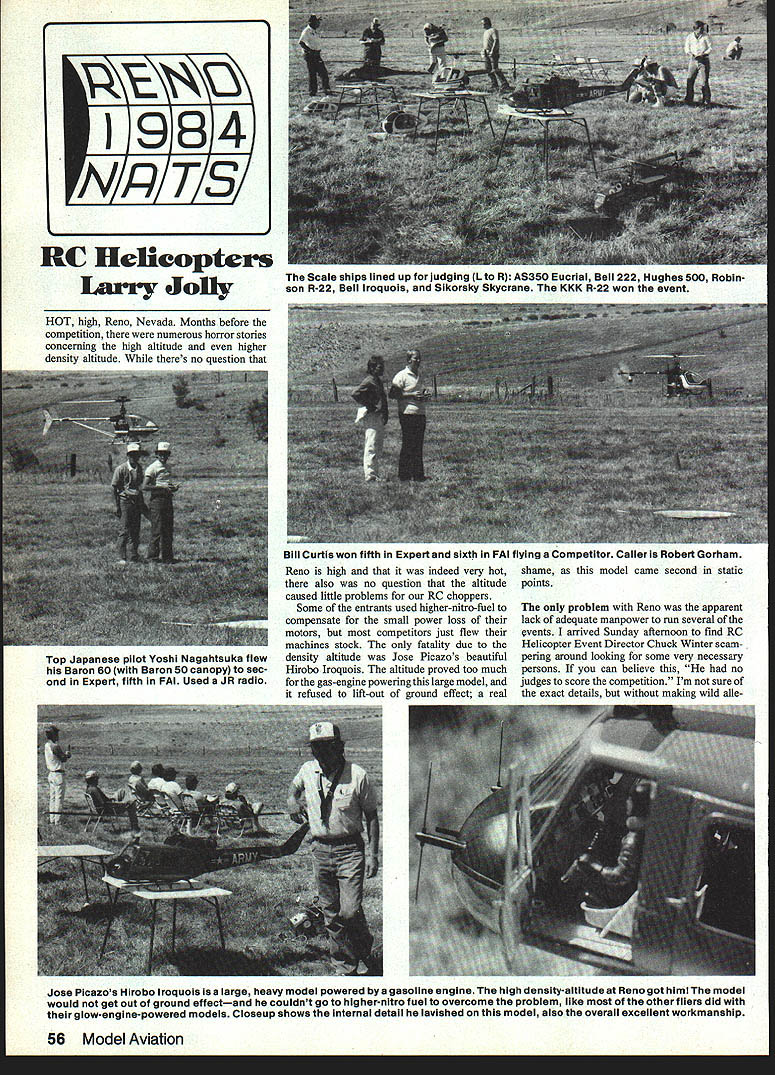
Hot, high Reno, Nevada. Months before the competition there were numerous horror stories concerning the altitude and even higher density altitude. While there is no question that Reno is high and that it was indeed very hot, the altitude caused little trouble for our RC choppers.
Some entrants used higher-nitro fuel to compensate for the small power loss of their motors, but most competitors flew their machines stock. The only fatality due to the density altitude was Jose Picazo’s beautiful Hirobo Iroquois. The altitude proved too much for the gas engine powering this large model, and it refused to lift out of ground effect. A real shame — this model came second in static points.
Organizational problems
The main problem in Reno appeared to be a lack of adequate manpower to run several of the events. I arrived Sunday afternoon to find RC Helicopter Event Director Chuck Winter scrambling around looking for very necessary personnel. If you can believe this, he initially had no judges to score the competition. Without making wild allegations, it seems safe to say a communication gap existed between the Nationals Planning Committee and Event Directors. Whose fault it was doesn’t really matter; what matters is that it was allowed to happen.
Fortunately, Chuck Winter is resourceful. A lesser contest director might have thrown up his hands, but Chuck took everything in stride with a “show must go on” attitude and handled the problems as they came along.
The originally chosen site, San Rafael Park, proved unsuitable for competition. The weekend before the Nationals began, Chuck spotted a suitable site adjoining the proposed site — it had hosted a vintage car show and had concession stands and other amenities. Since the site generated revenue, Chuck moved the event there Monday morning and took over. When a ranger told Chuck to move, Chuck stood his ground — a good decision. It’s doubtful the event would have flown Monday morning had competition been scheduled to begin at the original site.
Because of the manpower shortage, the competition used contestant judging. Incredibly, National Championships contestants in the Intermediate class were judging Expert FAI contestants. Allowing contestants to judge Intermediate and Novice classes can be understood, but having Intermediate contestants judge Expert added extra strain. No sooner would a contestant fly than he would have to judge. Five judges were used, with the high and low marks discarded.
Another decision allowed the use of metal-ballasted rotor blades. Apparently Chuck received no directive from the AMA safety ruling, nor was there any method to enforce the rules — meaning no metal detector.
Competition summary
Helicopter competition took place Monday, Tuesday and Wednesday, with 59 contestants posting 208 flights. Expert and FAI classes featured international and domestic talent, including:
- Fran DeProft (Belgium)
- The Schluter team
- Taya Shigetada (1983 Japanese National Champion)
- Yoshi Nagatsuka (current top Japanese flier)
- Hubert Bitner (past National Champion)
- Bob Gorham (1983 AMA Champion)
From the contestant list it was clear the competition would be tough — unlike the Helicopter Super Bowl.
As scores compiled it became apparent the top four in Expert could win the contest. The consistent pilot Yoshi Nagatsuka of Japan, flying a Baron 60, averaged 655.425 points per round over four rounds. In the end, Cliff Hiatt won the big Expert FAI competition. Flying a stock Superior-powered Enya 60X, Cliff outpointed everyone in FAI Expert. He showed excellent consistency in nose-in hovering, rolls, autorotations and the landing pad.
Results (highlights):
- Expert FAI: Cliff Hiatt — first place (Enya 60X)
- Expert: Yoshi Nagatsuka — consistently high scoring (Baron 60)
- Intermediate: Micky Yates — winner, 75 points ahead of John Gorham
- Novice: Askok Sheude — winner
Scale
Scale is my favorite event, and this year there were some real beauties entered. Franz Fletcher not only had the high static score but also the highest flight score with his very stock KKK Robinson R22. Other scale entries included:
- Schoonard A‑Star and Bell 222
- Michael Johnson’s Hughes 500
- Jose Picazo’s Iroquois
Equipment and trends
It was evident at this Nationals that no single helicopter model dominated. In Expert class the top five places were taken by three different types of machines. This diversity is good — it shows manufacturers have developed machines with winning potential and that success depends on the fliers honing their skills.
There was a good spread of helicopter types and motors used. However, in radios chosen, the J.R. Unlimited had the contest virtually tied up.
Looking ahead
Now that the Nationals are over, we can speculate on how our U.S. team will fare against the world in Canada next year. Cliff Hiatt is still fairly new to the helicopter game and can be expected to improve. Roberto Gorham is practicing hard. I believe these two will make the U.S. team and do well in Canada.
Congratulations to all the 1984 champions and to Chuck Winter for a job well done. One suggestion: future planning committees should include the proposed Event Director — the Nationals is an important contest that must have adequate planning to run successfully.
See you in 1985.
Transcribed from original scans by AI. Minor OCR errors may remain.

