
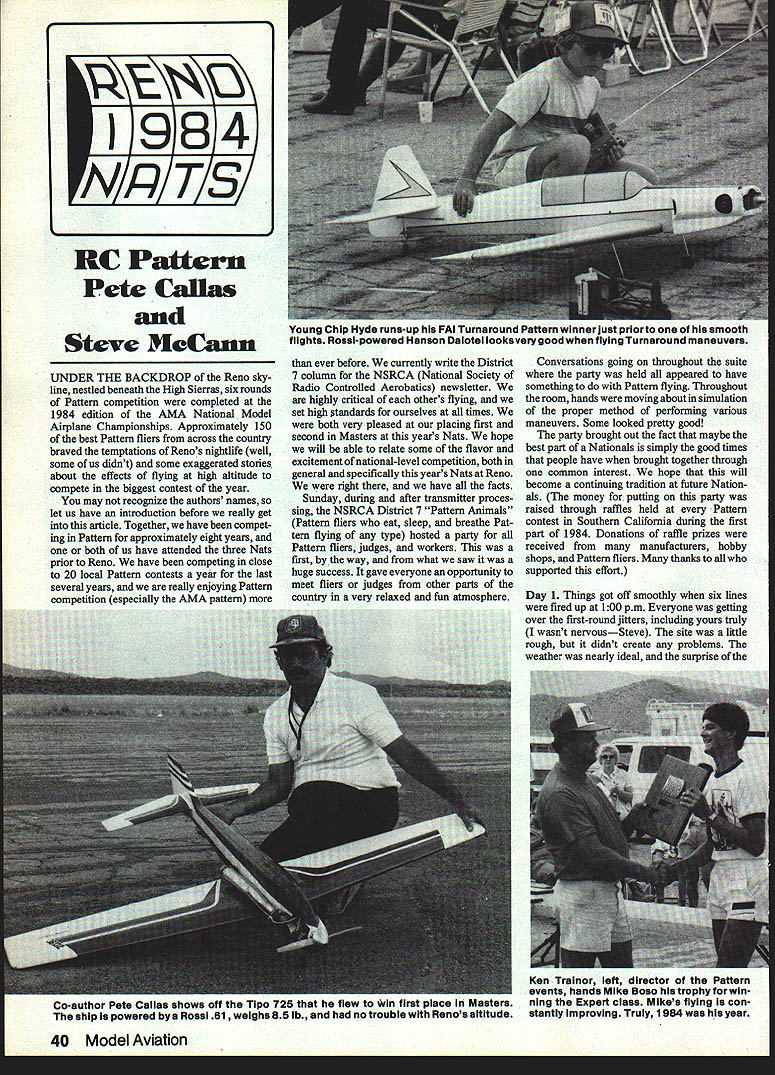
Reno 1984 Nats: RC Pattern
Pete Callas and Steve McCann
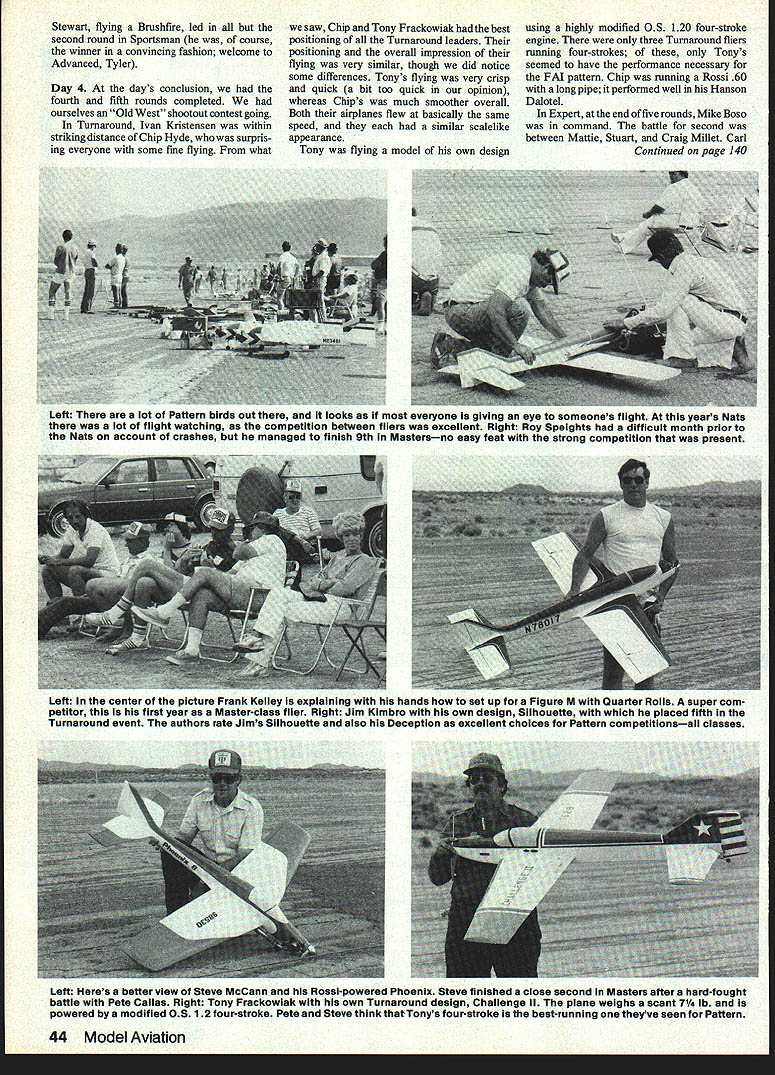
UNDER THE BACKDROP of the Reno skyline, nestled beneath the High Sierras, six rounds of Pattern competition were completed at the 1984 edition of the AMA National Model Airplane Championships. Approximately 150 of the best Pattern fliers from across the country braved the temptations of Reno's nightlife (well, some of us didn't) and some exaggerated stories about the effects of flying at high altitude to compete in the biggest contest of the year.
You may not recognize the authors' names, so let us have an introduction before we really get into this article. Together, we have been competing in Pattern for approximately eight years, and one or both of us have attended the three Nats prior to Reno. We have been competing in close to 20 local Pattern contests a year for the last several years, and we are really enjoying Pattern competition (especially the AMA pattern) more than ever before. We currently write the District 7 column for the NSRCA (National Society of Radio Controlled Aerobatics) newsletter. We are highly critical of each other's flying, and we set high standards for ourselves at all times. We were both very pleased at our placing first and second in Masters at this year's Nats. We hope we will be able to relate some of the flavor and excitement of national-level competition, both in general and specifically this year's Nats at Reno. We were right there, and we have all the facts.
Opening social
Sunday, during and after transmitter processing, the NSRCA District 7 "Pattern Animals" (Pattern fliers who eat, sleep, and breathe Pattern flying of any type) hosted a party for all Pattern fliers, judges, and workers. This was a first, and from what we saw it was a huge success. It gave everyone an opportunity to meet fliers or judges from other parts of the country in a very relaxed and fun atmosphere.
Conversations throughout the suite where the party was held all appeared to have something to do with Pattern flying. Hands were moving in simulation of the proper method of performing various maneuvers—some looked pretty good!
The party highlighted that perhaps the best part of a Nationals is simply the good times people have when brought together through a common interest. We hope this becomes a continuing tradition at future Nationals. The money we raised for the party came from raffles held at Pattern contests in Southern California during early 1984. Donations of raffle prizes were received from many manufacturers, hobby shops, and Pattern fliers. Many thanks to all who supported this effort.
Contest Report
Day 1
Things got off smoothly when six lines were fired up at 1:00 p.m. Everyone was getting over the first-round jitters. The site was a little rough, but it didn't create any major problems. The weather was nearly ideal. On a positive note, aircraft performance at Reno-Stead Airport's high altitude was nearly normal. Apparently most fliers had been able to get some practice flying in before the contest and had their engines and airplanes tuned to perfection.
We had gone out a few days before the contest started and made only two changes: we increased the nitro in our fuel from 5% to 12% and shortened our pipes by 3/8 inch. We used the same props we always use at sea level; with these changes we noticed no decrease in engine rpm. The airplanes seemed a little slower coming off the ground, but once up to speed they flew much like at sea level.
The first round of the four AMA classes went smoothly, and then FAI Turnaround started with a bang. The Turnaround pilots wrote a protest regarding the "imaginary box" mentioned in the FAI rules. Contest management took the protest and Nats officials discussed it that evening; the changes requested by the fliers were instituted in the second round. During all of this excitement, Dave Brown was disqualified for unsportsmanlike behavior.
Whether Dave should or should not have been disqualified is not really the issue, in our opinion. Dave Brown is a great flier, and he means a lot to Pattern flying. Many fliers throughout the country look up to Dave (and fliers like him) to pattern themselves after their "hero." We feel a flier of Dave Brown's stature has a responsibility to the hobby, to Pattern flying, and to all those who admire him. This incident should never have happened. We're not saying he should not have been disqualified; we're saying he never should have let himself get into a situation where he possibly could be disqualified. No flier is above the rules. Everyone should remember that this is a hobby and not Wimbledon.
The only other problem involving Turnaround was that it took 2½ hours to run 22 Turnaround flights.
Day 2
There was good weather, good flying, and good food. We still had some money left from the previous night's party. The second round progressed smoothly, and we got into the third round near the end of the day. After Day 1's excitement, Day 2 was a relief.
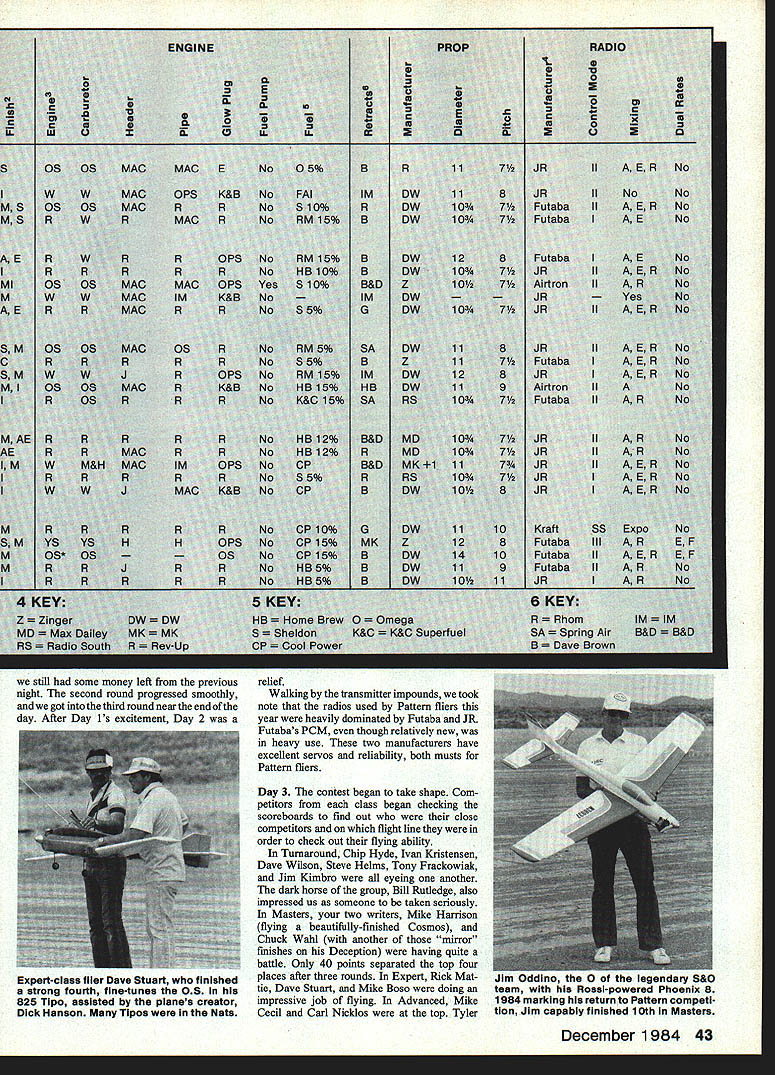
Walking by the transmitter impounds, we noted the radios used by Pattern fliers were heavily dominated by Futaba and JR. Futaba's PCM, even though relatively new, was in heavy use. These two manufacturers have excellent servos and reliability—both musts for Pattern fliers.
Day 3
The contest began to take shape. Competitors from each class began checking the scoreboards to find out who their close competitors were and on which flight line they were, in order to watch their flying.
In Turnaround, Chip Hyde, Ivan Kristensen, Dave Wilson, Steve Helms, Tony Frackowiak, and Jim Kimbro were all eyeing one another. The dark horse of the group, Bill Rutledge, also impressed us as someone to be taken seriously.
In Masters, your two writers, Mike Harrison (flying a beautifully finished Cosmos) and Chuck Wahl (with another of those mirror finishes on his Deception), were having quite a battle. Only 40 points separated the top four places after three rounds.
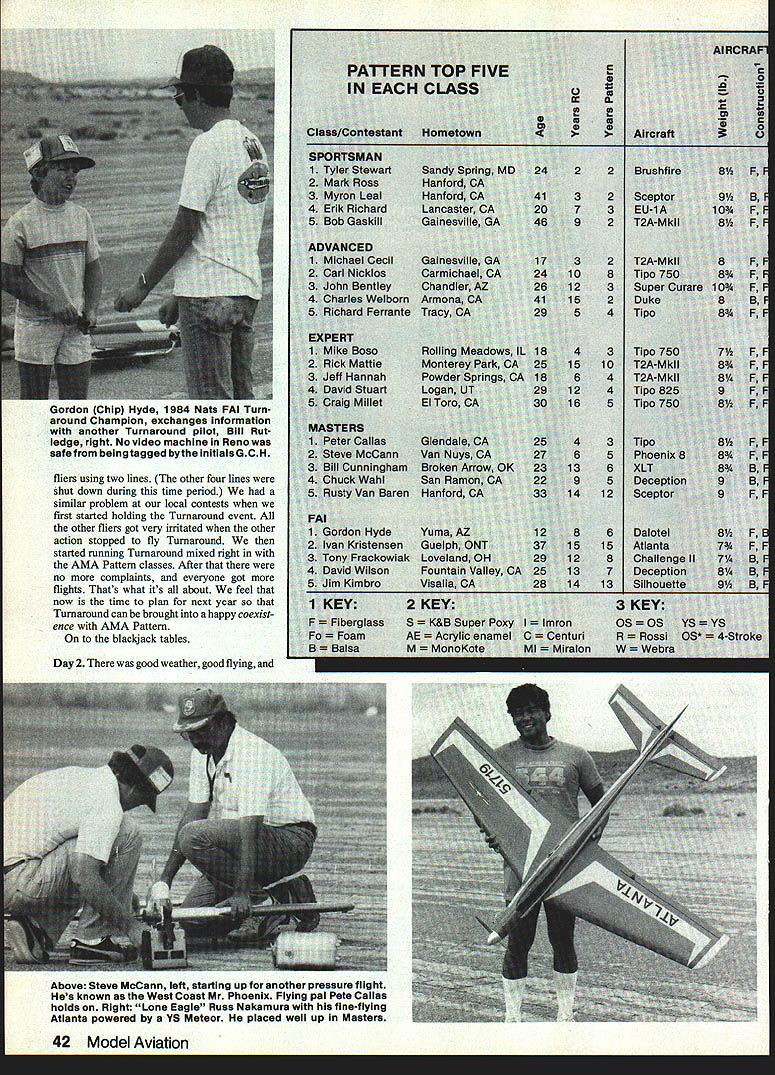
In Expert, Rick Mattson, Dave Stuart, and Mike Boso were flying impressively. In Advanced, Mike Cecil and Carl Nicklos were at the top. Tyler Stewart, flying a Brushfire, led in all but the second round in Sportsman; he was the winner in a convincing fashion and will be welcome in Advanced.
Day 4
By the day's conclusion we had completed the fourth and fifth rounds. We had ourselves an "Old West" shootout going.
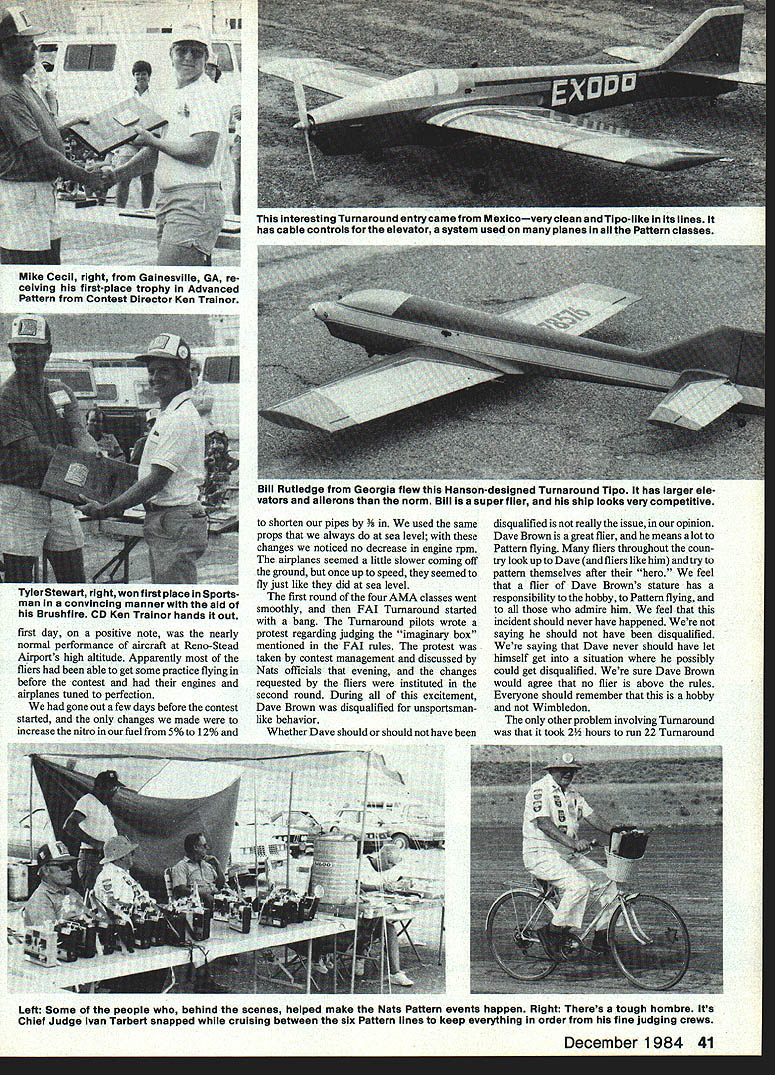
In Turnaround, Ivan Kristensen was within striking distance of Chip Hyde, who was surprising everyone with some fine flying. From what we saw, Chip and Tony Frackowiak had the best positioning of all the Turnaround leaders. Their positioning and the overall impression of their flying were very similar, though with noticeable differences. Tony's flying was very crisp and quick (a bit too quick in our opinion), whereas Chip's was much smoother overall. Both airplanes flew at basically the same speed and had a similar scale-like appearance.
Tony was flying a model of his own design using a highly modified O.S. 1.20 four-stroke engine. There were only three Turnaround fliers running four-strokes; of these, only Tony's seemed to have the performance necessary for the FAI pattern. Chip was running a Rossi .60 with a long pipe; it performed well in his Hanson Dalotel.
In Expert, at the end of five rounds Mike Boso was in command. The battle for second was between Mattson, Stuart, and Craig Miller.
In Advanced, Carl Nichols had pulled to within 10 points of the leader, Mike Cecil. In Sportsman, Tyler Stewart was way ahead, but Mark Ross, Myron Leal, and Richard Byrd Jr. were battling closely for second. In Masters, your authors, Steve McCann and Pete Callas, were within 1½ points of each other. Round 6 would decide the winner.
At the end of the day, it was clear that all the leaders would be turning in early that night.
Day 5
Young Chip Hyde held off some impressive flying by Ivan Kristensen, Tony Frackowiak, Dave Wilson, and Jim Kimbro with very smooth flights. Tony was still fast and doing a nice job with his electric-like quickness, but Chip's overall rhythm was better. At the end of the fifth round, Chip had a slight edge.
Windy conditions challenged the fliers. We saw Chip's and Tony's last flights in the wind, and both did fine jobs. Ivan Kristensen put up the second-highest score of the contest on his last flight—a very impressive performance. His airplane, a YS-powered Atlantic, did much better in the high winds than either Chip's or Tony's.
In Expert, Mike Boso put up a strong flight in windy conditions to score his first Nats victory.
In Advanced, Mike Cecil, who had been leading since the third round, hung on to win his class.
Tyler Stewart won Sportsman and moves into Advanced.
In Masters, Pete Callas put in the better windy-weather flight and became the Masters National Champion.
Acknowledgments and Observations
It takes many volunteers to put on a Nationals—from judges to scorekeepers, Contest Directors, AMA officials, and on and on. These people spend their vacations to put on a Nats for our benefit. On behalf of all the Pattern fliers, we want to extend our thanks for the efforts of all these people. They exemplify the motto we adopted for the 1984 Nationals: "Don't sweat the little things, and everything's a little thing." (Pattern philosopher Jim Oddino)
We saw a lot of new Pattern designs:
- Challenge II
- Atlanta
- Citation
- Cosmos
- Dalotel
- The ever-improving breed of Tipos and Phoenixes
Quite a few fliers were running YS engines and having good success, though Rossis still seem to dominate and set the performance standards with which all engines are compared.
The best place to stay abreast of all the new Pattern setups is the NSRCA K-Factor, a monthly newsletter written by and for Pattern fliers. Of the fliers at the Nationals, 127 were NSRCA members, as were all the top five finishers in each class. NSRCA is the special-interest group recognized by AMA for Pattern issues. If you love Pattern as we do, talk to an NSRCA member in your area and get involved in this great organization.
NSRCA membership details:
- Dues: $10 a year
- Send to: Linda Kuckeheck, 869 Cedar Hill Dr., Allentown, PA 18103
- Include: your name and address, AMA number or current Pattern class, and indicate whether new or renewal membership
We hope to see you in 1985 at the Nats in Chicopee, MA.
Transcribed from original scans by AI. Minor OCR errors may remain.

