
Reno 1984 Nats: RC Pylon Racing
Wayne Yeager
Trip West
"Go west," she said, and I promptly pulled out of the drive facing east. "Too many trips to Toledo," I muttered. The van is on automatic south. Back in Drive, start over. I'm allowed two direction mistakes on this trip, and I'd already made one.
The trip to the "Gnats" can be as much an experience as the Nats themselves—2,200 miles of road construction and an endless procession of bugs making the ultimate sacrifice to your windshield. Off we go across the breadth of the home state, dip around Lake Michigan, notch a corner out of Indiana, past the Windy City, and out into the wilds of Illinois. On we rolled, westbound and down across the mighty Mississippi and out into the rolling plains of "Eye-Oh-Way," past Sig-Land and the "Halls of Montezuma" (hi Hazel, hi Maxey).
"Onwards," says wifey. Across the wide Missouri and the bluffs of Council Bluffs into Nebraska, past Lincoln (site of the '79 and '82 Nats), and out into the Platte River Valley—the same trail used by the Mormons, Pony Express, the great wagon trains, and competitors of the 1952 Nats. I looked for wagon tracks, but the highway crews had most of them fixed.
"Onward," says the other half—Gnats-bound and down! Three hundred forty-five miles of Nebraska and I never saw anyone husking corn. We swung southwest and started the climb onto the high prairies of eastern Colorado. Caller and I played a game: who could spot the first mountain? I lost. Up we climbed past Mile High City, switchbacked up the Great Divide and down the other side, flying past money-rich Vail and through Glenwood Canyon following the Colorado River. On onto great mesas and spectacular rock formations of eastern Utah. Breakfast in Green River and on the road again.
People talk about crowded cities in the East—they should try Utah. On one 150-mile stretch I never saw another person. "Lots of room," says I. Camera was working overtime; film was getting short. "Why so many pictures?" says she. "Never enough," says I. "Onward," she sighs. Reno-bound and down!
We crossed a great valley into Nevada. Dust devils everywhere—amazing. Getting close now: only 400 miles to go. I can do that standing on one foot! It turned out I had to, since there were only three rest stops in the entire 400. Finally, over one last mountain ridge and there it was—Reno! Slot machines, blackjack, great food, nightlife. "Hey, dummy," says wife, "forget all that—you came here to fly."
Processing and Safety
Safety processing started early Sunday afternoon without the usual long line of fliers carrying wings under their arms, because only the occasional Pylon pilot trickled out of the transmitter-processing line, which was miles long. There were helicopter pilots, pattern pilots, sailplane pilots, and hundreds more—never such a mess. People in the rear waited over three hours; however, it gave those in line a chance to grumble, greet old friends, and renew friendships. Nothing beats AMA's annual Processing Party.
I almost didn't get to fly because my transmitter was off frequency—10 KC splattering. Ken Trainor, Pattern Event Director, a complete stranger, rode up on a white horse, gave me a module out of his own transmitter and saved the day. Nice guy; I won't forget him.
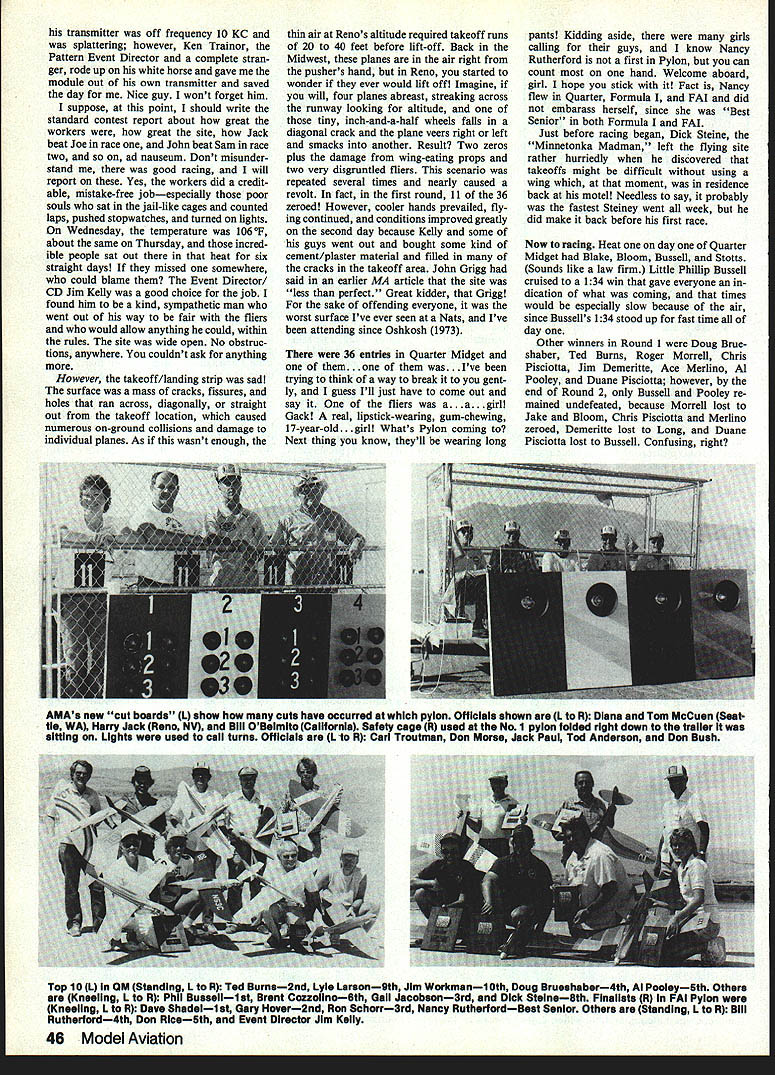
I suppose I should write the standard contest report about great workers and great site: Jack beat Joe, John beat Sam, ad nauseam. Don't misunderstand—good racing was reported. Workers did a creditable, mostly mistake-free job—especially the poor souls who sat in jail-like cages, counted laps, pushed stopwatches, and turned lights.
Wednesday and Thursday temperatures were about 106°F. Incredible—people sat out the heat six straight days. If I missed a detail somewhere, you can blame Event Director/CD Jim Kelly. Good choice for the job; he was a kind, sympathetic man who went out of his way for fair fliers and would allow anything he could within the rules. The site was wide open with no obstructions; couldn't ask for more. However, the takeoff/landing strip had a sad surface—massive cracks, fissures, and holes ran diagonally across it.
Thin air at Reno's altitude required takeoff runs of 200 to 400 feet before lift-off. Back in the Midwest these planes are airborne right from the pusher's hand, but in Reno you started to wonder if they ever would lift off. Imagine four planes abreast streaking across the runway looking for altitude and one of those tiny, inch-and-a-half wheels falling into a diagonal crack so the plane veers and smacks into another. Result: two zeros plus damage from wing-eating props and two disgruntled fliers. This happened several times and nearly caused a revolt. In the first round, 11 of the 36 zeroed! Cooler heads prevailed: Kelly and some workers bought a cement/plaster material and filled many of the cracks in the takeoff area, and conditions improved on the second day.
John Grigg had called the site "less than perfect" in an earlier M.A. article. For the sake of offending everyone, it was the worst surface I've ever seen at a Nats, and I've been attending since Oshkosh in 1973.
Quarter Midget
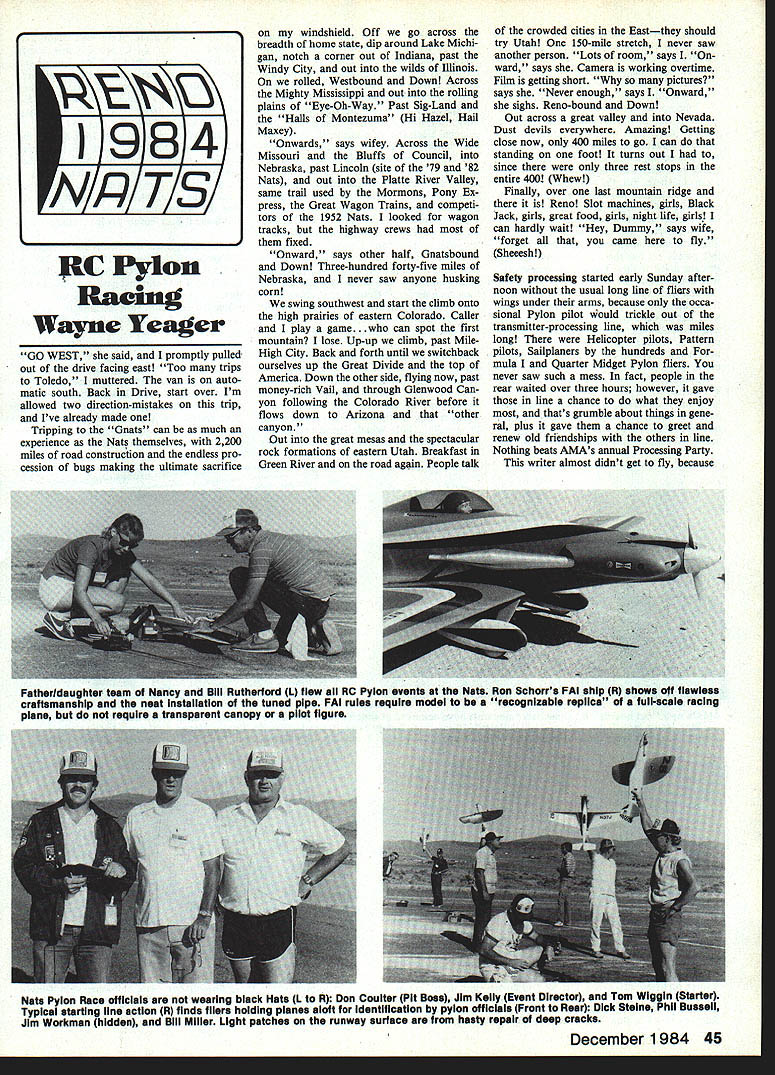
There were 36 entries in Quarter Midget and one of them was—gasp—a girl. A real, lipstick-wearing, gum-chewing, 17-year-old girl. What's Pylon coming to? Kidding aside, there were several girls pyloning. Nancy Rutherford flew in Quarter, Formula I, and FAI and did not embarrass herself—she was Best Senior in both Formula I and FAI. Welcome aboard.
Just before racing began, Dick Steine, the "Minnetonka Madman," left the flying site hurriedly when he discovered that takeoffs might be difficult without using a wing that, at that moment, was back at his motel. Needless to say, it was probably the fastest Steine went all week, but he made it back before his first race.
Round 1 featured Blake, Bloom, Bussell, and Stotts. Little Phil Bussell cruised to a 1:34 win that gave everyone an indication of what was coming; that time stood up as the fast time all of day one (especially slow because of the thin air). Other winners in Round 1 included Doug Brueshaber, Ted Burns, Roger Morrell, Chris Pisciotta, Jim Demeritte, Ace Merlino, Al Pooley, and Duane Pisciotta.
By the end of Round 2, only Bussell and Pooley remained undefeated—Morrell had lost to Blake and Bloom; Chris Pisciotta and Merlino had zeroed; Demeritte lost to Long; and Duane Pisciotta lost to Bussell. In Round 3, Pooley lost to Burns, and suddenly Bussell was all alone on top with Burns, Jacobson, Cozzolino, and Pooley one point back.
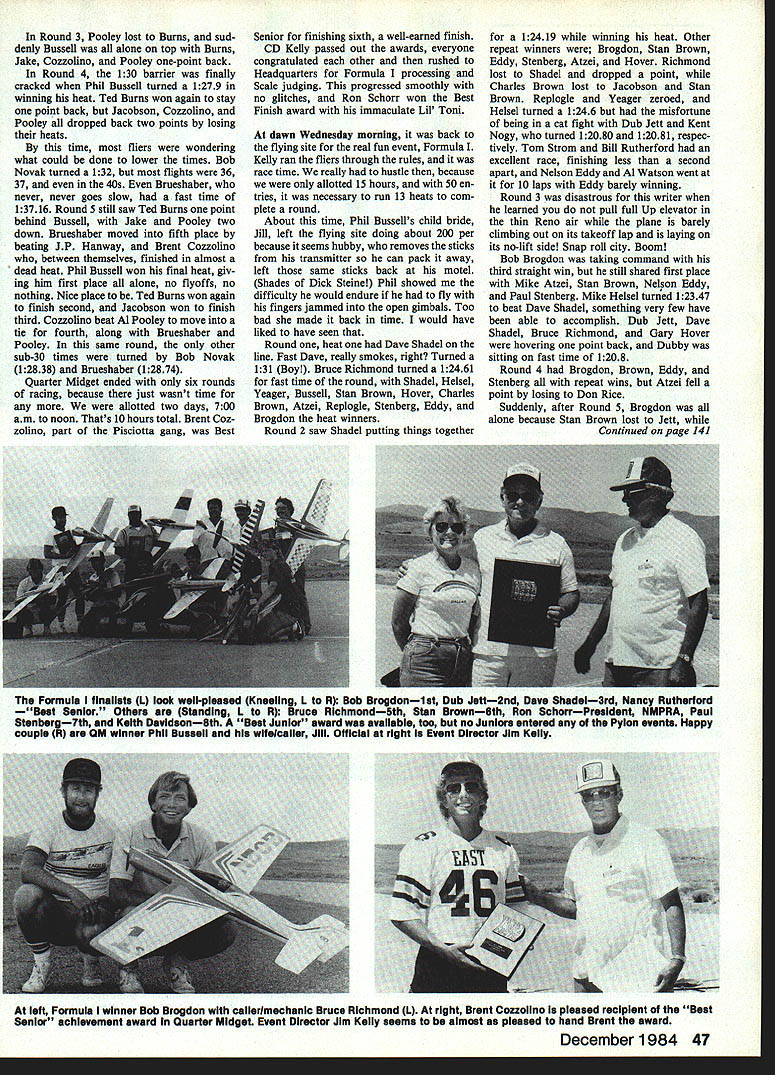
Round 4 saw the 1:30 barrier finally cracked when Phil Bussell turned a 1:27.9 in winning his heat. Ted Burns won again to stay one point back. By Round 5, Bussell remained the leader and won his final heat, giving him first place outright—no flyoffs. Ted Burns finished second and Jacobson finished third. Brent Cozzolino moved into a tie for fourth with Al Pooley and Doug Brueshaber. Brent Cozzolino, part of the Pisciotta gang, was Best Senior for finishing sixth.
Summary—Quarter Midget top finishers:
- 1st: Phil Bussell
- 2nd: Ted Burns
- 3rd: Jacobson
- Best Senior: Brent Cozzolino
CD Kelly passed out the awards and everyone rushed to Headquarters for Formula I processing and Scale judging. This progressed smoothly with no glitches; Ron Schorr won Best Finish with his immaculate Lil' Toni.
Formula I
At dawn Wednesday it was back to the flying site for Formula I. Kelly ran the fliers through the rules and it was race time. We had to hustle—only 15 hours allotted for 50 entries, requiring up to 13 heats to complete a round.
Phil Bussell's child bride, Jill, left the flying site in a hurry when Phil discovered he'd left his transmitter sticks back at the motel. Shades of Dick Steine! Phil showed me how difficult it would be to fly with fingers jammed into open gimbals. Too bad she made it back in time.
Round 1 heat winners included Bruce Richmond (fast time 1:24.61), Dave Shadel, Helsel, Yeager, Bussell, Stan Brown, Hoyer, Charles Brown, Atzei, Replogle, Stenberg, Eddy, and Brogdon. Round 2 saw Shadel put things together with a 1:24.19 win. Repeat winners included Brogdon, Stan Brown, Eddy, Stenberg, Atzei, and Hoyer. Richmond lost to Shadel and dropped a point; Replogle and I (Yeager) zeroed. Mike Helsel turned 1:23.47 to beat Dave Shadel—something very few had done.
Round 3 was disastrous for me when I learned you do not pull full up elevator in the thin Reno air while the plane is barely climbing on its takeoff flap and is laying on its no-lift side—snap roll city, boom!
Bob Brogdon was taking command with his third straight win, sharing first place with Mike Atzei, Stan Brown, Nelson Eddy, and Paul Stenberg. Dub Jett was sitting on fast time of 1:20.8.
By Round 6 Brogdon was nervous but kept winning. In his last heat he faced Gary Hover and Keith Davidson. Hover went squeaky clean and then flamed out; it became a two-plane race and Brogdon held a slight lead. He won, landed, and discovered only one bolt was holding his engine mount to the firewall—the other three were missing and the engine was flopping around loose. Someone up there said, "It's Bob's turn."
CD Kelly limited the event to seven rounds, then called flyoffs. Brogdon sat back with 28 points. Shadel, Atzei, and Jett tied for second and went to a flyoff. During that flyoff Shadel nudged Jett and discovered he couldn't go for a two-inch prop; Atzei flamed out, so Dubby coasted to an easy win and second place. Shadel had the faster time and was awarded third; Atzei was fourth. Bruce Richmond was fifth.
Stan Brown, Paul Stenberg, and Keith Davidson were tied for sixth. Davidson declined a flyoff and accepted eighth; Brown and Stenberg were to fly for sixth and seventh, but Stenberg couldn't get started—Brown had a freebie, nosed over on takeoff and finished sixth.
Formula I top finishers:
- 1st: Bob Brogdon
- 2nd: Dub Jett
- 3rd: Dave Shadel
- 4th: Mike Atzei
- 5th: Bruce Richmond
FAI
FAI was a different animal. In ukie Combat it's the best spectator event around; in RC Pylon it was something else this year. Thirteen entries, three- and two-plane heats, and many no-starts, flame-outs, and dice-on-the-line resulted in many one- or two-plane heats and limited excitement.
Highlights and oddities:
- Don Coulter, the pit boss, was seen working a crossword puzzle while flying progressed.
- The truck that cleans out the johns came around and people stood watching for something to do.
- Rice had a propensity for off-field landings—"Puffed Rice" became the joke for his dusty landings.
Round winners included Shadel, Jake Jacobson, Schorr, Hover, Bill Rutherford, and Nancy Rutherford (a welcome win). Kent Nogay eventually called it quits after several mishaps. Bob Smith had a particularly rough FAI—five straight zeroes.
FAI top finishers:
- 1st: Dave Shadel
- 2nd: Gary Hover
- 3rd: Ron Schorr
- 4th: Bill Rutherford
- 5th: Don Rice
Final Notes and Reflections
All the trophies were awarded and, before you knew it, everyone was gone—headed home to the four winds. Six straight days of noise, friends, and excitement—then it's over. Reflecting back, the Nats was fun because we got a chance to see friends we don't see often: the Pisciotta clan, Phil and Jill Bussell, the Brogdons, John B. Jr., Dubby, Dave, J.P., Keith Davidson, and many others. It was also nice to meet new friends like Jim Kelly, Don Coulter, the Rutherfords (Nancy and Bill from England), Ted Burns, Larry Stotts, and others. The wife said she met some neat ladies under the Samurai tent, so all in all, good or bad—the flying surface aside—the Nats was fun.
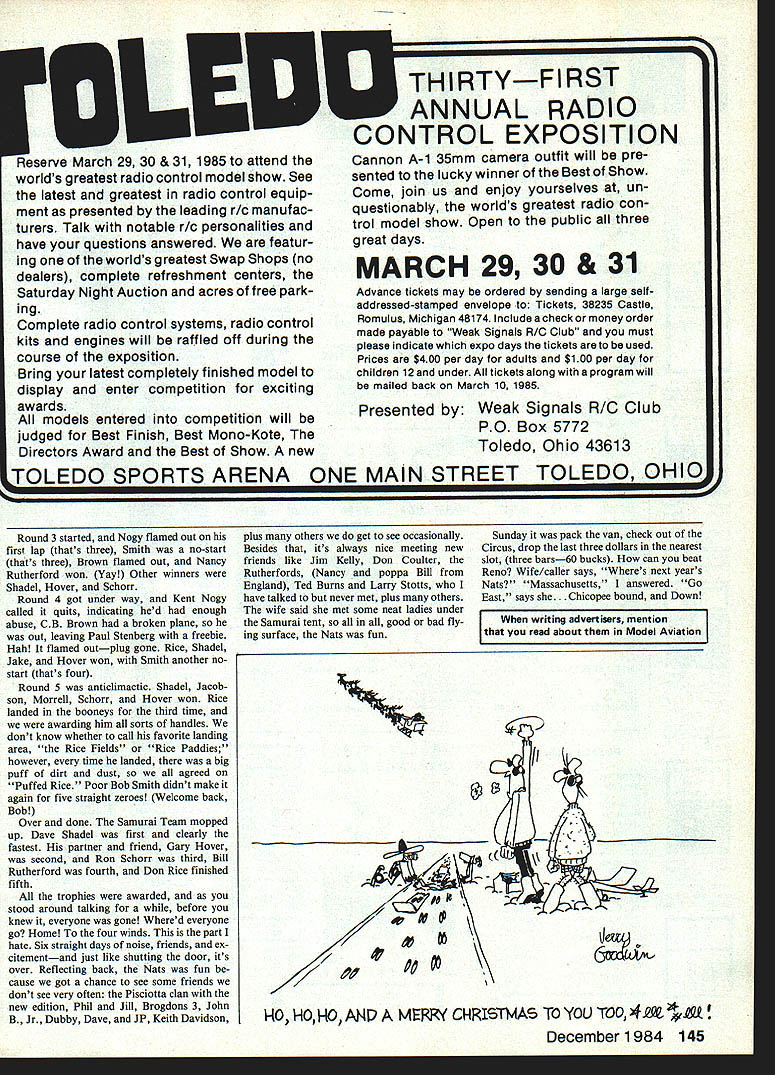
On Sunday we packed the van, checked out of the circus, and dropped the last three dollars in the nearest slot (three bars—$60). How can you beat Reno? Wife/caller asks, "Where's next year's Nats?" "Massachusetts," I answered. "Go east," says she. Chicopee bound, and down!
Transcribed from original scans by AI. Minor OCR errors may remain.

