
Reno 1984 Nats: RC Soaring
Dan Pruss
DEAR BOSS: You probably think I'm enjoying the heck out of this assignment. Well, you're partly right. After all, this is Reno, the city that claims to keep more light bulbs lit than any other city in the world.
Headquarters and accommodations
First off, the selection of Nationals Headquarters and the AMA staff should be commended. The convention center made a first-class image for the public and for AMA members — a far cry from crowded derelict hangars we've seen in the past. Contestant housing was in pretty fine hotels rather than the old barracks-style arrangements.
I stayed at one of Reno's finer hotels for $26 a day — and that included free circus acts (I guess the circus is just in case anybody missed the transmitter weigh-in ceremonies). There were breakfast, noon, and evening buffet setups with food spreads longer than some flight lines. All three meals cost less than $8 total, which helped on this assignment.
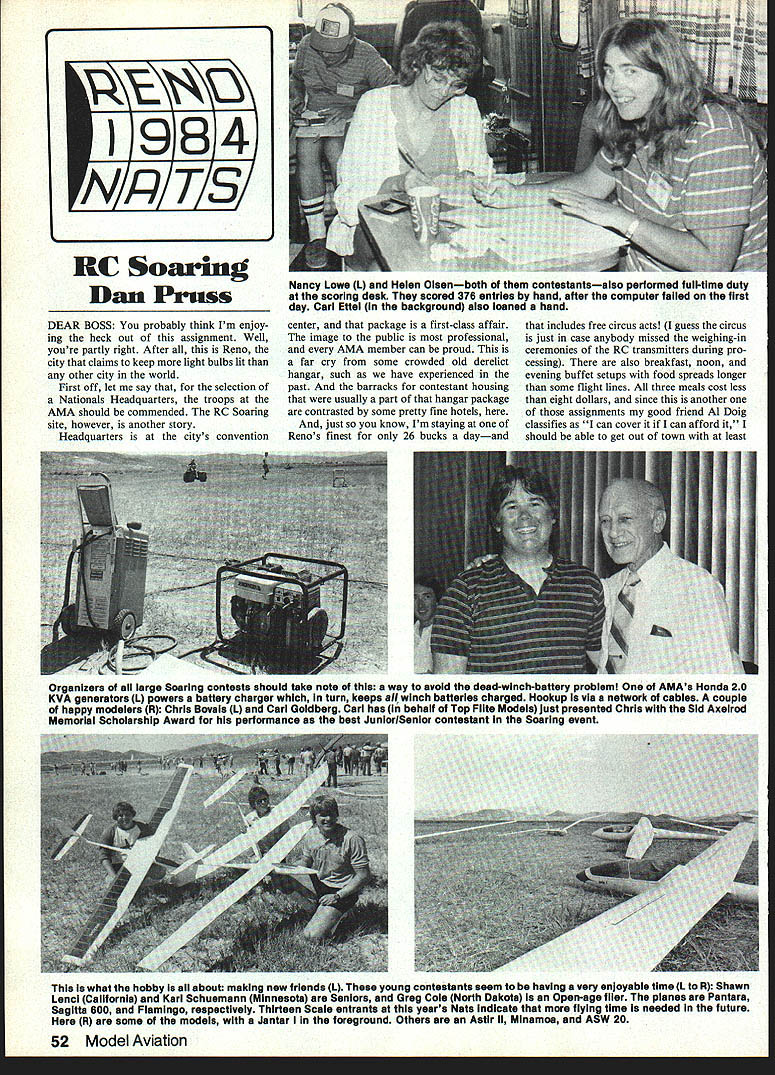
Organizers also avoided dead-winch-battery problems by using AMA's Honda 20 kVA generators to power battery chargers and keep winch batteries charged. Hookups via network cables kept the modelers happy.
Event format and entries
A contest labeled "National" carries premium expectations. Entry fees were $35 for basic RC and $12 for each additional event. Soaring categories included four regular thermal classes, scheduled to fly over three days for nine rounds per class. The task was a seven-minute precision-duration flight plus a 100-point in-or-out landing. Fliers elected which events to enter.
- Categories:
- Two-Meter
- Standard
- Modified Standard
- Unlimited
Totals and participation:
- Total entries listed: 376 (147 fliers) — the largest entry list at the Nats.
- Breakdown (contest-wide): 147 contestants from 24 states, Canada, and Mexico.
- 119 registered in Standard and Modified Standard
- 118 in Unlimited
- 89 in Two-Meter
- Top states by entries: California (71), Washington (13), Colorado (12), Oregon (10).
The fourth day (Thursday) was set aside for Scale (13 entries). Friday and Saturday included F3B on the calendar for the first time ever at the AMA Nationals. Thirty-seven fliers preregistered for F3B, but only 13 actually flew.
Organization and manpower
Rich Hansen was promised help, but manpower was short. Whoever schedules a National Soaring contest should realize it takes at least two dozen people to run it at a high level, especially if competitors expect to log six rounds a day in two categories. The unwritten rule "Fly one, time one" is as old as sailplanes; when contestants must fly six rounds and time six rounds, there is little room left to help run the meet — something they shouldn't have to do after paying entry fees.
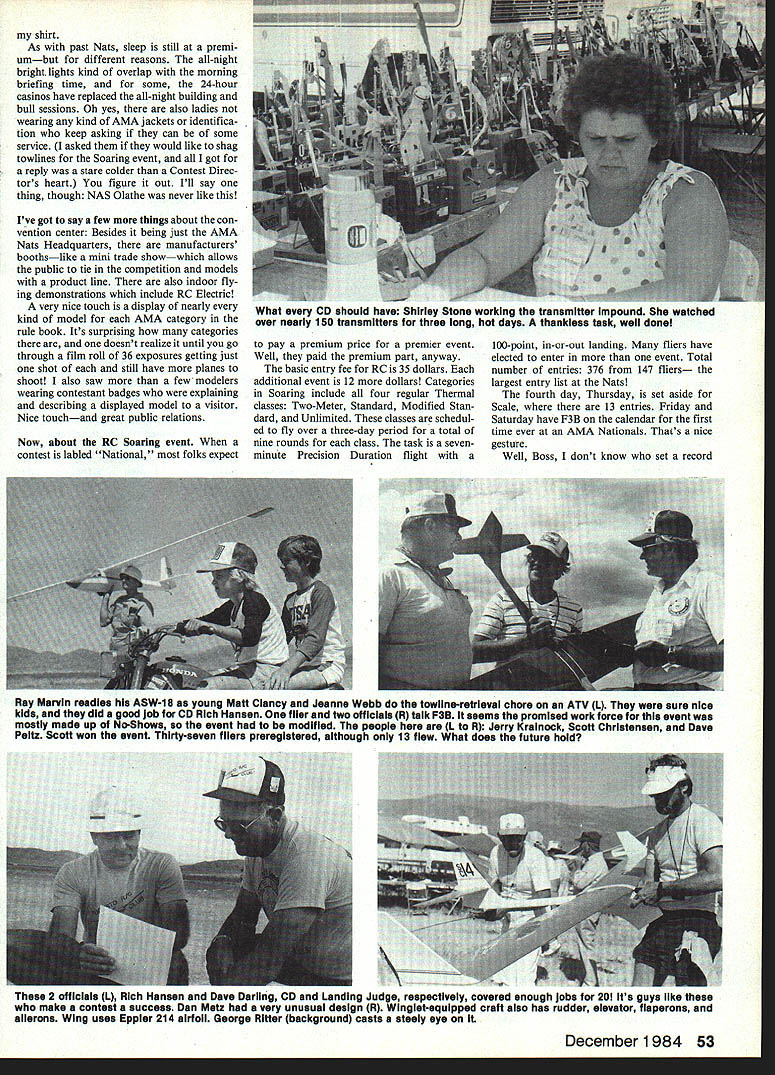
Davey Systems supplied winches and retrieval systems (the same type used at last year's Nats and the 1983 LSF Tournament). Because of the manpower shortage and no time to practice on the new equipment, organizers elected to use three-wheel all-terrain vehicles for retrieving towlines instead.
Despite the gripes, Hansen and a handful of dedicated folks threw away the schedule, worked long days and evenings, and pulled off what began as a nearly impossible task. The weather cooperated in the sense that there was no rainout and steady wind for three days (which meant no switching of winches).
Weather and site conditions
The site itself had problems. Foot-and-a-half hummocks, roughly three per compact-car length, presented a challenge even for four-wheel-drive rigs. The field smoothed out in places but then turned swampy. Rate this place three lemons.
Temperatures reached about 100°F with blowing dust — a scene some compared to "Lawrence of Arabia." One contestant joked he was so dirty at the end of the day he left a ring around the shower.
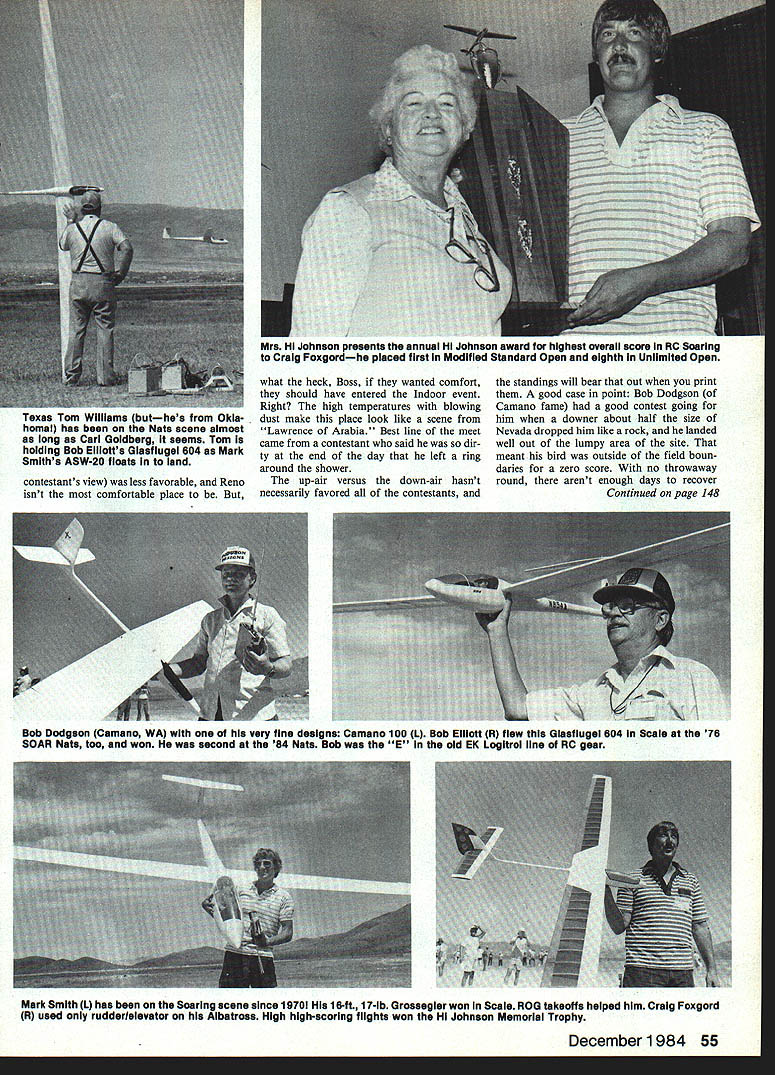
The up-air versus down-air conditions didn't favor everyone. For example, Bob Dodgson had a good contest going until a downer about half the size of Nevada dropped him and his bird landed well outside the lumpy area, putting it outside the field boundaries for a zero score. With no throwaway round, there wasn't enough time to recover from that kind of luck. Conversely, Scott Christensen (with his Antares) climbed from a miserable start (36th place in round one) to finish in the top three.
Volunteers, officials, and notable efforts
Some individuals deserve special recognition:
- Nancy Lowe and Helen Olsen — contestants who also acted as scorekeepers, putting in long hard days, especially after the computer broke down after the first day.
- Shirley Stone — worked the transmitter impound area that had more transmitters than most casinos have slot machines; she literally lost her voice by the end of the third day.
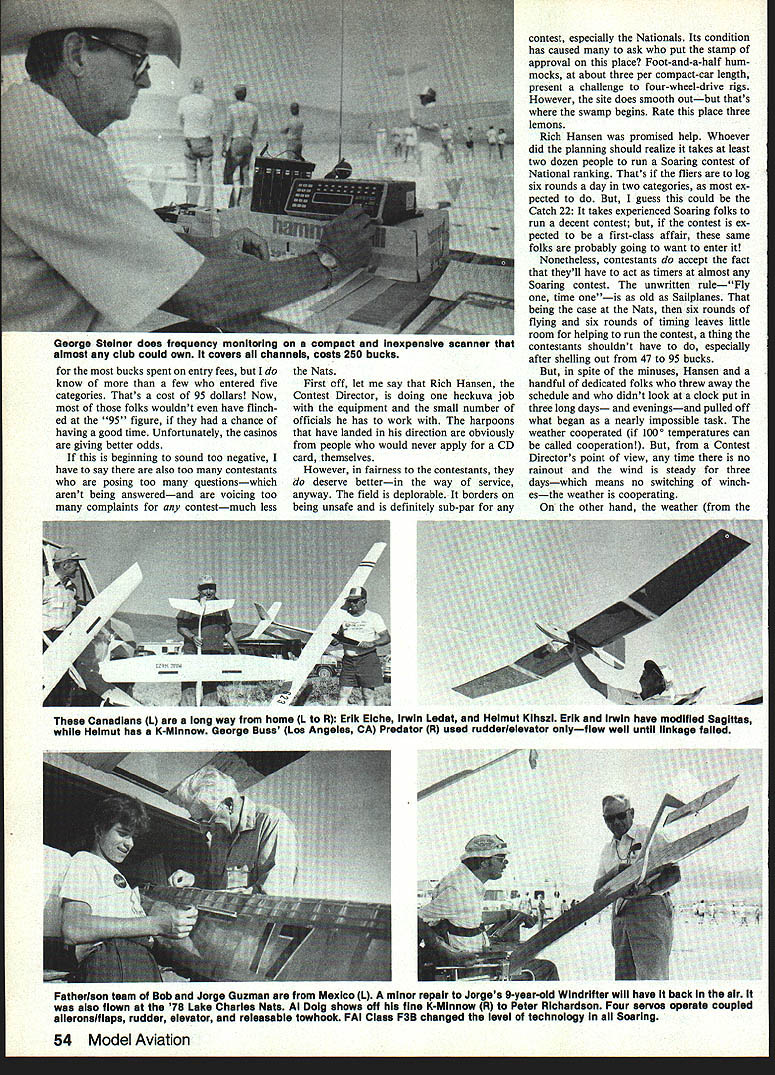
- George Stiner — monitored radio frequencies with a very expensive compact monitor.
- Greg Nikola — showed outstanding sportsmanship. He was refused entry for arriving 20 minutes past the registration deadline (after flying from Los Angeles and paying for an extra seat to transport his sailplane). While he couldn't fly, Nikola broiled in the sun for three solid days running the winch and flight line.
There were also many familiar faces from earlier Nationals: Mark and Rod Smith, Colonel Bob Thacker, Al Doig (California), Bob Elliot (Texas), Tom Williams (Oklahoma), and Dave Johnson (Oregon), among others.
Scale event
No event in Soaring commands more attention than Scale. This year 13 entries made the largest Scale field at any Nats. Notable entries included:
- Minimoa by Mick Carlin (Denver)
- Last year's Nats winner Ed Whyte with his newly covered TG-3
- Mark Smith with a 16-foot ASW-20 (ROGing a 17-pound bird)
Mark Smith's two flights were a highlight: realistic, applause-punctuated aerobatic flights and perfect landings. He took top honors. General comment: allow more Scale flying time after the first round and then, as time, space, and radio frequencies permit, have planes launch together for a better show.
Final thoughts
A contest labeled "National" should deliver a first-class experience. If you talk to anyone planning next year's event, tell them to record the names of all volunteers they're going to promise as help. That would make the job easier for the next Contest Director and provide a much better contest for those paying the entry fees.
Take care; I'm going to go look for my shirt.
Transcribed from original scans by AI. Minor OCR errors may remain.

