
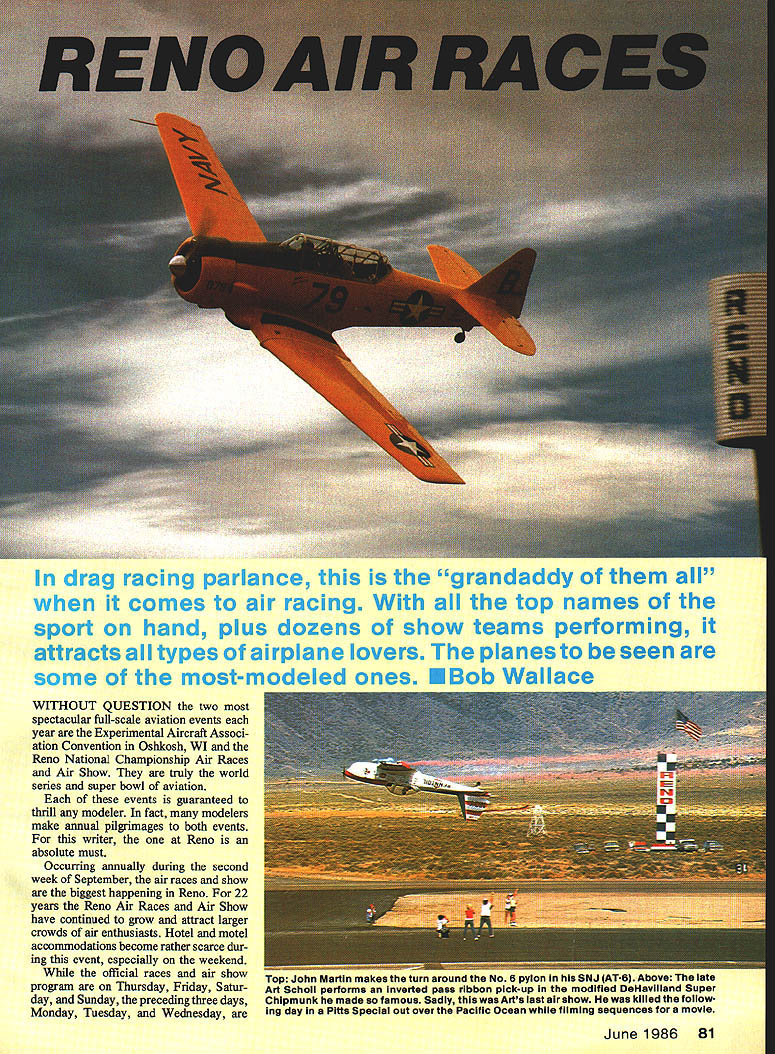
RENO AIR RACES
In drag-racing parlance, this is the "granddaddy of them all" when it comes to air racing. With all the top names of the sport on hand, plus dozens of show teams performing, it attracts all types of airplane lovers. The planes to be seen are some of the most-modeled ones.
WITHOUT QUESTION the two most spectacular full-scale aviation events each year are the Experimental Aircraft Association Convention in Oshkosh, WI and the Reno National Championship Air Races and Air Show. They are truly the World Series and Super Bowl of aviation.
Each of these events is guaranteed to thrill any modeler. In fact, many modelers make annual pilgrimages to both events. For this writer, the one at Reno is an absolute must.
Occurring annually during the second week of September, the air races and show are the biggest happening in Reno. For more than two decades the Reno Air Races and Air Show have continued to grow and attract larger crowds of air enthusiasts. Hotel and motel accommodations become rather scarce during this event, especially on the weekend.
Schedule and qualifying
While the official races and air show program take place Thursday through Sunday, the preceding three days—Monday, Tuesday, and Wednesday—are qualifying days. The pit area is open to the public during qualifying; spectators can freely roam among the aircraft and talk to pit crew members and pilots. Anyone with a camera will want to be in the pits.
From nine in the morning until after four in the afternoon Thursday through Sunday, Reno features nonstop programmed airborne action. The qualifying days themselves also feature nonstop thrills as the various Biplane, Formula One, AT-6, and thundering Unlimited-class planes vie for starting positions in the official racing. Admission on qualifying days is absolutely free, and the pit area is less crowded and less hectic—an excellent time for close-up photo and documentation work.
Be sure to have a good supply of film (or tape), as the pit area is a scale-model documentation treasure chest.
Performers and attractions
Virtually every top aerobatics team and individual performer has appeared at Reno, including:
- U.S. Navy Blue Angels
- U.S. Air Force Thunderbirds
- Canadian Snowbirds
- Christen Eagle team
- Leo Loudenslager
- the late Art Scholl
- Bob Hoover
- Joann Nothke
- U.S. Army Golden Knights
- and others
Reno also features static displays of new and different aircraft, from jets to ultralights. Souvenir and memorabilia enthusiasts will find a large selection of items to choose from. An interesting and unique aspect is that the sale of official souvenirs and refreshments is managed by local civic groups, with all profits used for charitable purposes.
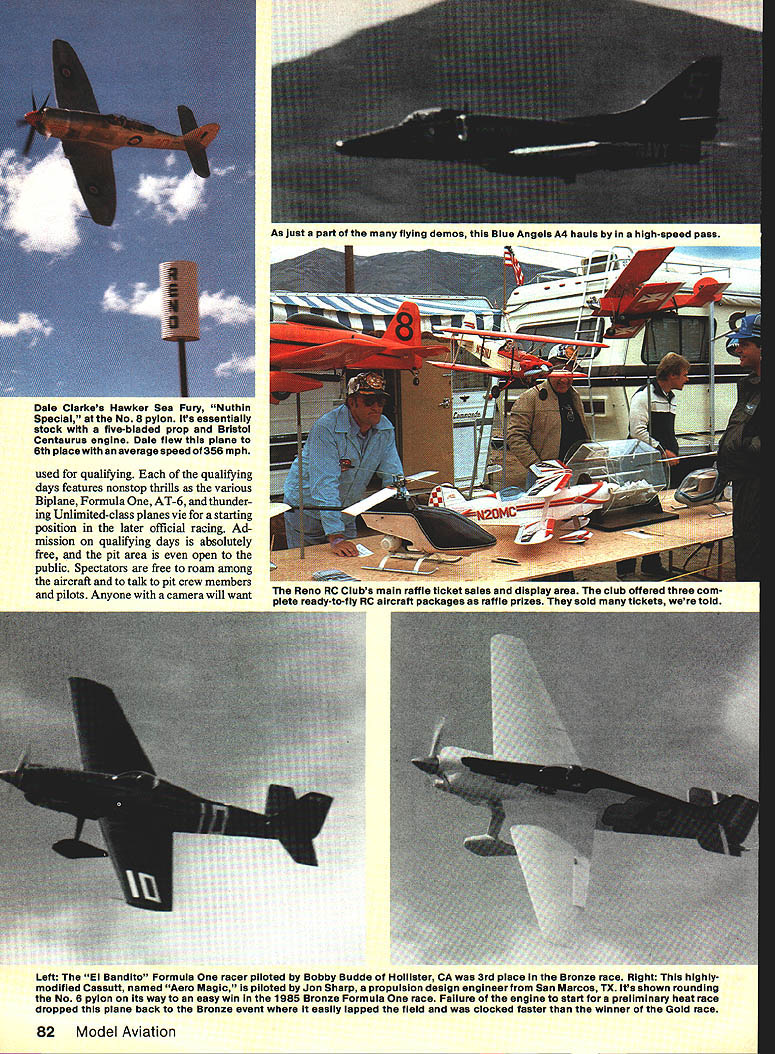
The Reno Radio Control Club is usually highly visible at the race site with a display and raffle booth. In addition to the club's main booth, they often have satellite booths offering raffle tickets on ready-to-fly RC model packages.
Race classes
Air racing at Reno is divided into four classes:
- Sport Biplane
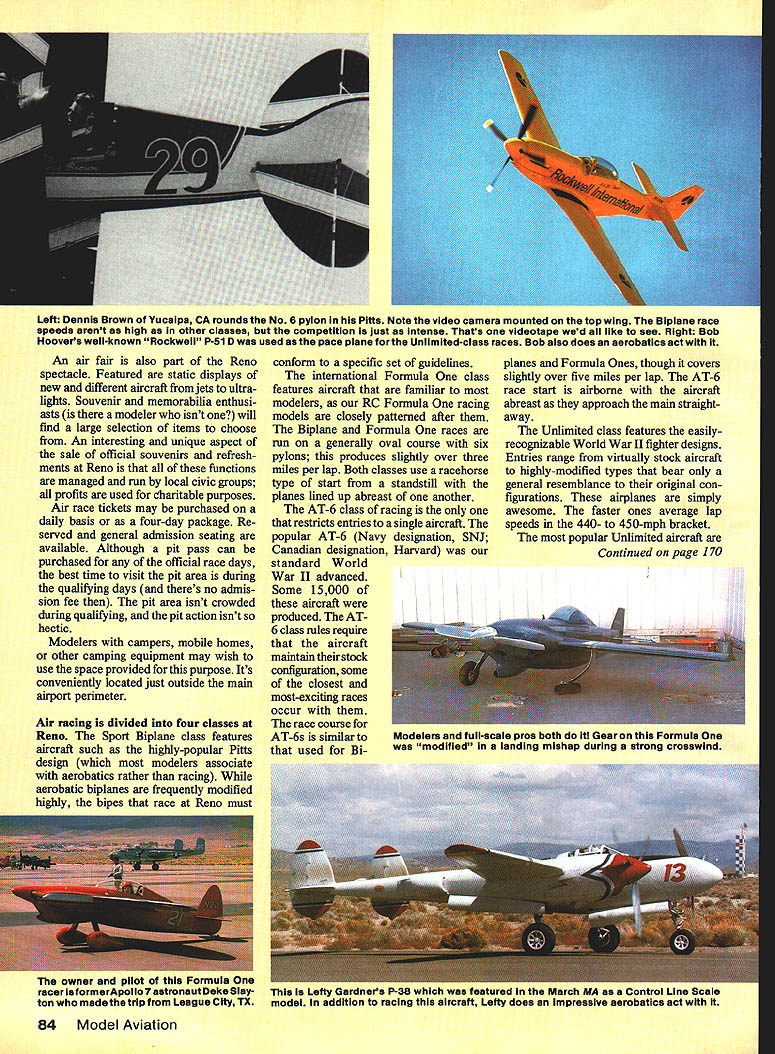
- Features aircraft such as the popular Pitts design. While many biplanes are associated with aerobatics, the biplanes that race at Reno must conform to a specific set of guidelines.
- Formula One (international)
- These aircraft are familiar to many modelers; RC Formula One racing models are closely patterned after them. The Biplane and Formula One races are run on a generally oval course with six pylons, producing slightly over three miles per lap. Both classes use a racehorse-type start from a standstill with the planes lined up abreast.
- AT-6
- This class restricts entries to a single aircraft type: the AT-6 (Navy designation SNJ; Canadian designation Harvard), the standard World War II advanced trainer. Some 15,000 AT-6s were produced. The AT-6 class rules require aircraft to maintain their stock configuration, and some of the closest, most exciting races occur within this class. The AT-6 course is similar to the Biplane and Formula One course but covers slightly over five miles per lap. AT-6 races start airborne with the aircraft abreast as they approach the main straightaway.
- Unlimited
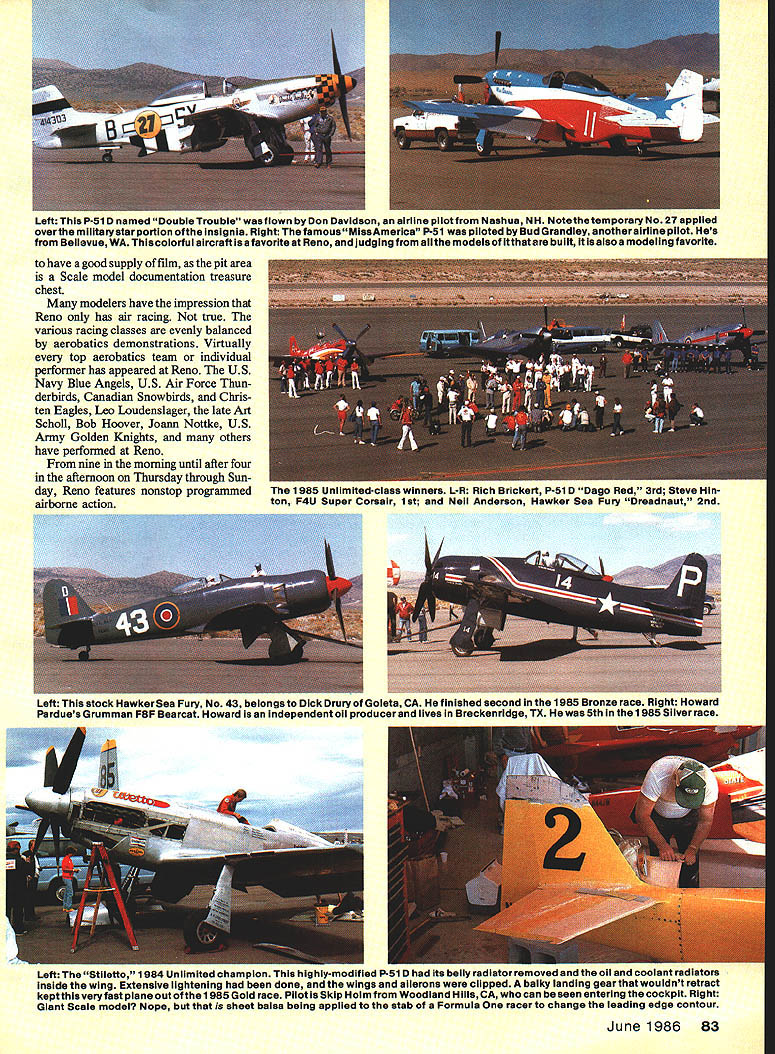
- Features easily recognizable World War II fighter designs such as the North American P-51 Mustang, British Hawker Sea Fury, Grumman F8F Bearcat, and the Chance-Vought F4U Corsair. Entries range from virtually stock aircraft to highly modified types that bear only a general resemblance to their originals. These airplanes are simply awesome; the faster ones average lap speeds in the 440–450 mph bracket. The Unlimited course is 9.2 miles per lap with eight pylons, entirely within view from spectator seating. Unlimited races start airborne with the planes abreast; they center the race course via the "chute." The sight and sound of seven to nine Unlimiteds thundering onto the course from a full-power descent is spectacular.
Facilities and travel
Reno Stead Airport, the site of the air races and show (and the main flying site for the 1984 AMA National Contest), is located approximately 11 miles north of downtown Reno via Interstate Highway 395. Some hotels and casinos provide free shuttle bus service to and from the race site.
Air race tickets may be purchased on a daily basis or as a four-day package. Reserved and general admission seating are available. Although a pit pass can be purchased for official race days, the best time to visit the pit area is during the qualifying days when there is no admission fee.
Modelers with campers, mobile homes, or other camping equipment may wish to use the space provided just outside the main airport perimeter.
The dates for the 1986 Reno Air Races and Air Show were established as September 11–14. Any model flier who attends won't be disappointed.
Tips for first-time attendees
- Make your travel and hotel accommodation arrangements early. Hotels are very busy during the week of the air races. Rates are reasonable; for example, Circus Circus has offered double rooms at modest rates (varied by weekday vs. weekend).
- Order your air race tickets early if you want reserved seating. Address: Reno Air Racing Association, P.O. Box 1429, Reno, NV 89505. Telephone: (702) 826-7500.
- Food in Reno is excellent and inexpensive. Most hotels and casinos offer top-rated dinners at far less than restaurants elsewhere, with varied buffets at low prices.
- Rental cars are readily available, and many companies offer bargain weekly rates with unlimited mileage for compact models. Shop around via the WATTS line numbers provided by rental companies, and reserve your car in advance.
- Bring your camera and lots of film (or tape). There is 24-hour film processing service at the race site.
- Take some warm clothing. Normal daytime temperatures are in the upper 70s to low 80s, but colder temperatures can occur.
- If you have a radio receiver equipped for the aircraft band, take it. You'll be able to listen to race pilots talking to air traffic control and the pace plane. These conversations are fascinating, and you'll know if an emergency develops even before it is announced. The air traffic radio frequency is 118.5.
Whether your modeling interest is in pylon racing, aerobatics, or scale—or if you have a general interest in aviation—Reno has it all, and you should try to attend.
Transcribed from original scans by AI. Minor OCR errors may remain.

