
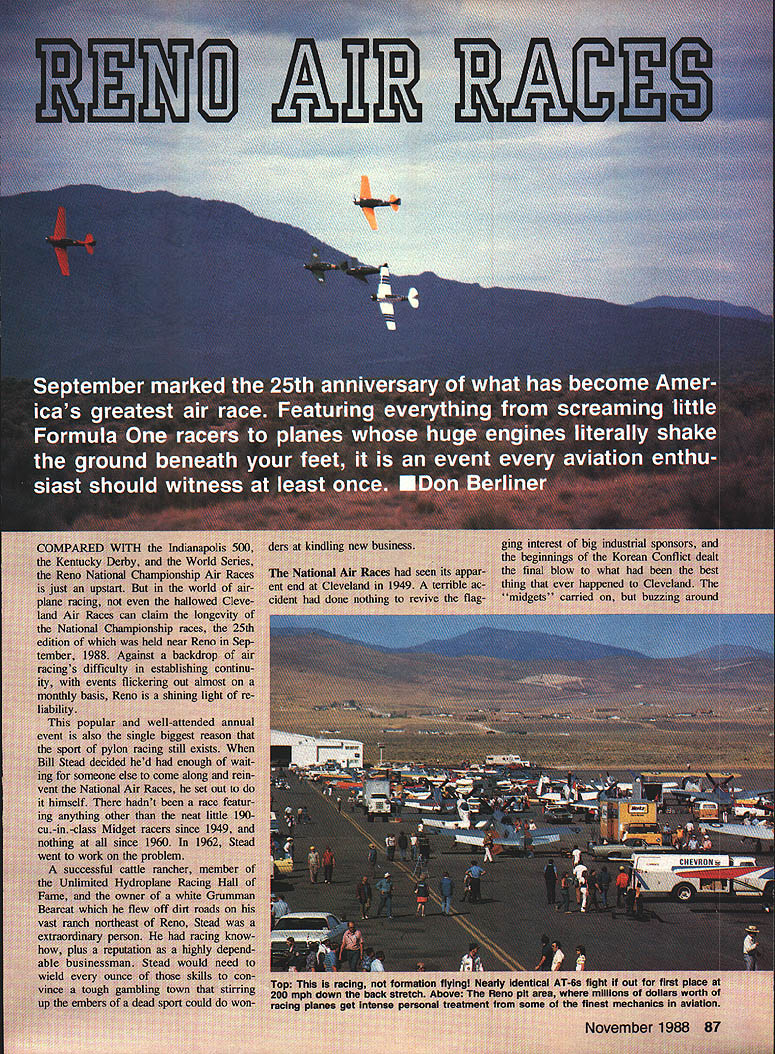
RENO AIR RACES
— Don Berliner
September marked the 25th anniversary of what has become America's greatest air race. Featuring everything from screaming little Formula One racers to planes whose huge engines literally shake the ground beneath your feet, it is an event every aviation enthusiast should witness at least once.
Origins and revival (1962–1966)
Compared with the Indianapolis 500, the Kentucky Derby, and the World Series, the Reno National Championship Air Races began as an upstart. In the world of airplane racing, however, not even the hallowed Cleveland Air Races could claim the longevity of the National Championship races, the 25th edition of which was held near Reno in September 1988. Against a backdrop of air racing's difficulty in establishing continuity, with events flickering out almost monthly, Reno became a shining light of reliability.
Bill Stead resurrected national pylon racing. There hadn't been a race featuring anything other than the neat 190-cu.-in.-class Midget racers since 1949, and nothing at all since 1960. In 1962 Stead began persuading Reno casinos and hotels, the state government, and ABC-TV's Wide World of Sports to support a rebirth. The National Air Races were scheduled to be reborn in September 1964 at Bill's Sky Ranch.
Sky Ranch was more grazing land than airport—no hard-surface runways, hangars, or ramps, and more than 100 miles from the nearest major city. But it had ample space to lay out long courses for the biggest and fastest airplanes. Stead hired air show man Duane Cole, and together they created a fast, exciting mix of dust and dreams.
Stead and Cole established multiple classes to give spectators variety:
- Unlimited (Mustangs, Bearcats, Corsairs and other big radial-engined fighters)
- 190-cu.-in. Midgets (Formula One/midget racers)
- Sport Biplane (home-built two-wingers)
- Stock Plane (identical Piper Cherokee 180s; originally for women pilots)
They also added the first NAA‑sanctioned National Aerobatics Championships and the National Hot Air Ballooning Championships.
From the first, the Unlimiteds captured the spotlight. Because many Unlimited pilots lacked pylon experience, the organizers eliminated the dangerous side-by-side "race-horse" start in favor of a formation flying start. The result: spectacular, noisy racing with a mix of near-stock Navy fighters, converted T‑6s, and highly modified specials.
In April 1966 Bill Stead was killed in a pre-race test-flight crash of his midget racer. The organization he created was solid enough to carry on without him. The site moved to the deactivated Stead Air Force Base, named for Bill's late brother, on a 5,000-ft plateau near the Sierra Nevada.
Early years and class development (1964–1970)
Action at the first meet included a transcontinental race (a throwback to the Bendix Derby) and multiple pylon events. Highlights and early winners include:
- 1964: Wayne Adams won the reintroduced transcontinental event; Bob Love posted a 359 mph qualifying for Unlimited; Bob Porter led the midgets at 201 mph; Clyde Parsons won the Biplane race.
- 1965: Unlimited — Darryl Greenamyer, F8F‑2, 375 mph.
- 1966: Unlimited time trials — Greenamyer 410 mph; finals — Greenamyer 396 mph. Sport Biplane and 190 classes continued to develop; the Women's Stock Plane race was held for the last time at Reno.
- 1969: Women were allowed to compete in formerly men-only classes; Connie Marsh became the first woman to compete in a former men-only pylon class at Reno. Greenamyer won Unlimited time trials (415 mph) and finals (413 mph), breaking the 1949 record. Formula One, Sport Biplane and AT‑6 classes grew in entries and speed.
- 1970: The transcontinental race was run for the last time due to low crowd appeal and weather issues. Clay Lacy won the Unlimited finals (387 mph). Bill Boland dominated Sport Biplane; Formula One remained highly competitive.
Growth, records and changing classes (1971–1979)
The 1970s saw dramatic speed increases, class reconfigurations, and several notable incidents.
Notable developments and results:
- 1971: Gunther Balz posted a 420-mph Unlimited qualifier; Greenamyer recaptured the title. Bill Falck and Ray Cote traded honors in Formula One.
- 1972: Richard Laidley briefly dominated Unlimited time trials in a modified F7 Bearcat but was disqualified in the finals for low flying; Gunther Balz won the finals (416 mph).
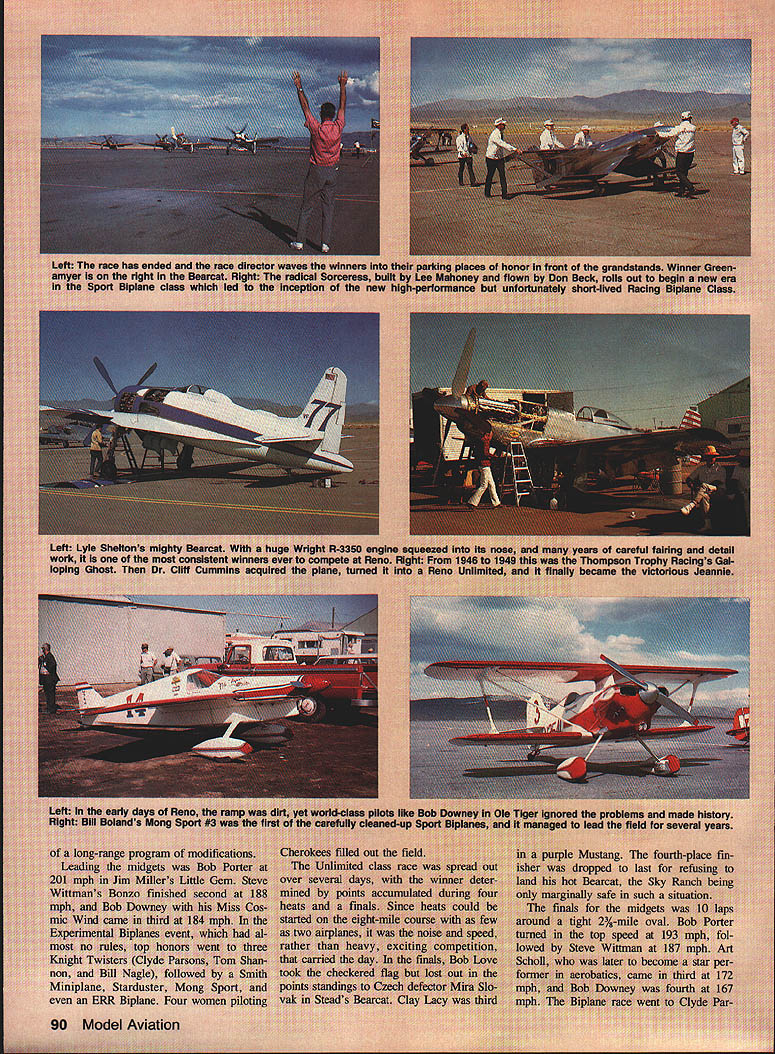
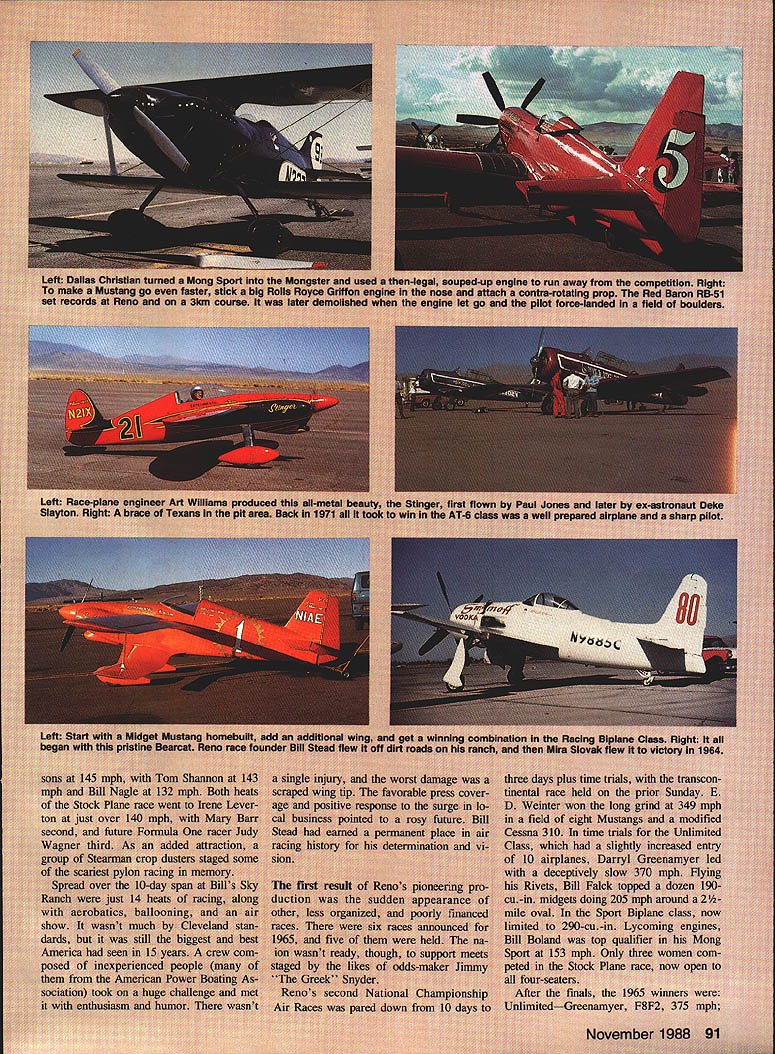
- 1973: Records fell across classes. Lyle Shelton's Wright R‑3350 Bearcat set time-trial and finals records in Unlimited (427 and 428 mph). Ray Cote set Formula One marks; Sid White’s all‑metal Sundancer set Sport Biplane records. Tommy Thomas suffered the first and only fatality in Sport Biplane history that year.
- 1974: Shelton set another time-trial record (432 mph); Ken Burnstine won the Unlimited finals (382 mph). Ray Cote posted record speeds in Formula One amid some questions about engine legality.
- 1975: Greenamyer set a time-trial record (436 mph); Shelton won the finals (430 mph). Ray Cote dominated Formula One with a 242-mph qualifier. Sid White broke the 200‑mph barrier in Sport Biplanes (205 mph).
- 1976: Don Whittington set an Unlimited time-trial record of 439 mph; Lefty Gardner won the finals in a near-stock P‑51. Judy Wagner became the first woman to win Formula One time trials (232 mph). Don Beck continued to excel in Sport Biplanes.
- 1977: Waldo Klibo led Unlimited qualifiers; Greenamyer won finals at a record 431 mph in the Red Baron RB‑51 (a Mustang with contra‑rotating propellers). Formula One was replaced by the IXL class (souped-up engines).
- 1978: Steve Hinton won IXL; his RB‑51 reached 427 mph in time trials. Winds scrubbed some finals; Ron DeWalt and Dimitry Prian died in a midair collision. Sport Biplane racing was absent two years in a row.
- 1979: Roy McClain set an Unlimited time-trial record (447 mph) in the P‑51 Jeannie; John Crocker won the finals (422 mph). Steve Hinton survived a crash that destroyed his RB‑51. Formula/IXL continued with Ray Cote and John Parker trading wins.
Modern era speed wars (1980–1987)
The 1980s accelerated the arms race between modified warbirds and custom racers. Highlights:
- 1980: Roy McClain set an Unlimited finals record (433 mph). Ray Cote and John Parker continued to dominate Formula/IXL. Sport Biplanes returned with Pat Hines setting a 219-mph time-trial record.
- 1981: Skip Holm set an Unlimited time-trial record of 450 mph in Jeannie and won the finals (428 mph). Bob Downey, a long-time racer, died during IXL practice. Pat Hines and AT‑6 classes set new marks.
- 1982: Ron Nehive won Unlimited in the new Dago Red (441 mph in time trials), and Formula One rules returned. Racing Biplane and Sport Biplane classes separated briefly.
- 1983: Neil Anderson dominated Unlimited in a Hawker Sea Fury (time trials 446 mph; finals 425 mph). Formula One saw Chuck Wentworth and Steve Thompson among leaders. Racing Biplane suffered a nonfatal accident that reduced the field.
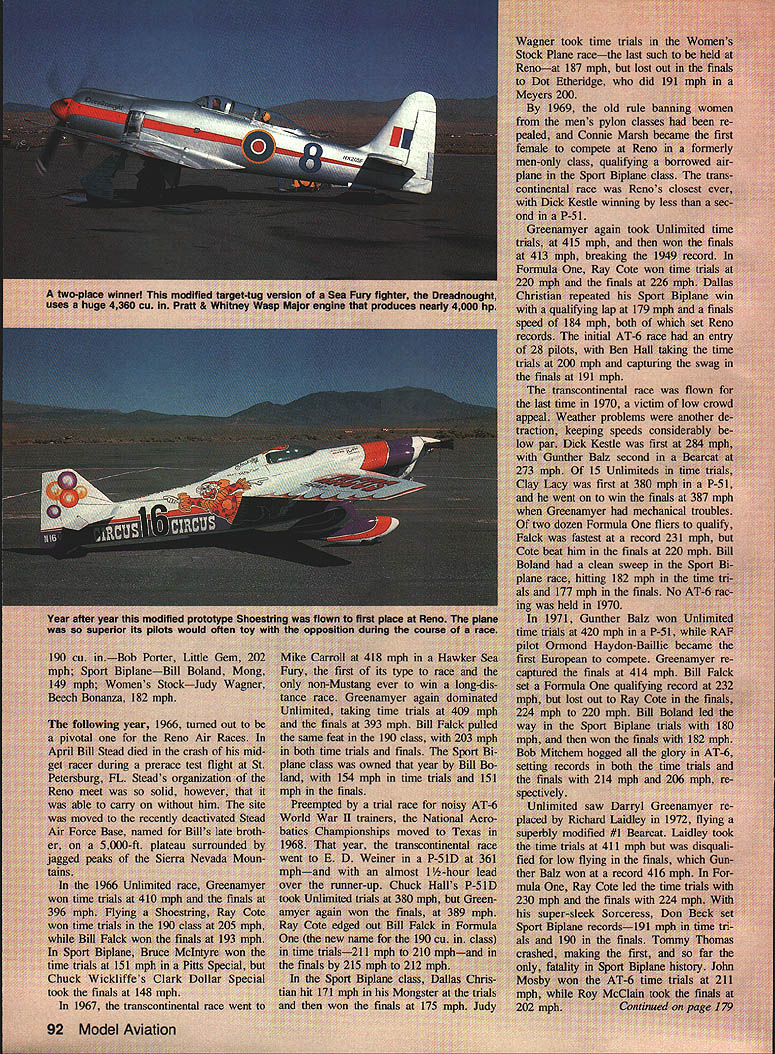
- 1984–1986: Speeds continued to climb. Neil Anderson, Skip Holm, Rick Brickert and others posted high marks. Rick Brickert’s Dreadnaught set a 453-mph time-trial record in 1986 and won the finals (435 mph). Alan Preston and Ralph Rina were prominent in their classes.
- 1987: The Unlimited class exploded with speed. Bill Destefani set a 467-mph time-trial record in his P‑51 Strega; Steve Hinton and Lyle Shelton were close behind. Destefani also set a finals record of 453 mph. Alan Preston swept Formula One; Tom Aberle and Eddie Van Fossen posted impressive Sport Biplane and AT‑6 results respectively.
Classes, aircraft and safety
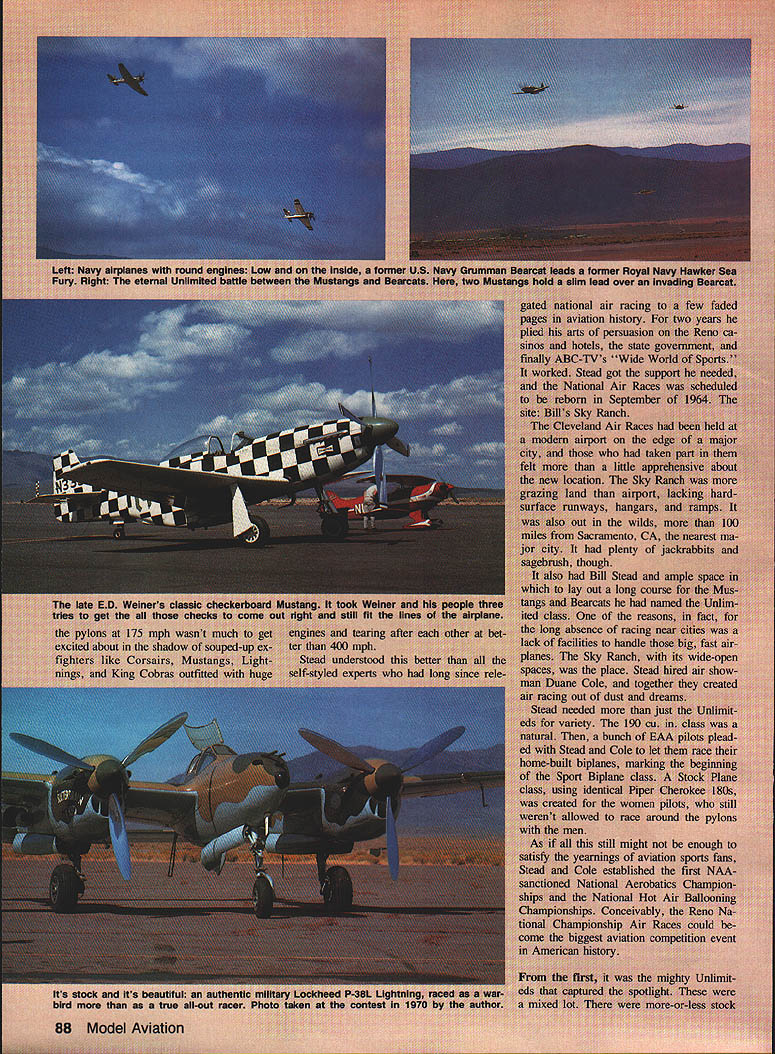
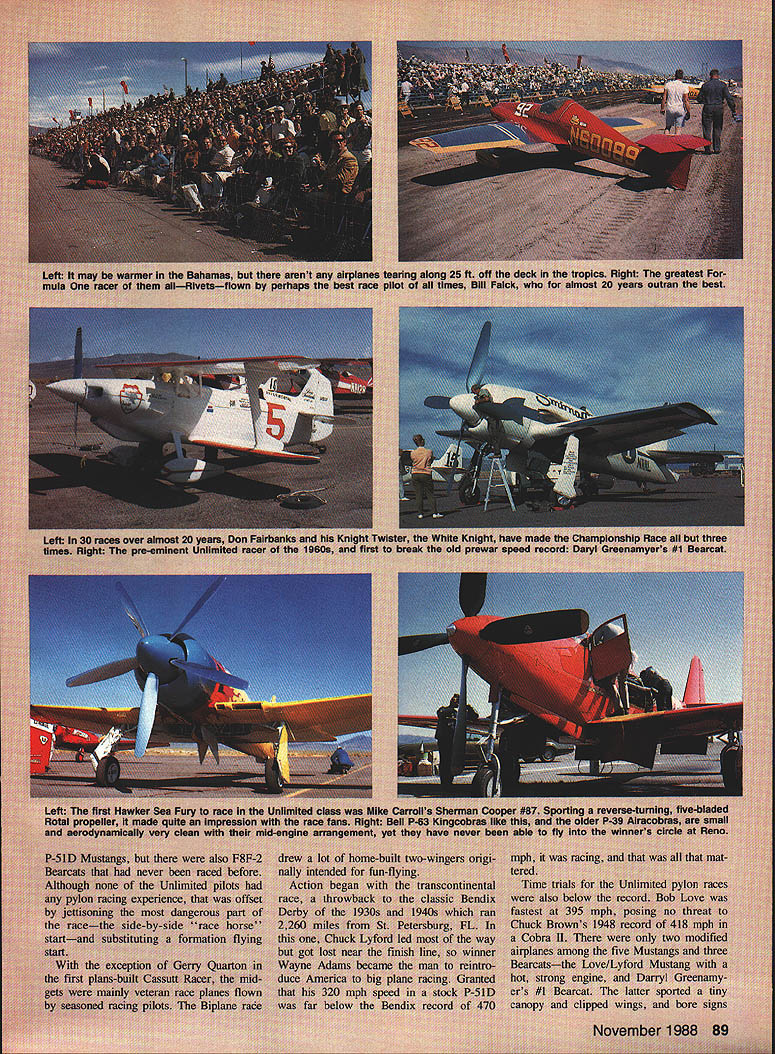
Over the years the nearly stock Mustangs and Bearcats of 1964 were eclipsed by overpowered Bearcats, Corsairs, Sea Furys and by custom racers such as the RB‑51 Red Baron and the sleek Tsunami. As speeds rose, the aircraft evolved from lightly modified warbirds to heavily modified and custom-built designs, heralding a new era of radical racecraft.
Despite the inherently dangerous nature of pylon racing, the Reno meet has had comparatively few fatalities: over 24 years only five pilots died in competition, and none in the Unlimited class (through the date of this account). Still, serious accidents did occur—Tommy Thomas’s fatal Sport Biplane crash, the 1978 midair collision (Ron DeWalt and Dimitry Prian), and the deaths of pilots in other classes underscore the risks involved.
Legacy
Spread over its early 10‑day spans and dozen-plus heats, Reno’s National Championship Air Races grew from a modest rebirth into the single biggest reason pylon racing still exists in America. A combination of Bill Stead’s vision, the efforts of organizers and the enthusiasm of pilots and spectators created a durable event. Hundreds of pilots have flown dozens of different airplanes for thousands of miles of close, wing‑tip racing just feet above the sagebrush.
Racing at Reno has lasted longer than at any other site in history and provided hundreds of thousands of spectators with thrills unmatched elsewhere. The continued evolution of aircraft—from stock Mustangs to overpowered warbirds and to radical custom racers—points to an uncertain but exciting future for air racing. Reno stands as a tribute to Bill Stead’s foresight and to all who have turned his dream into a lasting era in aviation competition.
Transcribed from original scans by AI. Minor OCR errors may remain.

