
FOR RESEARCH: PATENT OFFICE FILES
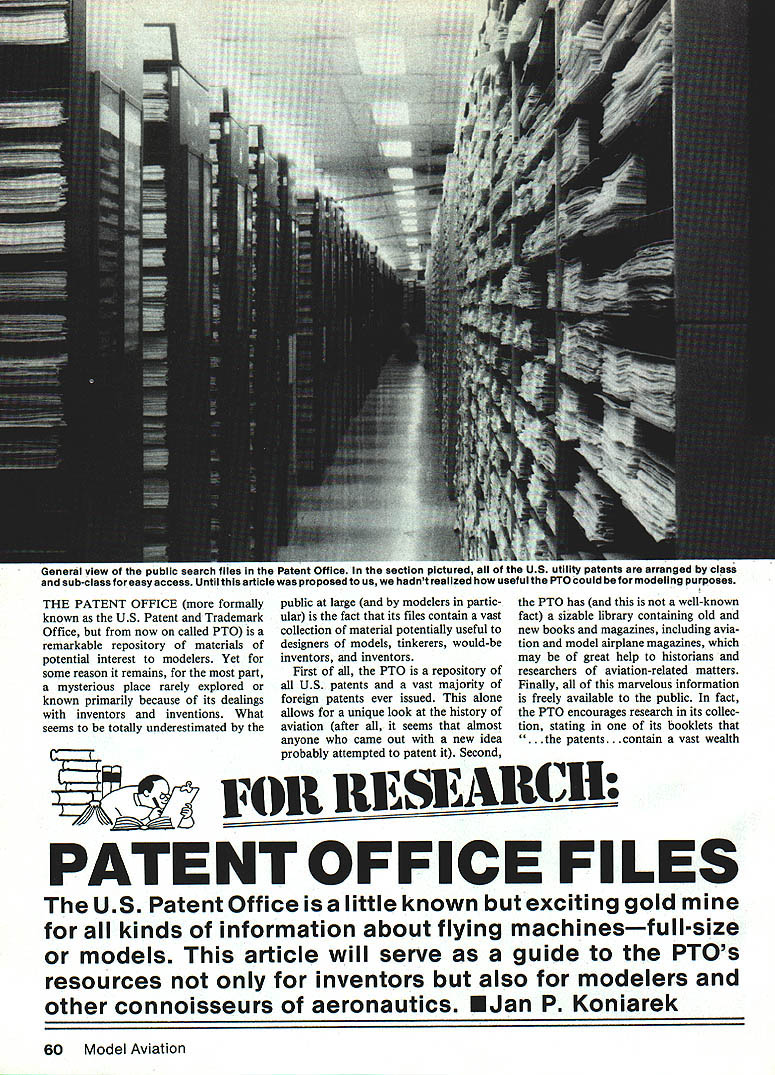
THE PATENT OFFICE (more formally the U.S. Patent and Trademark Office, hereafter PTO) is a remarkable repository of materials of potential interest to modelers. Yet it remains, for the most part, a mysterious place rarely explored—primarily because of its dealings with inventors and inventions. What seems underestimated by the public at large (and by modelers in particular) is that its files contain a vast collection of material useful to designers of models, tinkerers, would-be inventors, and inventors.
First, the PTO is a repository of all U.S. patents and a large majority of foreign patents ever issued. This alone provides a unique look at the history of aviation—after all, almost anyone with a new idea probably attempted to patent it. Second, the PTO maintains a sizable library of old and new books and magazines, including aviation and model airplane periodicals, which may be of great help to historians and researchers. Finally, all of this information is freely available to the public; the PTO actively encourages research in its collection.
This article is a guide to the PTO's resources not only for inventors but also for modelers and other connoisseurs of aeronautics.
Jan P. Koniarek
Patent types of interest to modelers
For the most part, only two types of patents are of interest to modelers: utility patents and design patents.
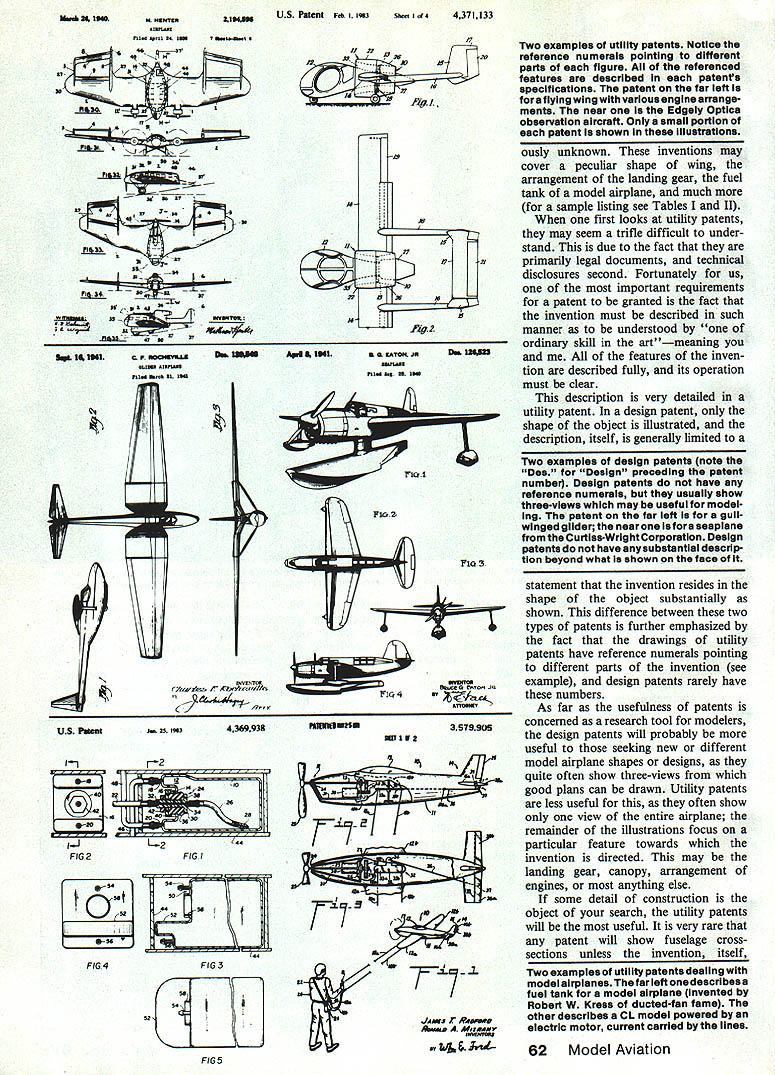
- Utility patents are granted for inventions concerning a particular feature of a device or for entirely new devices. They are primarily legal documents with technical disclosures, but one of the key requirements for a patent is that the invention be described in such a manner that "one of ordinary skill in the art" can understand it. Thus utility patents usually contain detailed descriptions and explanations of operation. Utility patent drawings often include reference numerals pointing to parts described in the specification. Utility patents are especially useful when you want construction details (e.g., a fuel tank design for a model airplane, landing-gear mechanism, control linkage, etc.), but they may show only one view of an entire airplane because the focus is on the patented feature.
- Design patents cover the shape or appearance of an object. The description is generally limited to what is shown in the drawings; the specification usually states that the invention resides in the shape of the object substantially as shown. Design patents often include three-view drawings and can be especially useful to modelers seeking new or different model airplane shapes from which plans can be drawn. Design patent drawings rarely have reference numerals.
As a rule:
- Use design patents when you want overall shape and three-view drawings for model plans.
- Use utility patents when you want detailed construction or functional descriptions.
Table I
Representative examples of sub-classes in Class 244, Aeronautics (selected to interest aircraft modelers).
- 4R Aircraft, Heavier-Than-Air
- 5 Airplanes, weight diminished by buoyant gas
- 8 Airplanes sustained by auto-rotating wing
- 11 Airplanes sustained by beating wing
- 12.4 Airplanes sustained by tilting thrust
- 17.11 Gyroplanes
- 24 Aircraft, Lighter-Than-Air (airships and balloons)
- 34R Aircraft Sustentation
- 35R Sustaining airfoils
- 36 Lifting fuselages
- 37 Lifting struts
- 38 Lift modification
- 205 Lift modification by controlling the boundary layer with an ionic or electrostatic surface
- 211 Having trailing edge flap
- 45A Airfoil arrangement — canard
- 53R Aircraft Power Plants
- 53B Air intakes
- 57 Radiator arrangement
- 61 Power plant using airship gas as fuel
- 62 Aircraft Propulsion
- 65 Screw
- 71 Reciprocating propeller
- 72 Beating wing
- 75R Aircraft Control
- 75A Flutter prevention
- 76C Gust compensators
- 190 Of pilotless aircraft using remote control
- 79 Gyroscope-actuated
- 87 Rudders and empennage
- 90R Ailerons and other roll control devices
- 100R Landing Gear
- 100C Endless track
- 102R Retractable
- 103 Crosswind gear
- 106 Flying boat
- 108 Skids
- 117R Aircraft Structure
- 119 Fuselage and body construction
- 123 Airfoil construction
- 125 Airship hull construction
- 130 Aerodynamic resistance reducing
- 138R Safety lowering devices
- 139 Lowering device
- 142 Parachutes
- 153R Kites
- 154 Airplane type
- 155A Kite controls
Two representative utility patents show how reference numerals point to different parts of the figures and how the specification describes each referenced feature. Utility patents may include inventions such as flying-wing engine arrangements or observation aircraft designs. Only small portions of each patent illustration are typically shown in publications.
Usefulness and examples
Patents can be divided roughly into two groups regarding usefulness to modelers:
- Patents by employees of large corporations (Grumman, Boeing, etc.). These are generally well thought out, often tied to existing or prototype aircraft, and usually assigned to companies. They can provide solid, buildable designs for scale models.
- Patents by individual inventors. These vary widely—from conventional originals to very fanciful ideas. Many of these inventions were never built or tested and may contradict aerodynamic principles. Nevertheless, some unusual patents can inspire original models or lead to worthwhile experimentation.
Patents are also valuable research tools because they typically cite earlier patents and non-patent literature. A seemingly novel solution in a recent patent often turns out to be one of many attempts over the years, and the cited references trace that history.
Table II
Representative examples of sub-classes dealing with model airplanes in Class 46, Toys (headings adjusted for clarity).
- 76R Toy Airplanes
- 76A Jet airplanes
- 77 Tethered (Control Line models)
- 78 Motor-driven propeller
- 79 Gliders
- 80 Gliders with folding wings
PTO facilities and how patents are organized
The PTO is divided generally into two parts:
- The public search room, accessible to anyone.
- The examiners' section, where patent examiners have their offices and files.
All patents are arranged by classes and sub-classes according to subject matter. The most pertinent classes for modelers are:
- Class 244 — Aeronautics
- Class 46 — Toys (most model airplanes and accessories)
- Class D12 — Aircraft design patents
Other classes cover engines, electronics (including RC gear), and other specialties. Each class is subdivided into sub-classes that focus on specific features.
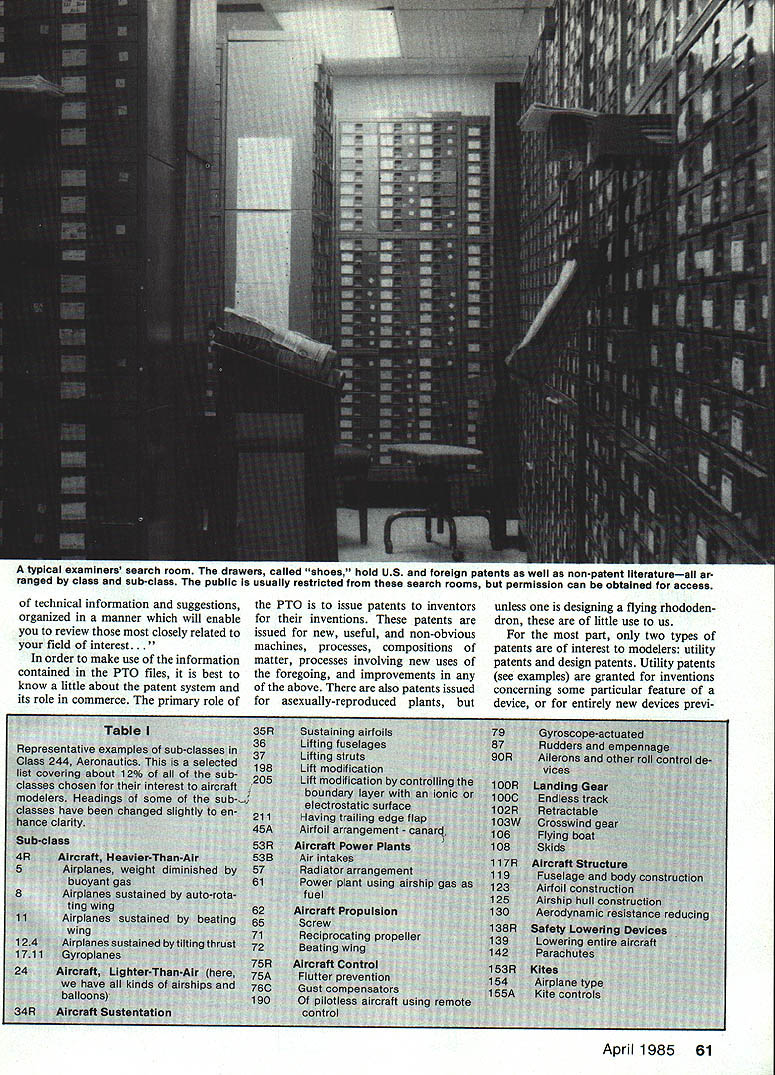
The public search room holds all U.S. patents arranged by class and sub-class, making it straightforward to find U.S. material. However, foreign patents in the public search room are not arranged by sub-class, which can be a serious drawback in aeronautics research where many inventions originate overseas.
The examiners' search rooms contain files (including foreign patents and non-patent literature such as magazine articles and old catalogs) that are conveniently arranged by class and sub-class. Class 244, in particular, has a large proportion of foreign patents and non-patent literature, so searching in the examiners' rooms is highly recommended when you need foreign references.
Table III
Representative examples of sub-classes in Design Class D-12, Aircraft (headings adjusted for clarity).
- 324 Vertical takeoff
- 331 Canard configuration
- 339 Pusher propeller
- 340 Pylon-mounted engine
- 343 Jet-propelled
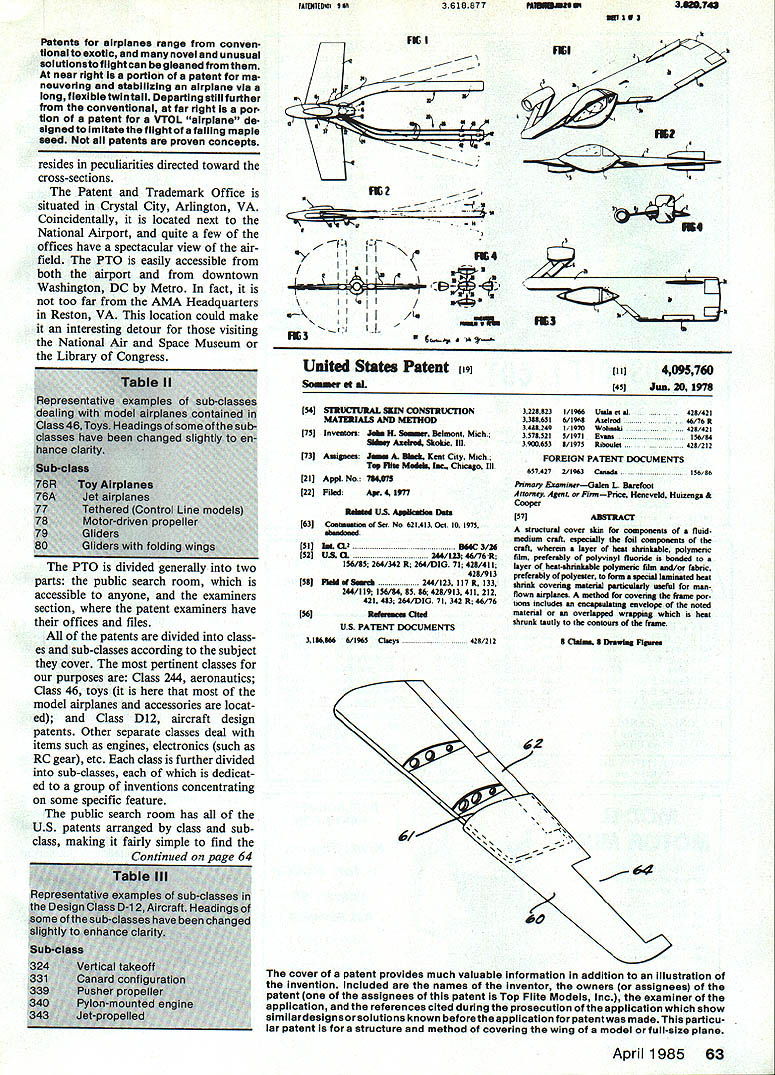
The cover (front page) of a patent provides valuable information beyond an illustration. Included are:
- The name(s) of the inventor(s)
- The owner(s) or assignee(s) of the patent
- The patent examiner(s) who prosecuted the application
- References cited during prosecution (showing prior similar designs or solutions)
The front page often identifies assignees (for example, a patent may be assigned to a model company such as Top Flite Models, Inc.). If you have a recent patent similar to your interest, the front page will also list the examiners involved; contacting those examiners (or visiting their group) can be helpful.
Best procedures for obtaining information from the PTO
- The PTO will not search for you unless you have a pending patent application. Do not expect the PTO to conduct a search in response to a phone call or letter asking them to find a particular design.
- The best way to search is to do it personally. PTO personnel will direct you to the proper areas if you have a definite objective, but staff in the public search room generally will not perform detailed searches for you due to workload and lack of specialized expertise.
- If you need expert help, visit an examiner who handles the type of inventions you are interested in. For airplane-related issues, go to Group 310 (transportation) and ask to see an examiner working in your area of interest. The secretaries will direct you. If you have a recent patent similar to your subject, look at the front page to find the examiners who handled it and try to contact them.
- When approaching an examiner:
- Know exactly what you are looking for (avoid vague requests).
- Do not expect the examiner to spend a lot of time; they have assigned workloads.
- Make an appointment if possible.
- Do not ask an examiner to perform an off-the-clock search by phone or mail; they will not do so.
If you cannot search the PTO in person, alternatives include engaging a professional searcher or contacting a patent attorney who can recommend searchers. Professional searchers vary in quality; be specific about your requirements and check references.
What material can be found and how useful is it?
Almost anything commercially manufactured is often patented—from the most advanced jets to small aircraft parts. There are thousands of patented solutions that are rarely documented elsewhere. Useful outcomes for modelers include:
- Design ideas and three-view drawings from design patents for plan drafting.
- Construction and functional details from utility patents for specific components.
- Historical and developmental insight into aircraft features via cited references.
Be aware:
- Not all patented inventions were built or tested—especially some individual-inventor aircraft designs, which may be aerodynamically impossible.
- Some outlandish patents (flying saucers, multiple tandem wings, wings attached directly to a pilot, etc.) may inspire unique experimental models but may require extensive modification and testing.
Location and accessibility
The Patent and Trademark Office is located in Crystal City, Arlington, VA, adjacent to National Airport and accessible by Metro from downtown Washington, DC. Many offices have views of the airfield. The PTO is not far from the AMA Headquarters in Reston, VA, and makes a convenient stop when visiting the National Air and Space Museum or the Library of Congress.
Obtaining copies and contact
Copies of patents can be obtained by writing to: Commissioner of Patents and Trademarks Washington, DC 20231
The current price (as of the article) is $1.00 per copy.
Questions and comments concerning this article can be addressed to the author: Jan P. Koniarek 154 So. State Rd. Briarcliff Manor, NY 10510
References for further reading
- A.K. Berle and L.S. de Camp, Inventions, Patents, and Their Management. D. Van Nostrand Company, Inc., Princeton, NJ, 1959.
- A.J. Sabin, "The Greatest Invention Since..., Pt. I." Radio Control Modeler, May 1977, p. 23.
- A.J. Sabin, "The Greatest Invention Since..., Pt. II." Radio Control Modeler, June 1977, p. 54.
- General Information Concerning Patents. U.S. Department of Commerce, Patent and Trademark Office, Washington, DC, 1983.
Transcribed from original scans by AI. Minor OCR errors may remain.

