
RETRACTS FOR STUNT
A novelty? Or the wave of the future? This reliable system offers advantages to merit individual experimentation. — Dick Mathis
LANDING GEARS have posed problems for aircraft designers from the beginning. The Wright brothers solved their problem by leaving most of the landing gear on the ground. Subsequent designers have yet to escape the fact that airplanes, to be useful, have to drag around 100 percent of the time something they use only 5 percent of the time.
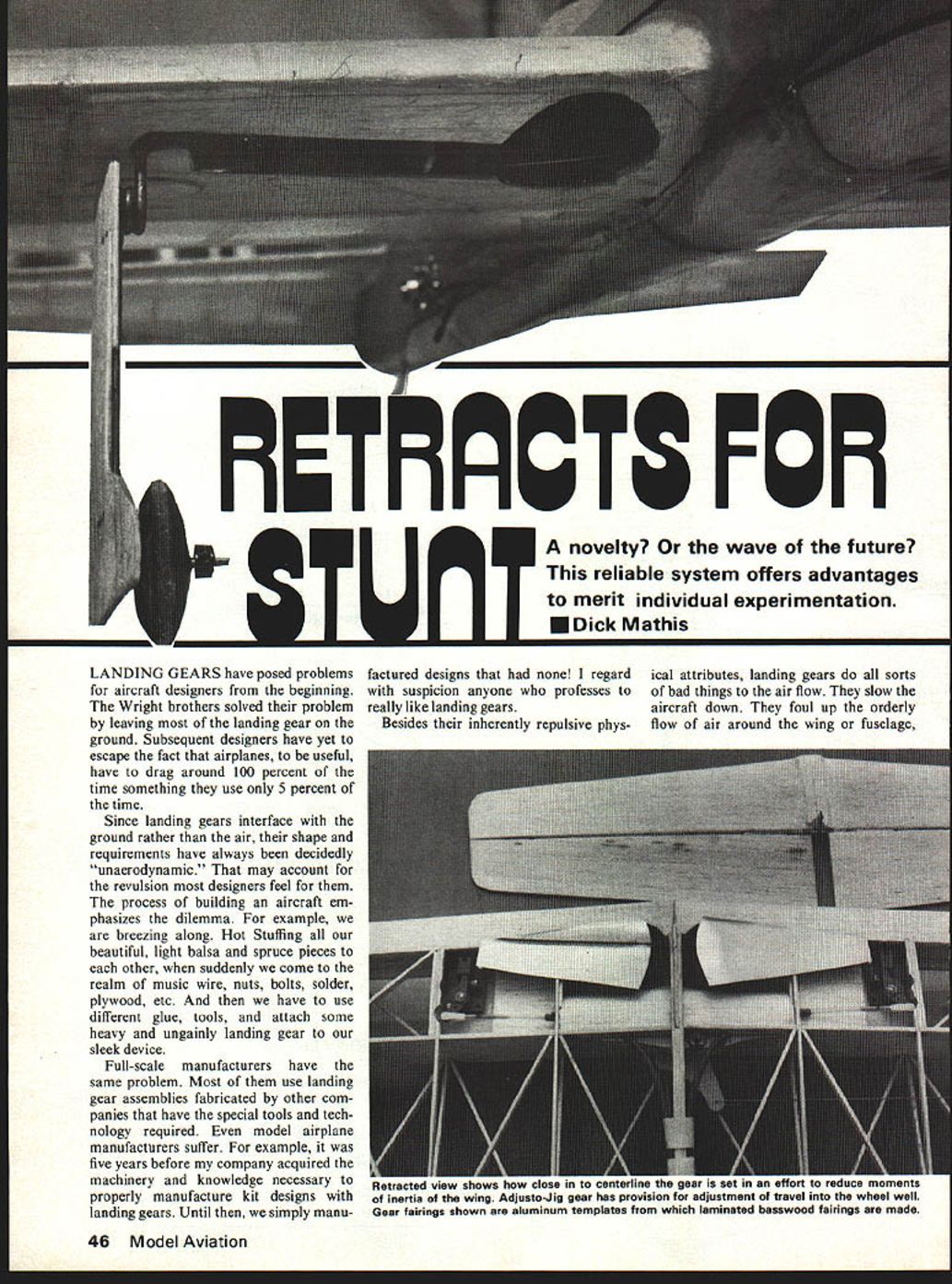
Since landing gears interface with the ground rather than the air, their shape and requirements have always been decidedly "unaerodynamic." That may account for the revulsion most designers feel for them. The process of building an aircraft emphasizes the dilemma. For example, we are breezing along, hot-stuffing all our beautiful, light balsa and spruce pieces to each other, when suddenly we come to the realm of music wire, nuts, bolts, solder, plywood, etc. And then we have to use different glue, tools, and attach some heavy and ungainly landing gear to our sleek device.
Full-scale manufacturers have the same problem. Most of them use landing gear assemblies fabricated by other companies that have the special tools and technology required. Even model airplane manufacturers suffer. For example, it was five years before my company acquired the machinery and knowledge necessary to properly manufacture kit designs with landing gears. Until then, we simply manufactured designs that had none! I regard with suspicion anyone who professes to really like landing gears.
Besides their inherently repulsive physical attributes, landing gears do all sorts of bad things to the air flow. They slow the aircraft down. They foul up the orderly flow of air around the wing or fuselage. and they siphon off precious power, even at the lowest speeds. In essence, landing gears irritate the air and the air responds by making the aircraft fly worse. Finally, it would be unrealistic, especially since we are discussing a modeling event (CL Stunt) where many top fliers design their latest winners around the paint scheme they are going to use, if we failed to mention that landing gears look bad.
Retracts do two good things: (1) they make the aircraft more efficient aerodynamically, and (2) they are better aesthetically. On the other hand, they do three bad things: (1) they make construction more difficult, (2) they are heavier, (3) they are less reliable. Therefore, fans of playing the percentages will see no need to mess up a good, safe thing, and they will read no further. Gamblers and others who like to see things happen will stay with me.
After studying the situation since 1967 and building nothing, I finally got to work on retracts for stunt this winter—testing and redesigning—and I have concluded they work, and are worth the effort. Primarily, I will describe the prototype system, which is flying in a conventional ship designed originally for fixed gears. The second system which is in a new untested aircraft designed specifically for retracts, and for the '78 contest season, will be fully described after it proves itself. Next, I will describe what effects the retracts have, and finally, discuss the pros and cons of retracts and try to predict their role in the future of stunt.
The System:
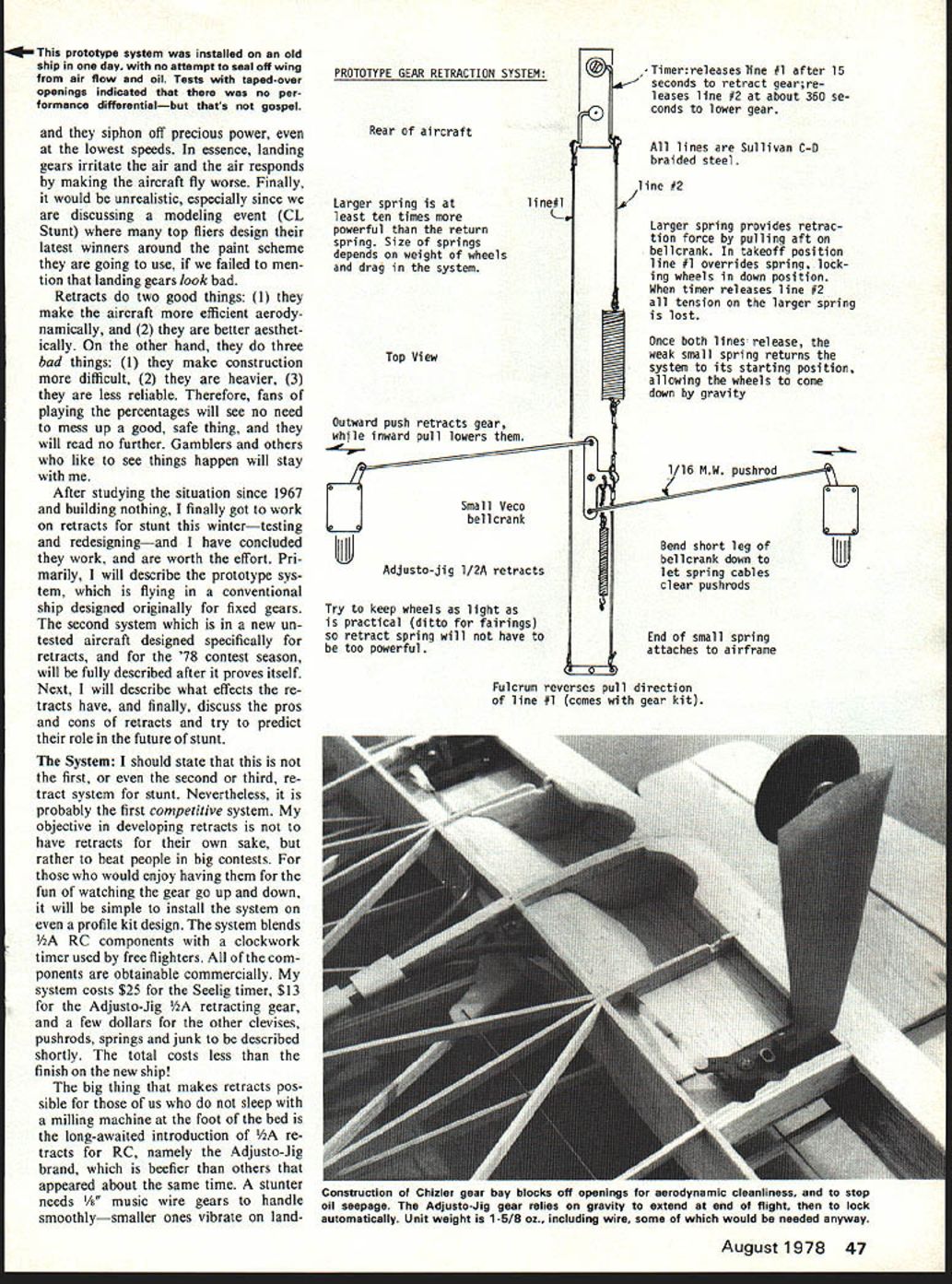
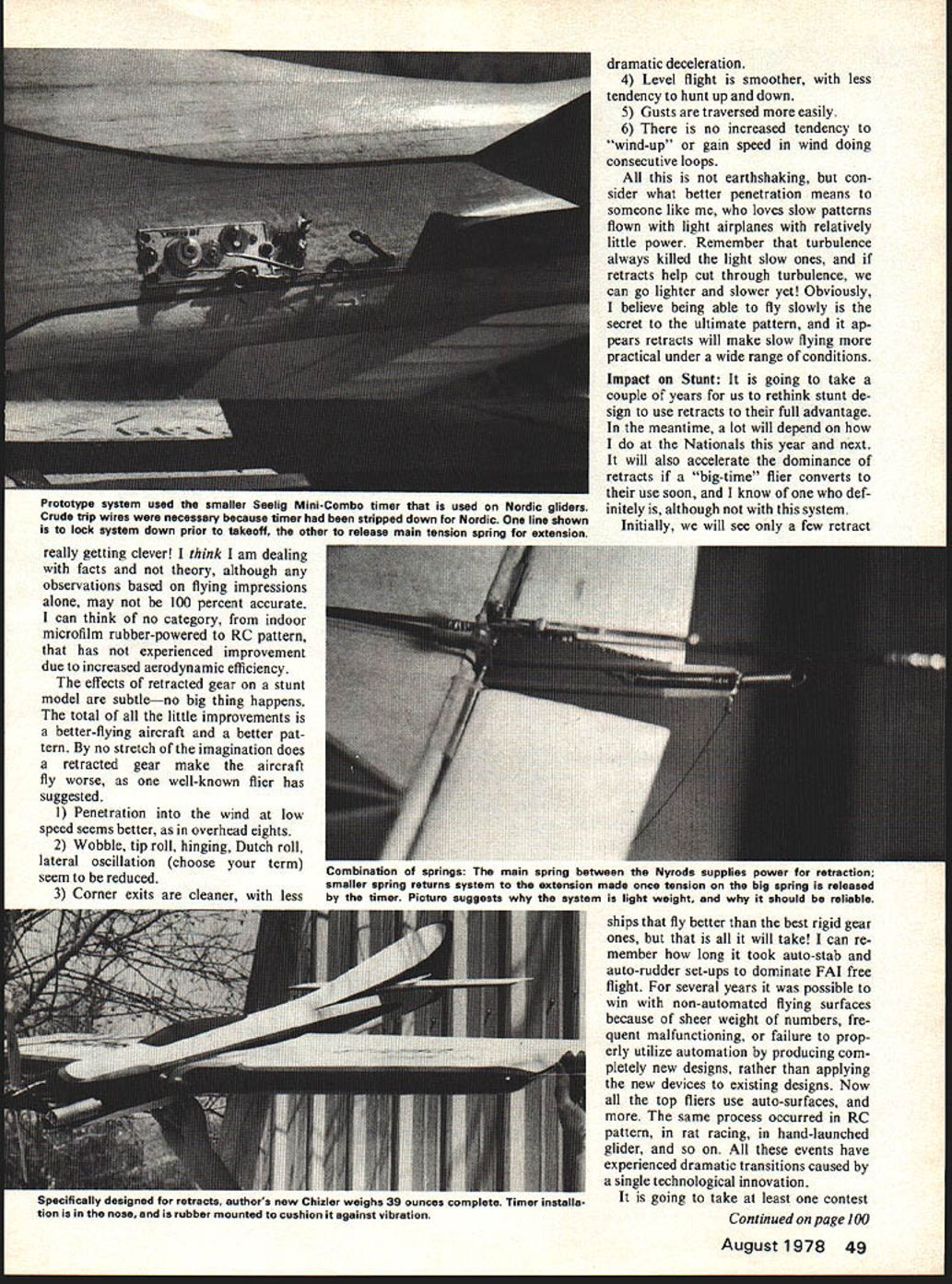
I should state that this is not the first, or even the second or third, retract system for stunt. Nevertheless, it is probably the first competitive system. My objective in developing retracts is not to have retracts for their own sake, but rather to beat people in big contests. For those who would enjoy having them for the fun of watching the gear go up and down, it will be simple to install the system on even a profile kit design. The system blends 1/2A RC components with a clockwork timer used by freeflighters. All of the components are obtainable commercially. My system costs $25 for the Seelig timer, $13 for the Adjusto-Jig 1/2A retracting gear, and a few dollars for the other clevises, pushrods, springs and junk to be described shortly. The total costs less than the finish on the new ship!
The big thing that makes retracts possible for those of us who do not sleep with a milling machine at the foot of the bed is the long-awaited introduction of 1/2A retracts for RC, namely the Adjusto-Jig brand, which is beefier than others that appeared about the same time. A stunter needs 1/8" music wire gears to handle smoothly—smaller ones vibrate on landing. ing—and the Adjusto-Jig gear has 1/8" wire. I doubt, however, whether a smoothly flown stunter needs as much strength in the gear mount area as a 1/4A RC, so the Adjusto-Jig gear mechanism is more than adequate. All of the new gear systems offer nose gears too.
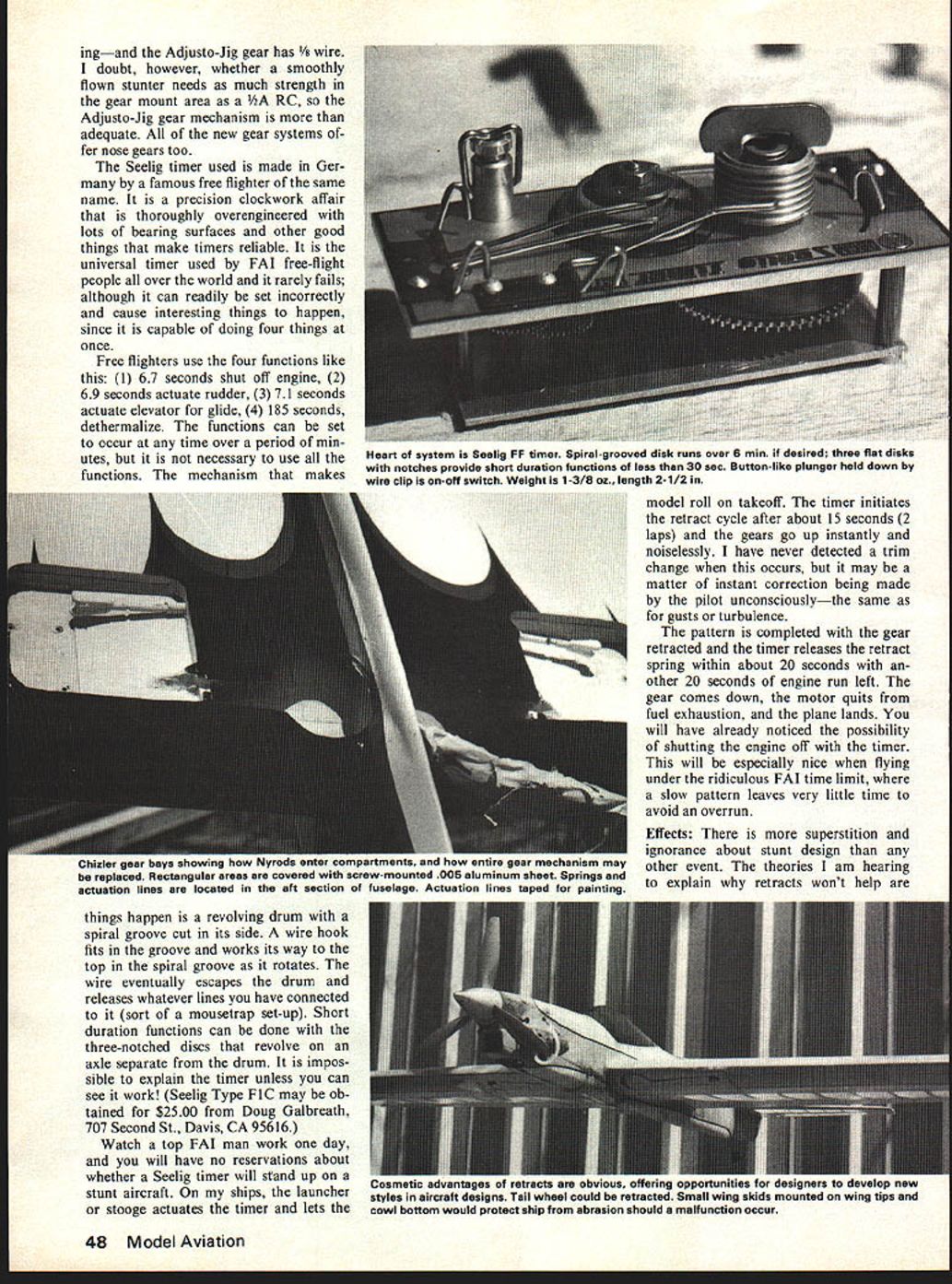
The Seelig timer used is made in Germany by a famous free flighter of the same name. It is a precision clockwork affair that is thoroughly overengineered with lots of bearing surfaces and other good things that make timers reliable. It is the universal timer used by FAI free-flight people all over the world and it rarely fails; although it can readily be set incorrectly and cause interesting things to happen, since it is capable of doing four things at once.
Free flighters use the four functions like this: (1) 6.7 seconds shut off engine, (2) 6.9 seconds actuate rudder, (3) 7.1 seconds actuate elevator for glide, (4) 185 seconds, dethermalize. The functions can be set to occur at any time over a period of minutes, but it is not necessary to use all the functions. The mechanism that makes things happen is a revolving drum with a spiral groove cut in its side. A wire hook fits in the groove and works its way to the top in the spiral groove as it rotates. The wire eventually escapes the drum and releases whatever lines you have connected to it (sort of a mousetrap set-up). Short duration functions can be done with the three-notched discs that revolve on an axle separate from the drum. It is impossible to explain the timer unless you can see it work! (Seelig Type FIC may be obtained for $25.00 from Doug Galbreath, 707 Second St., Davis, CA 95616.)
Watch a top FAI man work one day, and you will have no reservations about whether a Seelig timer will stand up on a stunt aircraft. On my ships, the launcher or stooge actuates the timer and lets the model roll on takeoff. The timer initiates the retract cycle after about 15 seconds (2 laps) and the gears go up instantly and noiselessly. I have never detected a trim change when this occurs, but it may be a matter of instant correction being made by the pilot unconsciously—the same as for gusts or turbulence.
The pattern is completed with the gear retracted and the timer releases the retract spring within about 20 seconds with another 20 seconds of engine run left. The gear comes down, the motor quits from fuel exhaustion, and the plane lands. You will have already noticed the possibility of shutting the engine off with the timer. This will be especially nice when flying under the ridiculous FAI time limit, where a slow pattern leaves very little time to avoid an overrun.
Effects:
There is more superstition and ignorance about stunt design than any other event. The theories I am hearing to explain why retracts won't help are really getting clever! I think I am dealing with facts and not theory, although any observations based on flying impressions alone, may not be 100 percent accurate. I can think of no category, from indoor microfilm rubber-powered to RC pattern, that has not experienced improvement due to increased aerodynamic efficiency.
The effects of retracted gear on a stunt model are subtle—no big thing happens. The total of all the little improvements is a better-flying aircraft and a better pattern. By no stretch of the imagination does a retracted gear make the aircraft fly worse, as one well-known flier has suggested.
1) Penetration into the wind at low speed seems better, as in overhead eights.
2) Wobble, tip roll, hinging, Dutch roll, lateral oscillation (choose your term) seem to be reduced.
3) Corner exits are cleaner, with less dramatic deceleration.
4) Level flight is smoother, with less tendency to hunt up and down.
5) Gusts are traversed more easily.
6) There is no increased tendency to "wind-up" or gain speed in wind doing consecutive loops.
All this is not earthshaking, but consider what better penetration means to someone like me, who loves slow patterns flown with light airplanes with relatively little power. Remember that turbulence always killed the light slow ones, and if retracts help cut through turbulence, we can go lighter and slower yet! Obviously, I believe being able to fly slowly is the secret to the ultimate pattern, and it appears retracts will make slow flying more practical under a wide range of conditions.
Impact on Stunt:
It is going to take a couple of years for us to rethink stunt design to use retracts to their full advantage. In the meantime, a lot will depend on how I do at the Nationals this year and next. It will also accelerate the dominance of retracts if a "big-time" flier converts to their use soon, and I know of one who definitely is, although not with this system.
Initially, we will see only a few retract ships that fly better than the best rigid gear ones, but that is all it will take! I can remember how long it took auto-stab and auto-rudder set-ups to dominate FAI free flight. For several years it was possible to win with non-automated flying surfaces because of sheer weight of numbers, frequent malfunctioning, or failure to properly utilize automation by producing completely new designs, rather than applying the new devices to existing designs. Now all the top fliers use auto-surfaces, and more. The same process occurred in RC pattern, in rat racing, in hand-launched glider, and so on. All these events have experienced dramatic transitions caused by a single technological innovation.
It is going to take at least one contest season to perfect the new routines that are needed in preparing the model between flights. Add winding the timer and setting the little trigger mechanisms to the refueling routine while you are tense and tired and it opens the door for foul-ups. Another thing is the added psychological stress of flying an important pattern knowing a year's work can be ruined if the gear doesn't come down.
One nice thing about all this is there is not a single part made of "unobtanium," so everyone can use retracts if they want—just buy the parts and put them in.
Ideas for Further Development: There are other timers and retractable gear set-ups available, and there are applications other than contest stunt for the system. For situations where utmost durability and reliability are not crucial, a Tatone dethermalizer timer will be cheaper, lighter, and easier to install. A Tatone fuel shut-off timer will not run long enough (about 30 seconds). The pneumatic timers, such as Austincraft's, are not accurate over a period as long as a stunt pattern, but might be used to trigger the retract cycle in conjunction with some other device to lower the gear, such as a pressure valve off the muffler. For the pure thrill of seeing the gear do something (sometimes even before you land), a simple dethermalizer fuse could be used.
I can't say what other brands of landing gears will work, although only the 1/2A types are compact and light enough. The biggest hassle I have had concerns installing the gear in a way that it retracts flush with the airfoil bottom, yet still have enough forward angle to give proper wheel location. A stunter's wing bottom is so highly cambered at the leading edge, as opposed to most RC's, that a conventional two-wheel wing-mounted gear will require a lot of meticulous fitting to give a clean exterior surface. One solution is to use a tricycle gear so that the two wing gears can be mounted on the section of the airfoil that is aft of the high point and not so critical to the airflow pattern.
One of the features I find so exciting about these retracts is their realism. It would be very easy to rig a simple gear that attached to the fuselage and swiveled back flush against the wing, but it would not be as efficient or as attractive. My original idea in 1967 was to have two sets of landing gears—one which went up, and one which came down. This was because I couldn't figure out how to lock the first gear when it came back down. That system would be illegal under present rules which state the plane must land on the takeoff gear. One of my primary motives for developing retracts was to provide for taller landing gears with prop clearance that would allow the use of larger diameter props without destroying the sleek appearance of the design. I still believe props are the ultimate key to further progress in stunt, so the ability to use larger props alone would justify the use of retracts.
Transcribed from original scans by AI. Minor OCR errors may remain.

