
REVIEW: FLYZONE MILLENNIUM MASTER RX-R
Scott Stoops smstoops73@gmail.com
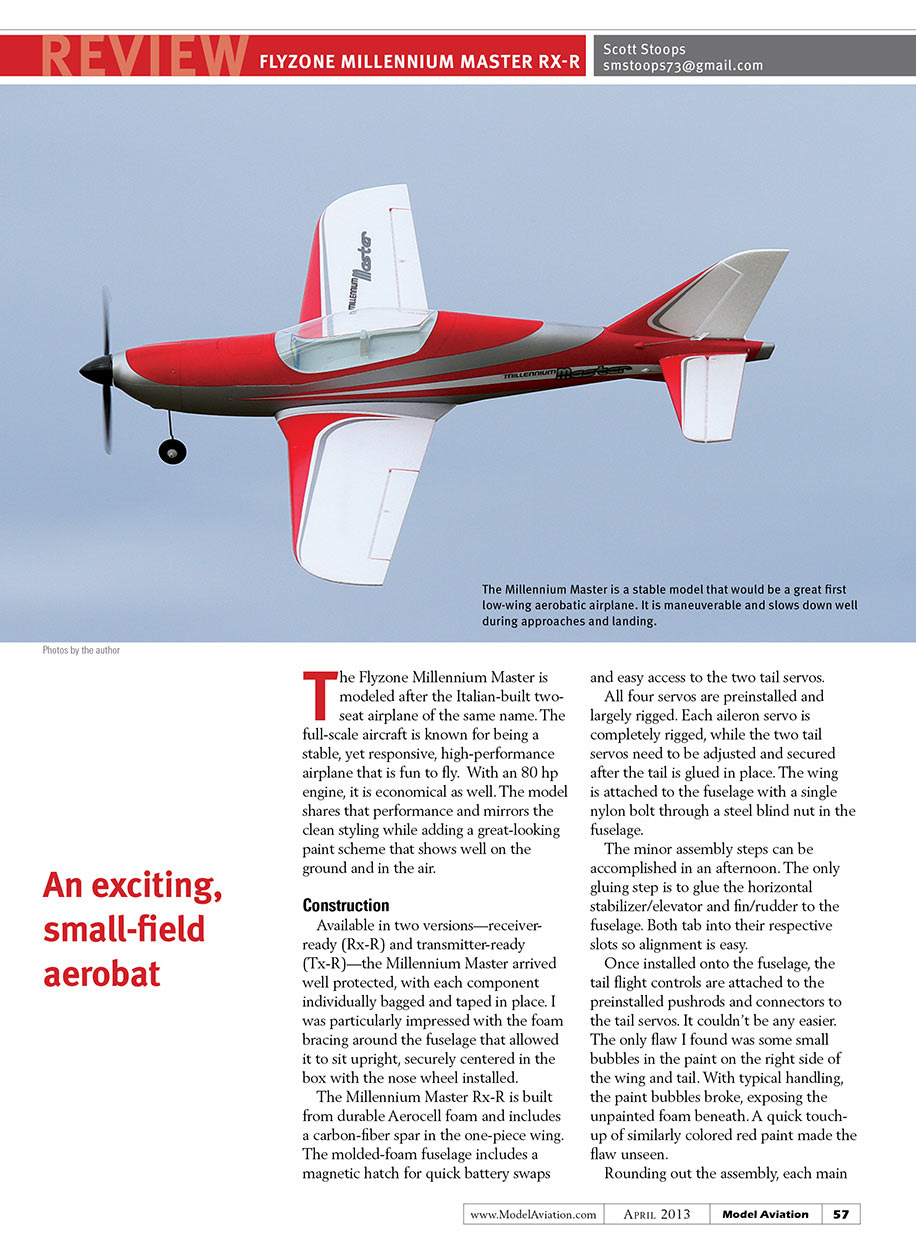
The Flyzone Millennium Master is modeled after the Italian-built two-seat airplane of the same name. The full-scale aircraft is known for being a stable, yet responsive, high-performance airplane that is fun to fly. With an 80 hp engine, it is economical as well. The model shares that performance and mirrors the clean styling while adding a great-looking paint scheme that shows well on the ground and in the air.
Construction
Available in two versions—receiver-ready (Rx-R) and transmitter-ready (Tx-R)—the Millennium Master arrived well protected, with each component individually bagged and taped in place. I was particularly impressed with the foam bracing around the fuselage that allowed it to sit upright, securely centered in the box with the nose wheel installed.
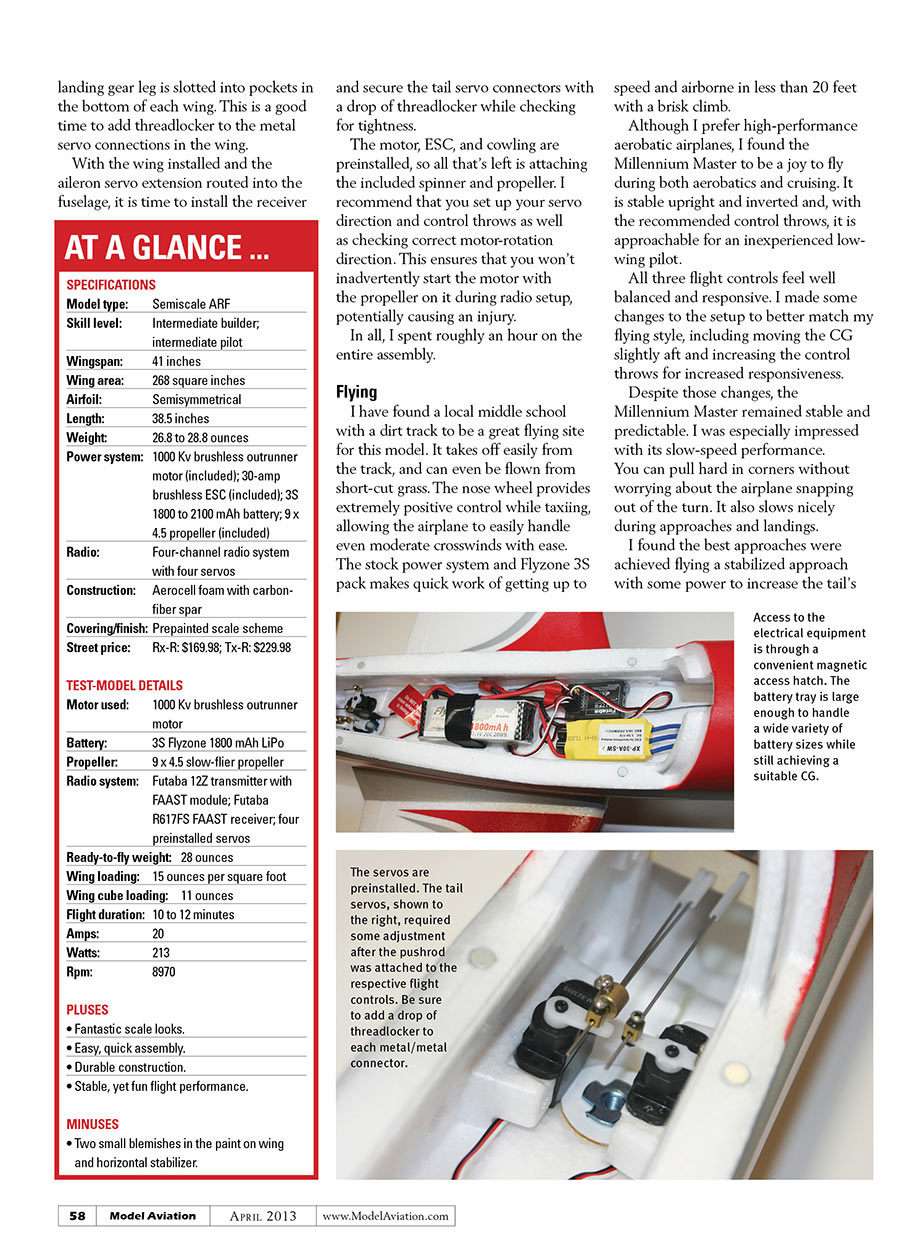
The Millennium Master Rx-R is built from durable Aerocell foam and includes a carbon-fiber spar in the one-piece wing. The molded-foam fuselage includes a magnetic hatch for quick battery swaps and easy access to the two tail servos.
All four servos are preinstalled and largely rigged. Each aileron servo is completely rigged, while the two tail servos need to be adjusted and secured after the tail is glued in place. The wing is attached to the fuselage with a single nylon bolt through a steel blind nut in the fuselage.
The minor assembly steps can be accomplished in an afternoon. The only gluing steps are to glue the horizontal stabilizer/elevator and fin/rudder to the fuselage. Both tab into their respective slots so alignment is easy.
Once the tail surfaces are installed onto the fuselage, the flight controls are attached to the preinstalled pushrods and connectors to the tail servos. It couldn't be any easier. The only flaw I found was some small bubbles in the paint on the right side of the wing and horizontal stabilizer. With typical handling the paint bubbles broke, exposing the unpainted foam beneath; a quick touch-up of similarly colored red paint made the blemishes invisible.
Rounding out assembly, each main landing gear leg is slotted into pockets in the bottom of each wing. This is a good time to add threadlocker to the metal servo connections in the wing. With the wing installed and the aileron servo extension routed into the fuselage, install the receiver and secure the tail-servo connectors with a drop of threadlocker while checking for tightness. The motor, ESC, and cowling are preinstalled, so all that's left is attaching the included spinner and propeller. I recommend that you set up your servo directions and control throws as well as check correct motor-rotation direction. This ensures that you won't inadvertently start the motor with the propeller on it during radio setup, potentially causing an injury.
In all, I spent roughly an hour on the entire assembly.
AT A GLANCE
SPECIFICATIONS
- Model type: Semiscale ARF
- Skill level: Intermediate builder; intermediate pilot
- Wingspan: 41 inches
- Wing area: 268 square inches
- Airfoil: Semisymmetrical
- Length: 38.5 inches
- Weight: 26.8 to 28.8 ounces
- Power system: 1000 Kv brushless outrunner motor (included); 30-amp brushless ESC (included); 3S 1800 to 2100 mAh battery; 9 x 4.5 propeller (included)
- Radio: Four-channel radio system with four servos
- Construction: Aerocell foam with carbon-fiber spar
- Covering/finish: Prepainted scale scheme
- Street price: Rx-R: $169.98; Tx-R: $229.98
TEST-MODEL DETAILS
- Motor used: 1000 Kv brushless outrunner motor
- Battery: 3S Flyzone 1800 mAh LiPo
- Propeller: 9 x 4.5 slow-flier propeller
- Radio system: Futaba 12Z transmitter with FAAST module; Futaba R617FS FAAST receiver; four preinstalled servos
- Ready-to-fly weight: 28 ounces
- Wing loading: 15 ounces per square foot
- Wing cube loading: 11 ounces
- Flight duration: 10 to 12 minutes
- Amps: 20
- Watts: 213
- RPM: 8,970
PLUSES
- Fantastic scale looks.
- Easy, quick assembly.
- Durable construction.
- Stable, yet fun flight performance.
MINUSES
- Two small blemishes in the paint on the wing and horizontal stabilizer.
Flying
I have found a local middle school with a dirt track to be a great flying site for this model. It takes off easily from the track, and can even be flown from short-cut grass. The nose wheel provides extremely positive control while taxiing, allowing the airplane to easily handle even moderate crosswinds. The stock power system and Flyzone 3S pack make quick work of getting up to speed and airborne in less than 20 feet with a brisk climb.
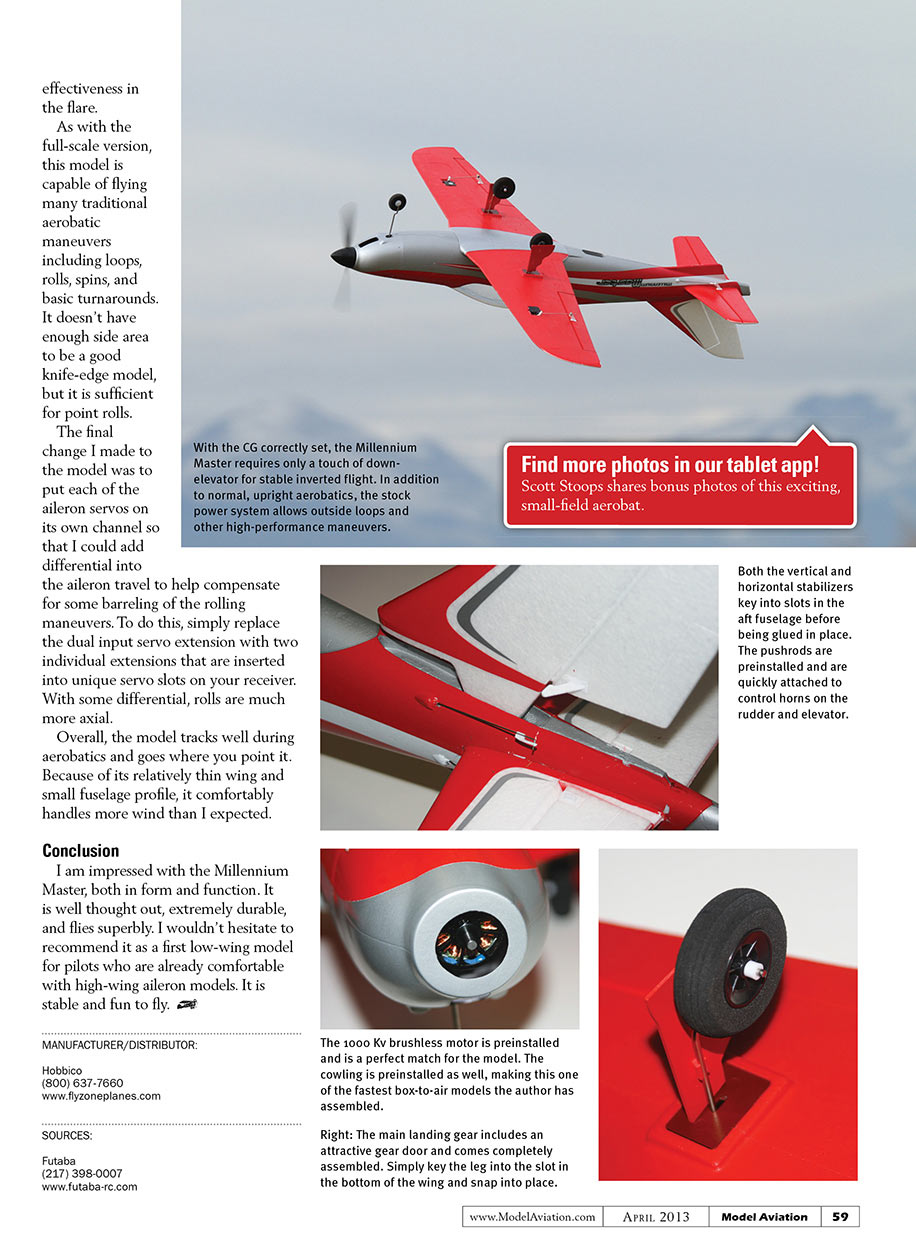
Although I prefer high-performance aerobatic airplanes, I found the Millennium Master to be a joy to fly during both aerobatics and cruising. It is stable upright and inverted and, with the recommended control throws, approachable for an inexperienced low-wing pilot.
All three flight controls feel well balanced and responsive. I made some changes to the setup to better match my flying style, including moving the CG slightly aft and increasing the control throws for more responsiveness. Despite those changes, the Millennium Master remained stable and predictable. I was especially impressed with its slow-speed performance. You can pull hard in corners without worrying about the airplane snapping out of the turn. It also slows nicely during approaches and landings, improving effectiveness in the flare.
I found the best approaches were achieved flying a stabilized approach with some power to increase the tail's authority.
As with the full-scale version, this model is capable of flying many traditional aerobatic maneuvers including loops, rolls, spins, and basic turnarounds. It doesn't have enough side area to be a great knife-edge model, but it is sufficient for point rolls.
The final change I made to the model was to put each aileron servo on its own channel so I could add differential to the aileron travel to help compensate for some barreling during rolls. To do this, replace the dual-input servo extension with two individual extensions that are inserted into unique servo slots on your receiver. With some differential, rolls are much more axial.
Overall, the model tracks well during aerobatics and goes where you point it. Because of its relatively thin wing and small fuselage profile, it comfortably handles more wind than I expected.
Conclusion
I am impressed with the Millennium Master, both in form and function. It is well thought out, extremely durable, and flies superbly. I wouldn't hesitate to recommend it as a first low-wing model for pilots who are already comfortable with high-wing aileron models. It is stable and fun to fly.
MANUFACTURER/DISTRIBUTOR
Hobbico (800) 637-7660 www.flyzoneplanes.com
SOURCES
Futaba (217) 398-0007 www.futaba-rc.com
Transcribed from original scans by AI. Minor OCR errors may remain.

