
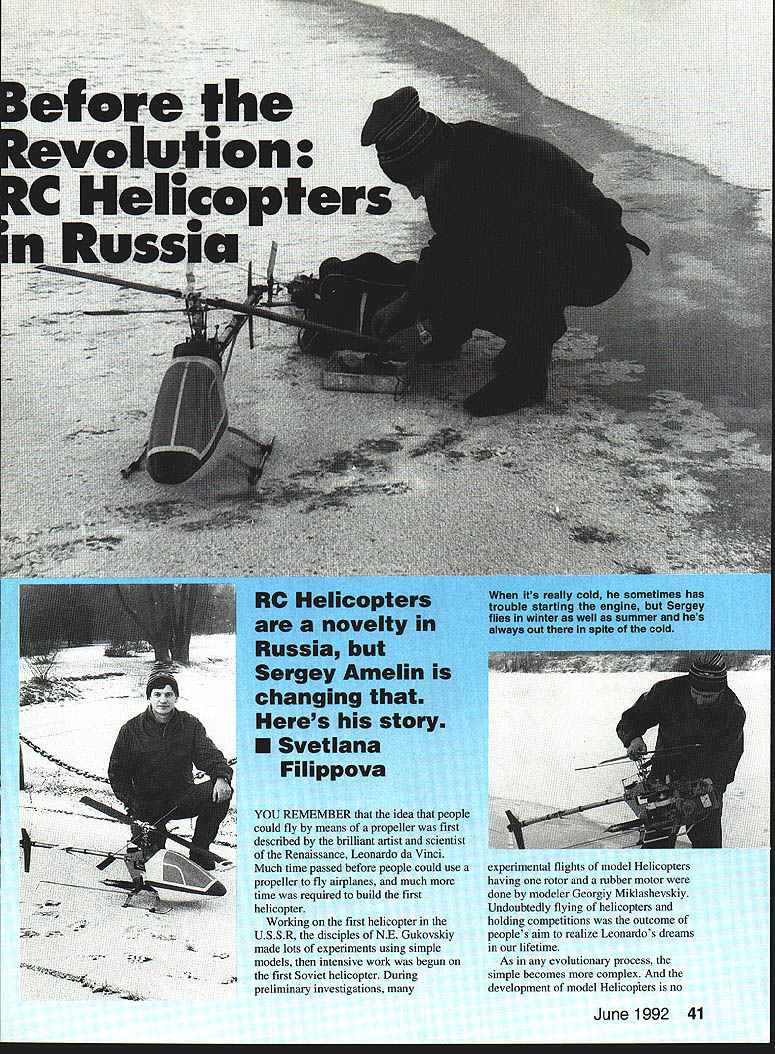
Before the Revolution: RC Helicopters in Russia
RC helicopters are a novelty in Russia, but Sergey Amelin is changing that. Here's his story. — Svetlana Filippova
Background: from da Vinci to model helicopters
You remember that the idea that people could fly by means of a propeller was first described by the brilliant artist and scientist of the Renaissance, Leonardo da Vinci. Much time passed before people could use a propeller to fly airplanes, and much more time was required to build the first helicopter.
Working on the first helicopter in the USSR, the disciples of N. E. Gukovskiy conducted many experiments using simple models, then began intensive work on the first Soviet helicopter. During preliminary investigations, modeler Georgiy Miklashevskiy flew many experimental single-rotor rubber-motor model helicopters. Undoubtedly, flying model helicopters and holding competitions was the outcome of people's aim to realize Leonardo's dreams in our lifetime.
As in any evolutionary process, the simple becomes more complex. The development of model helicopters is no exception.
Early radio control in the USSR
Because radio-control models were very rare in the USSR, information about this activity was hard to obtain. Sergey Amelin searched Czechoslovak magazines about model airplanes and was lucky to find plans for an RC plane. After considerable difficulty he obtained a Soviet RC system, the nonproportional RUM-2. It was not very good, but it enabled him to build his first radio-control model.
Sergey spent many hours polishing and fixing models, trying to find experts who could advise him. He persevered. Eventually he built an F3B model and his skill improved steadily. He took a job at a plant producing radio-control models — machines that remotely resembled aerobatic airplanes. His duties included flying models and teaching others, and he flew for hours every day until he became a professional. The job also gave him contacts and the means to acquire RC systems, mostly Bulgarian units that he could use without restrictions.
At the time there were no special clubs of RC modelers in the USSR and little or no domestic production of radio equipment. Before the breakup of the states, people in individual republics paid about 3,000 rubles for an RC system; when brought from other countries the cost was about 3,500 rubles.
Sergey Amelin: early years and turning to helicopters
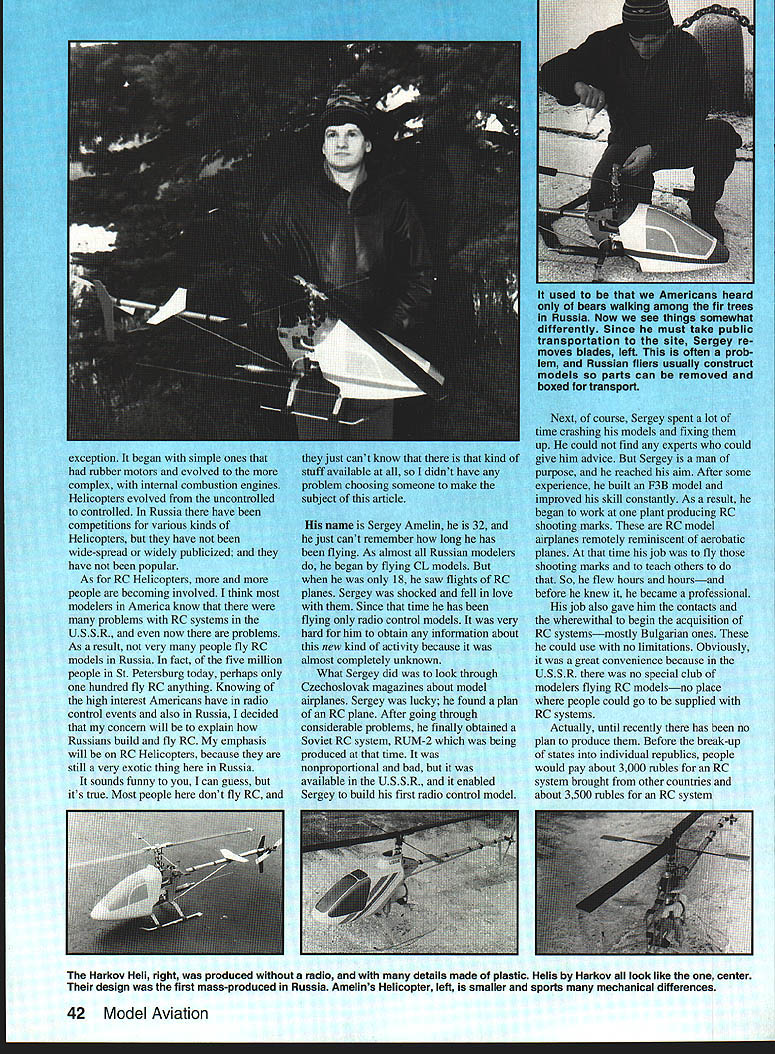
Sergey Amelin is 32 and cannot remember exactly how long he has been flying. Like most Russian modelers he began with control-line (CL) models. At 18 he saw RC plane flights and was immediately captivated. From that point he flew only radio-control models.
Because RC was so little known in the USSR, Sergey had trouble obtaining information, but he persisted. After finding plans in foreign magazines and obtaining the RUM-2 system, he built his first radio-control model. He gained experience, built an F3B model, and improved his skills. Working at the plant gave him the chance to fly professionally and to acquire better RC systems.
Sergey improved the F3B scheme into a training model that later took part successfully in the USSR model championship. A few contests and RC events existed in classes F3B, F3D, F3C, and F4C; people flew RC models in Moscow, St. Petersburg, and in Ukraine. Helicopter contests have been sponsored by the Kharkov Aviation Institute and held in Kharkov City since 1984. Each year more people attend; sometimes modelers from Czechoslovakia and Hungary join. Modelers come to fly, learn, build helicopters, and share experiences — they do not keep secrets, and that's how everyone learns and improves.
Building the first helicopters
Sergey began to build his first helicopter in 1982. He found the Helix helicopter plan in a Czechoslovak magazine and used its mechanics as a basis, modifying the shape. In winter 1982 he attempted the first flights. The very first try failed because the mechanical traction control system was incorrectly linked; it was dangerous to stand under the model with parts connected incorrectly, and Sergey's RC system lacked a reverse function.
On a subsequent attempt he flew courageously and climbed vertically to about 33 yards. He tried horizontal flight, but the model would not cooperate. His transmitter had a throttle/tail-rotor stick and an elevator/aileron stick, but the helicopter had no gyroscopic stabilizer and no capability to change collective pitch. In addition, recognizing the helicopter's attitude relative to the horizon was difficult for him — he was used to judging a model airplane by its wing position. Sergey flew the helicopter as if it were an airplane because he had no teacher to show him otherwise, and the model crashed repeatedly.
Despite the setbacks, persistent effort brought results and Sergey developed enough skill to fly his helicopter reasonably well. He went to Kharkov to participate in the first contest for helicopter fliers. Most competitors used the Helix scheme with various fuselage shapes, though a few brought very unusual constructions — one with two rotors on the same axle, for example. All were enthusiastic, flying daily, sharing ideas, and learning from each other. A 10-minute videotape recorded their early attempts and helped attract more people to the developing event. In 1985 Sergey’s picture was published in the Soviet magazine Modeler-Designer.
International contacts and technical progress
A Finnish modeler building helicopters read that magazine. One day Sergey received a letter from Raimo Makela in Virksy, Finland, offering to exchange experiences. Raimo later brought Sergey a book, Flying Model Helicopters (from basics to competitions) by Dave Day — at that time the only comprehensive source on model helicopters available in the USSR.
Sergey built a second helicopter powered by a 10 cc Soviet-made Raduga engine (the Kalt design he had seen originally was intended for a 3.5 cc engine). The second model had collective pitch but still lacked a gyroscopic stabilizer and remained difficult to fly. Sergey then made a mechanical mixer for collective pitch and tail rotor control.
When his Finnish friend helped him obtain a JR 128-H RC system, Sergey felt encouraged to build his own gyro. The new radio allowed inverted flying, and Sergey decided to attempt the first upside-down helicopter flight in the USSR. He invited friends and photographers. On his first inverted attempt he climbed to about 165 yards and engaged the invert switch but forgot to increase engine RPM; the model descended and he righted it about 55 yards above ground. On the second try he inverted the craft with full RPM, but rotor blades bent and broke, and the helicopter crashed. The trial ended in failure but produced memorable photographs.
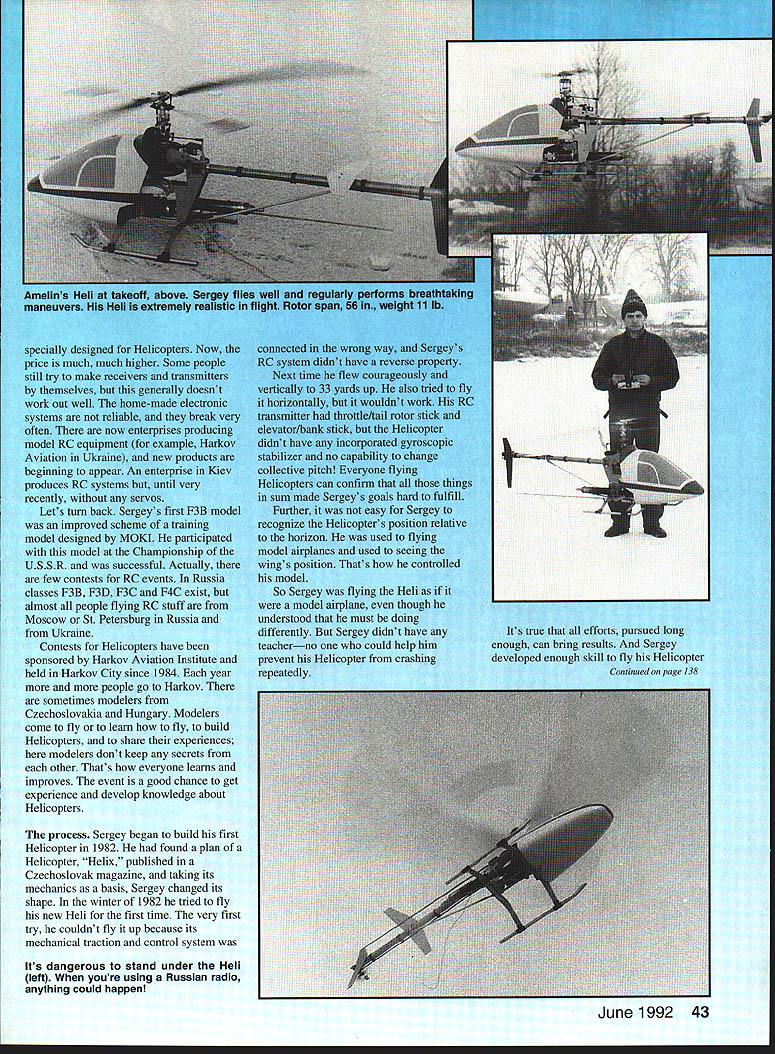
Later, his Finnish friend sent him a gyro and improvements continued. Since 1982 Amelin has built six model helicopters, each an improvement over the last. His latest model incorporates the sum of his experience and everything he has read or seen. Only a few details are plastic; Sergey usually fabricates metal parts. However, an enterprise in Kharkov has mastered the technology to produce most details from plastic.
Community needs and outlook
Talking with Sergey about RC events developing in Russia, it is clear that many people want to fly RC helicopters, but there are problems acquiring serial models and reliable RC systems. Many modelers would rather buy ready-made models than build them — they prefer not to spend time making mistakes and gaining experience, but then have less time to fly. Modelers here also want more contests — not just FAI events, but simpler competitions that give beginners a chance to practice.
- Existing contest classes include: F3B, F3D, F3C, F4C.
- Helicopter contests have been held in Kharkov City since 1984, with growing attendance and occasional international participants.
Who knows — perhaps enthusiasts can bring change and one day there will be contests between Americans and Russians flying helicopters. For now, helicopters are still exotic in Russia, but Sergey Amelin is working to change that.
Transcribed from original scans by AI. Minor OCR errors may remain.

