
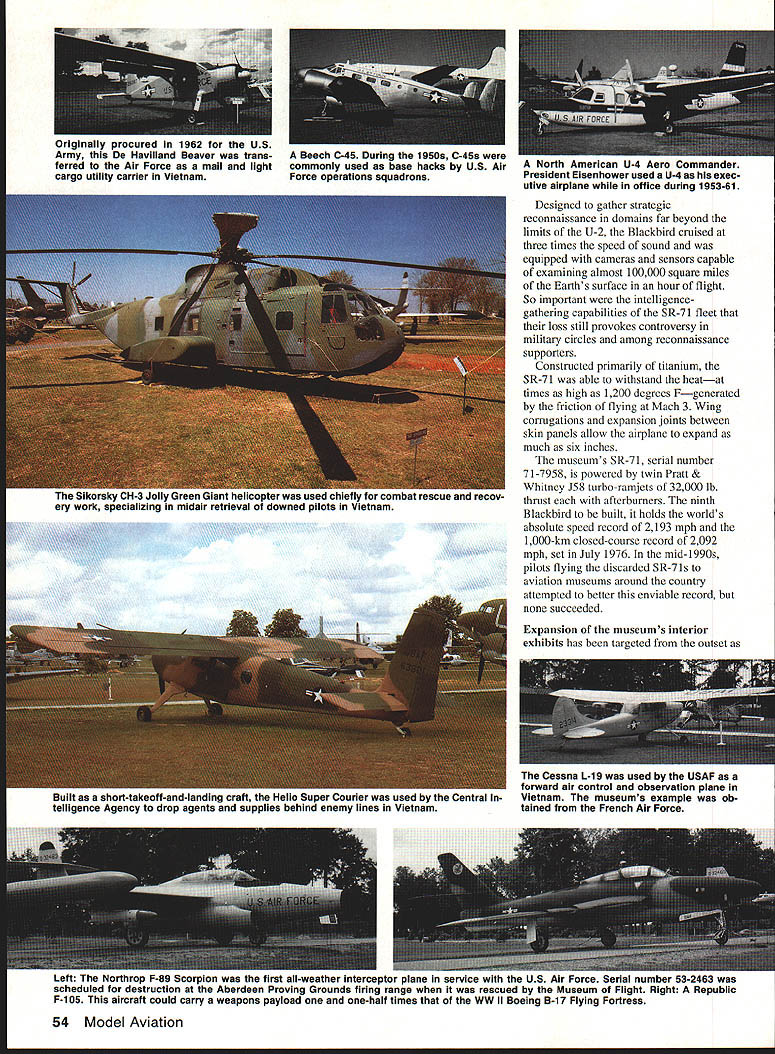
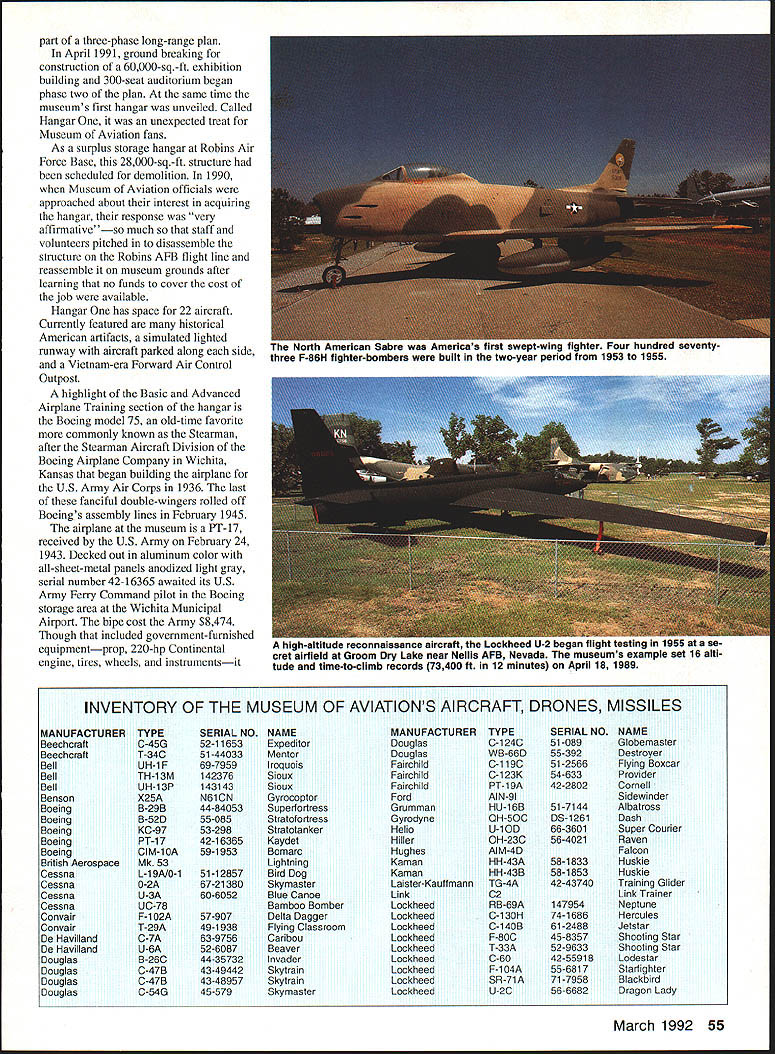
Robins AFB Air Museum
From flight simulators to futuristic avionics systems to action-packed movies, this fast-growing aviation museum offers something for every member of the family.
History
At Robins Air Force Base near the center of Georgia, where dogwood trees and azaleas bloom in spring and camellias brighten the landscape in winter, visitors can stroll through the indoor and outdoor collections of the fastest-growing military aviation museum in the Southeast.
The Museum of Aviation traces its roots to World War II. On August 8, 1941, the U.S. War Department negotiated a contract for the construction of an Air Corps supply and repair depot. Completed a year later, the installation was officially named Robins Field, after General Augustine Warner Robins (1882–1940). The name was later modified to Robins Air Force Base.
General Robins, a West Point graduate of 1907, served as Chief of the Materiel Division of the Army Air Corps at Wright Field, Ohio, an antecedent of the present Air Force Logistics Command. In 1939 Brigadier General Robins became commandant of the Air Corps Training Center at Randolph Field in San Antonio, Texas, remaining in that post until his death on June 16, 1940.
Originally called Wellston Air Depot, after the nearby town of Wellston, the facility became the Warner Robins Army Air Depot in October 1942 when the town was renamed Warner Robins. After a total of eight name changes mirroring restructuring of the U.S. Army Air Forces and later the U.S. Air Force, the depot is today the Warner Robins Air Logistics Center of Robins Air Force Base. Over the years it has been transformed into a technologically advanced giant sometimes called the Avionics Center of the Air Force.
In September 1981 General James P. Mullins, head of the Air Force Logistics Command, ordered that each Air Force Logistics Center develop a program to preserve and publicize its heritage. In December 1981 the Robins Air Force Base Heritage Committee was formed to carry out that task. Soon after, a Museum Foundation Board was established to create a museum to preserve aircraft and artifacts associated with the base's history. Through the efforts of dedicated volunteers, the Museum of Aviation welcomed its first visitors on November 9, 1984.
Site and exhibits
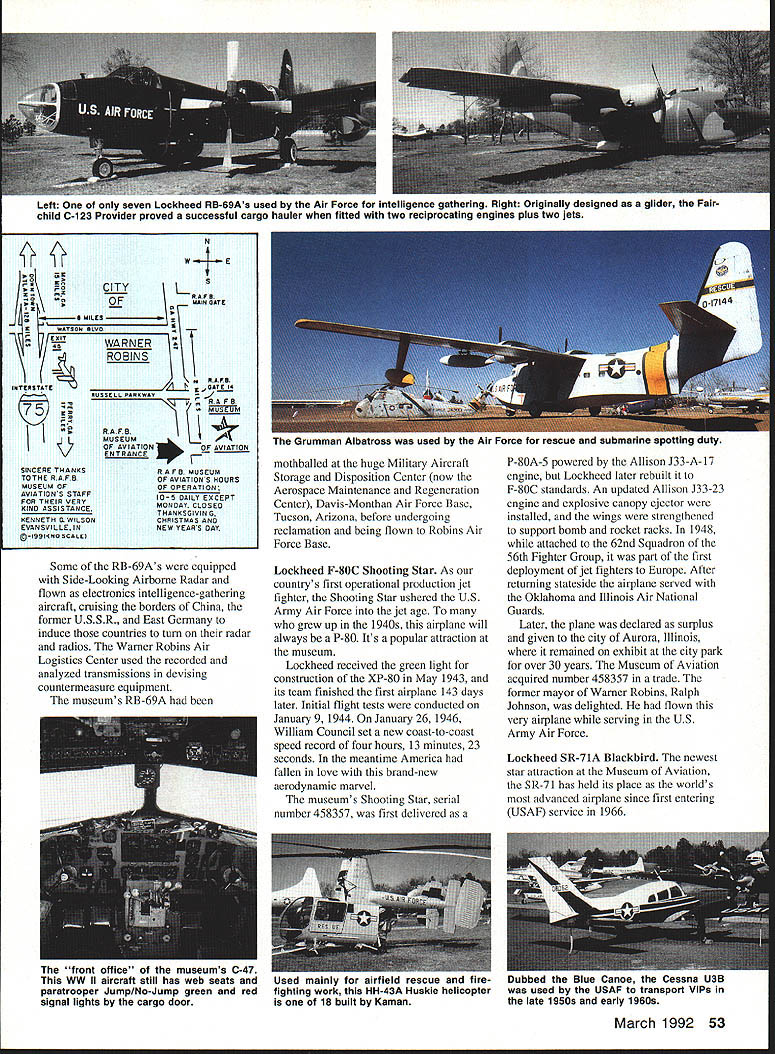
The 43-acre museum site is located at the southern end of Robins AFB. As you enter from Russell Parkway off Georgia State Highway 247 South, towering native Georgia pine trees are integrated into the outdoor aircraft displays, creating an evocative setting.
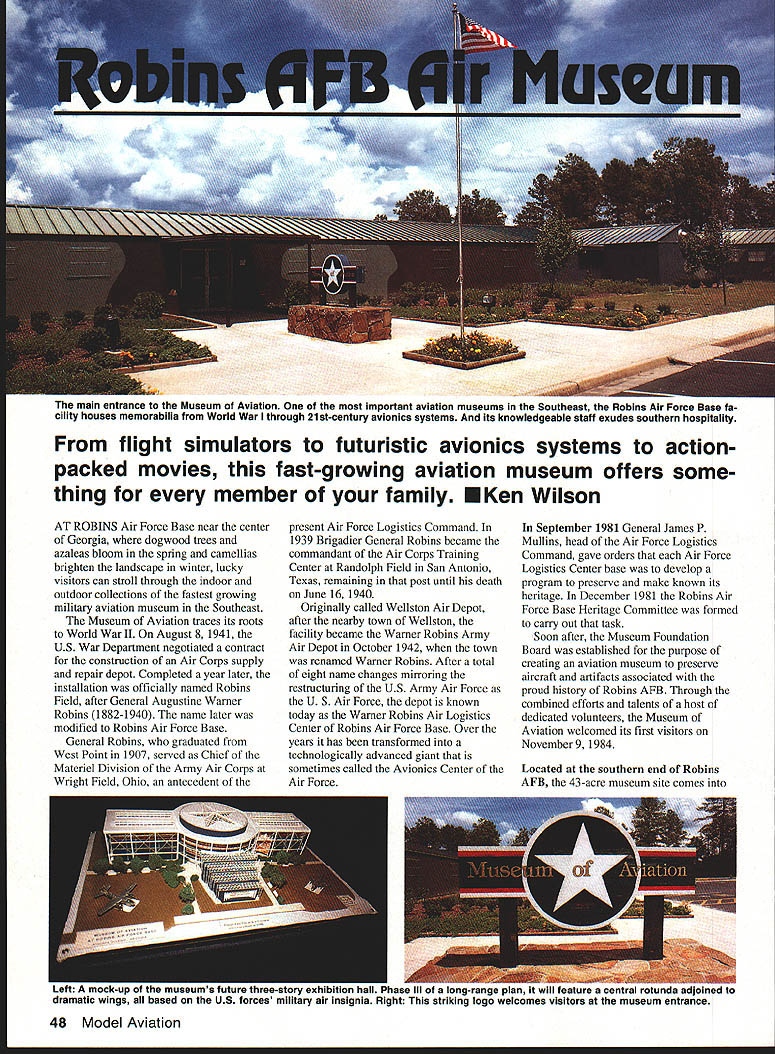
Interconnected World War II single-story Butler-type buildings house indoor exhibits arranged in chronological sequence clockwise from the lobby. Volunteer guides are usually on hand to greet visitors and answer questions. Many visitors browse the gift/bookstore before beginning the tour.
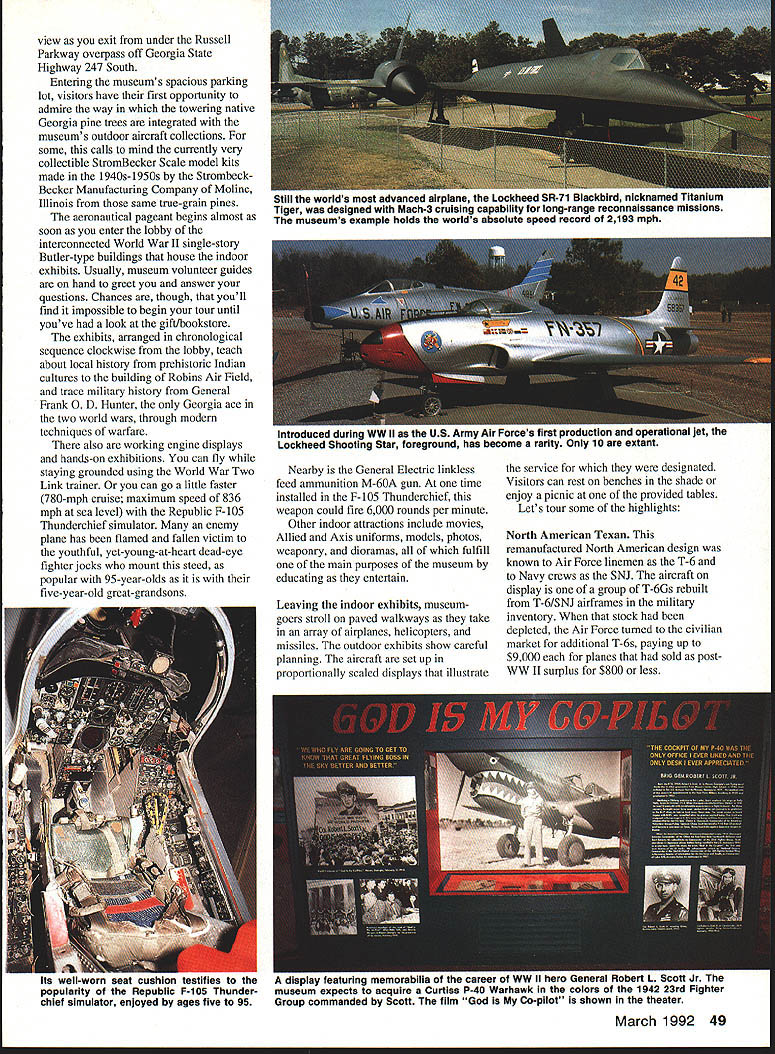
Indoor exhibits cover local history, prehistoric Indian cultures in the building area, the construction of Robins Air Field, and military history — from General Frank O'D. Hunter, a Georgia ace in two world wars, through modern warfare techniques. The museum includes working engine displays, hands-on exhibitions, movies, Allied and Axis uniforms, models, photos, weaponry, and dioramas.
Simulators and interactive attractions:
- World War II Link trainer.
- Republic F-105 Thunderchief simulator (F-105 cruise speed roughly 780 mph; maximum ~836 mph at sea level). Nearby is a General Electric linkless-feed M-60A gun installation; the F-105's weapon system could fire up to 6,000 rounds per minute.
These attractions are popular with visitors of all ages.
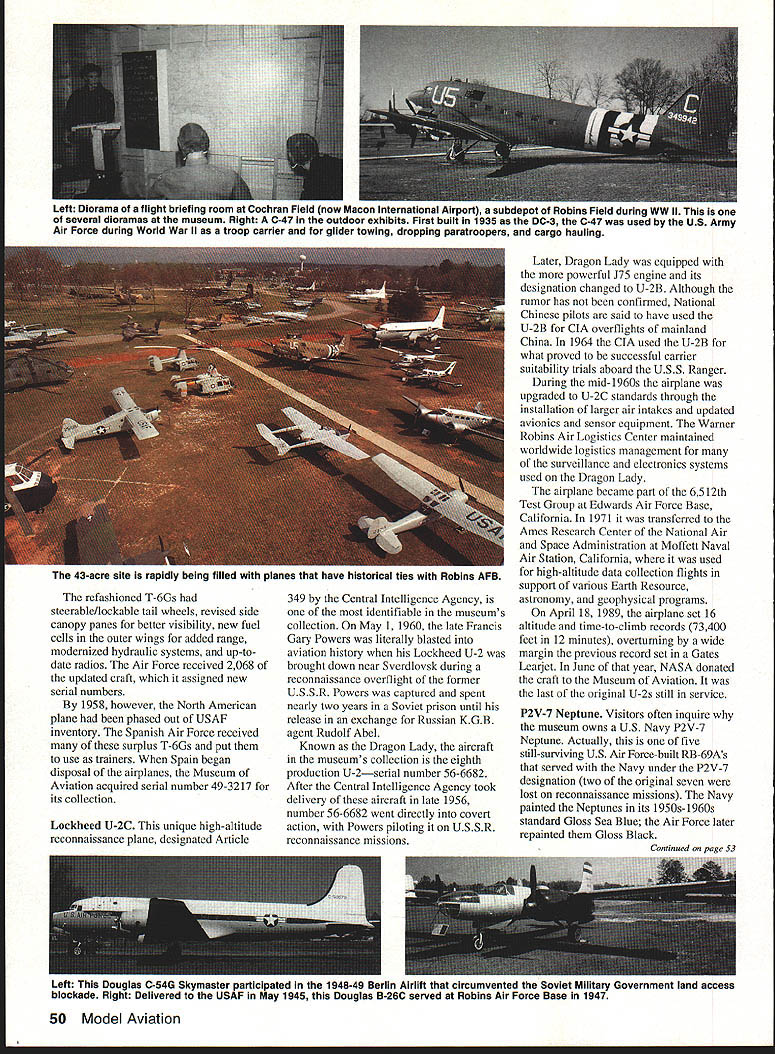
Outdoor exhibits are carefully planned and proportionally scaled to illustrate the service roles of each aircraft. Paved walkways, shaded benches, and picnic tables make the outdoor visit comfortable.
Highlights
The museum maintains an extensive collection; below are some notable aircraft and exhibits.
North American Texan (T-6 / SNJ)
This remanufactured North American design was known to the Air Force as the T-6 and to the Navy as the SNJ. The museum's aircraft is one of a group of T-6s rebuilt from existing military airframes; when military stock was depleted, the Air Force acquired civilian examples, paying up to $9,000 each for planes that had sold post-WWII as surplus for $800 or less.
The refashioned T-6G featured steerable/lockable tail wheels, revised side canopy panes for better visibility, new fuel cells in the outer wings for added range, modernized hydraulic systems, and updated radios. The Air Force received 2,068 of the updated craft and assigned new serial numbers. By 1958 the North American plane had been phased out of USAF inventory; many were sold to the Spanish Air Force as trainers. The Museum of Aviation acquired serial number 49-3217 after Spanish disposals.
Lockheed U-2C (Dragon Lady)
The museum's U-2C, serial number 56-6682, is one of the most identifiable aircraft in the collection. Article 349 by the CIA, the U-2 became famous on May 1, 1960, when Francis Gary Powers was shot down near Sverdlovsk during a reconnaissance overflight of the U.S.S.R.
The aircraft in the museum was the eighth production U-2. After CIA ownership in late 1956, number 56-6682 entered covert missions, with Powers piloting U.S.S.R. reconnaissance flights. Later versions were equipped with the more powerful J75 engine and redesignated U-2B; the airplane also participated in carrier suitability trials aboard USS Ranger in 1964. During the mid-1960s it was upgraded to U-2C standards with larger air intakes and updated avionics and sensor equipment.
The Warner Robins Air Logistics Center managed worldwide logistics for many surveillance and electronics systems used on the Dragon Lady. The airplane later became part of the 6,512th Test Group at Edwards AFB and was transferred to NASA Ames Research Center at Moffett Field for high-altitude data collection. On April 18, 1989, the aircraft set 16 altitude and time-to-climb records (73,400 feet in 12 minutes). In June 1989 NASA donated the craft to the Museum of Aviation; it was the last of the original U-2s still in service.
P2V-7 Neptune (RB-69A)
The museum's Neptune is one of five surviving U.S. Air Force-built RB-69As that served with the Navy as P2V-7s (two of the original seven were lost on reconnaissance missions). The Navy painted them Gloss Sea Blue in the 1950s–1960s; the Air Force later used Gloss Black.
Some RB-69As were equipped with Side-Looking Airborne Radar and flown as electronic intelligence-gathering aircraft along the borders of China, the U.S.S.R., and East Germany to elicit radar and radio emissions. The Warner Robins Air Logistics Center used the recorded transmissions to devise countermeasure equipment. The museum's RB-69A was reclaimed from the Military Aircraft Storage and Disposition Center (now the Aerospace Maintenance and Regeneration Center) at Davis-Monthan AFB before being flown to Robins AFB.
Lockheed F-80C Shooting Star
The F-80 was the United States' first operational production jet fighter, ushering the Army Air Forces into the jet age. Lockheed finished the XP-80 143 days after receiving authorization in May 1943; initial flight tests were on January 9, 1944. On January 26, 1946, William Council set a coast-to-coast speed record of 4 hours, 13 minutes, 23 seconds.
The museum's Shooting Star, serial number 48-5357, was first delivered as a P-80A-5 powered by an Allison J33-A-17 engine and was later rebuilt to F-80C standards with an updated Allison J33-23 engine, explosive canopy ejector, and strengthened wings to support bombs and rockets. In 1948 it participated in the first deployment of jet fighters to Europe while with the 62nd Squadron, 56th Fighter Group. It later served with the Oklahoma and Illinois Air National Guards, was declared surplus and displayed in Aurora, Illinois, for over 30 years before entering the Museum of Aviation collection. The former mayor of Warner Robins, Ralph Johnson, had flown this very airplane while serving in the U.S. Army Air Forces.
Lockheed SR-71A Blackbird
The museum's SR-71, serial number 71-7958, is a star attraction. Since entering USAF service in 1966, the Blackbird has been the world's most advanced airplane for strategic reconnaissance, cruising at Mach 3 and equipped with cameras and sensors capable of examining almost 100,000 square miles of Earth's surface in an hour.
Constructed primarily of titanium, the SR-71 could withstand skin temperatures as high as 1,200°F generated by Mach 3 flight. Wing corrugations and expansion joints allow the airframe to expand as much as six inches in flight. The museum's aircraft is powered by twin Pratt & Whitney J58 turbo-ramjets (32,000 lb thrust each with afterburners). It holds the world's absolute speed record of 2,193 mph and the 1,000-km closed-course record of 2,092 mph, set in July 1976.
Hangar One and training exhibits
As part of a multi-phase long-range plan, museum expansion included groundbreaking in April 1991 for a 60,000-square-foot exhibition building and a 300-seat auditorium (phase two). At the same time the museum unveiled its first hangar, Hangar One.
Hangar One is a 28,000-square-foot surplus storage hangar that had been scheduled for demolition. In 1990 museum officials agreed to acquire it; staff and volunteers disassembled the structure on the Robins AFB flight line and reassembled it on museum grounds when no funds were available to contract the move. Hangar One has space for 22 aircraft and features historical artifacts, a simulated lighted runway with aircraft parked along each side, and a Vietnam-era Forward Air Control outpost.
A highlight of the Basic and Advanced Airplane Training section is the Boeing Model 75 (Stearman), commonly known as the PT-17. Built by the Stearman Aircraft Division of Boeing in Wichita, Kansas, the PT-17 was a primary trainer for the U.S. Army Air Corps beginning in 1936; production continued until February 1945.
The museum's PT-17, serial number 42-16365, was received by the U.S. Army on February 24, 1943. It was aluminum-colored with sheet-metal panels and an anodized light gray interior. The biplane cost the Army $8,474 — a tidy sum in 1943 — which included government-furnished equipment such as prop, 220-hp Continental engine, tires, wheels, and instruments.
The PT-17 first saw service at the 2,164th Base Unit, Tuskegee Institute Field Number Two, a contract pilot school in Tuskegee, Alabama, arriving February 25, 1943. It served as a basic trainer for U.S. Army Air Forces Black aviators and later was assigned to the Coast Aviation Corporation contract flight school at Eagle Field, Dos Palos, California. On August 2, 1945, the PT-17 was stricken from Army records and turned over to the Reconstruction Finance Corporation for surplus disposal. Many Boeing Army models were advertised for sale in September 1945 magazines for $875; some were sold for as little as $300.
Collection goals and notable artifacts
The Museum of Aviation maintains a wish list of over 50 aircraft sought for display. Promised or sought aircraft include:
- Boeing B-17G Flying Fortress (found in La Paz, Bolivia).
- Republic P-47D Thunderbolt.
- Curtiss P-40 Warhawk.
These aircraft conform to the museum's mission: during World War II the Warner Robins Air Logistics Center was responsible for supply and depot maintenance of all U.S. Army aircraft in its assigned area (Georgia, South Carolina, North Carolina, Virginia, and most of Florida), totaling over 6,500 aircraft of all types.
The Curtiss P-40 Warhawk holds special significance because of its close connection with local and national World War II hero Brigadier General Robert L. Scott Jr.
Brigadier General Robert L. Scott Jr.
A native of near Macon, Georgia, General Scott commanded the 23rd Fighter Group, which piloted P-40 Warhawks in the China-Burma-India theater. The 23rd had close attachments with Major General Claire Chennault's American Volunteer Group (the Flying Tigers). While serving with the 23rd, Scott shot down 13 Japanese planes with another nine probable.
Scott authored the 1943 memoir God Is My Co-Pilot, which described the dedication of American pilots despite overwhelming enemy superiority. Ordered back to the United States for public relations, war bond drives, and briefings, Scott became a popular public figure. God Is My Co-Pilot was made into a film (premiered February 1944 in Macon, Georgia). General Scott retired from the U.S. Air Force in 1957 and serves as ongoing Campaign Chairman for the Museum of Aviation.
The museum displays a first-rate collection of Scott's 23rd Fighter Group memorabilia, shows God Is My Co-Pilot in the museum theater, and exhibits photographs from the film and a first edition of Scott's book presented by him to his mother.
Staff and visitor experience
The enthusiasm of the staff and volunteers at this nationally prominent depository of historical aircraft and memorabilia is unmistakable. They work to preserve the history and tradition of Robins Air Force Base and the U.S. Air Force and to make visitors feel welcome. Anyone attending can expect a cordial southern-style greeting and a fascinating educational experience.
Transcribed from original scans by AI. Minor OCR errors may remain.

