
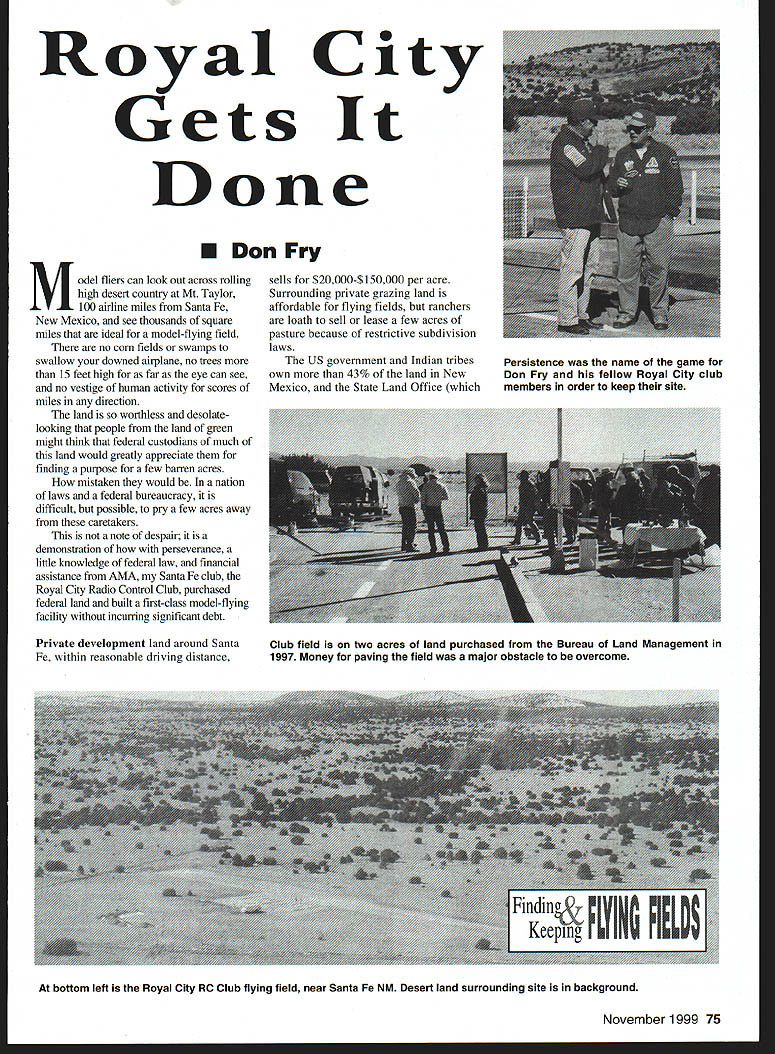
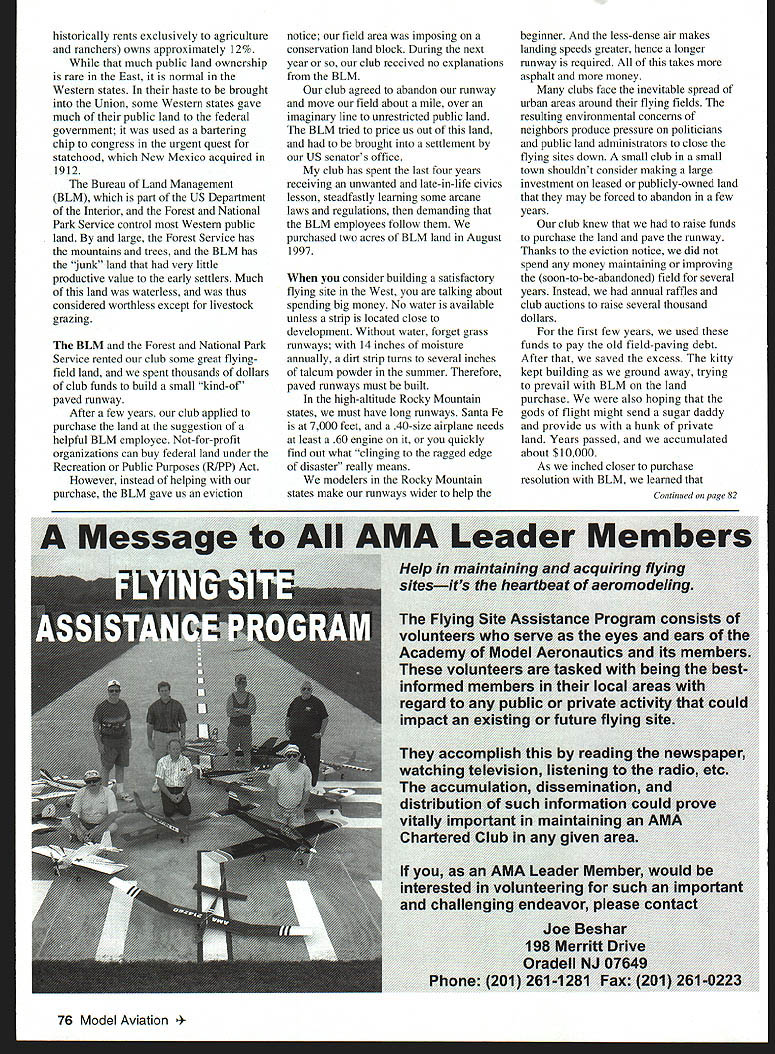
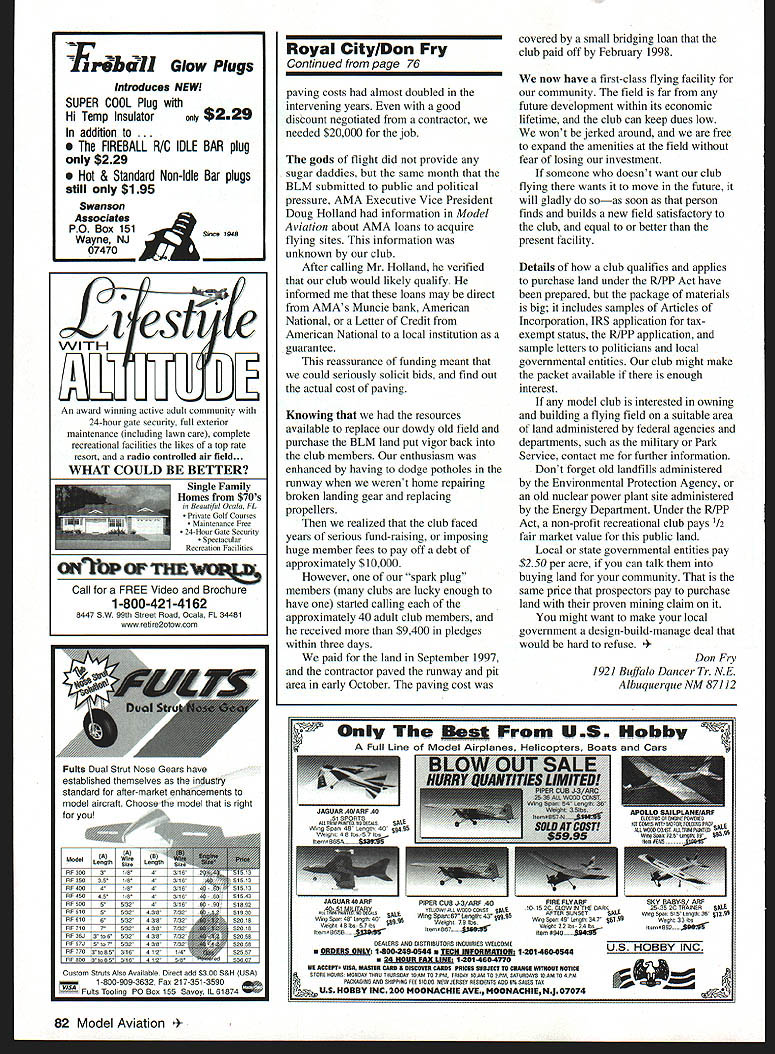
Royal City Gets It Done
Don Fry
Ideal location for a flying field
Model fliers can look out across rolling high-desert country at Mt. Taylor, about 100 airline miles from Santa Fe, New Mexico, and see thousands of square miles ideal for a model-flying field. There are no cornfields or swamps to swallow a downed airplane, no trees more than 15 feet high for as far as the eye can see, and little sign of human activity for scores of miles in any direction.
The land looks worthless and desolate to people from greener regions, and one might think federal custodians of much of this land would welcome finding a purpose for a few barren acres. How mistaken they would be. In a nation of laws and a federal bureaucracy, it is difficult — but possible — to pry a few acres away from these caretakers.
Public land and the BLM
Private development land around Santa Fe, within reasonable driving distance, sells for $20,000–$150,000 per acre. Surrounding private grazing land is affordable for flying fields, but ranchers are loath to sell or lease a few acres of pasture because of restrictive subdivision laws.
The U.S. government and Indian tribes own more than 43% of the land in New Mexico, and the State Land Office (which historically rents land exclusively for agriculture) owns approximately 12%. Much public land ownership, so normal in the Western states, is rare in the East. In the haste of bringing the West into the Union, some states gave much public land to the federal government; New Mexico acquired statehood in 1912.
The Bureau of Land Management (BLM), part of the U.S. Department of the Interior, controls large amounts of Western public land. The Forest Service has mountains and trees; the BLM has the "junk" land of very little productive value — much of it waterless and considered worthless except for livestock grazing.
Leasing, eviction, and the civics lesson
The BLM rented our club some great flying-field land, and the club spent thousands of dollars of club funds to build a small, somewhat paved runway. After a few years the club applied to purchase the land at the suggestion of a helpful BLM employee; not-for-profit organizations can buy federal land under the Recreation and Public Purposes (R&PP) Act.
Instead of helping with the purchase, the BLM issued an eviction notice, claiming our field was imposing on a conservation land block. For about a year the club received no clear explanations. We agreed to abandon the runway and move the field about a mile over an imaginary line onto unrestricted public land. The BLM tried to price us out of the replacement site; the matter required intervention through a U.S. senator's office to reach a settlement.
Over the next four years our club received an unwanted, late-in-life civics lesson: we had to learn arcane laws and regulations and insist that BLM employees follow them.
Purchasing land and building a first-class facility
We purchased two acres of BLM land in late summer 1997 (the purchase was completed in September 1997) to build a satisfactory flying site. When you're talking about building, you're talking about spending big money. No water is available unless a strip is located close to development; without water, forget grass runways. With about 14 inches of annual moisture, a dirt strip turns to talcum powder in summer. Therefore paved runways must be built.
At high altitude you must have long, and often wider, runways. Santa Fe is at about 7,000 feet; a .40-size airplane needs at least 60 feet. Less-dense air makes landing speeds higher and engines less forgiving. That means more asphalt — and more money.
Paving costs had almost doubled in the intervening years. Even with a good discount negotiated from a contractor, we needed about $20,000 for the job.
Financing the project
Thanks to the eviction notice, we had not spent money maintaining the soon-to-be-abandoned field for several years. Instead, annual raffles and club auctions raised several thousand dollars; the first few years' funds were used to pay off the old field-paving debt, and then we saved the excess. Years passed and we accumulated about $10,000.
Around the time the BLM submitted to public and political pressure, Model Aviation contained information about AMA loans to acquire flying sites. After calling Doug Holland, AMA Executive Vice President, he verified that our club would likely qualify. He informed me that these loans might be direct from AMA's bank or provided as a Letter of Credit from American National to a local institution as a guarantee. That reassurance meant we could seriously solicit bids and determine the actual cost of paving.
One of our "spark plug" members called each of the approximately 40 adult club members and received more than $9,400 in pledges within three days. We paid for the land in September 1997, and the contractor paved the runway and pit area in early October. The paving cost was covered by a small bridging loan that the club paid off by February 1998.
We now have a first-class flying facility for our community. The field is far from any likely development within its economic lifetime, and the club can keep dues low. We won't be jerked around, and we are free to expand amenities at the field without fear of losing our investment. If someone who doesn't want our club flying there wants it to move in the future, they can — as soon as that person finds and builds a new field satisfactory to the club and equal to or better than the present facility.
How a club can pursue federal land (R&PP Act) — practical notes
- A non-profit recreational club may purchase public land under the Recreation and Public Purposes (R&PP) Act, often at favorable terms.
- Under the R&PP Act a non-profit typically pays one-half of fair market value for the public land.
- Local or state governmental entities may purchase land for community recreational use at a rate of $2.50 per acre if they will buy it on behalf of the community.
- Consider other federal agencies beyond the BLM:
- military land
- National Park Service land
- Environmental Protection Agency sites (old landfills)
- Department of Energy sites (old nuclear or power-plant sites)
The R&PP application package is large. It includes, for example:
- sample Articles of Incorporation
- IRS application for tax-exempt status
- the R&PP application itself
- sample letters to politicians and local governments
Our club might make the packet available if there is enough interest. If any model club is interested in owning and building a flying field on suitable public land administered by federal agencies other than the BLM, contact the appropriate agency (military, Park Service, EPA, DOE) or contact me for further information.
You might also persuade your local government to take a design-build-manage role that would be hard to refuse.
Don Fry 1921 Buffalo Dancer Tr. N.E. Albuquerque, NM 87112
Transcribed from original scans by AI. Minor OCR errors may remain.

