
Rubber - All You Need to Know
In a previous article the development of several new types of excellent-quality rubber was described. Laboratory tests and field tests with models have demonstrated that these new rubber types are equivalent in quality to pre-1973 Pirelli. Since 1973, when the Pirelli company reorganized and disrupted the supply of rubber used by most contestants, there was no consistent supply of good rubber strip for model airplanes until 1976. In that year FAI rubber appeared and, a little later, Sig and Vintage Aero rubber with similar properties. In 1978 Pirelli arrived back on the scene with the new Pirelli especially made for model fliers. The new Pirelli is yellow-brown and almost translucent, whereas the Filati is dark brown and opaque. The excellent quality of these new types of rubber, according to Mike Dikovitzky, has "put the fun back into flying rubber-powered models!"
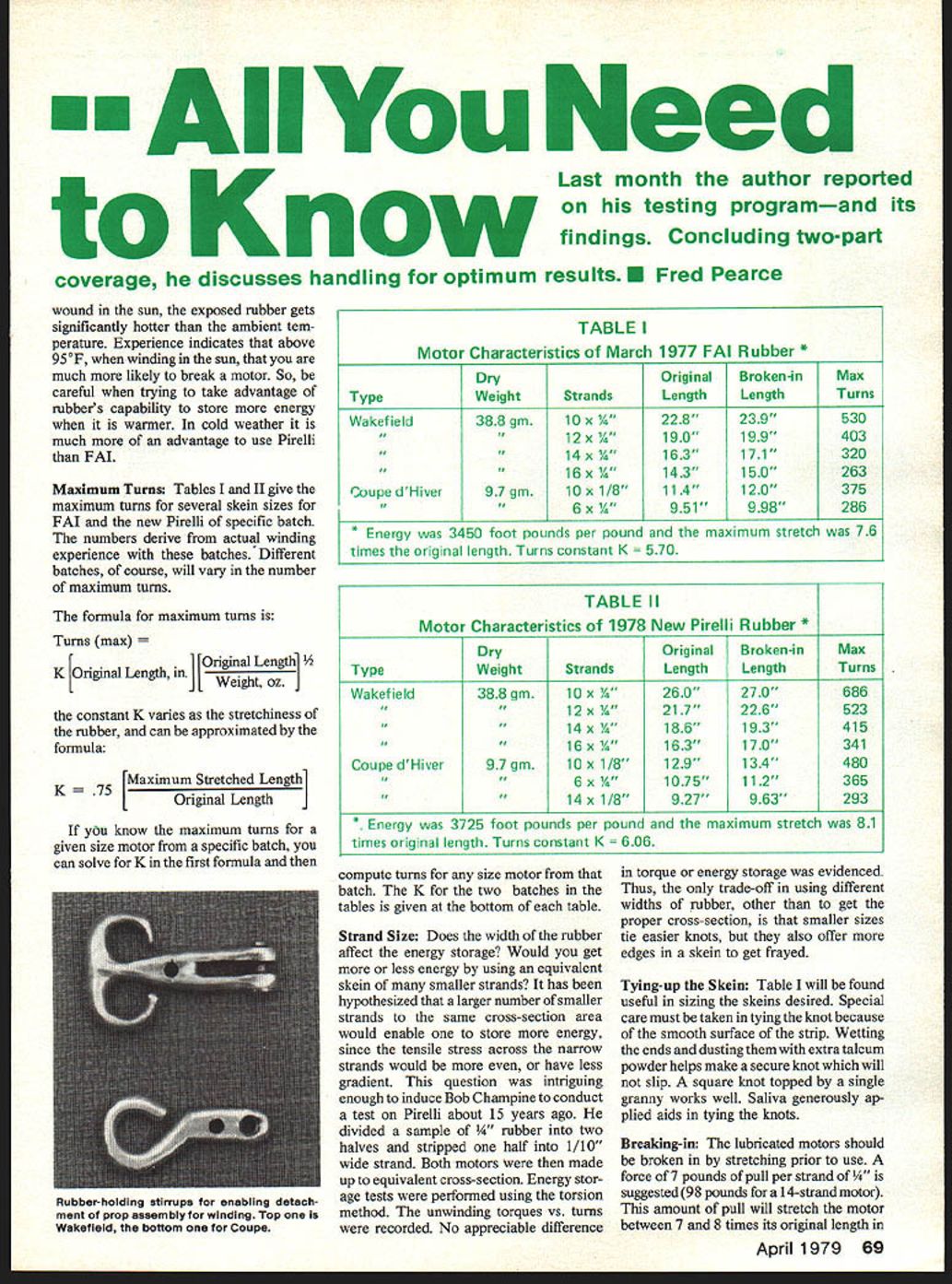
Table I gives the characteristics of a typical batch of FAI rubber. Table II gives the characteristics of a batch of the 1978 new Pirelli. The FAI rubber is thicker than the Pirelli. Typically, 14 strands of FAI is equivalent to 16 strands of Pirelli. The stretchiness of rubber will vary considerably from batch to batch, and is closely correlated with the capability to take turns. Good rubber varies from a maximum stretch in terms of original length of 7.3 to 8.1. Be suspicious of rubber with more or less stretchiness than these figures.
If the maximum stretch is less than 7.3 it is probably old and can be brittle. If it is above 8.2 it can be undervulcanized or too soft. Undervulcanized rubber has a torque curve which drops off more rapidly than good rubber. This gives trimming problems and leads to mushing and stalls shortly after launch, although the power towards the end of the motor run holds up very well.
Expect to find differences from batch to batch of both good types of rubber and inferior types of rubber. Tests of Pirelli from 1958 to 1972 ranged in stretch from 7.4 to 8.4 and energy ranged from 2,940 to 3,525 ft·lb/lb. Current tests of FAI rubber indicate as wide a range of properties as encountered with Pirelli and with the average energy as good as the pre-1973 Pirelli. At the time of this writing, experience with the new Pirelli was limited to one batch. It was superior in energy to all previously tested rubber, giving 3,725 ft·lb/lb. This rubber gave a significant increase in duration as was demonstrated in the down 4-minute rounds at the 1978 Taft Wakefield Eliminations. Although the new Pirelli was the obvious choice for cool early-morning flying, the few fliers with supplies of this scarce new product experienced difficulty later in the day. The Pirelli tended to blow up when the temperatures got over 90°F. This led those with both Pirelli and FAI to switch to FAI rubber, which is much less likely to blow up.
Ambient Temperature Effect
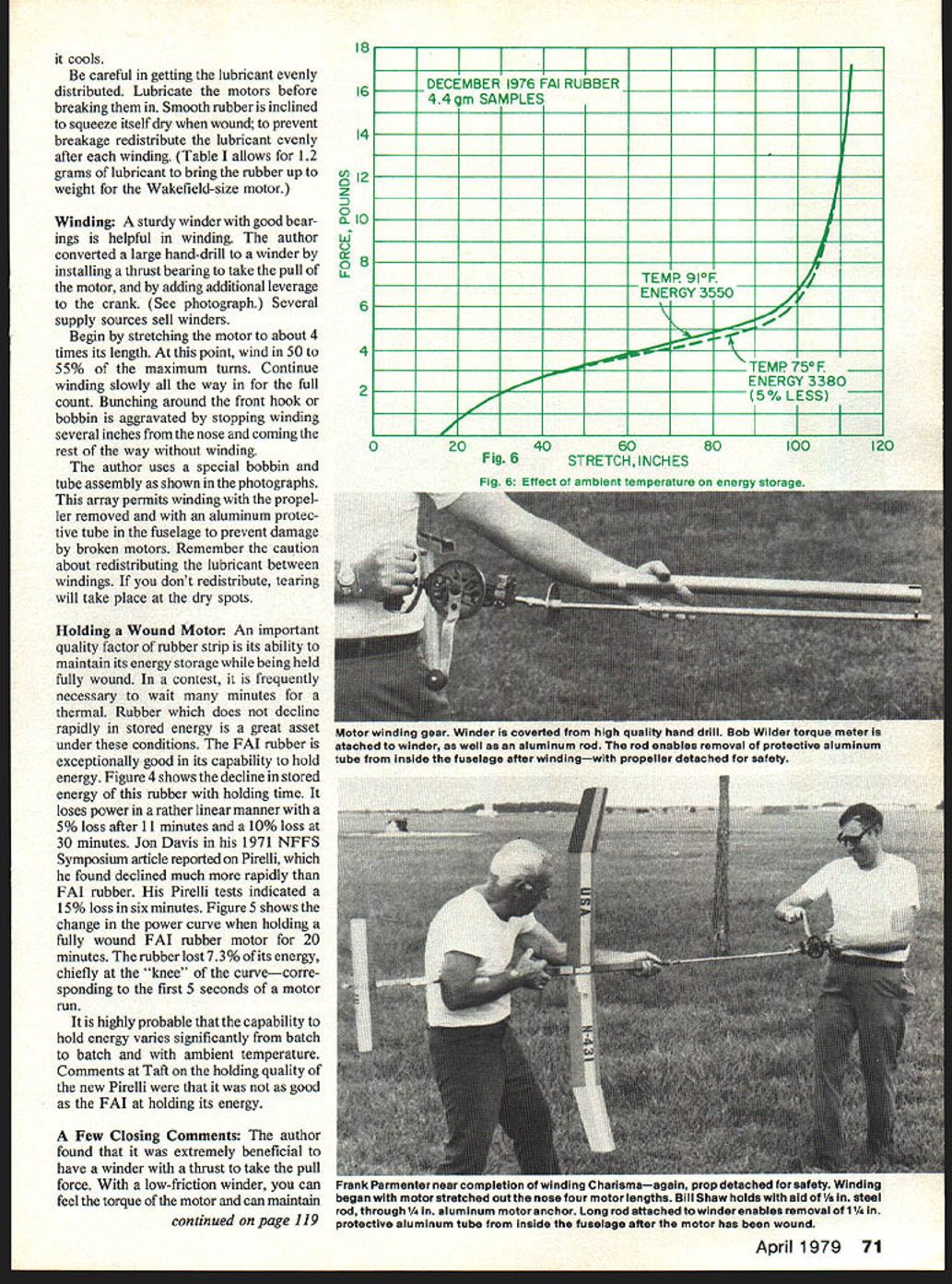
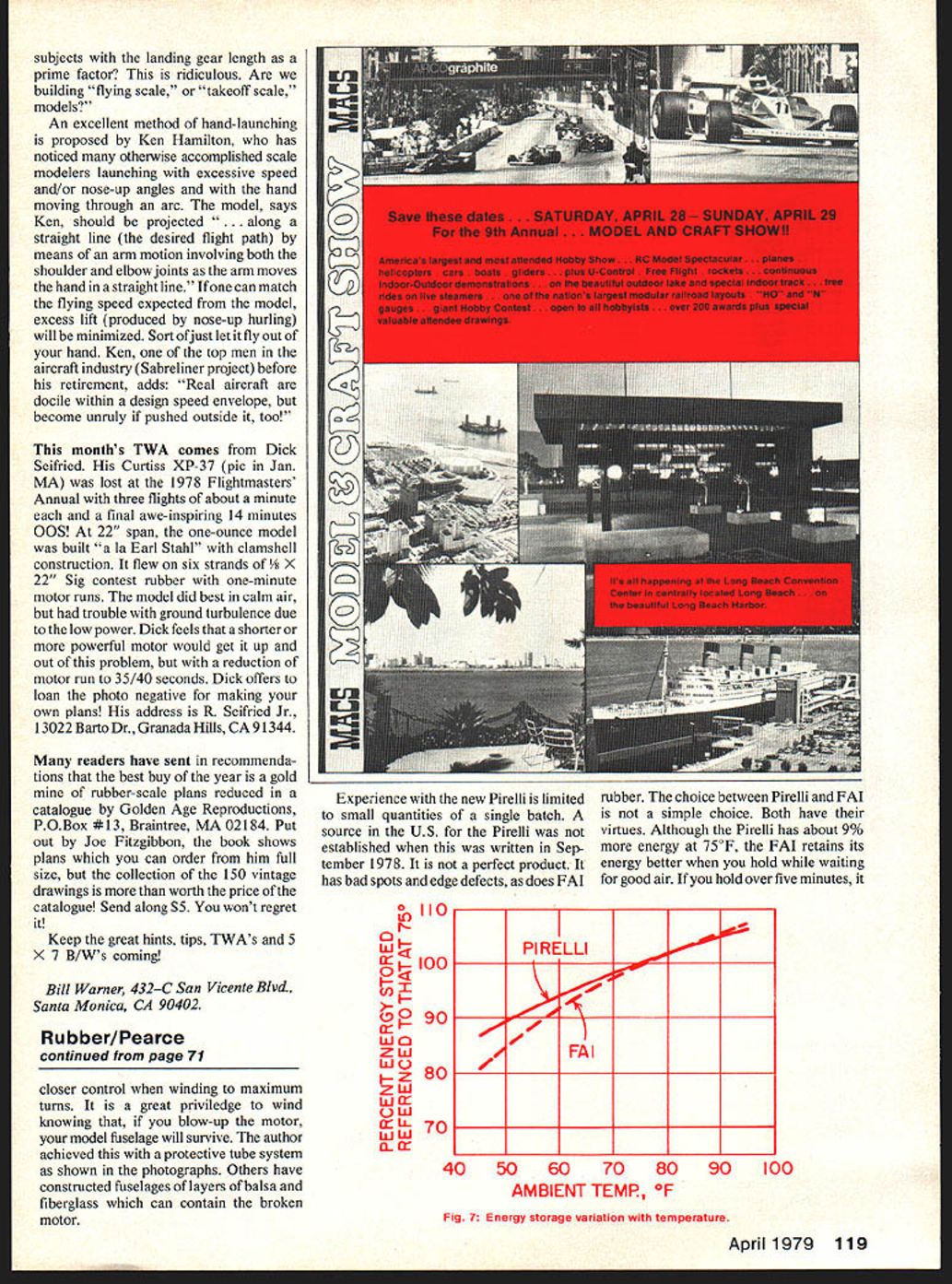
The higher the ambient temperature, the more energy can be stored. In addition, the shape of the power curve is better at higher temperature. There is more energy in the knee of the power curve. With more energy in the knee, the airplane will perform better through the period a few seconds after launch when stalls are more likely. At present the writer has a limited amount of temperature-effect data. Both FAI and Pirelli have about 5% more energy at 90°F than at 75°F. Below 75°F the characteristics diverge. The Pirelli rate of change remains about the same as at higher temperature, but the FAI declines more rapidly, being down perhaps 20% at 40°F. It is thought that these figures vary from batch to batch. (Walter Erbach discussed temperature effect in his report "Energy Storage in Rubber Filaments," published in the 1971 NFFS Symposium.)
Since the rubber stores more energy when it gets hotter, why not try to keep rubber as hot as possible? When being wound in the sun, the exposed rubber gets significantly hotter than the ambient temperature. Experience indicates that above 95°F, when winding in the sun, you are much more likely to break a motor. So be careful when trying to take advantage of rubber's capability to store more energy when it is warmer. In cold weather it is much more of an advantage to use Pirelli than FAI.
Maximum Turns
Tables I and II give the maximum turns for several skein sizes for FAI and the new Pirelli of a specific batch. The numbers derive from actual winding experience with these batches. Different batches, of course, will vary in the number of maximum turns.
The formula for maximum turns is:
Turns (max) = K [Original Length, in.] [Original Length / Weight, oz.]^1/2
The constant K varies as the stretchiness of the rubber and can be approximated by the formula:
K = 0.75 [Maximum Stretched Length / Original Length]
If you know the maximum turns for a given size motor from a specific batch, you can solve for K in the first formula and then compute turns for any size motor from that batch. The K for the two batches in the tables is given at the bottom of each table.
Table I — Motor Characteristics of March 1977 FAI Rubber
Type Dry Weight Strands Original Length Broken-in Length Max Turns Wakefield 38.8 g 10 x 1/4" 22.8" 23.9" 530 38.8 g 12 x 1/4" 19.0" 19.9" 403 38.8 g 14 x 1/4" 16.3" 17.1" 320 38.8 g 16 x 1/4" 14.3" 15.0" 263 Coupe d'Hiver 9.7 g 10 x 1/8" 11.4" 12.0" 375 9.7 g 6 x 1/4" 9.51" 9.98" 286
- Energy was 3,450 ft·lb/lb and the maximum stretch was 7.6 times the original length.
- Turns constant K = 5.70.
Table II — Motor Characteristics of 1978 New Pirelli Rubber
Type Dry Weight Strands Original Length Broken-in Length Max Turns Wakefield 38.8 g 10 x 1/4" 26.0" 27.0" 686 38.8 g 12 x 1/4" 21.7" 22.6" 523 38.8 g 14 x 1/4" 18.6" 19.3" 415 38.8 g 16 x 1/4" 16.3" 17.0" 341 Coupe d'Hiver 9.7 g 10 x 1/8" 12.9" 13.4" 480 9.7 g 6 x 1/4" 10.75" 11.2" 365 9.7 g 14 x 1/8" 9.27" 9.63" 293
- Energy was 3,725 ft·lb/lb and the maximum stretch was 8.1 times original length.
- Turns constant K = 6.06.
Strand Size
Does the width of the rubber affect the energy storage? Would you get more or less energy by using an equivalent skein of many smaller strands? It has been hypothesized that a larger number of smaller strands with the same cross-sectional area would enable one to store more energy, since the tensile stress across the narrow strands would be more even. This question was intriguing enough to induce Bob Champine to conduct a test on Pirelli about 15 years earlier. He divided a sample of 1/4" rubber into two halves and stripped one half into 1/10" wide strand. Both motors were then made up to equivalent cross-section. Energy storage tests were performed using the torsion method. The unwinding torques vs. turns were recorded. No appreciable difference in torque or energy storage was evidenced. Thus, the only trade-off in using different widths of rubber, other than to get the proper cross-section, is that smaller sizes tie easier knots, but they also offer more edges in a skein to get frayed.
Tying-up the Skein
Table I will be useful in sizing the skeins desired. Special care must be taken in tying the knot because of the smooth surface of the strip.
- Wet the ends and dust them with talcum powder to help make a secure knot which will not slip.
- A square knot topped by a single granny works well.
- Saliva generously applied aids in tying the knots.
Breaking-in
The lubricated motors should be broken in by stretching prior to use. A force of 7 pounds of pull per strand of 1/8" is suggested (98 pounds for a 14-strand motor). This amount of pull will stretch the motor between 7 and 8 times its original length in several minutes. The author pulls the motors twice: once very quickly to 7 lb/strand, relaxing immediately; then a second time, holding the motor for 5 minutes. It is important to have a secure anchor point. A second anchor point for the end you pull is equally important. Inspect and re-tie any slipped or torn knots. If measuring the pull force is impractical, stretch to at least 7 times the original length and hold for 5 minutes.
Lubrication
A green soap and glycerine mixture is recommended. The green soap is hard to find, although it can occasionally be found in one-pound jars. It resembles brown grease in this form. More often, only tincture of green soap is available. All the alcohol must be boiled out of the tincture as it is very corrosive to rubber.
To prepare the lubricant:
- Boil 8 ounces of tincture in a saucepan at low heat.
- After it boils for about 20 minutes, add about 3 ounces of glycerine and boil another 20 minutes at low heat.
- Adjust the viscosity to that of thin honey by adding glycerine after it cools.
Be careful in getting the lubricant evenly distributed. Lubricate the motors before breaking them in. Smooth rubber is inclined to squeeze itself dry when wound; to prevent breakage, redistribute the lubricant evenly after each winding. (Table I allows for 1.2 g of lubricant to bring the rubber up to weight for the Wakefield-size motor.)
Winding
A sturdy winder with good bearings is helpful in winding. The author converted a large hand drill to a winder by installing a thrust bearing to take the pull of the motor and by adding additional leverage to the crank. Several supply sources sell winders.
- Begin by stretching the motor to about 4 times its length. At this point, wind in 50–55% of the maximum turns.
- Continue winding slowly all the way in for the full count.
- Bunching around the front hook or bobbin is aggravated by stopping winding several inches from the nose and coming the rest of the way without winding.
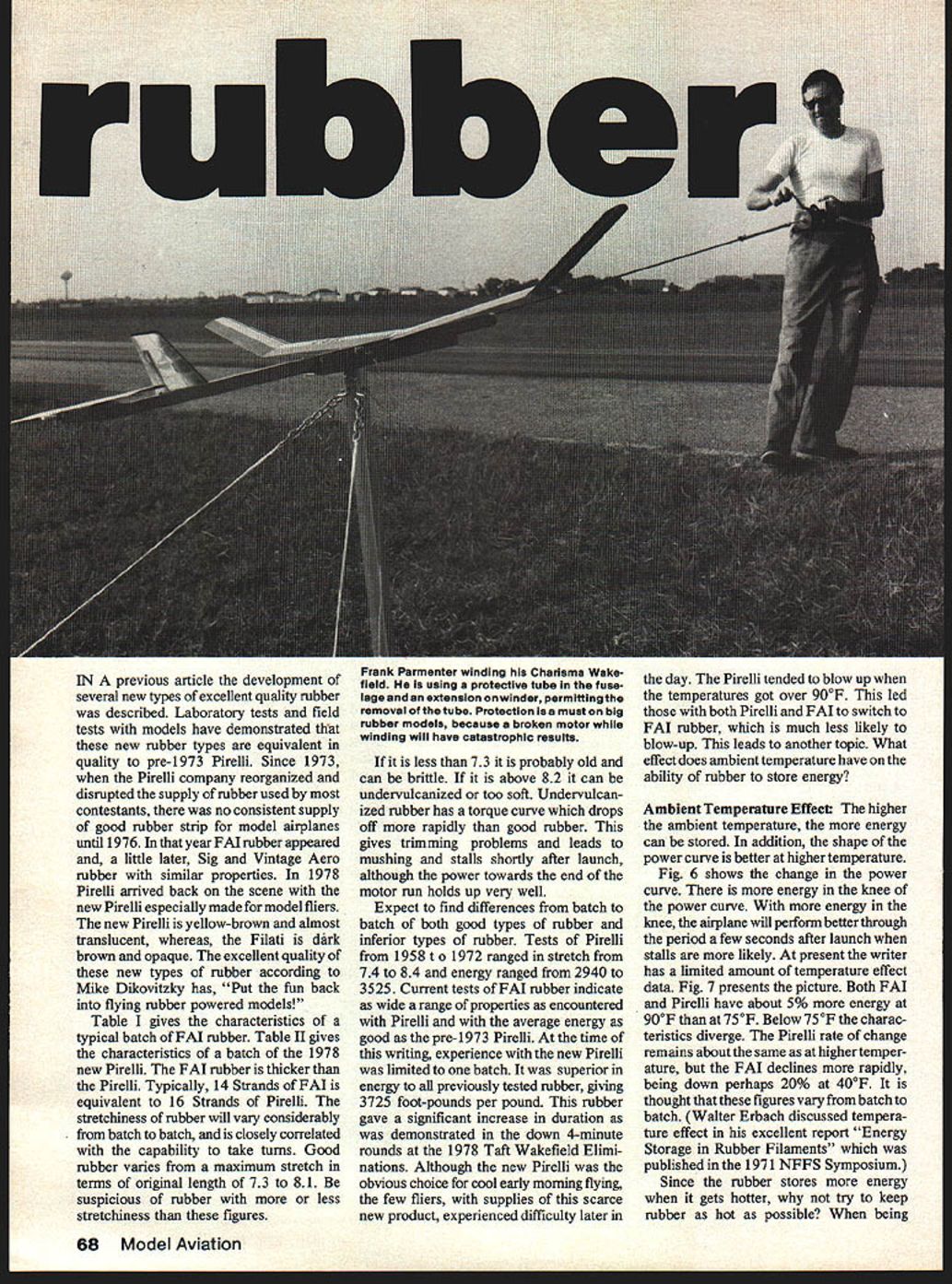
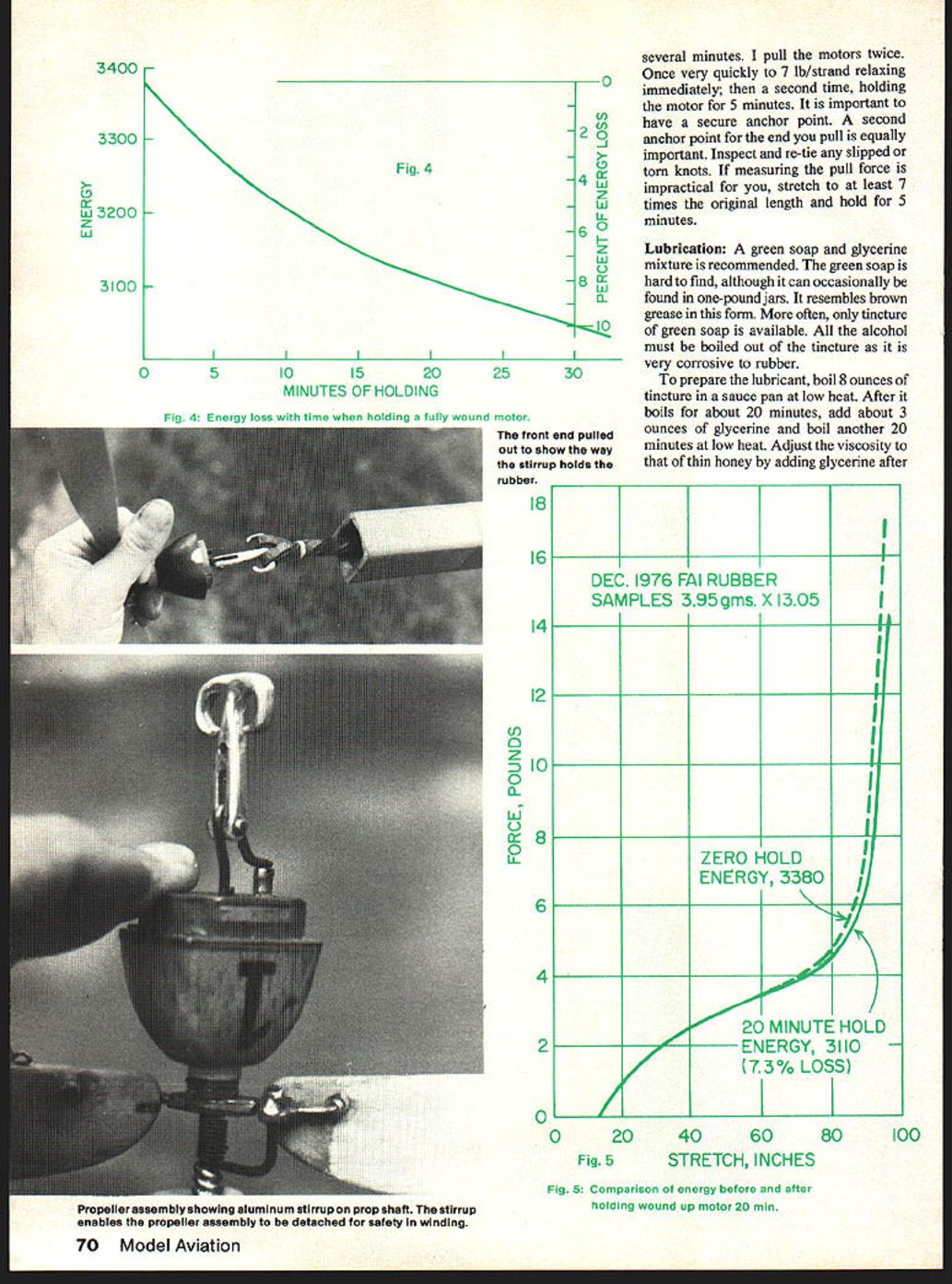
The author uses a special bobbin and tube assembly. This arrangement permits winding with the propeller removed and with an aluminum protective tube in the fuselage to prevent damage from broken motors. Remember the caution about redistributing the lubricant between windings. If you don't redistribute, tearing will take place at the dry spots.
Holding a Wound Motor
An important quality factor of rubber strip is its ability to maintain its energy storage while being held fully wound. In a contest it is frequently necessary to wait many minutes for a thermal. Rubber which does not decline rapidly in stored energy is a great asset under these conditions. The FAI rubber is exceptionally good in its capability to hold energy. It loses power in a rather linear manner with a 5% loss after 11 minutes and a 10% loss at 30 minutes. Jon Davis, in his 1971 NFFS Symposium article, reported on Pirelli, which he found declined much more rapidly than FAI rubber. His Pirelli tests indicated a 15% loss in six minutes. When holding a fully wound FAI rubber motor for 20 minutes the rubber lost 7.3% of its energy, chiefly at the "knee" of the curve—corresponding to the first 5 seconds of a motor run.
It is highly probable that the capability to hold energy varies significantly from batch to batch and with ambient temperature. Comments at Taft on the holding quality of the new Pirelli were that it was not as good as the FAI at holding its energy.
A Few Closing Comments
The author found that it was extremely beneficial to have a winder with a thrust bearing to take the pull force. With a low-friction winder, you can feel the torque of the motor and can maintain closer control when winding to maximum turns. It is a great privilege to wind knowing that, if you blow up the motor, your model fuselage will survive. The author achieved this with a protective tube system. Others have constructed fuselages of layers of balsa and fiberglass which can contain the broken motor.
Experience with the new Pirelli is limited to small quantities of a single batch. It is not a perfect product. It has bad spots and edge defects, as does FAI rubber. The choice between Pirelli and FAI is not a simple choice. Both have their virtues. Although the Pirelli has about 9% more energy at 75°F, the FAI retains its energy better when you hold while waiting for good air. If you hold over five minutes, it is probable that the FAI will have more energy, since the FAI loses energy at a much lower rate. The Pirelli, despite its 9% higher energy storage, proved treacherous in very hot weather at Taft when frequent breaking was encountered. But we have experience with only one batch of new Pirelli. Who knows what subsequent batches may be like!
FAI rubber can be obtained from FAI Model Supply, P.O. Box 9778, Phoenix, AZ 85068. The new Pirelli can also be obtained from FAI Model Supply and from Oldtimer Models, P.O. Box 18002, Milwaukee, WI 53218.
If you have any questions or news concerning rubber, please contact the author, Fred Pearce, at 5317 Blythewood St., Houston, TX 77021.
Transcribed from original scans by AI. Minor OCR errors may remain.

