
Rubber Scale Round Up
Allan Schanzle
For every RC plane that rings a cashier's bell, there must be ten rubber-powered scale kits sold to kids, aged 5 to 95. Yet we seldom see these "kids" with their models. Maybe the choice of kit exceeded the builder's skills, or the design required considerable experience to trim for successful flight. Whatever the reason, we hope that by the time you finish this article, your chances of success with rubber-powered scale kits will be significantly increased.
Since we will talk only about kits, the majority of the information presented here is directed to the sport flier. The truly competitive-minded individual seldom builds from kits, usually designs his own models, and is already familiar with many of the tricks of rubber power. Consequently, let's define a successful rubber-powered scale kit as one which can be expected to fly at least 30 seconds without the assistance of thermals or buoyant air.
One other point should be emphasized: the definition of "scale." It is seldom, if ever, that you will find true scale structure in any mass-produced rubber kit, and even the outlines for the same plane will vary from manufacturer to manufacturer. In all cases, however, the models referenced here are easily recognizable as replicas of the full-scale aircraft.
I've known for many years that the real secret of success for rubber power is to obtain the magical combination of prop and rubber for a given aerodynamic configuration. The impetus for experimentation occurred recently when an abundance of rubber-scale activity emerged in the Washington, D.C. area. Through trial and error (95% error), this group has become recognized as some of the best rubber scale modelers in the country. For the last four years, the AMA outdoor rubber-scale champion has come from the ranks of the D.C. Maxecuters. The Grand National Champion of the Flying Aces Club Nationals also comes from this group of fliers. We've learned many of the tricks of rubber scale, but some models still defy our current skills. That's what makes this hobby fun—the challenge of always doing a little better than before, even if you compete only against yourself.
For those not currently active in rubber scale, a few non-scale beginner's kits will be mentioned to tide you over the teething period of rubber power. In addition, some suggestions will be made concerning techniques for getting the most out of any rubber model. Finally, a list of manufacturers who carry items of interest to rubber scale is given at the end of this article. I strongly suggest sending off for their catalogs to see exactly what is available.
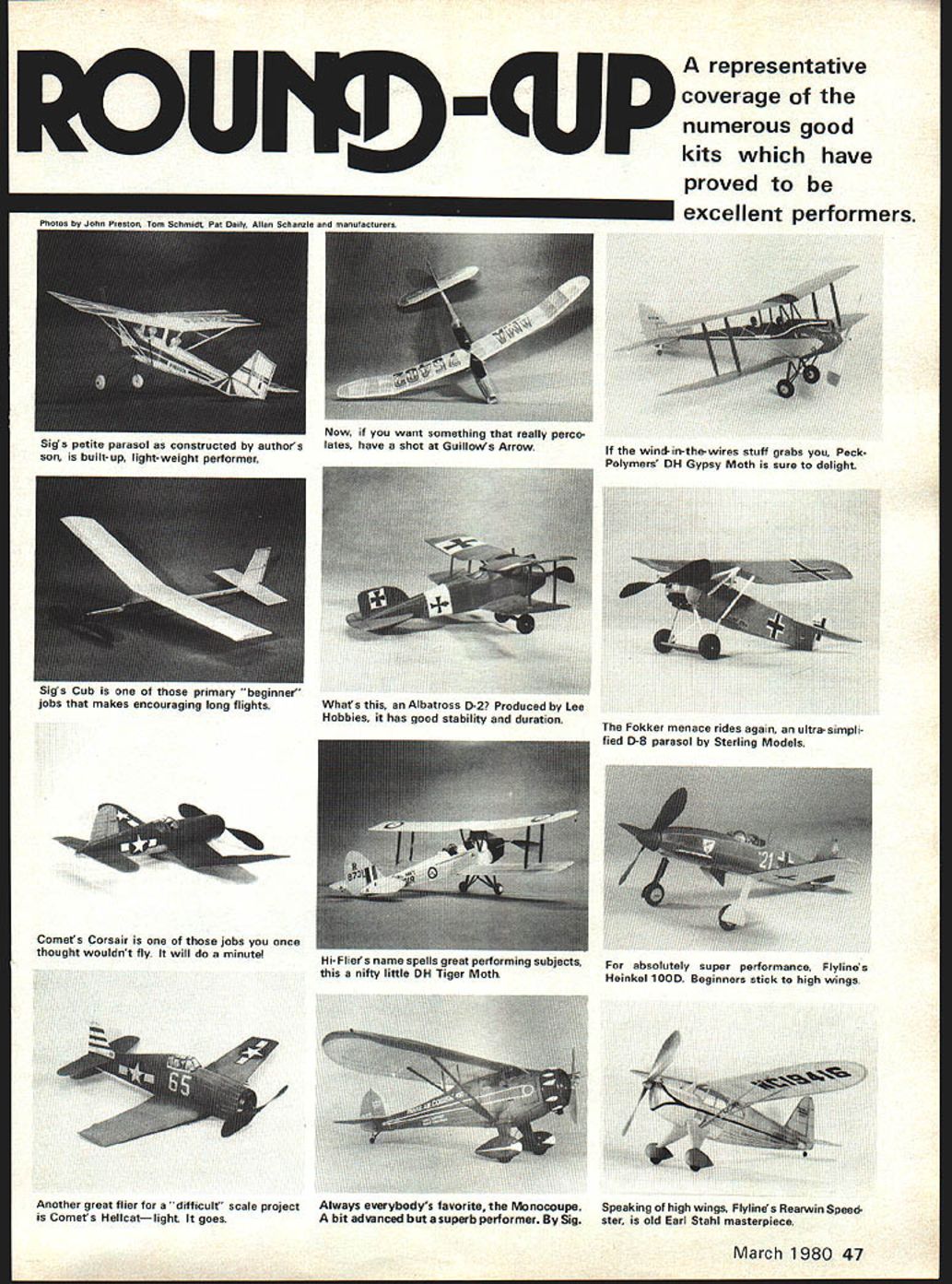
A representative coverage of numerous good kits that have proved excellent performers is presented here. Photos by John Preston, Tom Schmidt, Pat Daily, Allan Schanzle and manufacturers.
- Sig's petite Parasol (as constructed by the author's son) is a built-up, lightweight performer.
- If you want something that really percolates, have a shot at Guillow's Arrow.
- If the "wind-in-the-wires" stuff grabs you, Peck-Polymers' DH Gipsy Moth is sure to delight.
- Sig's Cub is one of those primary "beginner" jobs that encourages long flights.
- Lee Hobbies' Albatross D-2 has good stability and duration.
- Sterling Models' ultra-simplified Fokker D-8 parasol revives a classic, peanut-scale design.
- Comet's Corsair is one of those jobs you once thought wouldn't fly — it will do a minute!
- Hi-Flier's DH Tiger Moth is a nifty little, great-performing subject.
- For absolutely super performance, Flyline's Heinkel He 100D is superb. Beginners should stick to high wings.
- Comet's Hellcat is another great flier for a "difficult" scale project — light and it goes.
- Always a favorite, the Monocoupe (by Sig) is a bit advanced but a superb performer.
- Flyline's Rearwin Speedster honors Earl Stahl's classic design.
Non-Scale Rubber Kits
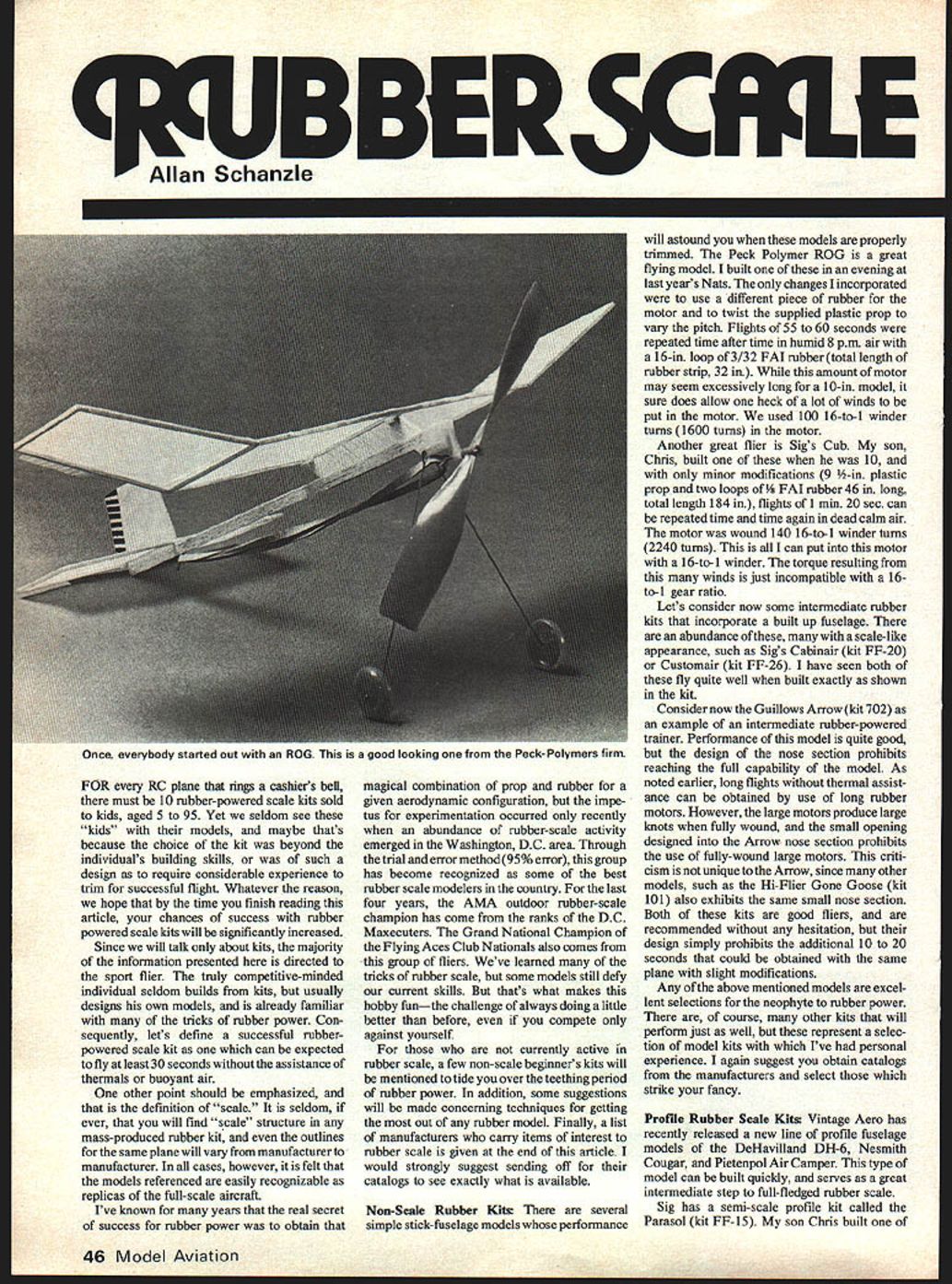
There are several simple stick-fuselage models whose performance will astound you when properly trimmed. The Peck Polymer ROG is a great flying model; I built one in an evening at last year's Nats. The only changes I made were to use a different piece of rubber for the motor and to twist the supplied plastic prop to vary the pitch. Flights of 55 to 60 seconds were repeated in humid 8 p.m. air with a 16-in. loop of 3/32 FAI rubber (total strip length 32 in.). While this amount of motor may seem excessively long for a 10-in. model, it allows a lot of winds to be put in the motor. We used 100 16:1 winder turns (1600 turns) in the motor.
Another great flier is Sig's Cub. My son Chris built one when he was ten. With only minor modifications (9½-in. plastic prop and two loops of 5/16 FAI rubber, 46 in. long each; total length 184 in.), flights of 1 minute 20 seconds can be repeated in dead calm air. The motor was wound 140 16:1 winder turns (2240 turns). This is about as much as I can put into this motor with a 16:1 winder—the torque from so many winds is just incompatible with that gear ratio.
Consider some intermediate rubber kits that incorporate a built-up fuselage. Many have a scale-like appearance, such as Sig's Cabinair (kit FF-20) and Customair (kit FF-26). Both fly quite well when built as shown in the kit.
Consider Guillow's Arrow (kit 702) as an example of an intermediate rubber-powered trainer. Performance is quite good, but the nose section design prohibits reaching the full capability of the model. Long flights without thermal assistance can be obtained by using long rubber motors; however, large motors produce large knots when fully wound, and the small nose opening on the Arrow prohibits the use of fully-wound large motors. This criticism applies to other models too, such as the Hi-Flier Gone Goose (kit 101). Both kits are good fliers and are recommended, but their design limits the additional 10–20 seconds that could be obtained with slight modifications (enlarging the nose opening).
Any of the above-mentioned models are excellent selections for the neophyte to rubber power. There are many other kits that will perform just as well; these represent models with which I've had personal experience. Obtain manufacturers' catalogs and select those that strike your fancy.
Profile Rubber Scale Kits
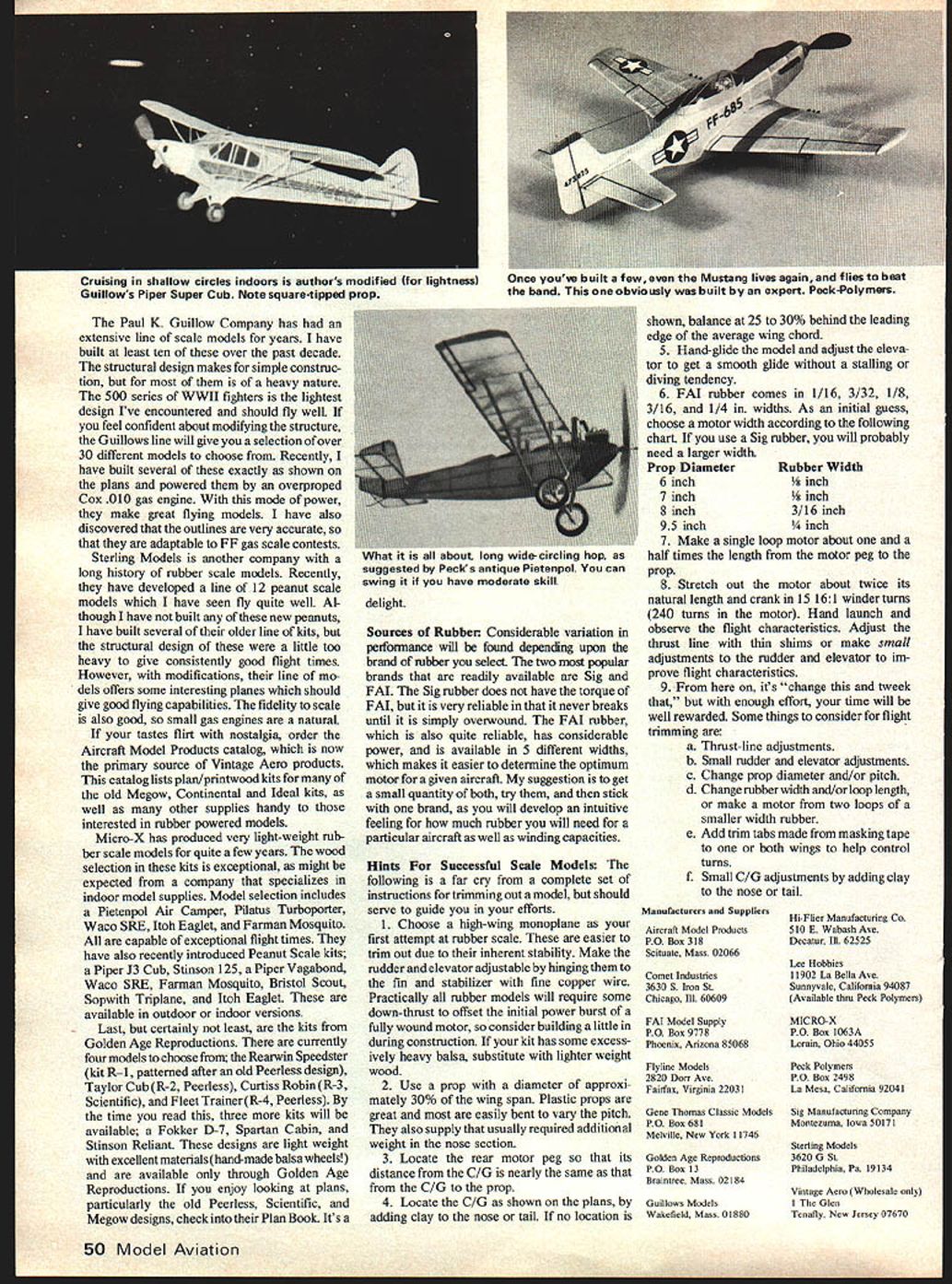
Vintage Aero recently released a new line of profile fuselage models: DeHavilland DH-6, Nieuport, Cougar, and Pietenpol Air Camper. These models can be built quickly and serve as a great intermediate step to full-fledged rubber scale.
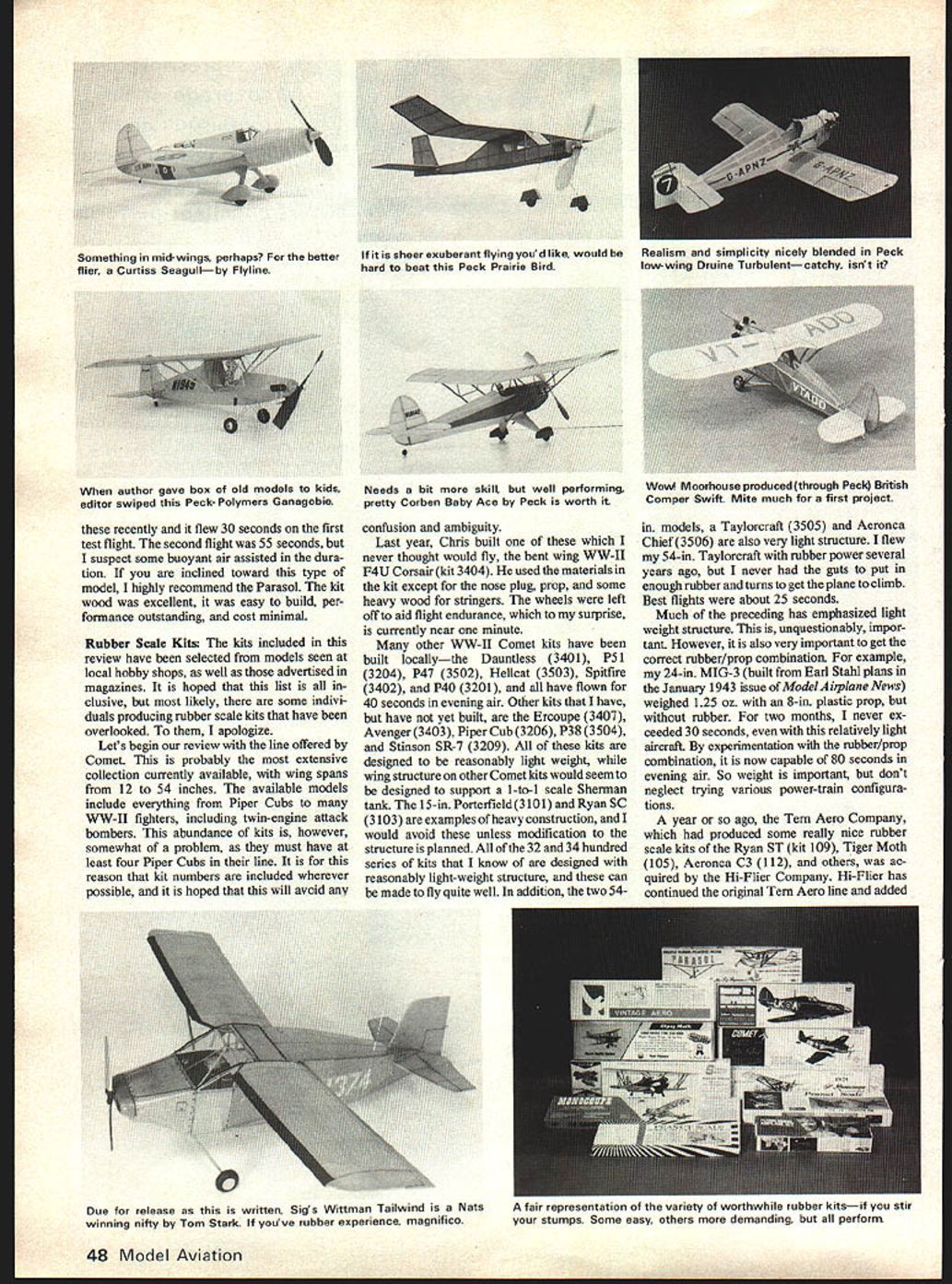
Sig has a semi-scale profile kit called the Parasol (kit FF-15). My son Chris built one of these recently; it flew 30 seconds on the first test flight and 55 seconds on the second (the second may have had some buoyant air assistance). If you are inclined toward this type of model, I highly recommend the Parasol. The kit wood was excellent, it was easy to build, performance was outstanding, and the cost was minimal.
Rubber Scale Kits
The kits included in this review have been selected from models seen at local hobby shops and those advertised in magazines. It is hoped that this list is all inclusive, but some manufacturers or small producers may have been overlooked. To them, I apologize.
Let's begin with Comet. This is probably the most extensive collection currently available, with wingspans from 12 to 54 inches. The available models include everything from Piper Cubs to many WWII fighters and twin-engine attack bombers. This abundance is somewhat of a problem—Comet must have at least four Piper Cubs in their line. Kit numbers are included where possible to avoid confusion.
Last year Chris built one I never thought would fly: the bent-wing WWII F4U Corsair (kit 3404). He used the kit materials except for the nose plug, prop, and some heavy wood for stringers. The wheels were left off to aid endurance; to my surprise, flights are currently near one minute.
Many other WWII Comet kits have been built locally—the Dauntless (3401), P-51 (3204), P-47 (3502), Hellcat (3503), Spitfire (3402), and P-40 (3201)—all have flown for 40 seconds in evening air. Other kits I own but haven't built yet include the Corregidor (3407), Avenger (3403), Piper Cub (3206), P-38 (3504), and Stinson SR-7 (3209). These kits are designed to be reasonably lightweight, while some Comet kits (15-in. Porterfield 3101 and Ryan SC 3103) are heavy and should be avoided unless you plan to modify the structure. All of the 3200 and 3400 series are reasonably light and can fly quite well. The two 54-in. models—a Taylorcraft (3505) and Aeronca Chief (3506)—also have light structure. I flew my 54-in. Taylorcraft with rubber power several years ago, but never had the guts to put in enough rubber and turns to get it to climb; best flights were about 25 seconds.
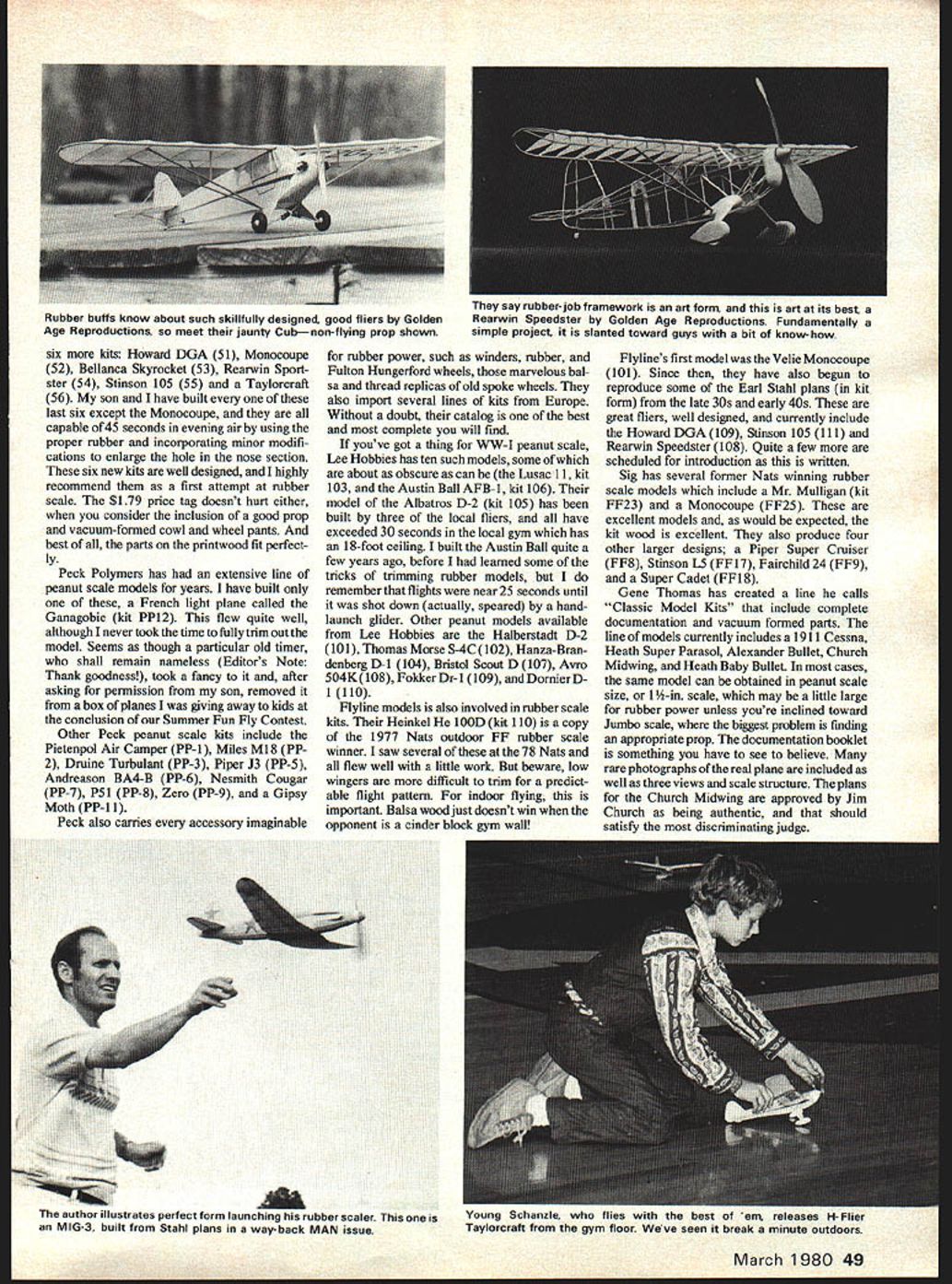
Lightweight structure is important, but getting the correct rubber/prop combination is equally critical. For example, my 24-in. MIG-3 (built from Earl Stahl plans) weighed 1.25 oz. with an 8-in. plastic prop (no rubber). For two months I never exceeded 30 seconds. By experimenting with rubber/prop combinations, it is now capable of 80 seconds in evening air. So weight matters, but don't neglect power-train experiments.
A year or so ago Tern Aero (producer of nice rubber scale kits: Ryan ST kit 109, Tiger Moth 105, Aeronca C3 112, etc.) was acquired by Hi-Flier. Hi-Flier continued the original Tern Aero line and added six more kits: Howard DGA (51), Monocoupe (52), Bellanca Skyrocket (53), Rearwin Sportster (54), Stinson 105 (55), and Taylorcraft (56). My son and I have built every one of these last six except the Monocoupe; they are all capable of 45 seconds in evening air when using the proper rubber and making minor modifications to enlarge the nose hole. These six new kits are well designed and highly recommended as first attempts at rubber scale. The $1.79 price tag is attractive, and the kits include a good prop and vacuum-formed cowl and wheel pants. The printwood parts fit perfectly.
Peck Polymers has had an extensive line of peanut scale models for years. I built one of these, a French light plane called the Gannagoc (kit PP12). It flew quite well, though I never fully trimmed it. Peck also offers many other peanuts: Pietenpol Air Camper (PP-1), Miles M.18 (PP-2), Druine Turbulent (PP-3), Piper J-3 (PP-5), Andreasson BA-4B (PP-6), Nesmith Cougar (PP-7), P-51 (PP-8), Zero (PP-9), and a Gipsy Moth (PP-11).
Peck carries every accessory imaginable for rubber power—winders, rubber, Fulton Hungerford wheels (marvelous balsa-and-thread replicas of old spoke wheels)—and imports several European kit lines. Their catalog is among the best and most complete you will find.
If you like WWI peanut scale, Lee Hobbies has ten such models, some quite obscure (Lusac 11 kit 103, Austin Ball A.F.B.-1 kit 106). Their Albatross D.II (kit 105) has been built by three local fliers and all exceeded 30 seconds in a gym with an 18-ft ceiling. I built the Austin Ball years ago and got about 25 seconds until it was speared by a hand-launched glider. Other Lee peanut models include Halberstadt D.II (101), Thomas Morse S-4C (102), Hansa-Brandenburg D.I (104), Bristol Scout D (107), Avro 504K (108), Fokker Dr.I (109), and Dornier D.I (110).
Flyline is also involved in rubber scale. Their Heinkel He 100D (kit 110) is a copy of the 1977 Nats outdoor FF rubber scale winner. I saw several at the '78 Nats; all flew well with some trimming. Be aware that low-winder models are more difficult to trim for a predictable flight pattern—important for indoor flying where a cinder-block gym wall awaits!
Flyline's first model was the Velie Monocoupe (101). Since then they've reproduced many Earl Stahl plans (kit forms) from the late '30s and '40s. Their line includes Howard DGA (109), Stinson 105 (111), and Rearwin Speedster (108), with more planned.
Sig has several former Nats-winning rubber scale models, including a Mr. Mulligan (kit FF-23) and a Monocoupe (FF-25). The kit wood is excellent. They also produce larger designs: Piper Super Cruiser (FF-8), Stinson L-5 (FF-17), Fairchild 24 (FF-9), and Super Cub (FF-18).
Gene Thomas's "Classic Model Kits" include complete documentation and vacuum-formed parts. Models include a 1911 Cessna, Heath Super Parasol, Alexander Bullet, Church Midwing, and Heath Baby Bullet. Many of the same models are available in peanut or 1/2-in. scale (the latter may be large for rubber power unless you're into jumbo scale). The documentation booklets are exceptional—rare photographs, three-views, and scale structure. The Church Midwing plans are approved by Jim Church.
The Paul K. Guillow Company has had an extensive line of scale models for years. I have built at least ten. The structural design makes for simple construction but is heavy in many cases. The 500 series of WWII fighters is the lightest Guillow design I've seen and should fly well. If you're confident modifying structure, Guillow offers over 30 different models. I have also powered several Guillow kits with overpropped Cox .010 gas engines; with that power they make great flying models. The outlines are accurate and adaptable to free-flight gas scale contests.
Sterling Models has a long history of rubber scale kits and recently developed a line of 1/2 peanut-scale models that fly well. Their older kits tended to be heavy, but with modification they offer interesting planes with good fidelity to scale—small gas engines are a natural fit.
For nostalgia, order the Aircraft Model Products catalog, now the primary source of Vintage Aero products. It lists plan/printed-balsa kits for many old Megow, Continental, and Ideal kits, plus supplies handy for rubber-powered modelers.
Micro-X has produced very lightweight rubber scale models for years. The wood selection is exceptional, as expected from a company specializing in indoor model supplies. Examples include Pietenpol Air Camper, Pilatus Turbopropter, Waco SRE, Itoh Eaglet, and Farman Mosquito. All are capable of exceptional flight times. Micro-X also introduced peanut-scale kits for outdoor flying: Piper J3 Cub, Stinson 125, Piper Vagabond, Waco SRE, Farman Mosquito, Bristol Scout, Sopwith Triplane, and Itoh Eaglet.
Golden Age Reproductions offers lightweight designs with excellent materials (hand-made balsa wheels!). Current models include Rearwin Speedster (R-1, patterned after an old Peerless design), Taylor Cub (R-2, Peerless), Currist Robin (R-3, Scientific), and Fleet Trainer (R-4, Peerless). Additional kits soon to be available include a Fokker D-7, Spartan Cabin, and Stinson Reliant. Their Plan Book, featuring old Peerless, Scientific, and Megow designs, is a delight.
Sources of Rubber
Considerable variation in performance will be found depending on the brand of rubber you select. The two most popular readily available brands are Sig and FAI. Sig rubber does not have the torque of FAI but is very reliable and seldom breaks until simply overwound. FAI rubber has considerable torque, is also reliable, and is available in five widths, making it easier to determine the optimum motor for a given aircraft. My suggestion: get a small quantity of both, try them, and then stick with one brand. You will develop an intuitive feeling for how much rubber you need for a particular aircraft and the winding capacities.
Hints For Successful Scale Models
The following is not a complete set of trimming instructions but should guide your efforts.
- Choose a high-wing monoplane as your first rubber-scale attempt. These are easier to trim due to inherent stability. Make the rudder and elevator adjustable by hinging them to the fin and stabilizer with fine copper wire. Practically all rubber models will require some down-thrust to offset the initial power burst of a fully wound motor, so consider building a little in during construction. If your kit has excessively heavy balsa, substitute lighter-weight wood.
- Use a prop with a diameter of approximately 30% of the wingspan. Plastic props are great and most are easily bent or re-pitched. They also add the usually required additional nose weight.
- Locate the rear motor peg so that its distance from the C/G is nearly the same as the distance from the C/G to the prop.
- Locate the C/G as shown on the plans by adding clay to the nose or tail. If no location is shown, balance at 25–30% behind the leading edge of the average wing chord.
- Hand-glide the model and adjust the elevator to get a smooth glide without a stalling or diving tendency.
- FAI rubber comes in 1/16, 3/32, 1/8, 3/16, and 1/4 in. widths. As an initial guess, choose motor width according to this guide (if you use Sig rubber, you will probably need a larger width):
- Prop diameter ~6 in — Rubber width 1/8 in
- Prop diameter ~7 in — Rubber width 1/8 in
- Prop diameter ~8 in — Rubber width 3/16 in
- Prop diameter ~9.5 in — Rubber width 1/4 in
- Make a single-loop motor about 1.5 times the length from the motor peg to the prop.
- Stretch the motor about twice its natural length and crank in 15 16:1 winder turns (240 turns in the motor). Hand-launch and observe the flight characteristics. Adjust the thrust line with thin shims or make small rudder and elevator adjustments to improve flight.
- From here on, it's "change this and tweak that." Some things to consider for flight trimming:
- Thrust-line adjustments.
- Small rudder and elevator adjustments.
- Change prop diameter and/or pitch.
- Change rubber width and/or loop length, or make a motor from two loops of a smaller-width rubber.
- Add trim tabs (masking tape) to one or both wings to help control turns.
- Small C/G adjustments by adding clay to the nose or tail.
Manufacturers and Suppliers
Aircraft Model Products P.O. Box 318 Scituate, Mass. 02066
Comet Industries 3630 S. Iron St. Chicago, Ill. 60609
FAI Model Supply P.O. Box 9776 Phoenix, Arizona 85068
Flying Models 2820 Dorr Ave. Fairfax, Virginia 22031
Gene Thomas Classic Models P.O. Box 681 Melville, New York 11745
Golden Age Reproductions P.O. Box 13 Braintree, Mass. 02184
Guillow Models P.O. Box 131 Wakefield, Mass. 01880
Hi-Flier Manufacturing Co. 510 E. Wabash Ave. Decatur, Ill. 62525
Lee Hobbies 11902 La Bella Ave. Sunnyvale, California 94087 (available through Peck Polymers)
MICRO-X P.O. Box 1043A Urbana, Ohio 43055
Peck Polymers P.O. Box 2488 La Mesa, California 92041
Sig Manufacturing Company Montezuma, Iowa 50171
Sterling Models 3620 GL Philadelphia, Pa. 19134
Vintage Aero (Wholesale only) The Glen Tenafly, New Jersey 07670
Transcribed from original scans by AI. Minor OCR errors may remain.

