
RUDY KLING
— Clarence Mather
A modeler of note shares recollections of his preteen days when he and his parents lived in the Illinois town for which Rudy Kling's 1937 Thompson Trophy winner, Jupiter — "Pride of Lemont" — was named.
Early life and Lemont
In 1987 it was 50 years since Clayton Folkerts' air-racer design SK-3 had its days of glory and its tragic finale as Rudy Kling's Jupiter, Pride of Lemont. I'd like to share my memories of some of the people, places, and events of that era. I'll be as accurate as a mediocre memory permits.
Lemont, Illinois, is situated on one of the Des Plaines River floodplains, a hilly, southeastward-facing bank about 30 miles southwest of Chicago. The Albert Kling farm was a couple of miles from town on a gravel road. A few more turns down the road was the John Mather farm where I was born. Among my earliest memories is riding to town in the family Model T. On the way we passed the Kling farm, which was somewhat unusual in that the house was on one side of the road and the barn on the other. Often one or more of the Kling boys—Tom, Rudy, and Fritz—would be on the property and wave as we passed.
In Lemont the pace of life was quickening. One day a gang of workmen, some horse-drawn earth scoops, and a concrete mixer appeared on one of the gravel roads. When the paving was completed, it was named Highway 66 — a concrete ribbon that I was to travel, many years later, all the way to Los Angeles. Soon after Highway 66 was completed, Rudy and Fritz Kling, who were mechanically gifted and worked on farm machinery, motorcycles, and cars, built a gas station-garage and opened for business.
Lemont, although home to farmers such as the Albert Klings and my father, was a typical Midwestern town with a population of about 1,100 in the early 1930s. Nearby limestone quarries and a local aluminum products plant employed some inhabitants; others rode the streetcar to Chicago-area industries. The majority of the population was Catholic. Incongruously, though the town bore a French name, it had no French Catholic church; it did have Irish, German, and Polish parishes.
Prohibition was often violated in those preteen years. One day my father, walking the Lemont sidewalk, met some uncles. After a short discussion we headed to a small dress shop, entered, and walked to the rear where the proprietress ushered us through a curtained doorway into a back room. There we watched men down a couple of shots of bootleg whiskey. Judging from their facial grimaces and tear-filled eyes, there was a lot of internal action for the money. Many years later, at my father's funeral, I was astounded to find that same dress shop still being operated by the same woman in the same building.
The Chicago Drainage Canal ran along the edge of Lemont. In those days it was really just a huge open sewer; barges plied the filthy waters and at irregular intervals corpses were fished from it. Others, it was rumored, had been induced to take the terminal dive after offending the notorious Chicagoland underworld, with some having received a preliminary dose of lead to help them along. This way the hit men avoided littering the streets and vacant lots.
The Illinois Central Railroad passed right through the business area of Lemont. There were several crossings with gates, lights, and bells. Waiting by the tracks, especially at night, was a terrifying experience: the red warning lights flashed, the alarm bells clanged, the earth shook, and the whistle shrieked as the steam locomotive thundered by. In spite of the warnings, an occasional impatient motorist zigzagged around the lowered gates to beat the train. A few lost the race and were given a swift and violent ride to eternity.
The biplane and Suzie
Some time after the garage opened I noticed a yellow biplane parked in the pasture across the highway from Kling's garage. Rudy had become a flier. Occasionally I'd get lucky and the airplane would be landing as we drove by. I believe Rudy kept the biplane at Art Chester's airport near Joliet, just a few miles away. The biplane would fly certain days and Rudy would fly to the pasture and squeeze in some airtime during breaks in the garage routine.
The next thing we heard was that Rudy had purchased a racing plane and kept it in the garage part time. It was one of the Keith-Rider racers, purchased used and named Suzie. The craft was painted light blue and yellow and was carried on a flatbed car trailer with the wing removed. Frequently the engine cowling would be off while the engine was being worked on. Once I was puzzled to see someone rubbing a tail surface with a piece of gray paper in a puddle of water — my introduction to wet-or-dry sandpaper.
Suzie was entered in air races, with Rudy as pilot. The airplane met a premature end at the Los Angeles Air Races when a car drove right in front of her as Rudy was setting down. Considering the high landing speed and the fragility of such tight-fitting aircraft, it was a miracle Rudy escaped uninjured. My father predicted with eerie accuracy that Rudy would kill himself someday flying those racing planes.
Building Jupiter — Pride of Lemont
After the Suzie accident I learned Rudy was building a new racing plane in Lemont — Jupiter, Pride of Lemont. The project was being sponsored, at least in part, by a group of Lemont businessmen, and it was being constructed in a building that formerly housed Wurtzler's drugstore. Many people in town, including my father who supplied some building materials and did some banking work, would hurry over to check the airplane's progress. Later, when the completed airplane was present, it was often found on its trailer in Kling's garage; usually the cowling was off and the engine was being worked on.
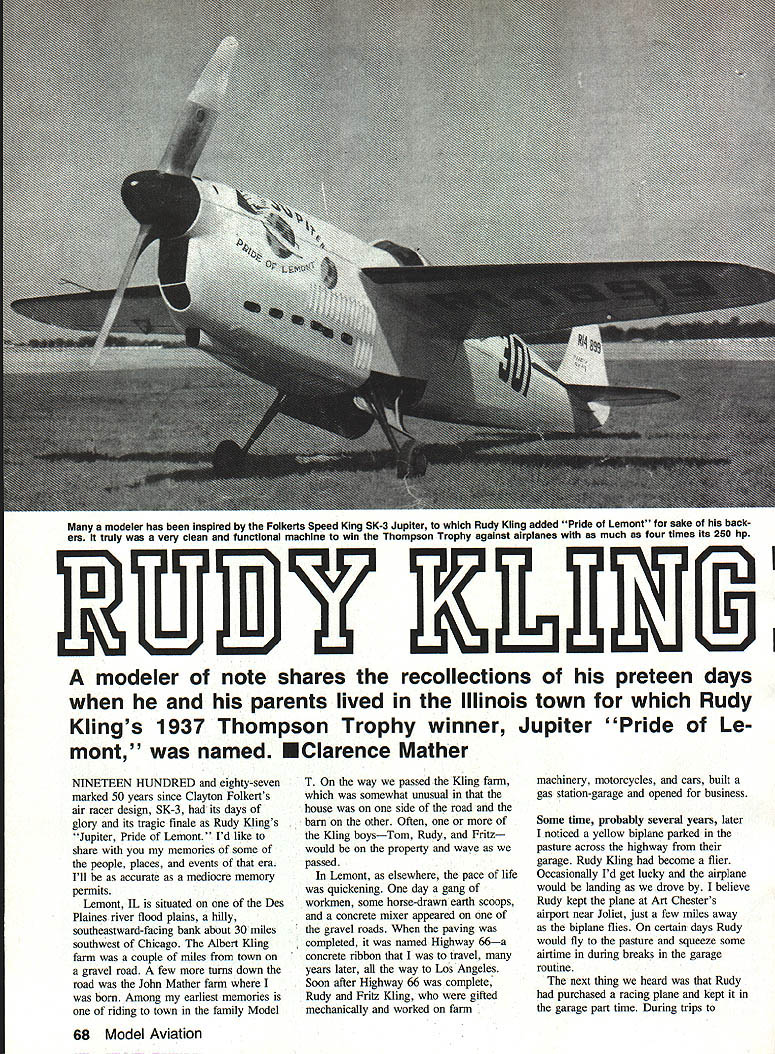
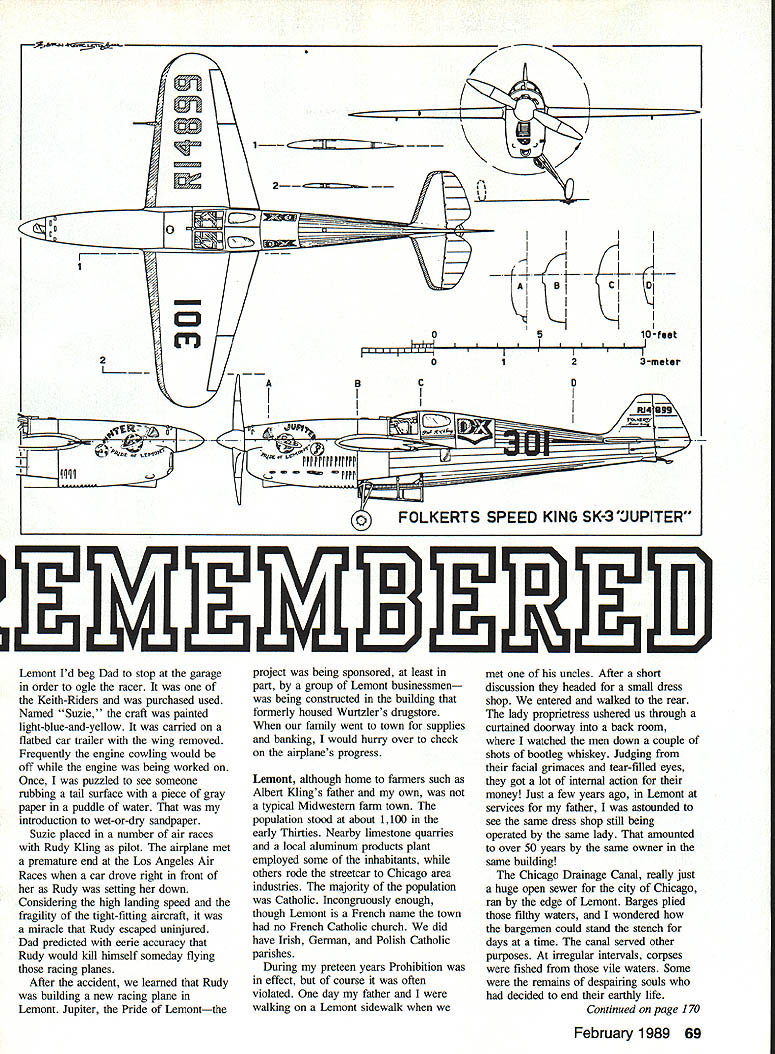
Jupiter was a small, very clean, lightweight racer. Its notable features included:
- 250-hp Menasco engine (small displacement by some race standards)
- Slim oval metal-tube fuselage with wooden formers and many stringers
- Bullet-shaped spinner covering part of the propeller hub
- Retractable landing gear completely enclosed by doors conforming to the fuselage lines
- Tapered, low-aspect-ratio, plywood-covered wing mounted at shoulder height with zero dihedral
- Thin airfoil and very small windshield
The combination of a thin airfoil, small frontal area, low-drag junctions, and a very high-pitch propeller gave Jupiter great reserves of speed. The high-pitch prop gave low acceleration at the outset but helped the airplane achieve high top speeds. By my eye, Jupiter was among the most beautiful of aircraft — elegant and very functional.
Victory at Cleveland
In September 1937 the Chicago Tribune bannered the exciting news: "Kling wins the Thompson." In fact, Rudy won both the Greve and the Thompson Trophy races at Cleveland. The Greve race was restricted to engines of a certain displacement, and Jupiter's Menasco was small enough to qualify. The Thompson race had no engine-size restriction, so Rudy was competing against racers with as much as 1,000 hp. It was a tremendous thrill to have a farmboy neighbor make good in a sport that required a highly specialized aircraft and expert piloting — and to do it at the Cleveland Air Races, the Indy 500 of the air.
By modern standards the winning speeds were not impressive, and Fritz Kling later indicated that Rudy had taken it easy on the throttle because Jupiter was a new plane in its first race. The racer was likely capable of much higher speeds.
Miami crash and aftermath
Just three months after his victory at Cleveland, Rudy Kling and Frank Haines were victims of a fatal crash at the Miami Air Races. All of us in town were stunned and felt a terrible sense of loss.
Kling and Haines, who had been one-two at the start of the Miami race, both stalled out at the first pylon turn. The Chicago Tribune reported that gusty winds were present. When racers are in a tight pylon turn they are likely near stall speed, so a wind shear of several miles per hour could produce a fatal stall. In the excitement of a close race a pilot could also exceed safe flight limits. It's possible Jupiter was marginal in stability; the SK-4, a later design very similar to Jupiter, also crashed, killing the pilot.
Most accounts mention that Rudy had relatively low overall flight time. Yet having flown Suzie in several races and Jupiter at least several times, he unquestionably had acquired considerable piloting skill. Anyone who could fly a high-speed plane with narrow-tread gear and tiny wheels off dirt fields clearly had what it takes. Moreover, experience is no guarantee against disaster: veteran air racer Art Chester was killed in a pylon turn in a much more docile aircraft than Jupiter.
When Jupiter crashed, the red spinner popped off, hardly damaged. Fritz Kling kept it in the garage for years. After the war, several of us who rode Harleys were in the habit of stopping at the garage to gas up and talk with Fritz. That red spinner would remind us of the days that used to be.
Personal recollections
Rudy was quite a bit older than I was, but although I didn't know him well I had plenty of opportunity to form some impressions. He was rather short and of average build, quiet and neither stuffy nor arrogant. Rudy always had a friendly grin, and he willingly and cordially answered questions put to him by a scrawny farmboy in bib overalls.
Obviously, the good old days had their murky underside. But Lemont was a picturesque town with a lot of friendly people. It's also the place where Jupiter, the Pride of Lemont, was spawned — a sleek, purposeful aircraft remembered by those of us who watched it come to life in a small-town garage.
Transcribed from original scans by AI. Minor OCR errors may remain.

